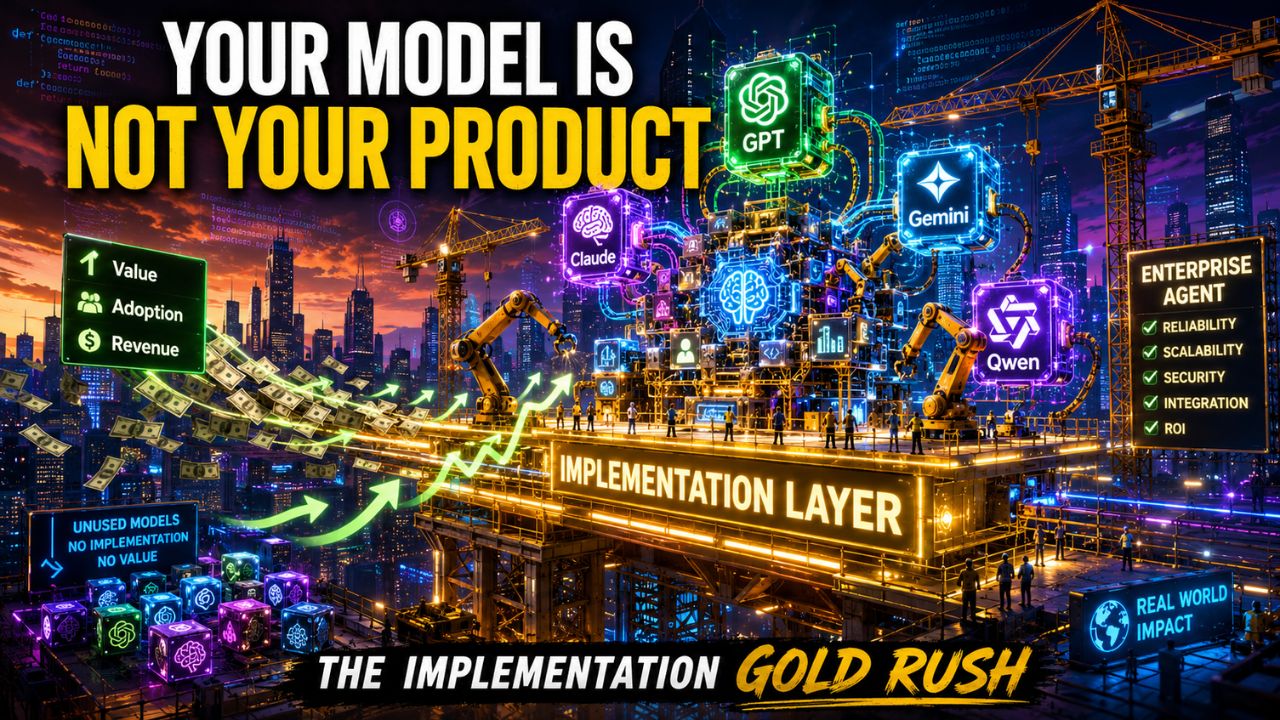
Anthropic and Blackstone just launched Ode with Anthropic, a $1.5 billion joint venture that bets the next trillion-dollar opportunity is not a better model. It is implementation. Backed by Hellman & Friedman and Goldman Sachs, Ode employs 100 engineers who build custom AI systems for enterprise clients. CEO Chris Taylor told TechCrunch the company could become a trillion-dollar business if it executes well. This is not a side project. Blackstone tried to hire AI implementation partners for its portfolio companies and failed. One of the largest private equity firms in the world, with companies across every industry, could not find competent help. So it built its own.
OpenAI launched its own Deployment Company initiative around the same time. Google Cloud quietly rebranded its entire AI platform around the same thesis. Vertex AI became the Gemini Enterprise Agent Platform, organized around four pillars: Build, Scale, Govern, and Optimize. The naming change is not cosmetic. It signals that Google sees the agent deployment layer, not the model API, as the product. The consensus is forming: the model arms race is giving way to the build phase, where execution beats research. If you are an AI engineer, the market just told you what it wants. It does not want a better model. It wants someone who can make the existing models work.
Why the Model Is Not the Product
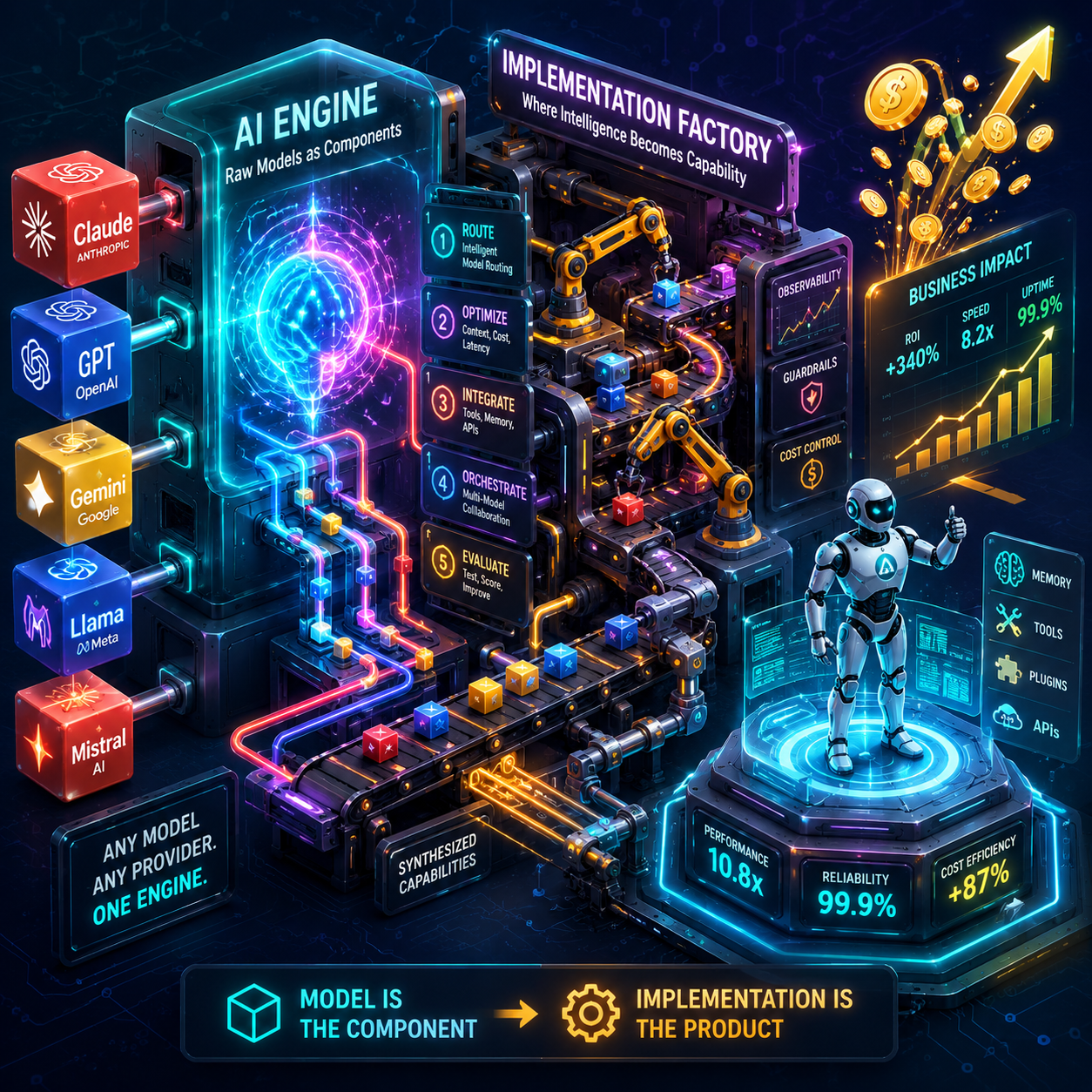
The Anthropic-Blackstone Ode venture is the strongest signal yet that the AI industry is entering a new phase. The model race, whose frontier model is biggest, fastest, or cheapest, is not over, but it is no longer where the money is moving. Ode operates on a "Claude-first" principle but will use rival models when needed. This is the key detail. The implementation layer is model-agnostic. The client does not care if the solution runs on Claude, GPT, or Gemini. They care if it works. The model is a component, not the product.
Blackstone's motivation is concrete. They could not find effective AI implementation partners for their portfolio companies. This is not a hypothetical problem. One of the largest private equity firms in the world tried to hire AI implementation help and failed. The supply of competent AI implementation engineers is near zero relative to demand. Ode chief technologist Eddie Siegel put it plainly to TechCrunch: model selection matters, but it is not where the majority of calories are spent. It is one ingredient in a system that has to be engineered. It is like the choice of programming language when you build a piece of software. You would not define an enterprise transformation by whether they choose Python or Java.
OpenAI's Deployment Company initiative mirrors the same shift. Both frontier labs are building implementation services alongside their model APIs. The API is the SDK. The implementation service is the product. AI Weekly Issue #514, titled "Applied AI Is Here," confirms the industry-level shift. The newsletter covers what is actually working in enterprise AI deployments, what has been pulled back, and why this is the inflection point. The gap between vendor promises and real-world results is the implementation gap, and that gap is where the money is.
The Cost Arbitrage Reshaping the Market
American AI startups are increasingly turning to cheaper Chinese models as US inference costs remain high. DeepSeek and Alibaba's Qwen offer competitive performance at a fraction of the cost. This is the early signal of an AI cost arbitrage market. NPR reported the trend on July 14, noting it mirrors what happened in hardware manufacturing: cost advantages drive supply chain shifts.
Why this matters for implementation: if the model is a commodity, the implementation is the differentiation. When models cost ten times less and perform comparably, the value moves from the model layer to the deployment layer. The engineer who can wire a cheaper Chinese model into a production system is worth more than the lab that built the model. Your orchestration layer is now your moat. Your routing logic is your intellectual property.
PrismML released Bonsai 27B, a fully open-source 27-billion-parameter reasoning model that runs locally on an iPhone. No cloud needed. This challenges the assumption that frontier reasoning requires datacenter-scale infrastructure. If a 27B model can run on a phone, the cloud inference market is not defensible on capability alone. It is defensible on convenience, which is an implementation problem. The quality-focused variant takes up about 5.9 GB and is meant for laptops. The smaller variant comes in at about 3.9 GB, small enough to fit on an iPhone 17 Pro Max. PrismML says the larger variant keeps 95 percent of the original model's performance. The smaller one keeps 90 percent. Math and coding stayed virtually unaffected.
IBM Research published a deep dive into model routing, the problem of deciding which AI model to use for which task. Their finding: naive routing strategies, cheapest model first or largest model always, perform poorly in production. Effective routing requires understanding model capabilities, cost profiles, latency requirements, and task characteristics simultaneously. This is implementation engineering, not model engineering. It is a different skill set. IBM stopped treating routing as a classification problem and started treating it as an optimization problem across cost, quality, and latency simultaneously.
US venture funding hit $412.7 billion in the first half of 2026, with 86 percent going to AI companies. That is the most extreme concentration the venture industry has recorded. Nearly nine of every ten venture dollars chase AI. But most of that money is going to frontier labs, not implementation services. The Ode venture is an early bet that the next wave of capital flows to the deployment layer.
The Enterprise Agent Platform Wars
Meta launched the Meta Business Agent Platform so enterprises can build, customize, and deploy AI agents at scale. Meta also launched Meta Compute, selling excess AI infrastructure to outside customers. Meta committed up to $145 billion in AI infrastructure this year and targets 14 gigawatts of compute by 2027. It signed a five-year, $27 billion capacity deal with Nebius.
Google Cloud launched the Gemini Enterprise Agent Platform, a full-stack platform for building, deploying, governing, and optimizing enterprise agents. The platform includes Agent Studio for low-code development, the Agent Development Kit for code-first builders, and Agent Garden, a library of prebuilt agents and templates. It ships with Model Garden, giving access to over 200 models including Google's Gemini family, Anthropic's Claude, and open models like Gemma. The platform's Agent Gateway enforces runtime security policies, and its Agent Registry provides centralized governance across the organization. Google's bet is that enterprises will not buy a model. They will buy a platform that abstracts the model away entirely.
The agent platform is the distribution play. Meta has billions of conversations on WhatsApp, Messenger, and Instagram. Turning those into an enterprise agent distribution channel is something no rival can match. Google has Gmail, Google Docs, BigQuery, and the entire Google Cloud enterprise install base. The model does not matter. The distribution does. If you are building an agent business, ask yourself not which model you are using but which channel you are reaching customers through.
NVIDIA and ServiceNow launched Project Arc, a self-evolving desktop agent that persists on a worker's desktop, learns workflows over time, and runs on NVIDIA's OpenShell secure runtime with open Nemotron models. This is not a chatbot. It is an always-on agent. The reliability bar for persistent agents is far higher than for one-shot chatbots. Persistent agents are becoming the default enterprise form factor as the industry moves past disposable prompts.
NVIDIA's Nemotron Labs published an argument for open-weight models as the enterprise AI foundation. The argument: closed models set a ceiling on what enterprises can inspect, tune, and improve. Open models provide complete ownership and control. NVIDIA advocates a "systems of models" approach where specialized agents are built on customized open models tuned on proprietary knowledge. This is not ideology. It is architecture. If you cannot see inside the model, you cannot govern it. If you cannot govern it, you cannot deploy it at scale in a regulated environment.
The pattern is consistent. Every major platform company is building the agent deployment layer, not just the model layer. Meta has distribution. Google has the platform. NVIDIA has hardware and open models. Anthropic has implementation services. Apple Intelligence got approved in China by integrating Alibaba's Qwen, not Apple's own models. The model is becoming infrastructure. The agent platform is becoming the product.
What Competent Implementation Actually Looks Like
Allen AI published a technical blog post on lessons learned from building Shippy, an AI agent for shipping logistics. The architecture is instructive because it shows what implementation engineering looks like at the code level, not just the strategy level.
Shippy is built as three things: a soul, skills, and config. The soul is the system prompt that frames the agent's persona and sets behavioral boundaries. Skills are plain markdown files with structured YAML frontmatter, following the same agent-skills spec used by coding tools like Claude Code and Codex. Each skill is a self-contained file that tells the agent how to handle a specific kind of request. The frontmatter defines the skill's name, description, trigger patterns, and tool dependencies. The markdown body contains the actual instructions. This means adding a new capability is writing a file, not modifying a prompt. The config covers everything else: which agent harness to run (Shippy uses OpenClaw, an open-source agent framework), which LLM to use (currently Claude Opus 4.6), and runtime settings. Secrets like API keys are injected at runtime. Swapping the model or the harness is a config change, not a rebuild.
A concrete example: a skill file for vessel tracking might have frontmatter declaring it depends on the Skylight search API and a pagination utility. The body tells the agent to always include the data source, the query timestamp, and a deep link back to the source map so the analyst can verify every number. The agent does not construct API calls from scratch. It calls a deterministic CLI wrapper that handles authentication, pagination, and structured output. Allen AI learned the hard way that letting the agent build raw API calls produces subtle bugs: malformed pagination that silently drops results, geometry encoding errors, and correct-looking queries that return wrong data because of a misunderstood filter type. The fix was wrapping every API behind a typed CLI with flag-based inputs. The agent picks from a menu of deterministic tools. It does not guess.
This is the implementation lesson that generalizes beyond Shippy. Structured memory beats raw chat logs. Explicit error recovery paths are essential. Composable tool interfaces matter more than model size. The model is a config change. The architecture is the product.
The Ode team operates with 100 engineers building custom AI systems for each client. This is not self-serve API consumption. It is white-glove deployment. The economics are straightforward. If a custom AI system saves a Fortune 500 company $50 million a year, charging $5 million for implementation is a rounding error. The implementation margin can exceed the model API margin by orders of magnitude. This is why Blackstone, a private equity firm, is in the implementation business. The returns are better than the underlying infrastructure.
Model routing is the implementation skill that matters most. IBM Research showed that effective routing requires balancing model capabilities, cost, latency, and task fit simultaneously. The implementation engineer who can build a routing layer that sends simple queries to a cheap model and complex reasoning to a frontier model is delivering more value than either model alone. Routing is not a side feature. It is the core architecture of a mature AI system.
The AI Weekly "Applied AI Is Here" issue identifies the gap between proof-of-concept and production. Most companies have AI demos. Few have AI in production. The gap is not model quality. It is data quality, cost management, error handling, and operational reliability. These are implementation problems. Uber reportedly burned through its entire 2026 AI budget in four months. One company ran through half a billion dollars in a single month before capping employee usage. When budgets get audited, "we think it will work" stops being enough.
Indian AI coding startup Emergent became a unicorn with a $130 million Series C, just over a year after launch. The company builds AI coding tools tailored to entrepreneurs and small businesses that need deployment, hosting, testing, and debugging alongside programming. Emergent has reached an annual run-rate revenue of $120 million, up 70 percent in the last four months, with more than 200,000 paying customers. This proves implementation is not just a US phenomenon. The global market for AI deployment services is forming.
The Implication for Your Career and Your Stack
If you are an AI engineer, the market signal is clear. Implementation skills are worth more than model training skills. The ability to build production agent systems, route between models, manage costs, handle errors, and deploy at scale is the scarce skill set. The builders who understand harnesses, memory architecture, tool interfaces, and evaluation pipelines are the ones who will capture the value.
If you are a company trying to adopt AI, the lesson from Blackstone is direct. You probably cannot find competent implementation help. The supply is near zero. Building internal capability is faster than waiting for the market to catch up. The firms that win will be the ones that treat AI implementation as a core competency, not a vendor relationship.
The cost arbitrage signal is unambiguous. If US models are too expensive and Chinese models are competitive, your implementation layer needs to be model-agnostic. Locking into a single model provider is a strategic risk. The routing layer is the abstraction that protects you. It lets you swap models as costs shift without rewriting your application logic.
The open-weight signal is equally clear. Bonsai 27B on iPhone, Thinking Machines' Inkling, NVIDIA's Nemotron push. Open models are not just about freedom. They are about cost control. If you can run a capable model on your own hardware, your inference cost drops to electricity and depreciation. The implementation layer is where you make that work. You still need the engineer who can quantize, deploy, monitor, and route. The model is free. The implementation is not.
Actionable Takeaways
The model is not the product. Anthropic and Blackstone put $1.5 billion behind that thesis. OpenAI is building its own deployment service. Google rebranded its entire AI platform around agent deployment. The implementation layer is where value is moving.
Cost arbitrage is reshaping the market. US startups are already switching to Chinese models because American inference is too expensive. Your implementation layer needs to be model-agnostic, not locked to one provider.
The scarce skill is not model training. It is production deployment: routing, cost management, error handling, structured memory, and operational reliability. Allen AI's Shippy blog post and IBM's model routing research show what this looks like in practice. The Shippy architecture, soul plus skills plus config with deterministic tool wrappers, is a concrete pattern you can adopt today.
Enterprise agent platforms are the new distribution layer. Meta's Business Agent Platform, Google's Gemini Enterprise Agent Platform, NVIDIA's Project Arc, and Apple's Qwen partnership in China all point the same direction. The agent deployment layer is where the durable money flows.
Open models are an implementation strategy, not just an ideology. Bonsai 27B runs on an iPhone. Nemotron models run on enterprise hardware. If you can deploy open models on your own infrastructure, your inference cost drops to power and depreciation. That is the implementation play.
The model is a component. The harness is the product. The engineer who wires them together is the one who wins.
Get More Articles Like This
Getting your AI agent setup right is just the start. I'm documenting every mistake, fix, and lesson learned as I build PhantomByte.
Subscribe to receive updates when we publish new content. No spam, just real lessons from the trenches.
Build Real AI Infrastructure
PhantomByte teaches you to build real AI infrastructure yourself: local AI stacks, autonomous agents, multi-agent orchestration, web scraping, and custom tools. Step-by-step PDF tutorials you download, follow, and deploy. No subscriptions. No fluff. Just skills that ship.