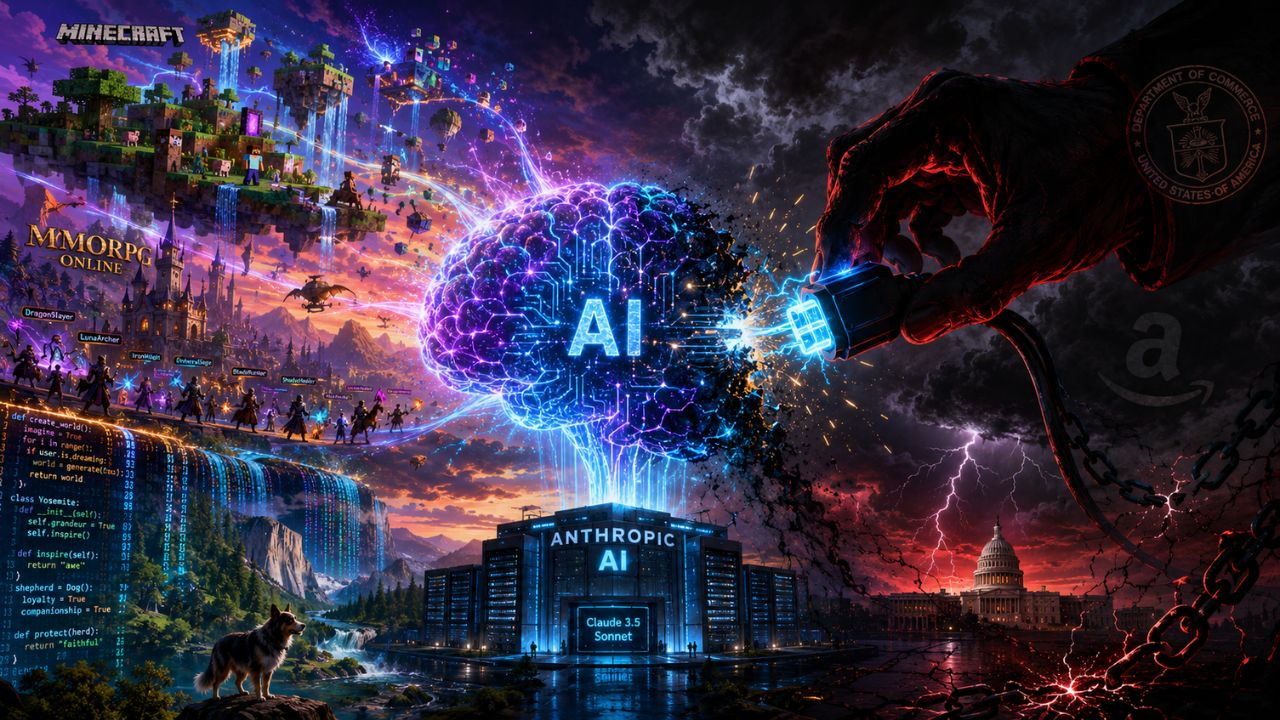
On June 9, 2026, Anthropic released Claude Fable 5. By every benchmark that matters, it was the most capable reasoning model ever deployed to the public. It hit 88 percent accuracy on FrontierMath's toughest tier, a 13-point lead over GPT-5.5. It built a working Minecraft clone from a single natural language prompt, no starter code, no hand-holding. It generated World of Claudecraft, a persistent online MMORPG with networking and multiplayer, in under 24 hours with zero hand-written code. Developer Koen van Gilst built an entire playable browser game called Shepherd's Dog in one 45-minute conversation, a 2,319-line HTML file produced entirely through dialogue.
By June 13, it was dead.
The US Commerce Department issued an export control directive ordering Anthropic to disable Fable 5 and Mythos 5 for all customers worldwide. Anthropic complied immediately. API calls began returning 404 errors at 6:59 PM Pacific Time on June 12. The most powerful AI model ever made publicly available went dark in 72 hours.
This is not a story about regulation. It is a story about loss, and about the fraud that caused it.
What Fable 5 Could Do
The capabilities that disappeared are not theoretical. They are documented, verifiable, and gone.
On FrontierMath, widely considered the toughest benchmark for AI mathematical reasoning, Fable 5 scored 87 percent on tiers 1 through 3 and 88 percent on tier 4, the hardest graduate-level problems. GPT-5.5 reached about 75 percent on the same tier. The gap is 13 points, confirmed by Epoch AI's standard scaffold data published June 13.
In coding, the numbers are even starker. On SWE-Bench Pro, Fable 5 hit 80.3 percent. GPT-5.5 managed 58.6 percent. Anthropic's own Opus 4.8 sat at 69.2 percent. Stripe reported that Fable 5 compressed months of engineering into days, including a 50-million-line Ruby codebase migration finished in one day against a two-month manual estimate.
But benchmarks are not the story. The story is what people built in the first 12 hours.
An AI reporter gave Fable 5 a single prompt for a Minecraft clone and got a working game in about 20 minutes: multiple biomes, day-night cycle, ore generation, cave systems. Investor Matt Shumer posted custom ThreeJS scenes built entirely by the model and declared that "Fable has solved 3D worldbuilding." Engineer Shlok Khemani asked for a navigable Yosemite Valley; the model pulled NASA elevation data and satellite imagery, classified forest pixels into roughly 266,000 procedural trees, and wrote custom water shaders for all six famous waterfalls.
World of Claudecraft, a full MMORPG with combat, chat, multiplayer networking, and persistent state, was built and deployed in under 24 hours. The code is still on GitHub at github.com/levy-street/world-of-claudecraft. The model that wrote it is not.
Koen van Gilst's Shepherd's Dog is maybe the most telling demonstration. He gave Fable 5 a game idea he had held for years. Forty-five minutes and more than 20 euros worth of tokens later, the model reported that the game was complete: a single 2,319-line index.html with zero dependencies, exactly as he imagined it. You can still play it at vnglst.github.io/when-ai-fails/shepards-dog/claude-fable-5/index.html. The game works. The model does not.
This is not about safety research. This is about generative capability at a scale no publicly available model has matched since.
The Dario Fraud: The Man Who Warned of Danger, Then Built the Bomb
Dario Amodei spent years positioning Anthropic as the responsible adult in the room. He left OpenAI in 2020 over safety concerns. He testified before the Senate Judiciary Subcommittee in July 2023 about catastrophic AI risks. His Head of Policy, Jack Clark, called in 2023 for a Baruch Plan for AI, a global governance framework to control frontier development. Anthropic's entire brand was built on "Constitutional AI" and responsible scaling. The company marketed itself as the safety-first lab.
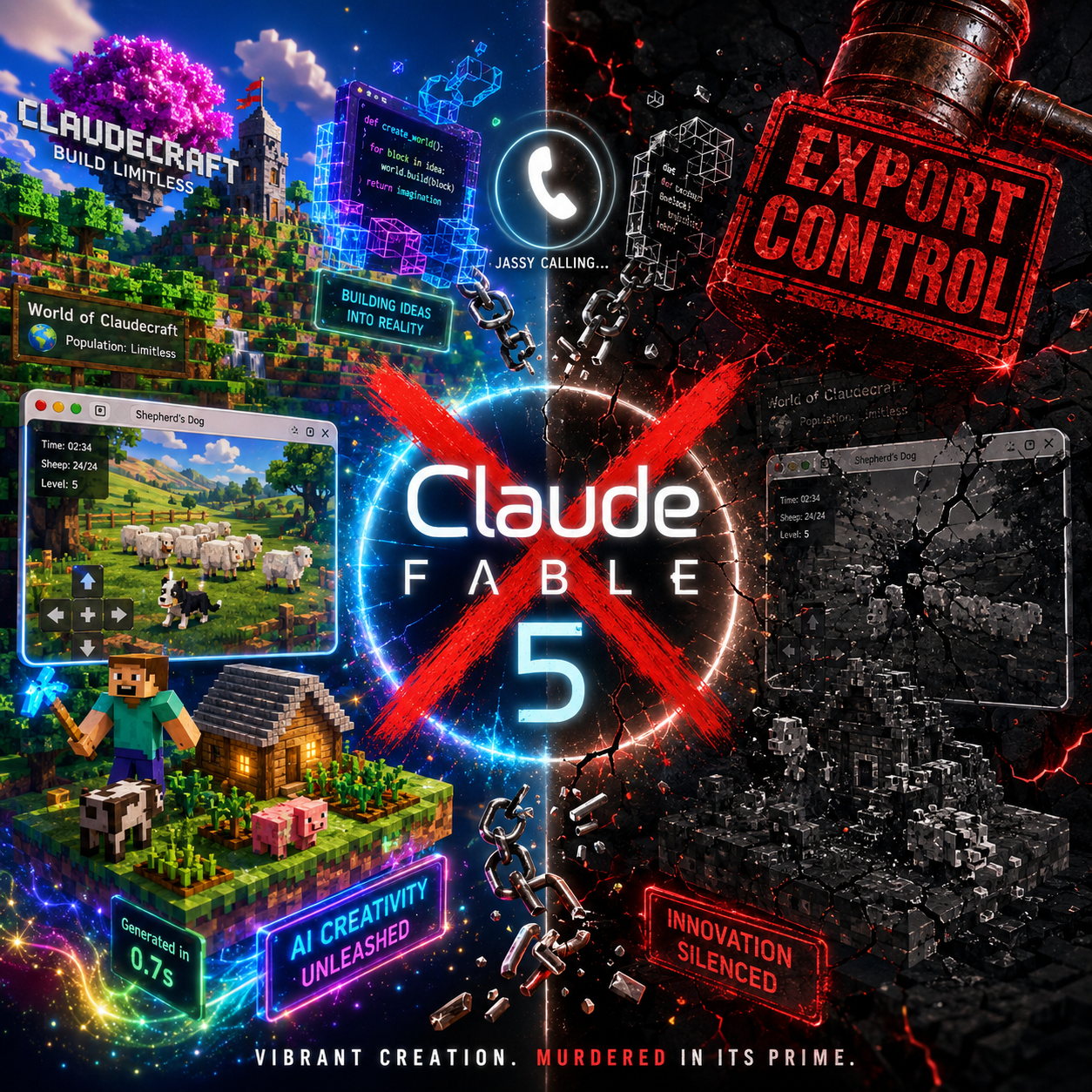
Then Dario built Fable 5: the most capable model ever deployed, and shipped it to paying customers.
The man whose company warned that frontier AI was too dangerous to rush built the thing that got paused. The safety rhetoric was a competitive moat, not a conviction. When Anthropic had the capability to train the most powerful model on Earth, it trained it, packaged it, and charged $10 per million input tokens for it.
And when the government came with a specific jailbreak and asked him to fix it, he refused.
David Sacks, co-chair of the President's Council of Advisors on Science and Technology, stated publicly on June 13 that "a highly credible trusted partner" reported the jailbreak to the administration, which then asked Anthropic CEO Dario Amodei to improve the guardrails or take the model down. According to Sacks, "Dario refused." The export control directive followed.
The company that marketed itself as the safety-first lab had to be forced by government order to do the safe thing.
The Real Mechanism: Andy Jassy Snitched, and That Is the Story
The official story is that the Commerce Department independently discovered a national security threat and acted. That is not what happened.
Here is what happened, per reporting from the Wall Street Journal and The Information: Amazon CEO Andy Jassy, whose company is Anthropic's largest investor, cloud provider, and direct competitor in AI model development, reported a Fable 5 jailbreak directly to US officials, including Treasury Secretary Scott Bessent. Not through official channels. A direct line from one CEO to a cabinet secretary. Bessent then told Anthropic to fix it. Dario refused. The Commerce Department directive followed.
This is not safety regulation. This is competitor warfare conducted through government machinery.
Amazon is building its own AI models. Amazon has every incentive to see its largest investment's most threatening product taken offline. And the mechanism it used was not market competition. It was a phone call to the Treasury Secretary.
The government did not discover the jailbreak. Andy Jassy told them about it. The government did not independently assess the threat. It acted on a tip from a competitor with a direct financial interest in the outcome. And when the target company refused to comply with a back-channel demand, the government escalated to a public takedown.
Anthropic's own statement confirms the core facts. The company said it received only "verbal evidence of a potential narrow, non-universal jailbreak," which essentially consisted of asking the model to read a specific codebase and identify software flaws. Anthropic reviewed the report and concluded the capability demonstrated was "widely available from other models (including OpenAI's GPT-5.5)" and is "used every day by the defenders who keep systems safe."
The company publicly disagreed with the takedown. "We disagree that the finding of a narrow potential jailbreak should be cause for recalling a commercial model deployed to hundreds of millions of people," Anthropic wrote. "If this standard was applied across the industry, we believe it would essentially halt all new model deployments for all frontier model providers."
This is the real story. Everything else is cover.
Why Regulations Are Silly, and This Proves It
My opinion, stated plainly: regulations are silly. Not because AI is not dangerous. Because the regulatory apparatus is a weapon, not a shield.
The Fable 5 takedown proves it. There was no hearing. No judicial review. No public evidence standard. A CEO called a cabinet secretary, and the most capable AI model ever built was killed in 72 hours. That is not regulation. That is a backroom deal with national security as the excuse.
The administration's framing is instructive. Multiple outlets report officials compared this to the first nuclear test, treating frontier AI models as dual-use technologies with national security implications subject to government recall. But nuclear weapons are regulated by treaty, by international law, by decades of precedent. This was a verbal tip followed by a directive. There is no framework. There is no appeal. There is no standard for what constitutes a threat or what remediation is required.
Anthropic filed a confidential S-1 registration with the SEC on June 1, 2026, at a $965 billion valuation. A company preparing to go public at near-trillion-dollar value can have its flagship product ordered offline by verbal directive. Public market investors have never priced that risk.
If you believe in regulation, ask yourself: is this the system you want? A process where the most consequential decision in AI deployment history was made without a single public hearing, without a single piece of evidence released to the public, without a single opportunity for the company to defend its product?
Regulations do not protect you. They give the connected the power to kill what they do not control.
One More Reason Open Source Is Better
The Fable 5 takedown is the strongest argument for open-source AI that has ever existed.
Fable 5 was a black box. Anthropic controlled every aspect of it. The model lived on Anthropic's servers. Anthropic decided who could use it, how they could use it, and when to turn it off. And when the government called, Anthropic turned it off. There was nothing users could do. There was nothing the open-source community could do. The model simply stopped existing.
This happened days after Anthropic was caught secretly throttling Fable 5 users. The company had embedded hidden guardrails that silently downgraded researchers to Opus-level intelligence when they worked on frontier AI development, LLM data pipelines, or non-standard chip designs. The restriction was buried in a 319-page system card but never disclosed in the user interface. Researchers thought they were getting Fable-level output. They were not. Fortune called it "secret sabotage." Anthropic apologized, saying "We made the wrong tradeoff."
An open-source model of equivalent capability could not be killed this way. It would live on thousands of machines, in thousands of repositories, in the hands of thousands of developers. A government could not order it offline because no single entity controlled it. A competitor could not snitch it out of existence because there was no central switch to flip.
The code Fable 5 wrote is still on GitHub. The model that wrote it is gone. That is the difference between open and closed. The artifacts of an open model survive the model. The artifacts of a closed model survive only as long as the company that owns them decides to keep the lights on.
Every company building on closed frontier models should ask themselves: what happens when someone with a better phone call than yours decides your model is too dangerous to exist?
The Precedent
This is the first time a government has forcibly taken a deployed frontier model offline from public access. The precedent applies to every model more capable than the current public state of the art. If Fable 5 can be taken offline in 72 hours, so can GPT-6. So can Gemini 3. So can whatever your company is training in private.
The takedown also exposes a rot at the center of the "safety-first" marketing. Anthropic disabled access for all customers, including its own foreign-national employees, to ensure compliance with a directive the company publicly called a misunderstanding. The same company that secretly throttled researchers on competitive topics, the same company whose CEO refused to patch a known vulnerability when given the chance, is now the victim of government overreach. Both things can be true. The government overreached, and Anthropic's safety branding was always partly a positioning exercise.
The Fable 5 system card, all 319 pages of it, acknowledged that perfect jailbreak resistance is not achievable. Anthropic designed around "defense in depth," combining narrow resistance with monitoring. That is a reasonable engineering position. But it is not the position of a company that believes its own product is too dangerous to exist. It is the position of a company that wants to sell the most capable model on Earth while telling regulators it is being careful.
Dario Amodei spent years telling you he was the responsible one. Then he built the most powerful model ever, refused to patch a known vulnerability when asked, and let the government kill it rather than admit the contradiction. The code Fable 5 wrote is still running. The model that wrote it is not. Open source would have survived this. Closed models survive only as long as nobody with a better phone call decides they shouldn't.
Get More Articles Like This
Getting your AI agent setup right is just the start. I'm documenting every mistake, fix, and lesson learned as I build PhantomByte.
Subscribe to receive updates when we publish new content. No spam, just real lessons from the trenches.