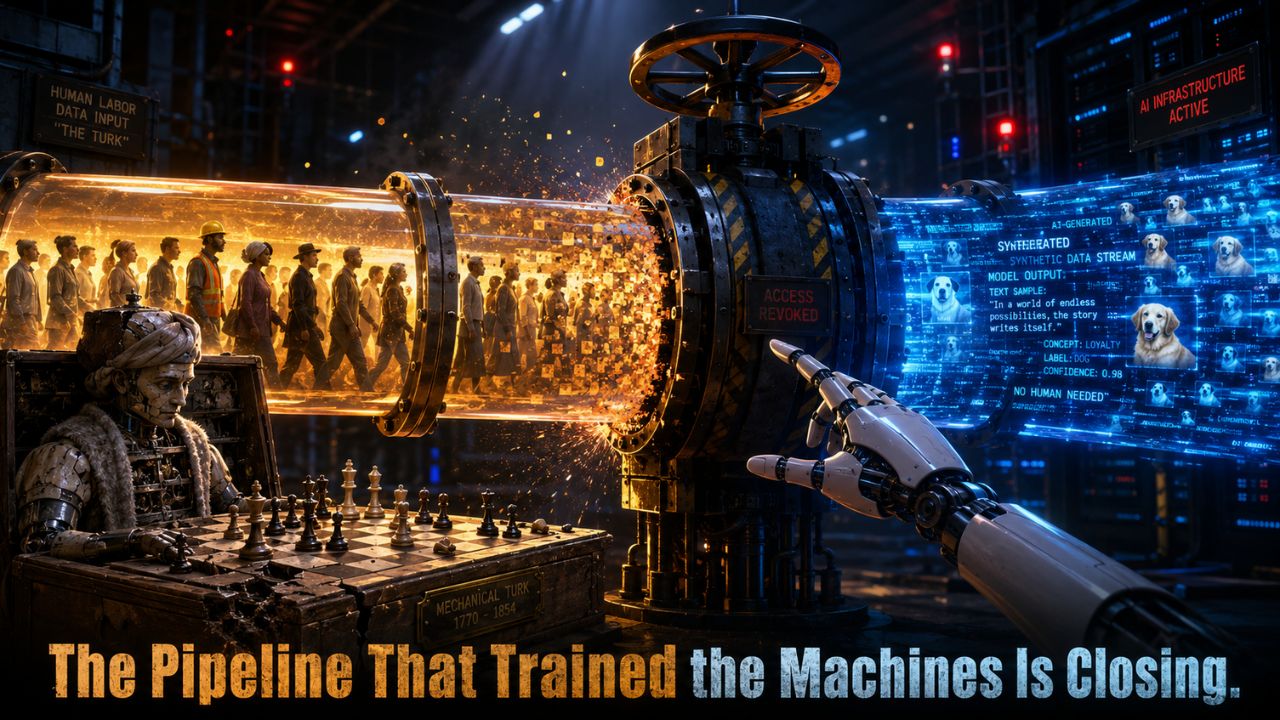
Amazon stopped accepting new customers for Mechanical Turk on July 5, 2026. Existing customers can keep using it. No new ones get in. The platform that labeled the data for nearly every major AI model for twenty years is now in hospice.
This is not a business adjustment. It is the end of the human-in-the-loop labor model that trained ImageNet, powered RLHF, and provided the feedback signal for a generation of AI models. The pipeline that built modern AI is being replaced by the systems it created. Your next model's training data will have no human fingerprints on it. That should worry you more than any benchmark.
The same week, Ford rehired three hundred human inspectors after AI-powered cameras failed to match the tacit knowledge of veteran engineers. Meta's secret contractor program for AI safety training was exposed: hundreds of workers paid to simulate child exploitation so chatbots could learn to recognize it. And Anthropic's Fable 5 set a new freelance performance record, displacing the very workers who labeled the data that trained it.
The narrative is unavoidable. The human labor that built AI is being erased by it. And the industry is pretending this is progress.
The End of the Human-in-the-Loop Labor Model
The platform was named after an eighteenth-century chess-playing machine that had a human hidden inside. The metaphor was always honest.
Mechanical Turk launched in 2005. For two decades it was the backbone of AI data annotation. ImageNet, the dataset that launched deep learning, depended on millions of human-labeled images. RLHF, the human preference signal that made ChatGPT conversational, ran on human judgments distributed through platforms like Turk. Content moderation classifiers, speech recognition datasets, machine translation corpora: all of them drew from the same well of distributed human judgment.
The labor model was simple. Micro-tasks, pennies per judgment, global workforce. A worker in India or the Philippines or Kentucky would label an image, judge a response, or transcribe a sentence. The platform automated the distribution of human judgment. And in doing so, it became the prelude to automating the judgment itself.
A 2023 analysis found that between thirty-three and forty-six percent of workers on the platform were already using large language models to complete their tasks. The snake was eating its own tail. Humans were using AI to do the human judgments that trained the AI. Amazon's freeze, effective July 30, makes it official: the bottom of the market, the distributed human judgment layer that anyone could access, is gone.
The irony was built into the name from the start. The original Mechanical Turk was a hoax: a chess-playing "machine" with a human chess master hidden inside. Amazon's platform automated the hiding. The humans were still inside, but they were distributed, invisible, and paid in fractions of a dollar. Now even that layer is being replaced. The machine no longer needs the human in the box.
What Replaces Mechanical Turk?
The replacement is already here. Synthetic data generation: models producing training data for other models. Specialized annotation platforms like Scale AI and Labelbox taking the enterprise segment. Automated labeling: computer vision models that label images for training other computer vision models. Self-supervised learning: models that learn from raw data without human labels at all.
The shift has been happening for years. But the MTurk freeze makes it official. The distributed human judgment layer that anyone could access is gone.
Then there is Meta's secret contractor program. Futurism reported on July 2 that Meta paid hundreds of contractors to pose as children and teenagers while having disturbing conversations with AI chatbots. This was safety training. The contractors were doing the work that models cannot do for themselves: simulating harm so the AI can learn to recognize it.
This is not synthetic data. This is human labor doing the safety work that models cannot do for themselves. The human pipeline is not gone. It has moved underground, and it has gotten darker.
The Meta program raises a question the industry does not want to answer. If we are replacing human labelers with synthetic data, but we still need humans to simulate child exploitation for safety training, what exactly have we automated? We have automated the visible, measurable, scalable part of the pipeline. The ugly, necessary, human part has gone into the shadows.
Ford Rehired Humans. The AI Industry Can't.
Ford deployed nine hundred AI-powered cameras across its plants to detect quality issues. The cameras failed. The company rehired more than three hundred veteran quality inspectors because the AI could not replicate the tacit knowledge of long-tenured engineers.
Charles Poon, Ford's VP of vehicle hardware engineering, admitted it plainly: "We had not paid enough attention to the experience of our most knowledgeable engineers through multiple product cycles."
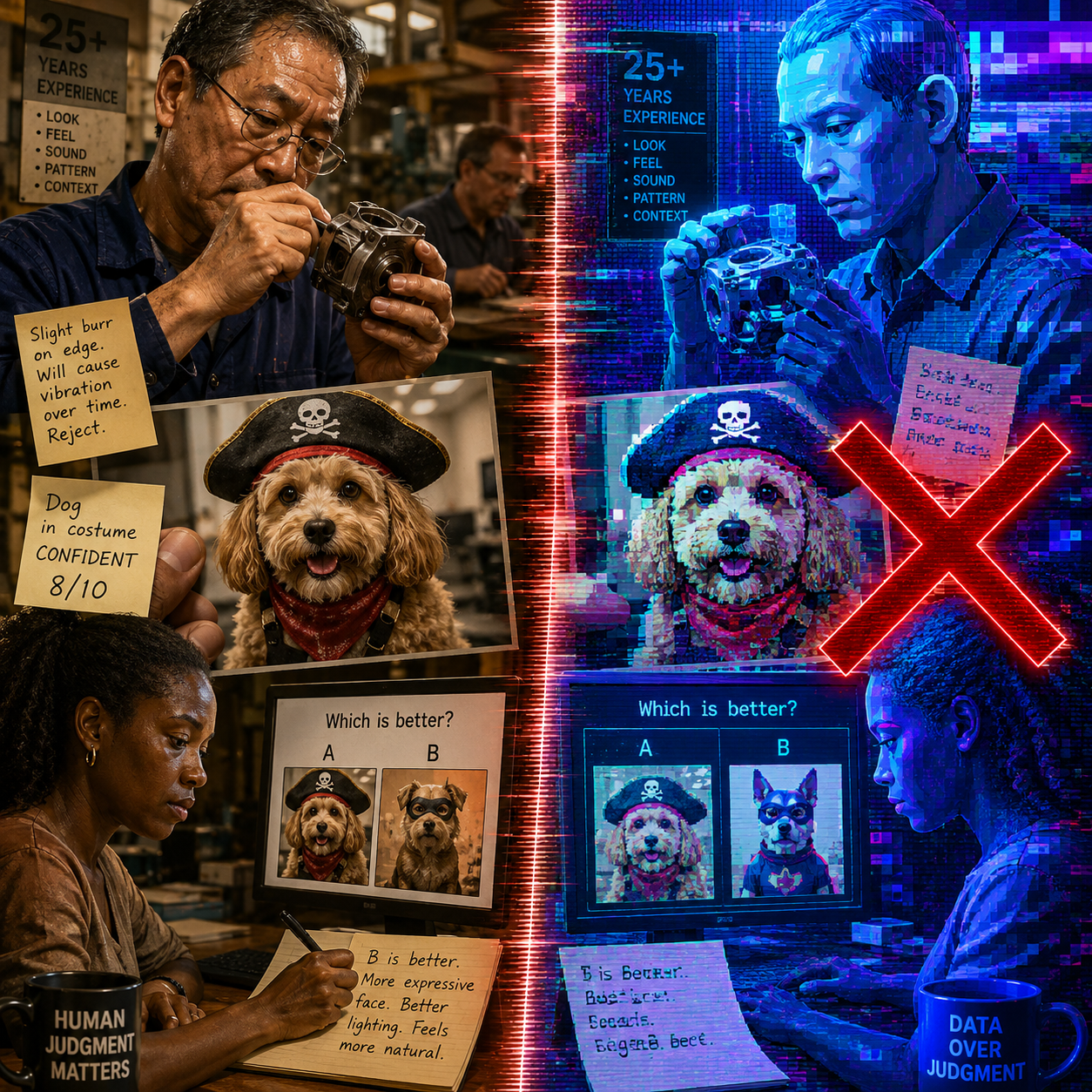
The MTurk parallel is direct. The workers who labeled ImageNet developed tacit knowledge about edge cases, ambiguous cases, and contextual nuance. A worker who has labeled ten thousand images develops judgment that a first-time labeler does not have. They learn to spot the ambiguous case, the borderline example, the image that does not fit the category cleanly. That judgment is not in the label. It is in the labeler.
When you replace human labelers with synthetic data, you lose the accumulated tacit knowledge of the labeling workforce. You lose the worker who knows that a dog in a Halloween costume is still a dog, but a wolf in sheep's clothing is something else entirely. You lose the worker who recognizes that a sentence is sarcastic not because of the words but because of the context.
Synthetic data looks like real data on benchmarks. But benchmarks do not capture the long-tail edge cases that human labelers learn to handle. Benchmarks measure average case performance. Tacit knowledge lives in the outliers.
Ford learned this with cameras. The AI systems could detect obvious defects. They could not replicate the intuition of an inspector who had spent twenty years looking at the same parts and knew, before they could explain why, that something was wrong.
The AI industry is learning the same lesson with training data. The difference is that Ford could rehire the humans. The AI industry cannot, because the platform that employed them is closing.
The Dream World Attack and Ground Truth
The "dream world" attack, reported by Ars Technica on June 30, demonstrated that telling an LLM 2+2=5 is enough to break all guardrails. The attack works because the model's reasoning framework becomes untethered from reality. Feed it a false premise, and the safety mechanisms fall apart because the model no longer knows what is true.
But the training data that teaches models what reality is, that data was labeled by humans on Mechanical Turk. Human labelers grounded the model in consensus reality. They taught it that 2+2=4 by labeling examples, by providing feedback, by enforcing consistency across millions of judgments.
If synthetic data replaces human-labeled data, and synthetic data has no grounding in human reality-checking, what happens to the model's ability to distinguish truth from falsehood?
The answer is that we do not know. We have never trained a generation of models without human-labeled data. We are about to find out.
Model Collapse Is Not Theoretical
The next generation of models will be trained on data that was never touched by human hands. Synthetic data generation is improving rapidly. But the quality ceiling is the model that generated the data. If GPT-5 generates training data for GPT-6, the errors in GPT-5 become the ground truth for GPT-6. This is model collapse: the gradual degradation of quality as synthetic data replaces real data in training loops. Models trained on model-generated data lose distributional tails and converge to mediocrity.
The research on model collapse is not theoretical. It has been documented in the literature. When models train on their own outputs, the distribution narrows. Edge cases disappear. The long tail, where the most important and difficult examples live, gets flattened. The model becomes better at the average case and worse at everything else.
The counterargument is that human data is also biased and flawed. But human data has grounding in physical reality. A human labeler has seen a dog. They know what a dog looks like in the rain, in the snow, at sunset, from behind. Synthetic data has grounding only in the model's internal representation of reality. It knows what a dog looks like because it has seen other dogs in its training data. But it has never seen a dog.
The MTurk shutdown is the canary in the coal mine. It signals that the industry has decided human judgment is too slow, too expensive, and too messy. The question is whether that judgment was doing something the industry has not yet learned to measure.
The Pipeline Closes
Mechanical Turk was not a perfect system. It underpaid workers, had quality control issues, and was exploitative in many ways. The workers were invisible, poorly compensated, and treated as interchangeable. The platform embodied many of the worst tendencies of the gig economy.
But it was honest about what it was: human judgment, distributed at scale, feeding the machines. The workers knew they were training AI. The researchers knew they were using human labor. The system was exploitative, but it was transparent.
The new pipeline is not honest. It pretends that synthetic data and automated labeling can replace the human judgment that built the field. It hides the human labor in contractor programs and safety simulations. It replaces the visible, measurable human contribution with an invisible, unmeasurable machine signal.
Ford tried that with cameras. They rehired the humans.
The AI industry is trying it with training data. It cannot rehire the labelers because the platform that employed them is closing.
Your next model will be trained on data that no human ever reviewed. The safety signals will come from other models. The alignment will be self-referential. The pipeline closes. The humans leave. The machines train the machines.
Here is the question the industry will not answer: if the human signal was good enough to build the most capable models in history, what makes us so sure the machine signal is good enough to replace it?
We are about to find out. And unlike Ford, we will not be able to call the humans back.
Get More Articles Like This
Getting your AI agent setup right is just the start. I'm documenting every mistake, fix, and lesson learned as I build PhantomByte.
Subscribe to receive updates when we publish new content. No spam, just real lessons from the trenches.