
1,000 tokens per second. On a single H100.
Let that number sit for a second. If you have spent the last two years optimizing prompt length, batch size, and caching strategies to squeeze latency out of your LLM pipeline, that number should feel like the goalposts were just obliterated while you were still running plays.
DiffusionGemma, released by Google DeepMind on June 10, 2026, generates text at 1,000 tokens per second on one H100. On a DGX Station it hits 2,000. It does this not by making the model bigger or the GPU hotter. It does this by annihilating the token-by-token constraint that has bottlenecked every large language model you have ever used.
For two years, the entire AI industry has treated autoregressive generation as a physical law. One token follows another. Each depends on the last. The GPU loads the full model weights from memory, computes one token, writes it back, then loads the weights again for the next token. It is serial by design, memory-bound by nature, and fundamentally slow no matter how much money you throw at it.
DiffusionGemma proves that assumption is an implementation detail, not a law of nature. And if your agent pipeline spends most of its time waiting for the next token, this changes your entire latency model.
How Diffusion Generates Text
DiffusionGemma is built on the Gemma 4 26B mixture-of-experts architecture, but with a critical twist: it activates only 3.8 billion parameters per step. Instead of predicting the next token left-to-right, it denoises a 256-token canvas in parallel using a diffusion process borrowed from image generation.
The model starts with a block of random noise tokens and iteratively refines them into coherent text over multiple passes. Every token in the canvas attends to every other token simultaneously. This is bidirectional attention, not causal masking.
The architectural shift is the entire story, so do not let anyone bury it under benchmark charts.
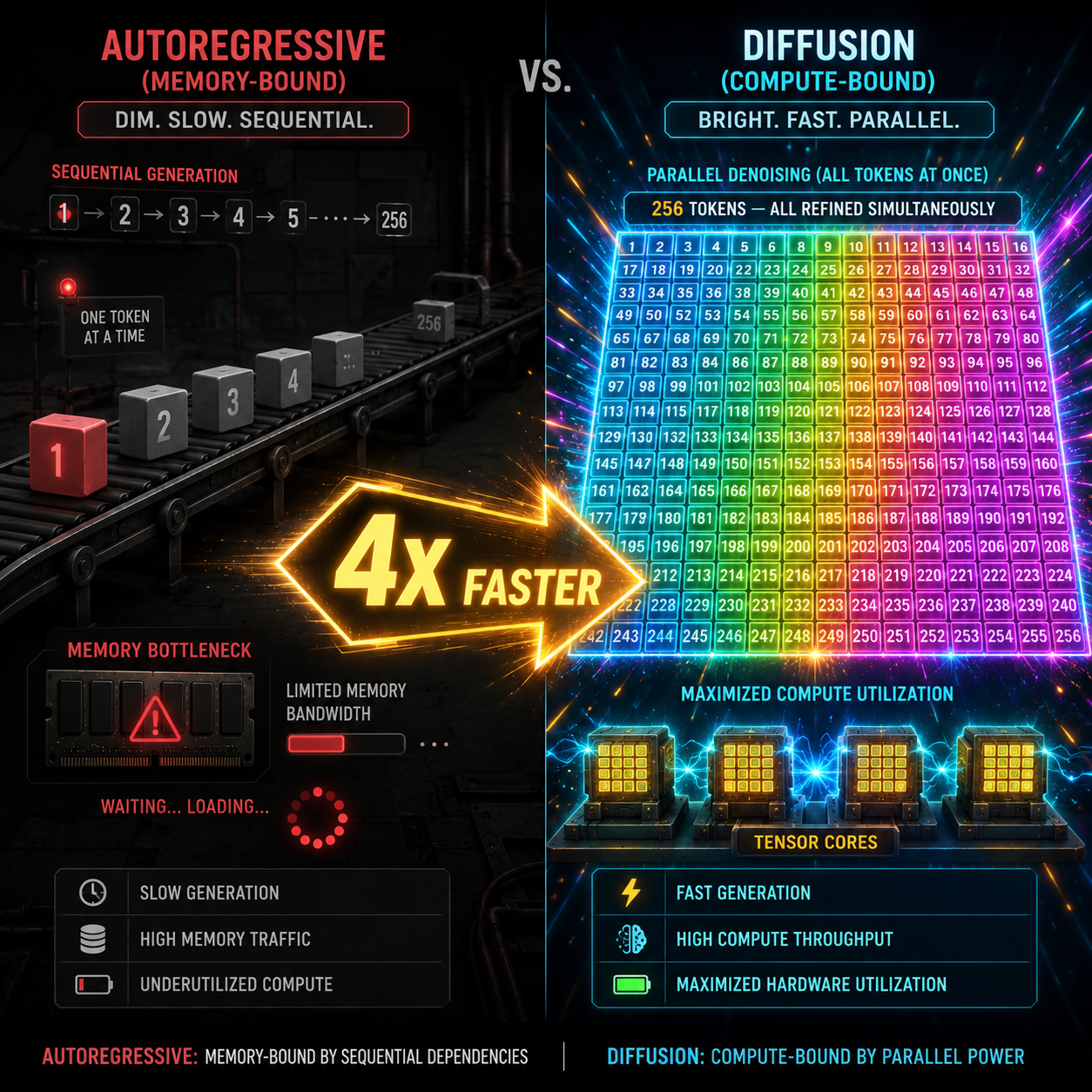
Autoregressive models are memory-bound. The GPU spends most of its time loading weights just to emit one token, then reloading for the next. Diffusion models are compute-bound. They keep the tensor cores busy by processing 256 tokens at once.
NVIDIA GPUs are specifically designed for compute-bound workloads. This is why the speedup is a staggering 4x, not some incremental 15% bump. NVIDIA tested and confirmed this across GeForce RTX cards, RTX PRO workstations, and DGX Spark. No custom tuning is required because Tensor Cores handle the workload on day one.
Google released DiffusionGemma under Apache 2.0, the fully permissive open-source standard, rather than the restrictive Gemma License. Weights are on Hugging Face. It runs on a GeForce RTX 5090 or 4090 at 4-bit quantization. It does not phone home. It does not require a cloud subscription.
For anyone who has been following the local AI movement, this is not an abstract research paper. It is a practical deployment option that arrived yesterday.
What Breaks When Your Model Generates 256 Tokens at Once
Agent architecture today is built around autoregressive assumptions you probably never named out loud. Streaming responses update the UI one word at a time because that is how tokens arrive. Tool calls happen between tokens because the model needs to pause, execute, and resume. Chain-of-thought reasoning unfolds sequentially because each reasoning step produces tokens that inform the next step.
When 256 tokens appear simultaneously, these patterns change. Streaming becomes chunking. The user sees a paragraph appear at once instead of a word at a time. For latency-sensitive, single-user applications like interactive chat, agentic loops, and on-device assistants, the chunking problem is well worth the speed trade-off. But for applications where users expect to watch the model "think" in real time, the UI pattern needs to change.
Tool use is harder. Agents that call APIs mid-generation rely on token-level control to decide when to stop generating and execute a function. Diffusion models need different tool-interpolation strategies because they do not generate token-by-token. The research on how to graft tool use onto diffusion text generation is early. It will get solved, but it is not solved today.
Chain-of-thought reasoning may behave differently too. The emergent reasoning we see in autoregressive models, namely the step-by-step problem solving that unfolds one token at a time, is tied to the sequential generation process. Whether the same reasoning quality emerges when the model drafts and refines an entire paragraph in parallel remains an open research question.
Google explicitly acknowledges this trade-off: "For applications that demand maximum quality, we recommend deploying standard Gemma 4." The numbers back that honesty up. On MMLU Pro, DiffusionGemma scores 77.6% versus Gemma 4's 82.6%. On GPQA it is 73.2% versus 82.3%. On MMMU Pro it is 54.3% versus 73.8%.
The quality gap is real, and Google is not hiding it.
That honesty matters. Most companies launching a 4x faster model would bury the quality regression in a footnote. Google put it in the first paragraph of the model card. The value proposition is speed and local deployability at acceptable quality for specific workloads, not a blanket claim that it is better than the autoregressive version at everything. Anyone selling you otherwise is lying.
When to Use What
Not every workload wants diffusion. Here is the honest breakdown:
Autoregressive still wins when:
You need a long-form coherent narrative where each sentence depends on the exact wording of the previous one.
The task requires fine-grained token-level control, like code generation with precise syntax constraints.
The streaming user experience is non-negotiable because your users expect to see words appear one by one.
Diffusion dominates when:
You are running short-response agent loops where latency is the bottleneck.
You are deploying on-device AI where memory bandwidth is scarce and compute is underutilized.
You are doing batch generation where throughput matters more than streaming perception.
You need the model to self-correct mid-generation, which diffusion can do by re-noising a token and replacing it. This is an operation autoregressive models cannot do because they permanently commit each token.
The speedup mechanism is operation fusion at the architectural level. In PyTorch profiling terms, a single GEMM-with-bias operation sees negligible improvement from torch.compile because it is already one fused kernel. The real gains come from fusing multiple operations into fewer kernel launches. Diffusion is the ultimate fusion. It replaces multiple serial token generations with one parallel denoising step. Instead of constant memory round-trips, you make one compute-heavy pass.
The Local AI Implication
DiffusionGemma runs on a GeForce RTX. It runs on DGX Spark. It does not require a cloud account, an API key, or a usage quota.
For the PhantomByte audience, which has been moving aggressively toward local AI with tools like Ollama, Hermes Agent, and OpenClaw in the Sovereign AI Stack conversation, this is not a theory piece. It is a deployment piece.
For two years the local-AI conversation was about quantization and smaller models. The playbook was to download a 7B model, quantize it to 4-bit, run it on your laptop, and accept that it is dumber than GPT-4.
DiffusionGemma flips that script. It is a 26B-class model running at full capability locally because the architecture changed, not because the model shrank. The bottleneck moved from memory bandwidth to compute, and NVIDIA GPUs are built for compute. Tensor Cores and CUDA mean day-one efficiency without custom tuning.
If you read "The $900/Month Question" back in April, you know the math that pushed me off cloud APIs. A runaway agent loop burned $340 in two hours while I was asleep. That is the autoregressive tax. You pay per token, and agents eat tokens fast.
DiffusionGemma does not eliminate cost entirely because you still need the GPU, but it completely eliminates the per-token cloud tax. And at 1,000 tokens per second, the latency argument for cloud APIs gets weaker every month. If you read "The $300 Raspberry Pi Warning," you already know the hardware end of this story too. Local inference is not a hobbyist toy anymore; it is a production option.
OpenAI vs. Anthropic: The Price War That Missed the Point
The same day DiffusionGemma shipped, the Wall Street Journal reported that OpenAI is considering drastic price cuts to compete with Anthropic. The two stories are connected in a way most coverage missed.
Frontier labs are commoditizing language model access into a race to zero on price. OpenAI and Anthropic are slashing API rates to win enterprise contracts. Meanwhile, Google shipped an open-weight, locally runnable, 4x faster alternative under Apache 2.0.
The labs are fighting over who can rent you intelligence cheaper. Google just made renting it optional for a large class of workloads.
Here is the uncomfortable question. If you can run a 26B model at 1,000 tokens per second on hardware you already own, why are you still pricing your product around someone else's API rate card?
When intelligence becomes a commodity, architecture differentiation matters more than price differentiation. The labs racing to zero are optimizing the wrong variable. The real disruption isn't cheaper API tokens. It is the extinction of the API tax entirely.
The Direct Challenge
For two years you have optimized around the assumption that text generation is serial. Every caching strategy, every streaming UI, and every token-budget calculation assumes one token follows another.
DiffusionGemma proves that assumption is an implementation detail. The question is not whether diffusion language models will become mainstream. The question is whether you will rebuild your agent pipeline to take advantage of 4x lower latency before your competitor does.
The model is on Hugging Face right now. It runs on consumer GPUs today. The license lets you ship it in a product without asking anyone's permission.
Why are you still waiting for the next token?
Get More Articles Like This
Getting your AI infrastructure right is just the start. I'm documenting every optimization, cost lesson, and architectural insight as I build PhantomByte.
Subscribe to receive updates when we publish new content. No spam, just real analysis from the trenches.