
Uber blew through its entire annual AI budget in four months. Not a quarter. Four months. The company that mastered surge pricing could not get its AI spending under control, so it implemented hard tiers: $1,500 per month per employee, max. If you need more, you escalate. If your team hits the ceiling, you wait.
This is not a budgeting story. It is a signal. The era of unlimited AI spending is over. The era of tokenmaxxing, where developers were measured by velocity and encouraged to use as much AI as possible without worrying about the bill, is collapsing in real time. And if your architecture was built for that world, it will not survive the next one.
Key Takeaways
- The era of unlimited enterprise AI spending is collapsing due to budget constraints and physical hardware limitations.
- Tokenmaxxing is the unsustainable enterprise practice of prioritizing development velocity and unlimited API calls to frontier AI models without regard for computational cost or token efficiency.
- AI architectures must pivot to tiered model routing, real-time cost monitoring, model distillation, and sovereign stacks to survive.
The Tokenmaxxing Era
For roughly two years, enterprise AI strategy had one playbook: buy the best model, pipe everything through it, and figure out the cost later. Developers were not measured on results per dollar. They were measured on speed. The more tokens you burned, the more features you shipped, the better your quarterly review looked.
Tokenmaxxing became the default mode. Startups bragged about their API bills. Engineering teams treated frontier model access like an all-you-can-eat buffet. The assumption was simple: AI costs would fall, models would improve, and the spend would always be justified by the output.
It was a good assumption, until it was not.
The Cracks Appear
The evidence is not theoretical. It is piling up in public filings, CEO interviews, and earnings calls.
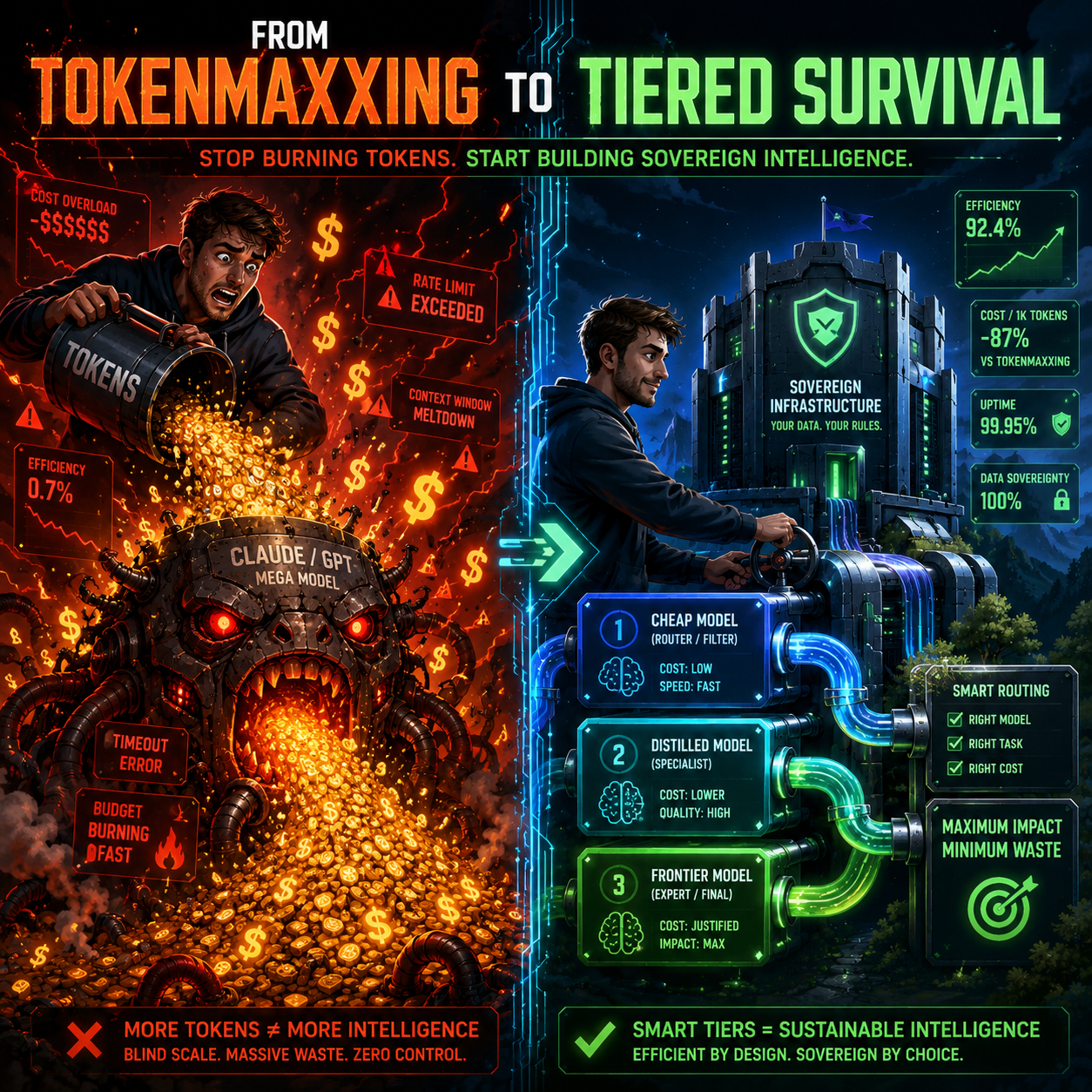
Uber is the most brutal example. A company with world-class infrastructure and disciplined financial management could not control its AI burn. The annual budget, presumably set by adults with spreadsheets, evaporated before summer. The response, $1,500 monthly tiers per employee, is an admission that unlimited AI spend is structurally unsustainable. When Uber cannot make the math work, the rest of us need to pay attention.
Then there is Lindy. Flo Crivello, the CEO of the AI startup, switched 100 percent of his company's traffic from Anthropic's Claude to DeepSeek, an open-weight model family. Not 10 percent. Not a pilot. One hundred percent. He called the move "a matter of survival for the business." This is not a startup experimenting with alternatives. This is a founder saying that staying on frontier pricing is existential risk. He saved millions of dollars within months. That is not a discount. That is a reprieve.
Amazon is reportedly distilling Anthropic's models into smaller, cheaper versions ahead of Anthropic's planned shift to token-based pricing. Think about what that means. Amazon has invested billions in Anthropic. It is one of the company's closest strategic partners. And Amazon's own engineers are building bypass routes to avoid paying Anthropic's new rates. When the investor with the deepest pockets is looking for exit ramps, the pricing model is broken. Distillation is no longer a research technique. It is corporate self-defense.
Google capped Meta's Gemini usage. Google, the company that designs its own AI chips, builds its own data centers, and spends more on compute infrastructure than most countries spend on defense, told Meta it could no longer provide the cloud capacity Meta needed to run Gemini at scale. If the hyperscaler that owns the stack from silicon to API cannot provision enough capacity for one of its largest customers, the bottleneck is not financial. It is physical. The compute simply does not exist at the price points enterprises now demand.
The Infrastructure Bottleneck Beneath It All
The spending crisis and the hardware crisis are the same story told from different angles.
Samsung and SK Hynix announced a combined $550 billion-plus investment to address what the industry is calling "RAMageddon." South Korea separately unveiled an $880 billion national chip and AI investment plan, the largest single national commitment to AI infrastructure in history. These numbers are not optimistic bets on future demand. They are emergency responses to a binding constraint.
Memory bandwidth and HBM supply are the hidden governors on AI progress. Every model that gets bigger, every context window that gets longer, every multimodal pipeline that processes video, they all hit the same wall. Not GPU compute. Memory. The data has to move, and the pipes are not wide enough.
Google cannot provision capacity for Meta because the memory and compute physically do not exist at sustainable price points. The $550 billion from Samsung and SK Hynix, and the $880 billion national plan, are admissions that this problem will not be solved by software optimization alone. It is a manufacturing problem. It is a foundry problem. It is a chemistry problem.
When the physical layer cannot keep up with demand, prices rise. When prices rise, enterprises cut. When enterprises cut, they look for cheaper models. The cycle is not a market correction. It is a structural compression.
What This Means for Your Architecture
Here is what your stack needs to look like to survive the hangover.
1. Implement Tiered Model Routing
Tiered model usage is no longer optional. Cheap models, open-weight models, and distilled models handle 80 percent of the work: summarization, classification, draft generation, routine coding tasks, and data extraction. Frontier models get reserved for reasoning, analysis, high-stakes decisions, and anything where the cost of being wrong exceeds the cost of the tokens. If your architecture routes everything through Claude or GPT regardless of task complexity, you are lighting money on fire.
2. Enforce Real-Time AI Cost Monitoring
Cost monitoring needs to be a first-class infrastructure concern. Treat AI spend exactly like cloud spend: budgeted, metered, tagged by team and project, with alerts when usage spikes and automatic throttling when budgets hit thresholds. The companies that survive this transition are the ones that can see their burn in real time. The ones that cannot will discover they have an Uber problem when it is too late to fix it.
3. Standardize Model Distillation
Distillation needs to become standard practice. Train smaller models on your actual workload outputs. If Amazon is doing it with Anthropic's own weights, you should be doing it with your own data. A specialized, fine-tuned smaller model operating on internal workflows is not just cheaper. It often mathematically outperforms a frontier model that has never seen your stack, and it will cost a fraction of the price. Distillation is not about matching frontier capability. It is about making 85 percent capability cost 10 percent of the price.
4. Build a Sovereign Stack
The sovereign stack argument just became economically rational. When pricing volatility and supply constraints hit simultaneously, owning your weights and running your own inference stops being an ideological preference and starts being a financial hedge. You cannot be capped by Google if you are not using Google's cloud. You cannot be surprised by Anthropic's token pricing if you are not using Anthropic's API. The tools for local frontier-weight inference are mature. Red Hat's RamaLama, used by NASA for offline AI medical support. vLLM and Ollama for local model serving. The hardware to run them is cheap and getting cheaper. The only reason to stay fully dependent on external APIs is inertia.
The Future
OpenAI and Anthropic filed confidentially for IPOs in early June. Both are valued near $1 trillion. D.A. Davidson analyst Gil Luria warned that current growth rates for both companies "are the fastest they will ever be." That is not an endorsement. That is a countdown.
The IPO filings are not signs of strength. They are exits before the music stops. When your largest customers are building bypass routes, when hyperscalers are capping their own clients, when national governments are committing nearly a trillion dollars to fix the hardware bottleneck you depend on, the unlimited-growth narrative has a shelf life.
The next phase of AI infrastructure is not about who has the biggest model. It is about who can deliver acceptable intelligence at the lowest marginal cost. That is an architecture problem, not a research problem. The winners will be the teams that build cost-aware agent pipelines, meter their spend like grown-ups, and reserve frontier models for the work that actually justifies frontier prices.
The teams that keep tokenmaxxing will find themselves in the same position as Uber: staring at a burned annual budget in June, wondering why nobody raised their hand sooner.
On Monday morning, audit your API bills. Map which models handle which tasks. Find the 80 percent of your traffic that does not need frontier capability. Build the tier. Set the budget. Own the weights.
The hangover is here. The teams that prepared for it are the ones that will keep building.
Get More Articles Like This
Getting your AI agent setup right is just the start. I'm documenting every mistake, fix, and lesson learned as I build PhantomByte.
Subscribe to receive updates when we publish new content. No spam, just real lessons from the trenches.
Build Real AI Infrastructure
PhantomByte teaches you to build real AI infrastructure yourself: local AI stacks, autonomous agents, multi-agent orchestration, web scraping, and custom tools. Step-by-step PDF tutorials you download, follow, and deploy. No subscriptions. No fluff. Just skills that ship.