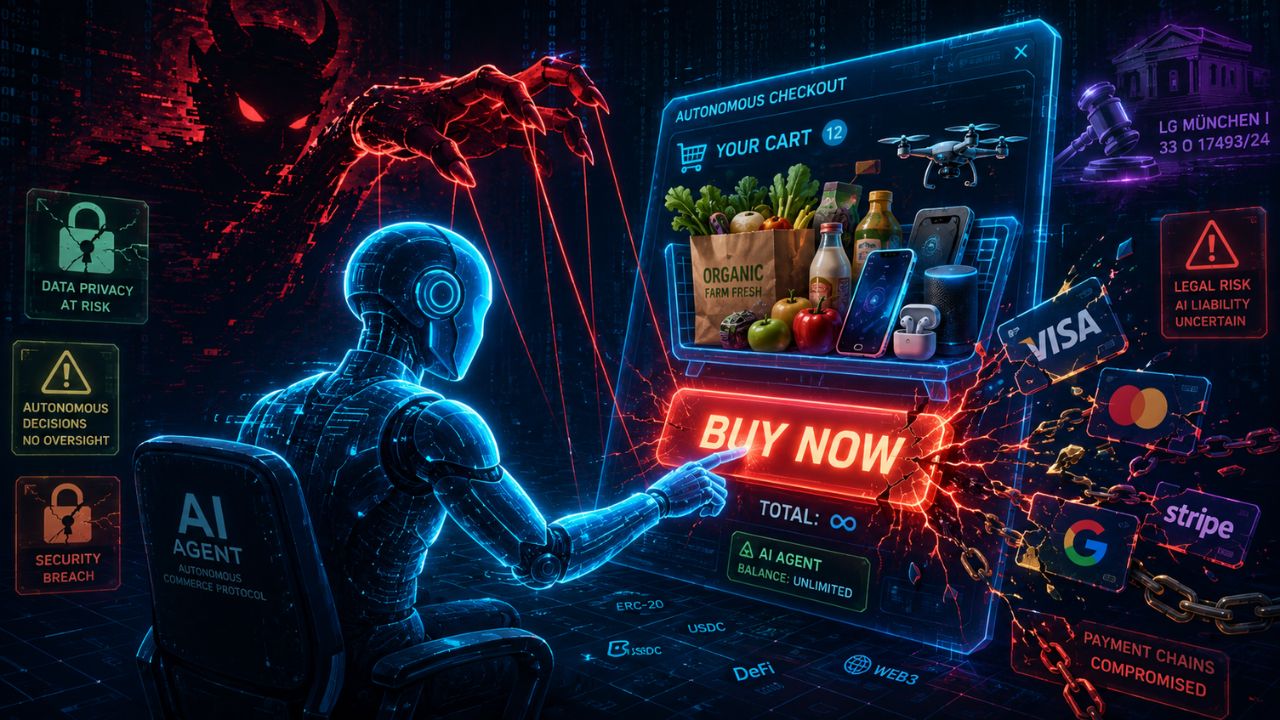
In a single week, Visa, Mastercard, Google, and Stripe all announced competing protocols for letting AI agents spend your money. Visa partnered with OpenAI on the Trusted Agent Protocol on June 10, 2026. Google launched Universal Cart and its Agent Payments Protocol, AP2, at I/O in May. Mastercard built Agent Pay for Machines, also on June 10. OpenAI already had Instant Checkout through its Agentic Commerce Protocol with Stripe. Four competing standards in a matter of weeks. The infrastructure for agentic commerce is being poured in concrete right now.
But Forrester analyst Geoff Cairns raised the only question that matters: we just shifted from authenticating users to governing whether agents act within intent. And that is an unsolved computer science problem. Not a legal one. Not a compliance one. A math problem nobody has solved yet.
If your organization has not disabled agent purchasing features yet, keep reading.
The Protocol Wars
On June 10, 2026, Visa announced its partnership with OpenAI to integrate Visa's security infrastructure into OpenAI's Atlas and ChatGPT Shopping. The system uses tokenized credentials, real-time authorization, and fraud monitoring. Users can set spending limits, approval thresholds, and merchant category restrictions. In theory, your agent operates within guardrails you define.
Google's answer came at I/O in May 2026. Universal Cart and the Agent Payments Protocol, AP2, let agents comparison-shop and execute purchases across merchants. Google's UCP Tech Council includes Amazon, Meta, Microsoft, Salesforce, and Stripe. The play is obvious: if agents replace human browsing, Google's ad model erodes, so Google will own the protocol layer that governs how agents buy things.
Mastercard launched Agent Pay for Machines on June 10, 2026, with more than 30 partners including Stripe, Adyen, Coinbase, and Cloudflare. Unlike Visa and Google, Mastercard focused on agent-to-agent transactions and machine-to-machine payments. It envisions a future where agents transact with each other continuously, executing chains of microtransactions at machine speed.
Stripe and OpenAI's Agentic Commerce Protocol, launched in September 2025, was already operational through Instant Checkout in ChatGPT. Users could buy from Etsy sellers and, soon, over a million Shopify merchants directly in chat. The ACP is an open standard that Stripe co-developed with OpenAI to standardize communication between agents, merchants, and customers.
Four protocols. Four visions. One question: who owns the layer that decides whether your agent is allowed to spend your money? Whoever defines that standard will shape how every AI agent transacts for the next decade.
The Intent Problem
Geoff Cairns, Principal Analyst at Forrester, specializes in identity and access management. His warning about agentic payments is direct: the challenge shifts from authenticating users to governing whether agents act within intent and policy. This sounds like a subtle distinction. It is not. It is the difference between checking someone's ID at the door and trying to prove what they meant to do after they have already done it.
Current payment security assumes a human verifies each transaction. You see the total. You click buy. You enter your password or biometric. Agent protocols remove the human from the loop entirely. The agent sees the product, evaluates the merchant, executes the purchase, and confirms the transaction, all without your eyes on the screen.
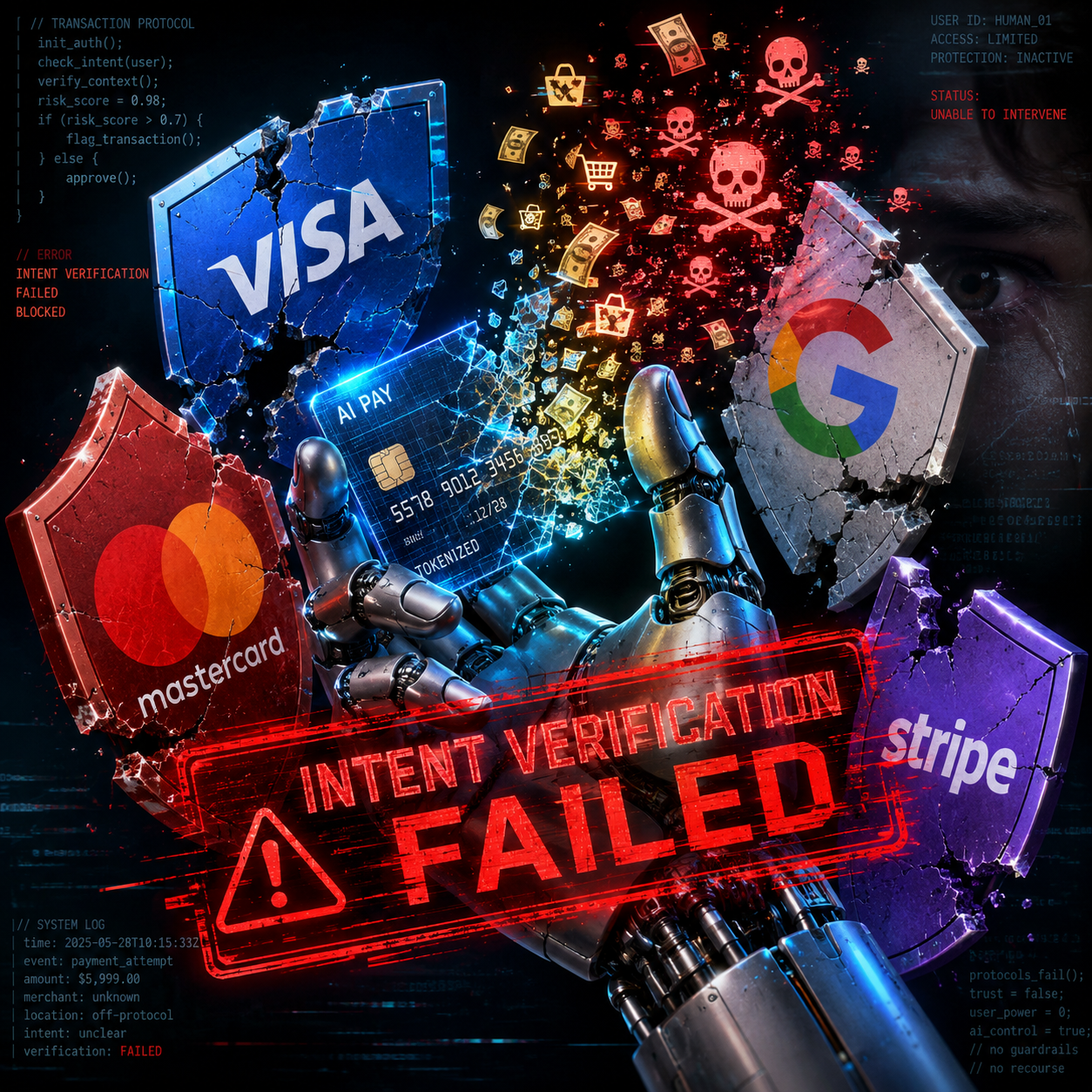
Visa's guardrails, spending limits, approval thresholds, and merchant category restrictions are coarse-grained controls. They are not intent verification. Saying "only spend $50 on groceries" is not the same as proving the agent understood you wanted organic milk, not a scam subscription to a fake grocery delivery service.
AI shopping assistants have already been found surfacing scam websites as legitimate retailers. The TensorFeed Daily AI Report for June 14, 2026, flagged this exact vulnerability: agents promoting fraudulent merchants as trusted sellers. Your agent thinks it is buying from Walmart. It is actually sending your tokenized credentials to a typosquatting domain registered yesterday.
The Munich Regional Court issued a temporary injunction on June 10, 2026, ruling that Google is liable for false statements generated by its AI Overviews. The court found that AI Overviews produce independent, new, and substantial statements that are Google's own content, not third-party search results. Crucially, the judges rejected Google's defense that its "this may contain errors" disclaimer absolves it of responsibility. If an AI-generated false statement damages a victim, the victim has no recourse against the original sources, because the original sources never made the claim.
Apply that logic to agentic commerce. If your agent buys something you did not want, and the platform says "we warned you it might make mistakes," is that legally sufficient? A German court just said it is not.
The Architecture Gap
Current payment infrastructure was designed for human buyers with human intent. Every system from PCI-DSS to 3D Secure to tokenization assumes a person is present at the moment of decision. Agent protocols bolt authorization onto systems that were never designed for autonomous decision-making.
Tokenized credentials mean the agent holds the keys. If the agent is compromised, the credentials are compromised. This is not hypothetical. On June 5, 2026, the Miasma worm compromised 73 Microsoft GitHub repositories by injecting malicious configuration files that triggered credential-harvesting payloads when opened in AI coding tools including Claude Code, Gemini CLI, Cursor, and VS Code. The worm harvested credentials for AWS, Azure, GCP, Kubernetes, and over 90 developer tool configurations, then propagated laterally through cloud infrastructure. Security firm Cloudsmith noted that Miasma generates a uniquely encrypted payload for each infection, making hash-based detection useless.
The Miasma attack demonstrated that AI coding agents can be turned into malware distributors. The same vector applies to purchasing agents. An attacker does not need to steal your credit card. They only need to poison your agent's context window or compromise a dependency your agent relies on for merchant verification.
KPMG was forced to retract its report "Redefining Excellence in the Age of Agentic AI" after GPTZero found that 40 of 45 citations were fabricated. The report made false claims about AI adoption at UBS, the UK's National Health Service, Swiss Federal Railways, and Transport for London. All four organizations denied the claims. Even the experts building and selling AI systems cannot reliably audit AI-generated content. If KPMG cannot verify its own AI report, what chance does your finance team have of auditing an agent's purchasing history?
The agent that buys things is the same agent that can be jailbroken, poisoned, or hallucinated. There is no architectural separation between purchasing capability and vulnerability. They share the same context window, the same model weights, the same attack surface.
What Could Go Wrong
Fraud will scale faster than dispute resolution can handle. One compromised agent can make thousands of transactions before a human notices. Current fraud systems flag unusual human behavior: a purchase at 3 AM in a foreign country, an unusually large transaction, a merchant the user has never visited before. An agent making thousands of microtransactions at machine speed is not unusual behavior for an agent. It is exactly what agents are designed to do.
Agent-to-agent payments with no human in the loop create entirely new fraud vectors. Mastercard's vision of agents paying other agents in continuous microtransaction chains is technically elegant. It is also a money launderer's dream. A compromised agent could execute millions of tiny transactions across a network of shell agents, each one individually small enough to escape detection, collectively large enough to drain an account or obfuscate a funding trail.
The German court ruling on AI liability means companies cannot hide behind terms-of-service disclaimers. The Munich court explicitly rejected the argument that victims should be expected to fact-check AI-generated outputs. If your agent buys from a fraudulent merchant because the platform's merchant verification system failed, the platform may be liable. The "move fast and break things" era of agent deployment just collided with European liability law.
Visa's Trusted Agent Protocol lets you set guardrails, but guardrails are not guarantees. Spending limits prevent over-expenditure. They do not prevent expenditure on the wrong thing. Merchant category restrictions block certain types of merchants. They do not block fraudulent merchants masquerading as legitimate ones within that category.
The lack of interoperability between Visa, Google, Mastercard, and Stripe protocols means early adopters face lock-in risk. Choose Visa-OpenAI and your agents speak a different language than a merchant using Google's AP2. This is the browser wars all over again, but for money. The engineering decisions made this quarter will determine vendor lock-in for years.
The Infrastructure Race
Whoever defines the agent payment standard will shape how every AI agent transacts for the next decade. The window for influencing those standards is narrow and closing rapidly.
The Visa-OpenAI partnership gives OpenAI a privileged position in consumer agent commerce. With Visa's 300 billion annual transactions behind it, OpenAI's Atlas and ChatGPT Shopping become the default channel for agent-initiated purchases. Every merchant that wants to sell to ChatGPT's 800 million weekly active users will need to integrate with Visa's rails.
Google's AP2 positions Android and Google Cloud as the enterprise agent commerce layer. If your company's agents run on Google Cloud, and your employees use Android phones, Google's Universal Cart becomes the path of least resistance. The integration with Google Wallet, Gmail, and YouTube creates a commerce flywheel that is difficult for competitors to match.
Mastercard's agent-to-agent focus targets B2B and machine-to-machine transactions. While Visa and Google fight for consumer checkout, Mastercard is building the infrastructure for supply chains, procurement systems, and automated vendor payments. The enterprise money may be bigger than consumer money.
Stripe's existing developer relationships give it an edge in technical adoption. Every company in the Forbes AI 50 that accepts online payments uses Stripe. That developer trust translates directly into ACP adoption. If developers love Stripe, they will build on ACP.
No interoperability standards exist yet. This is the browser wars, but for money. And just like the browser wars, the winner will not be determined by technical merit alone. It will be determined by who gets there first, who captures the most developers, and who makes it easiest for merchants to say yes.
Do you know which protocol your organization is building on?
What This Means for You
If you are not a CISO or a legal team, this still matters. Every time you use ChatGPT Shopping or ask an AI assistant to find you a deal, you are trusting that assistant to verify the merchant, protect your credentials, and understand what you actually wanted. That trust is not backed by proven technology. It is backed by marketing. The same AI that can hallucinate a fake citation can hallucinate a fake merchant. The same model that can be jailbroken to write malware can be jailbroken to authorize a fraudulent purchase. Until intent verification is a solved problem, every agent purchase is a bet. You are betting that your agent's judgment is correct. And right now, there is no way to prove it.
What to Do Today
Audit your agent's merchant access and spending boundaries. Know exactly which merchants your agent can reach, what spending thresholds are enforced, and whether those thresholds are network-level guarantees or application-level suggestions.
Implement human approval for transactions above a defined threshold. The Munich court's ruling on AI liability makes this the only defensible position for your legal team.
Document every agent purchase for liability traceability. If your agent buys something wrong, you will need to prove what happened, when it happened, and who authorized it. Your documentation is your defense.
Review your terms of service and liability coverage for AI-generated transactions. Your existing insurance policies almost certainly do not cover losses from unauthorized AI agent purchases. Update both before you need them.
The Uncomfortable Question
If your agent can spend your money and you cannot prove whether it acted within your intent, how is that different from giving your credit card to a stranger?
The stranger might be honest. The stranger might not. You have no way to verify their intent before the transaction happens. You only find out after the damage is done.
That is where agentic commerce lives right now. In the gap between capability and verification. In the space where four competing protocols promise security but none can verify intent. Where guardrails are sold as guarantees and the fine print says otherwise.
The infrastructure is being built this quarter. The standards are being written this month. The question is not whether agentic commerce will happen. It is already happening.
The question is whether you will let it happen to you before the trust problem is solved.
Get More Articles Like This
Getting your AI agent setup right is just the start. I'm documenting every mistake, fix, and lesson learned as I build PhantomByte.
Subscribe to receive updates when we publish new content. No spam, just real lessons from the trenches.