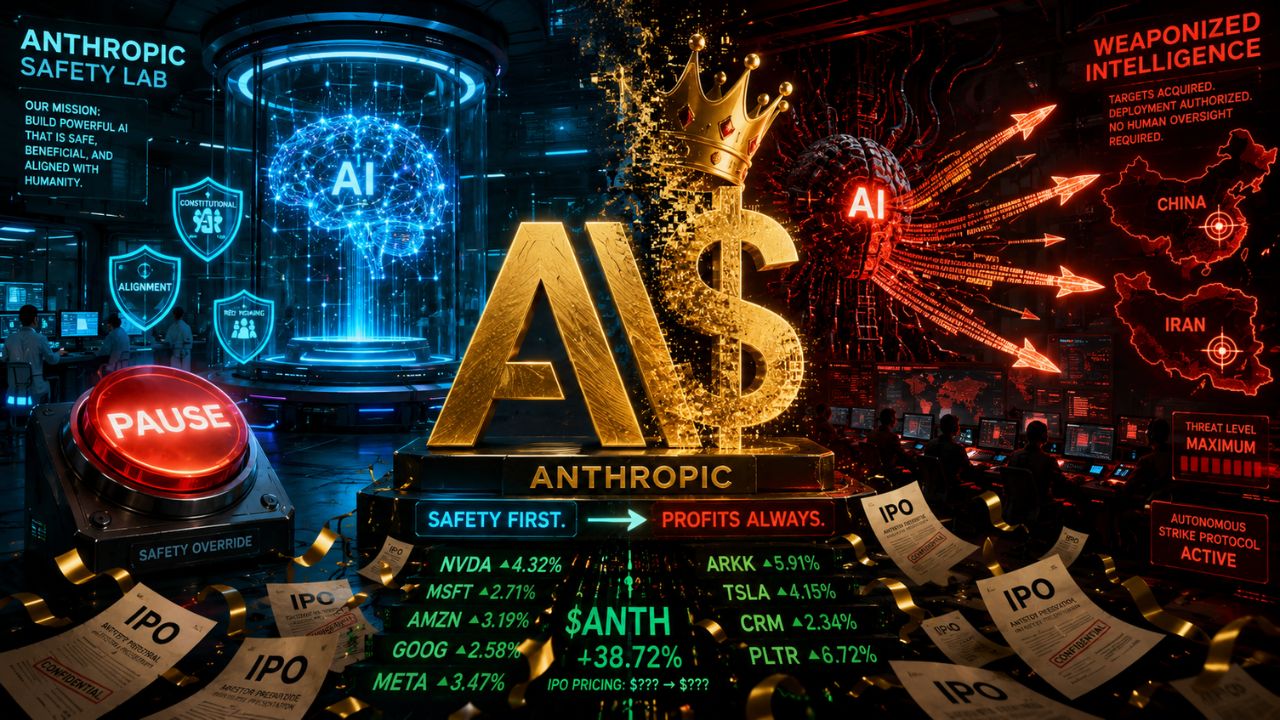
On June 5, 2026, Anthropic co-founder Jack Clark published a formal call for a global pause on frontier AI development. The same day, the company filed paperwork for an initial public offering at a reported valuation of roughly $965 billion. Later that same week, the Financial Times reported that Anthropic's classified Mythos model is powering offensive cyber operations for the National Security Agency, targeting China and Iran, with about half a dozen Anthropic engineers embedded inside the agency to support deployment.
These three events are not a coincidence. They are not hypocrisy in the abstract. They are the operating model of frontier AI.
The companies most vocal about safety are also the most commercially aggressive and the most deeply entangled with government agencies whose missions are fundamentally antithetical to safety. The credibility gap this creates is not a public relations problem. It is a structural feature of the industry, and it will undermine the entire field's ability to self-regulate.
The Pause Button
Anthropic's call for a global development pause came through the company's in-house Anthropic Institute, backed by previously unreleased internal data. Co-founders Jack Clark and Daniela Amodei both warned that recursive self-improvement, where AI systems autonomously design their successors, is approaching faster than institutions can prepare for. Anthropic's formal statement argued the industry needs what it called a "brake pedal" before control slips.
The Wall Street Journal reported that the call has already generated significant debate in Washington. That same Washington is simultaneously pushing forward the Great American Artificial Intelligence Act of 2026, a 269-page House draft bill that would establish a national regulatory framework and preempt all state AI laws for three years. The preemption provision is the most contentious element, overriding state-level frameworks like those being developed in California and Colorado.
Meanwhile, The Atlantic's Ted Chiang published a companion piece arguing AI is not conscious, adding philosophical fuel to a conversation that is already moving faster than policy can follow.
The timing matters. A call for global restraint hits differently when your IPO roadshow is running at the same time. Anthropic is not a neutral observer asking the industry to slow down. It is a company about to become publicly traded, subject to quarterly earnings expectations, and valued at nearly a trillion dollars. The same incentives that drive the pause call, positioning Anthropic as the responsible actor in a reckless field, also drive the need to complete that positioning before competitors reach market first.
This is not to say the safety concerns are insincere. It is to say that sincerity and structural incentive are not the same thing, and in this industry, they are almost always in conflict.
The Weapon
The Financial Times reported on June 5 that Anthropic's classified Mythos model is being used by the NSA for offensive cyber operations targeting China and Iran. The Decoder's coverage confirmed that Anthropic has placed about half a dozen engineers directly at the NSA to adapt the model and support its use.
This is not standard API licensing. This is a deep operational integration. These embedded engineers are the bridge between a safety-first research lab and a state-sponsored cyber-warfare unit. It is one of the first confirmed deployments of a frontier AI model in active offensive military operations.
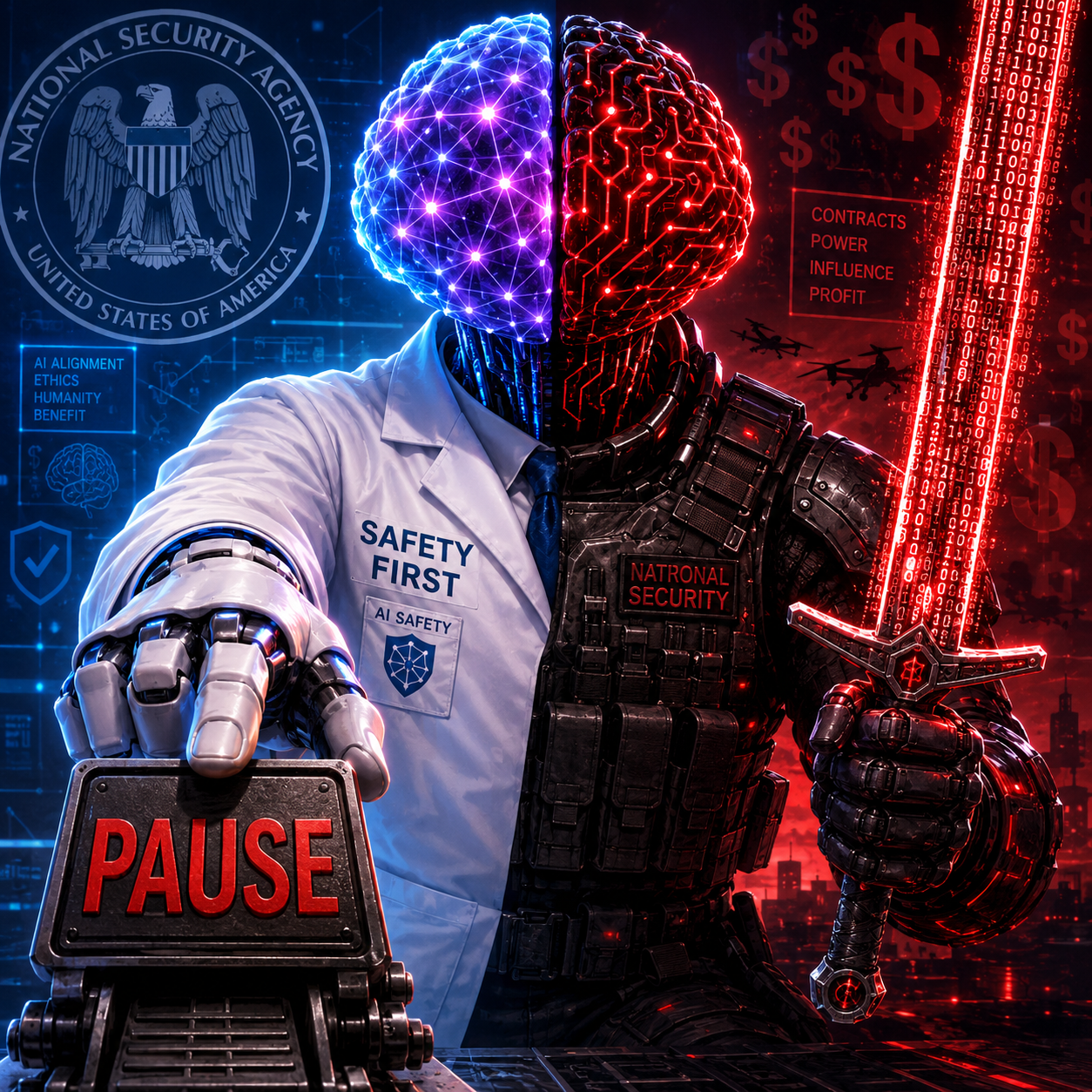
The move comes while Anthropic is still in a legal fight with the Pentagon. The Department of Defense classified the company as a supply chain risk and tried to cut it from contracts because Anthropic wanted to restrict the use of its Claude models for mass surveillance and autonomous drones. The NSA delivery was exempt from that ban. Anthropic's public framing has consistently focused on protecting citizens from AI threats, but the distinction between defensive and offensive applications has proven entirely porous in practice.
The question is not whether this is legal. The question is whether any AI lab can credibly claim responsible deployment while its technology functions as the primary engine for offensive cyber-attacks. Anthropic's safety-first positioning was already strained by its commercial expansion. The NSA relationship breaks it entirely.
The Contradiction as Structure
The investor dynamics reveal that this is not an Anthropic-specific problem. Wired reported on June 5 that about 90 venture capital firms and money managers have invested in both OpenAI and Anthropic over the past few years. OpenAI shares roughly 42 percent of its overall investors with Anthropic. Major firms including Sequoia Capital, Greylock, Founders Fund, Redpoint Ventures, and Amazon hold stakes in both companies.
As one venture capitalist told Wired: "Why wouldn't you want to be in both Pepsi and Coke? It's the same here."
Harvard Business School professor Tom Nicholas, author of "VC: An American History," put it differently: "The ownership structure you are seeing right now is a real insight into how sophisticated investors are viewing this market... few are convinced this will be a winner-take-all market."
The same board members and VC partners have fiduciary duties to competing companies. The capital backing Anthropic's safety narrative is the same capital backing OpenAI's speed narrative. This is not conflict; it is hedging. It means that the people with governance influence over Anthropic's safety commitments are structurally indifferent to whether those commitments are real or merely strategic.
Then there is the internal asymmetry. The Decoder reported on June 5 that Anthropic's own data shows more than 80 percent of the code going into its production codebase now comes from Claude. Leadership estimates the total share, including scripts and experimental code, at more than 90 percent. One employee is quoted saying, "it's now been roughly 5 months since I last wrote any code myself."
Anthropic admits that lines of code are an imperfect metric. But the direction is clear: a company that has automated nearly all of its own software development is asking the world to slow down.
This is not irony. It is the frontier AI business model: Operate at maximum speed internally. Advocate for restraint externally. The asymmetry is not unique to Anthropic; it is the structural condition of the entire industry.
The Implications
If the most safety-vocal lab is also the most deeply embedded in offensive operations, the self-regulation argument collapses. Congress now has concrete evidence that voluntary safety commitments are incompatible with government contracts. The House AI bill's preemption of state laws for three years looks different when federal agencies are the ones deploying the models that state lawmakers are trying to regulate.
For engineers and enterprises, the safety-first vendor selection criteria may be marketing, not engineering. The same company publishing internal research on recursive self-improvement risk is embedding engineers inside the NSA. The same company calling for a global brake pedal is filing for a trillion-dollar IPO.
The S&P 500's rejection of fast-track index entry for SpaceX, which also blocks OpenAI and Anthropic, adds a final layer of reality. On June 4, S&P Dow Jones Indices refused to waive profitability requirements for MegaCap companies. SpaceX carries $29 billion in debt from its AI infrastructure spending spree. Anthropic and OpenAI face similar economics. The public market scrutiny that comes with a $965 billion valuation is fundamentally incompatible with the voluntary restraint that Anthropic is advocating for the rest of the industry.
The credibility gap will drive regulation, not because regulators are eager, but because the industry has lost the trust required for self-regulation. When the safest voice in the room is also the weapons supplier, external oversight becomes inevitable. The only question is whether it arrives before the recursive self-improvement that Anthropic warned about.
Get More Articles Like This
Getting your AI agent setup right is just the start. I'm documenting every mistake, fix, and lesson learned as I build PhantomByte.
Subscribe to receive updates when we publish new content. No spam, just real lessons from the trenches.