
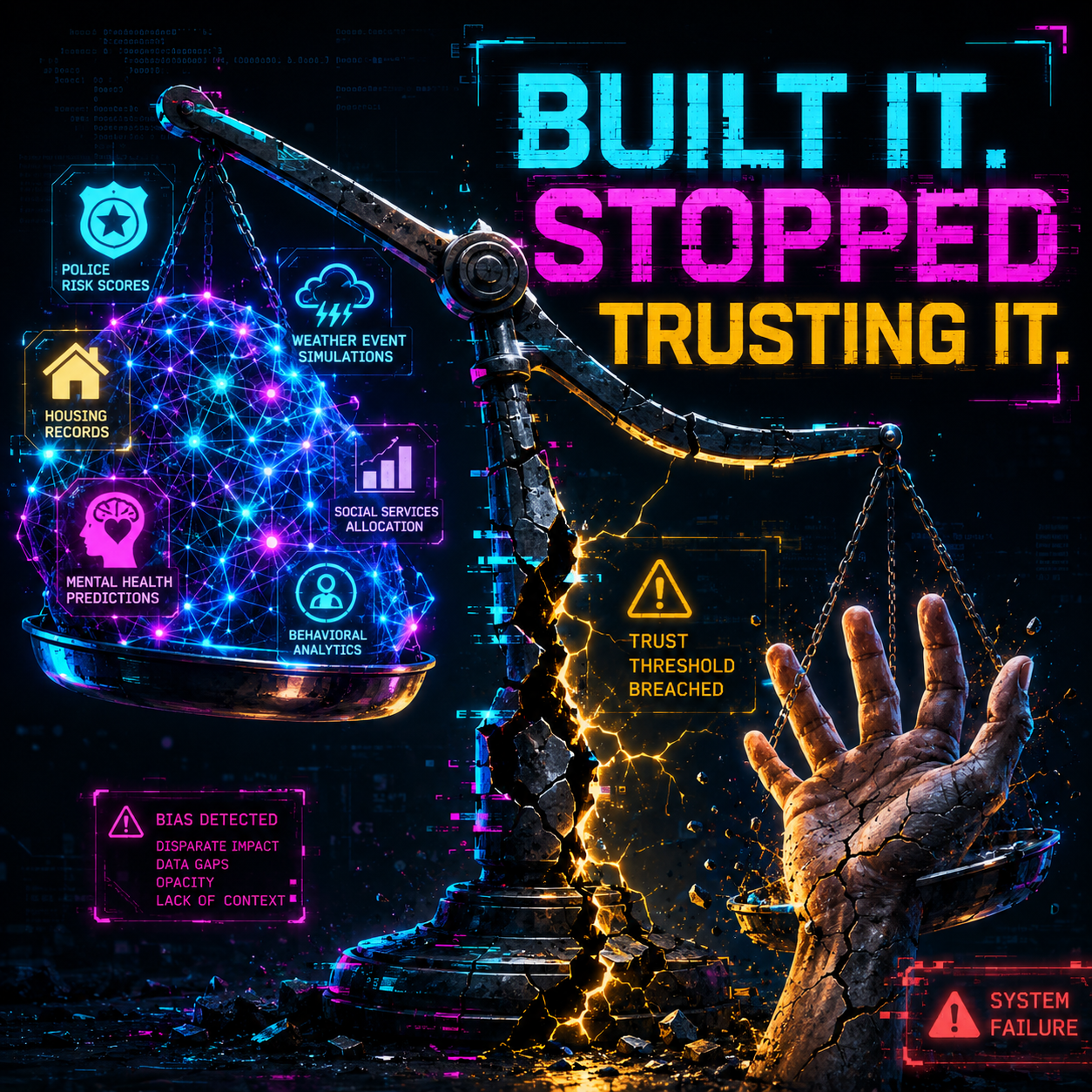
Avon and Somerset Police built 23 machine learning models. They scored half a million people on risk of crime, domestic abuse, and court non-appearance. They fed the machines police intelligence reports, mental health records, housing status, and free school meal eligibility.
Then they quietly abandoned at least two of those models. Even the people who built them stopped trusting the results.
This is not a prompt engineering problem. It is not a "better alignment" problem. It is a systems engineering problem, and it is happening everywhere.
The WIRED investigation into the Think Family Database is visceral and concrete. One police data scientist described the approach at a 2022 event this way: "I essentially dump all that data in a big bucket and stir it with a data-science spatula, and we come out with a lovely risk score for everybody." Independent reviewers found a "startling lack of transparency." John Pegram, a local police accountability advocate, did not even learn the Offender Management App existed until 2023, years after it had been created. When he filed a data request, the police refused to say how they were using his information.
The shock is not that the models were biased or inaccurate. The shock is that the builders abandoned their own tools. When the people who stir the data-science spatula look at the output and say, "I do not believe this anymore," the system is not just broken. It is toxic.
The Trust Deficit: Three Stories That Tell the Same Story
The British police story is not an outlier. It is the most visible crack in a foundation that is failing everywhere. Here are three examples from this week alone that prove the pattern.
At Meta, employees are warning internally that the company's AI moderation rollout is too fast. Edge cases in hate speech and misinformation are not validated before deployment. The playbook is familiar: ship first, apologize later, moderate never. Meta switched from Google's Gemini to its own Muse Spark model for moderation decisions, and insiders say the models still remove or shadow-ban harmless content while lacking enough oversight for the speed of the rollout. The transition is already leading to layoffs, especially among external contractors. The people who knew the edge cases are being replaced by systems that have not learned them yet. The result is a moderation system that makes decisions about speech at scale without the institutional knowledge to validate those decisions.
Insurers are now using generative AI for catastrophe modeling. Diffusion models generate tens of thousands of plausible weather events where historical data does not exist. Fathom, a Swiss Re subsidiary, uses a diffusion tool trained on roughly 1,000 years of climate simulations to produce scenarios for a projected 2030 climate. The problem? Hallucinations. Models can produce events that look plausible but violate basic laws of physics. Oliver Wing, Fathom's scientific director, put it bluntly: "You can hallucinate some absolute slop using these techniques." And the sales logic is just as dangerous. One modeler told the Financial Times that insurers "will generally purchase the model that allows them to do more business, that produces a lower loss estimate." When the model gets the hurricane wrong, who pays? Not the vendor. The policyholders. The people who trusted the output.
ZDNet's "12 Rules of Agentic AI" dropped this week with numbers that should alarm anyone deploying agents. More than half of US desk workers consider themselves AI skeptics. More than half of agentic AI adopters cite data quality and retrieval issues as deployment barriers. The top three reasons for unsuccessful AI pilots among US workers are generic outputs, insufficient training, and low trust in outputs. This is not a capability gap. This is a trust gap.
Three stories. Same root cause. Systems deployed without verification, without feedback loops, without the infrastructure to earn and maintain trust.
The Core Error: Trusting the Model Instead of the System
Most AI pilots focus on capability and speed while skipping the hard work of earning trust. The assumption is simple and wrong: if the model scores well on the benchmark, it is trustworthy in production.
Benchmarks are sanitized. Production is messy. A model that aces SWE-Bench can still hallucinate a library import in your codebase. A model that scores 95 percent on a safety evaluation can still misclassify satire as hate speech when the context shifts. Benchmarks test isolated behavior. Production tests integrated behavior, and integrated behavior is where systems die.
The British police did not have a verification layer. They had outputs and hope. The Think Family Database produced risk scores for half a million people, but there was no systematic mechanism to check whether those scores matched reality. No feedback loop. No ground truth validation. Just a number that determined how the state treated its citizens.
Meta's moderation system lacks validated edge-case handling. The model is deployed faster than safety testing can validate it. The people who understood the edge cases are being laid off while the system runs unchecked.
Here is the line you need to draw clearly: trust is not a property of the model. It is a property of the system around the model. A perfect model in an unverified system is still an unverified system. And an unverified system that makes decisions about people's lives is a weapon.
Engineering Trust: Verification as Infrastructure
If trust is a systems property, then you build it like you build any other system property. You do not hope for it. You engineer it.
Verification loops. Every agent output gets checked against a deterministic rule, a secondary model, or a human before it drives action. Not after. Before. The British police models had no verification loop. The risk score went straight into operational decisions. That is not a model failure. That is an architecture failure.
Confidence scoring. The agent should know when it does not know. The British police models had no "I am uncertain" signal. A model that always produces a number is a model that always lies with confidence. Build threshold-based escalation. If confidence drops below a defined level, hand off to a human. Do not let the model guess its way through critical paths.
Human-in-the-loop escalation. Define thresholds where the agent hands off. Not as a failure mode. As a design pattern. The goal is not to eliminate human judgment. The goal is to focus human judgment on the cases where it matters most.
Deterministic governance. Deontic policy enforcement outside the LLM. This connects directly to PhantomByte's "Agents Need Governors, Not Gatekeepers" from June 21. A governor is a deterministic layer that enforces policy regardless of what the model outputs. It does not ask the model to be nice. It prevents the model from being harmful by construction. If the British police had deontic governance on their risk-scoring system, certain data types would have been categorically excluded from the model's input, not merely "handled carefully" by the algorithm.
This section should feel like a blueprint. You should be able to implement one of these patterns by the end of this paragraph. Here is a concrete example from our own workflows: in the IronPulse verification pipeline, every generated news summary gets checked against source URLs before publication. If the summary claims a fact that cannot be found in the primary source, the pipeline flags it for human review. The model does not get to publish unverified claims. The system prevents it. That is not censorship. That is engineering.
The Cost of Skipping Verification
Ford learned this lesson the hard way. After relying too heavily on automated design and manufacturing systems, the company watched its quality rankings drop. Charles Poon, Ford's VP of vehicle hardware engineering, admitted: "Mistakenly, we thought that by just introducing artificial intelligence and adjusting the design requirements that we had, that that would produce a high-quality product." Ford had to rehire experienced technicians, sometimes bringing back former employees, to correct errors made by the company's robots. The institutional knowledge had left before it could be fully transferred into the automated systems.
Oracle cut approximately 21,000 jobs over the last 12 months, attributing the reductions in part to AI advancements. That is roughly 13 percent of its workforce. Oracle's disclosure is notable because it explicitly names AI as a driver of headcount reduction, not the usual "restructuring" language. This is one of the largest single-company AI-attributed job cuts to date.
The critical question is whether Oracle is repeating Ford's mistake. By cutting the human verification layer before their AI systems are completely trustworthy, they risk the exact same collapse in quality.
The pattern is clear. Automation creates problems that only the people it replaced can solve. If you are deploying agents, you are not just building software. You are rebuilding workflows. Skip the verification step and you get British police-style abandonment: a system that works on paper but collapses in practice because the humans who must rely on it cannot keep up with the system they built.
What to Build This Week
Four concrete actions. No vague "consider implementing" language. Use imperatives.
Add a confidence threshold to every agent tool call. If confidence is below your threshold, escalate. Do not let the model guess its way through critical paths. Define the threshold in advance, not in retrospect.
Build a "trust dashboard" that tracks not just accuracy but disagreement rates between your agent and human reviewers. A rising disagreement rate is an early warning signal. Accuracy can look fine while trust is collapsing underneath. Disagreement rates surface the rot before it breaks the system.
Run a red-team session specifically on your verification layer, not just your model. Attack the system that checks the model. If your verification layer can be fooled, your entire trust architecture is decorative. The model is not the target. The system around it is.
Document your edge cases. Meta did not. You should not repeat that. Every edge case you do not document is an edge case that will surprise you in production. Write them down. Test against them. Update them as the model changes.
The One-Sentence Close
A model nobody trusts is worse than no model at all. Build the verification first.
Get More Articles Like This
Getting your AI agent setup right is just the start. I'm documenting every mistake, fix, and lesson learned as I build PhantomByte.
Subscribe to receive updates when we publish new content. No spam, just real lessons from the trenches.
Build Real AI Infrastructure
PhantomByte teaches you to build real AI infrastructure yourself: local AI stacks, autonomous agents, multi-agent orchestration, web scraping, and custom tools. Step-by-step PDF tutorials you download, follow, and deploy. No subscriptions. No fluff. Just skills that ship.