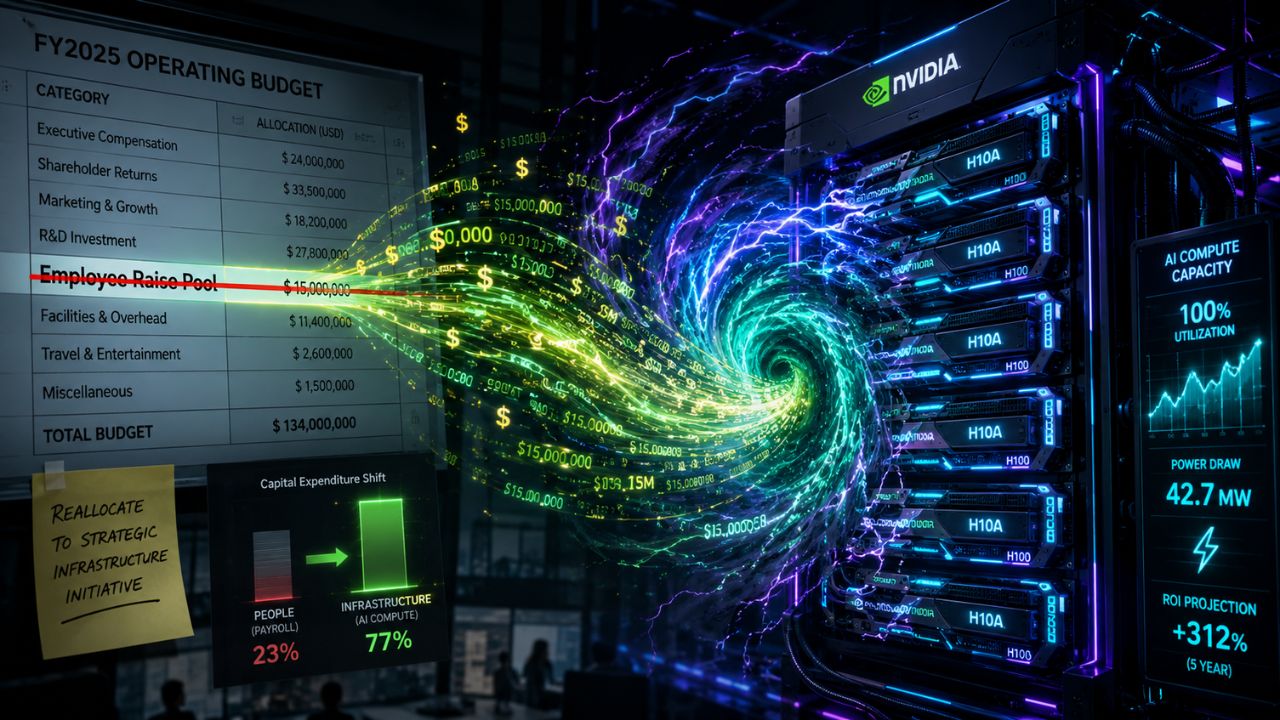
A software company sent an all-hands memo to 5,000 employees. The message was blunt: there will be no raises this year. The budget is going to AI.
This is not a layoff announcement. Nobody is being fired. The workers stay. The work continues. The paycheck just stops growing.
The AI labor disruption narrative everyone fears, robots taking jobs, is happening, but not the way we were told. The first wave of AI labor disruption is not unemployment; it is wage suppression. Workers are not being replaced by machines. They are being outbid by them inside their own company's budget meetings.
THE RECORDS THAT LANDED ON THE SAME DAY
The same week that memo circulated, the US tech sector recorded its largest single-month layoff total of the year. According to reports from Tom's Hardware and other outlets, nearly 40,000 tech workers lost their jobs in a single month. AI was the most frequently cited reason, more than market downturn, more than restructuring, and more than offshoring.
Companies are openly replacing roles with AI tools and restructuring workforces around automation. The data confirms the displacement wave is not coming. It is already here and accelerating faster than any prior automation wave.
The parallel story is quieter but no less significant. A separate software company redirected its entire raise pool to AI investments. Now, 5,000 employees have learned their compensation is frozen so the company can buy more GPUs and licenses.
Layoffs make headlines. Wage freezes do not. But the freeze affects more people and causes less public scrutiny. That is the point.
WHY WAGE SUPPRESSION IS MORE INSIDIOUS THAN DISPLACEMENT
Displacement is visible. A worker is fired. Headcount drops. Regulatory scrutiny follows. Unemployment claims spike. The social safety net, however thin, activates.
Wage suppression is invisible. The worker keeps the job. The taxes keep flowing. The company keeps the institutional knowledge. But the worker's real income erodes with inflation while their productivity is multiplied by AI tools they were forced to adopt.
The company gets two wins: it keeps the human worker AND it invests in AI. The worker absorbs the cost of both.
The structural mechanism is buried in accounting categories. AI tools are classified as capital expenditure (CapEx). Headcount is classified as operating expenditure (OpEx).
CFOs aren't just saving money; they are gaming the balance sheet. By shifting labor costs into infrastructure assets, they aren't just cutting raises; they are inflating the company's asset value on paper while eroding the workers' real-world value. Wage suppression is the path of least resistance. It requires no severance packages, no WARN Act notices, and no awkward all-hands meetings about "difficult decisions." It just requires a line item transfer from payroll to silicon.
WALMART'S MIRROR IMAGE: ADOPTION OUTPACES INFRASTRUCTURE

Walmart deployed an internal AI assistant expecting moderate usage. Employee demand exceeded projections by nearly 400% in three weeks, according to reports from Yahoo Finance and Hacker News. The company was forced to cap usage and announce a multi-hundred-million-dollar infrastructure rebuild.
This is the flip side of the same coin: when AI actually works, demand is unstoppable. But the funding for that AI, whether through infrastructure or wage suppression, is coming from somewhere. Walmart's struggle is one of scale; the 5,000-employee company's struggle is one of theft. Both prove the same thing: the hunger for compute is an insatiable beast that will eat whatever budget line is most convenient.
The Stanford HAI 2026 AI Index reports that 73% of enterprises now deploy AI in production. Only 31% have staff who can evaluate what it is actually doing. The workers are not even equipped to argue about the tools that are eating their raises.
THE LONG VIEW: WHAT HAPPENS WHEN AI PAYS FOR ITSELF BY NOT PAYING YOU
GitHub Copilot switched from flat subscription to token-based billing in 2026, a change TechCrunch reported on May 30 drew developer backlash. Some developers report real-world costs two to four times above projections as usage scales unpredictably.
The AI economics stack is being built on unpredictable consumption models. Workers pay for AI tools, or their employers do, while the output of those tools reduces the worker's bargaining power.
Microsoft's premium Copilot agents were tested by ZDNet and found "confidently bad," fluent but incorrect. Workers are paying the AI productivity tax of correcting AI output. Hours spent fixing hallucinated code or rewriting AI-generated reports are hours not billed, not counted, and not compensated.
The Verge reviewed Google's Spark agent and found the same paradox: the more capable the agent, the more it distances you from the details you need to understand.
This creates a brutal cycle. The worker is forced to use a tool that makes the job harder through constant verification, but because the final output looks polished, the manager believes the job is now "easier." The human's leverage in a salary negotiation disappears exactly when the mental burden of the work increases.
CLOSING
The AI industry has spent years talking about "augmenting" workers. The June 2026 data reveals a more honest ledger.
In at least one company with 5,000 employees, augmentation means, "we keep you and redirect your raise to silicon." The workers are not being replaced by robots. They are being outbid by them in their own company's budget meetings.
That is harder to protest than a pink slip. And that is precisely the point.
Get More Articles Like This
Getting your AI agent setup right is just the start. I'm documenting every mistake, fix, and lesson learned as I build PhantomByte.
Subscribe to receive updates when we publish new content. No spam, just real lessons from the trenches.