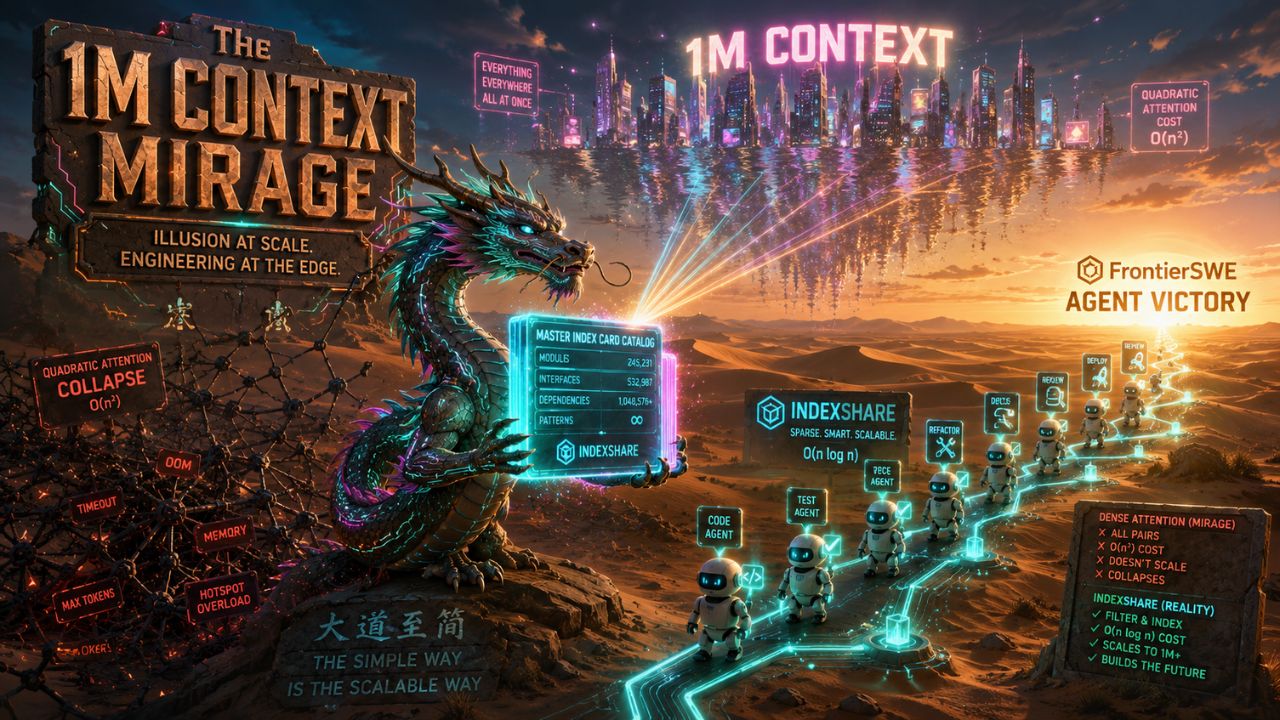
GLM-5.2 shipped today with 1 million tokens of context and an MIT license. On FrontierSWE it trails Claude Opus 4.8 by exactly 1 percent. Here is the part nobody is talking about: it cuts per-token FLOPs by 2.9 times at 1M context length through an architecture trick called IndexShare. While every frontier lab is marketing "long context" as a specification, this open-source Chinese model solved it as an engineering problem.
The Marketing Tax
Every frontier model now claims "1M context" or more. Most of them break under real agent pressure.
Long context is not a specification sheet number. It is an architecture problem. Agents do not need 1M tokens of chat history. They need coherent attention across thousands of tool calls, file reads, and reasoning steps over hours. Most "1M context" models fall apart after 200K tokens of real agent traffic—a failure mode documented internally at multiple AI infrastructure shops and confirmed by independent stress-testing on long-horizon benchmarks like SWE-Marathon and RULER. The gap between marketing and reality is the mirage.
Here is what happens when you actually stress-test these claims. A model that accepts 1M tokens does not mean it can reason across 1M tokens. Dense attention scales quadratically. At 1M tokens, the compute bill explodes. Providers quietly throttle. Latency spikes. Quality degrades. The marketing says "1M context." The engineering reality says "we accept 1M tokens but good luck getting coherent output past the quarter-million mark."
The frontier labs know this. They are not lying on the spec sheet. They are lying by omission. The spec sheet says "context window: 1M tokens." It does not say "usable reasoning depth: approximately 200K before attention collapse." It does not say "latency at full context: unusable for real-time agent work." It does not say "cost per million tokens at 1M context: pray you have venture funding."
This is the marketing tax. You pay frontier prices for a capability that only exists on the brochure.
IndexShare: What Actually Works
Z.AI's architectural innovation is simple to describe and hard to build. They reuse the same indexer across every four sparse attention layers. This reduces per-token FLOPs by 2.9 times at 1 million context length while maintaining quality.
It is not quantization. It is not distillation. It is a structural redesign of how attention works at scale.
Full dense attention is O(n²). Double the context, quadruple the compute. Every token attends to every other token. At 1M tokens, that means 1 trillion attention operations per layer. The math does not care about your marketing budget. It breaks agent workloads entirely because agents do not chat. They work. A coding agent making tool calls across a four-hour session pushes hundreds of thousands of tokens through the context window. Each new token needs to attend to everything that came before.
Sparse attention fixes this by only attending to relevant tokens instead of everything. The problem has always been coherence. If you only attend to a subset of tokens, you risk missing critical dependencies. The sparse attention models of two years ago were fast and incoherent. They could handle long context for retrieval tasks, where the answer lives in one specific chunk of text. They failed at agent tasks, where reasoning depends on chains of dependencies scattered across the full context span.
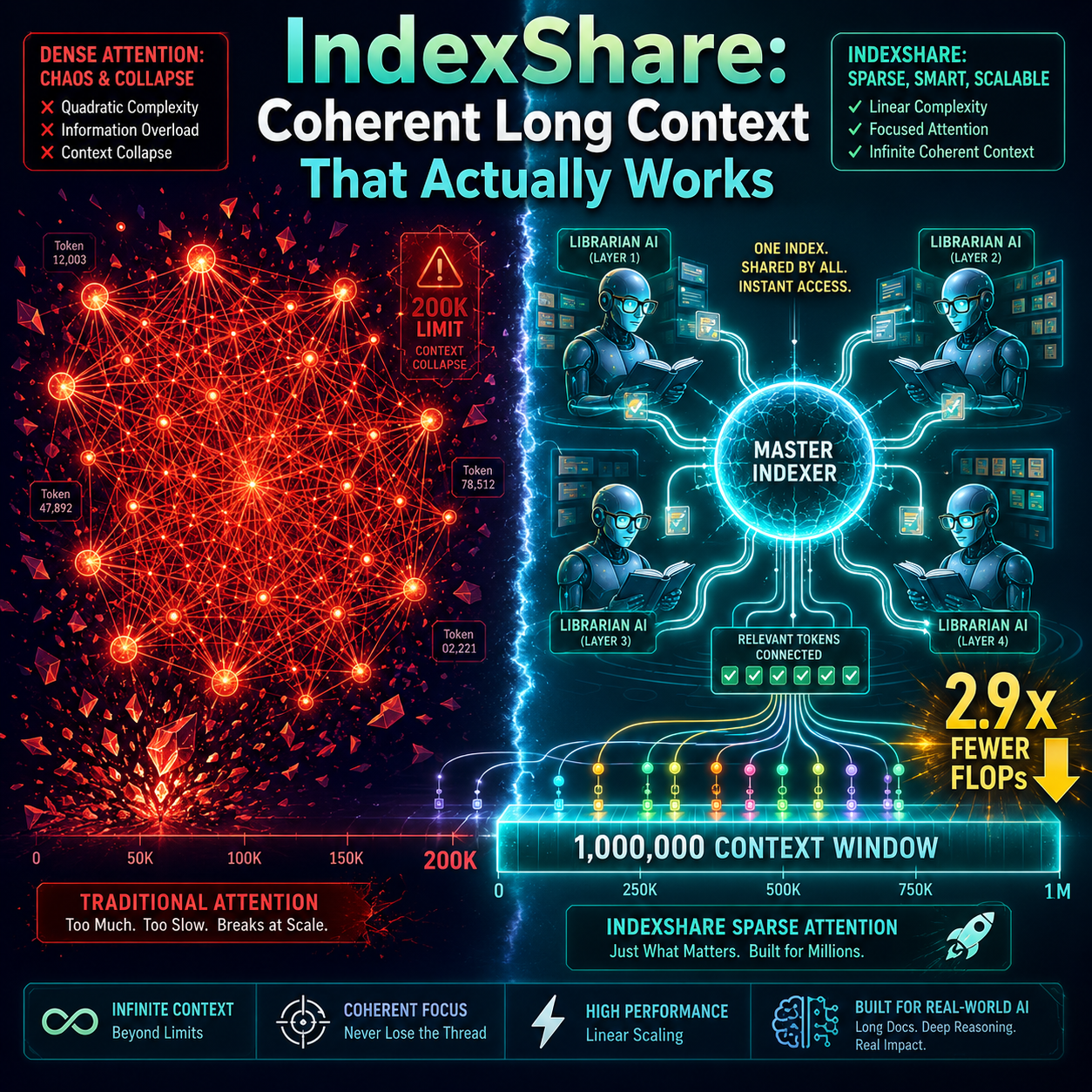
IndexShare solves the coherence problem by sharing the indexing infrastructure across layers instead of rebuilding it four times over. Think of it this way: instead of four separate librarians each creating their own card catalog for the same library, you have one master catalog that all four reference. The librarians still do their own work. They still read different books and reach different conclusions. But they all agree on where the books are.
This shared indexer means the sparse attention layers maintain a consistent view of the full context. When an agent needs to recall a file it read twenty minutes and forty thousand tokens ago, the indexer still knows where that information lives. The retrieval stays coherent. The compute stays bounded. The quality does not collapse at distance.
GLM-5.2 also improves its MTP layer for speculative decoding, increasing the acceptance length by up to 20 percent. That is not the headline. But for production agent systems running at scale, a 20 percent increase in speculative decoding acceptance means lower latency and lower cost on every single generation. The IndexShare architecture makes the 1M context feasible. The MTP improvement makes it economical.
The Benchmarks That Matter
FrontierSWE measures what actually matters for agents: the ability to complete open-ended technical projects over hours. Not multiple-choice questions. Not code completion. Real projects that span systems optimization, large-scale code construction, and applied machine learning research.
GLM-5.2 trails Claude Opus 4.8 by 1 percent. It edges GPT-5.5 by 1 percent. It beats Opus 4.7 by 11 percent.
These are not cherry-picked numbers. FrontierSWE is designed to resist benchmark hacking. It tests sustained reasoning across tasks that take hours to tens of hours. You cannot memorize your way through it. You cannot prompt-engineer around it. Either your model maintains coherent attention across a long-horizon task, or it does not.
On PostTrainBench, where each agent is given an H100 GPU and evaluated by how much it can improve small models through post-training, GLM-5.2 outperforms both Opus 4.7 and GPT-5.5. It ranks second only to Opus 4.8.
On SWE-Marathon, an ultra-long-horizon benchmark covering tasks like building compilers, optimizing kernels, and developing production-grade services, GLM-5.2 trails Opus 4.8 by 13 percent while remaining second only to the Opus series. There is still room to grow. But it is already competitive at the frontier.
On standard coding benchmarks, the improvement over GLM-5.1 is stark. Terminal-Bench 2.1: 81.0 versus 63.5. SWE-bench Pro: 62.1 versus 58.4. On Terminal-Bench 2.1, GLM-5.2 lands within a few points of Claude Opus 4.8 at 85.0, while staying ahead of Gemini 3.1 Pro.
Across every benchmark that measures sustained agent work, GLM-5.2 is the highest-ranked open-source model.
Released under MIT license. No regional restrictions. No usage policy anxiety. No export control uncertainty. You can download it, modify it, deploy it commercially, and embed it in products. The license is not a footnote. It is the point. For every startup that got burned by sudden API price hikes, model deprecations, or geographic blocks, an MIT-licensed frontier-class model is not just a technical alternative. It is an insurance policy.
Why This Changes the Agent Game
Agent workloads are not chat. They are sustained reasoning sessions.
Current agent pipelines fly without instruments. That is the argument from "The Verification Gap" (PhantomByte, June 9, 2026). Most production agent systems have no reliable way to verify whether the agent is actually making progress, whether its reasoning is sound, or whether it has drifted off course. The pipeline just keeps running, and you hope the output is correct.
The last thing an unreliable agent pipeline needs is a model that loses coherence halfway through a 4-hour task. If your verification is already broken, you cannot afford a model that quietly forgets why it is doing what it is doing. IndexShare keeps the attention window stable across the full span. The shared indexer means distant context stays retrievable. The agent does not wander off into hallucinated reasoning because it lost track of the original goal.
For production agent systems, this is not a nice-to-have. It is a requirement.
Consider what a production agent actually does. It reads files. It makes tool calls. It observes outputs. It reasons about next steps. It repeats. After an hour, the context window contains tens of thousands of tokens of tool outputs, error messages, partial results, and reasoning traces. The model must locate the relevant information in that mess without losing the thread.
Dense attention models at scale cannot do this reliably. The attention weights diffuse. The signal gets buried in noise. The model starts inventing details it thinks it remembers rather than retrieving the actual details from context. This is not a failure mode. It is the expected behavior of quadratic attention at scale.
IndexShare changes the economics of reliable agent work. By cutting FLOPs by 2.9 times at 1M context, it makes full-context agent reasoning practically affordable. By maintaining coherent retrieval across the span, it makes full-context agent reasoning practically reliable.
The Infrastructure Implication
For every agent startup running on Claude or GPT, GLM-5.2 is now a drop-in alternative. MIT license means no usage policy debates, no export control anxiety, no pricing surprises. You own the weights. You run them on your own infrastructure. If the API provider changes terms, blocks your region, or doubles prices overnight, your product keeps working because the model lives on your machines.
This connects directly to a point made in "The Cache Is the Model" (PhantomByte, June 11, 2026). That article showed how inference costs shape architecture decisions. Prefix caching, KV cache optimization, and byte-stable prefixes can slash serving costs by orders of magnitude. But those optimizations assume you control the serving stack. You cannot optimize what you do not own.
GLM-5.2 takes the next step. It is not just about optimizing inference on a model someone else controls. It is about attention architecture itself becoming a competitive variable. When a Chinese open-source lab ships a model that matches the frontier on long-horizon tasks while cutting FLOPs by nearly three times, the infrastructure conversation changes. The question is no longer "which API provider do we use?" It is "what attention architecture can we afford to run at scale?"
If your infrastructure team is not evaluating sparse attention models, they are evaluating yesterday's options. The frontier has shifted. The capability gap between closed-source and open-source has narrowed to 1 percent on the most demanding agent benchmark in existence. The cost gap has swung the other way entirely. Running GLM-5.2 on your own infrastructure with prefix caching and optimized serving will cost a fraction of what frontier APIs charge for equivalent or worse performance on long-horizon tasks.
The business model implication is straightforward. The labs selling API access are betting that convenience outweighs cost and control. GLM-5.2 tests that bet directly. When the open-source alternative matches your capability and undercuts your cost by a multiple, the convenience premium starts looking expensive.
The Uncomfortable Question
If an open-source Chinese model can match Claude Opus within 1 percent on long-horizon agent tasks while cutting FLOPs by 2.9 times, what exactly are you paying the premium for?
Are you buying capability, or are you buying the logo?
The honest answer is probably some of both. Frontier models still lead on the hardest tasks. Claude Opus 4.8 is not beaten yet. But the margin is 1 percent. On a benchmark designed to measure sustained agent reasoning over hours. If 1 percent is the gap between the fifty-dollar-per-million-tokens API and the free model you can run yourself, that premium is getting harder to justify every month.
The open-source trajectory is clear. GLM-5.1 scored 63.5 on Terminal-Bench 2.1. GLM-5.2 scores 81.0. That is not incremental improvement. That is a generational leap in a single release cycle. The gap to frontier on standard benchmarks has narrowed from "several years behind" to "within statistical noise." On long-horizon benchmarks, the gap is already inside the margin where noise, evaluation variance, and prompt engineering can flip the ranking.
IndexShare is not the end of the story. It is the beginning. The architectural insight—that shared indexing can maintain coherence while slashing compute—will be adopted, adapted, and improved by the open-source community at a pace no closed lab can match. The next GLM release will not trail Opus by 1 percent. It will pull ahead.
The mirage is not the 1M context claim. The mirage is the assumption that only frontier labs can build models worth using. The open-source model that matches you within 1 percent while costing you nothing in licensing is not a competitor. It is a verdict.
Get More Articles Like This
Getting your AI agent setup right is just the start. I'm documenting every mistake, fix, and lesson learned as I build PhantomByte.
Subscribe to receive updates when we publish new content. No spam, just real lessons from the trenches.
Build Real AI Infrastructure
PhantomByte teaches you to build real AI infrastructure yourself: local AI stacks, autonomous agents, multi-agent orchestration, web scraping, and custom tools. Step-by-step PDF tutorials you download, follow, and deploy. No subscriptions. No fluff. Just skills that ship.