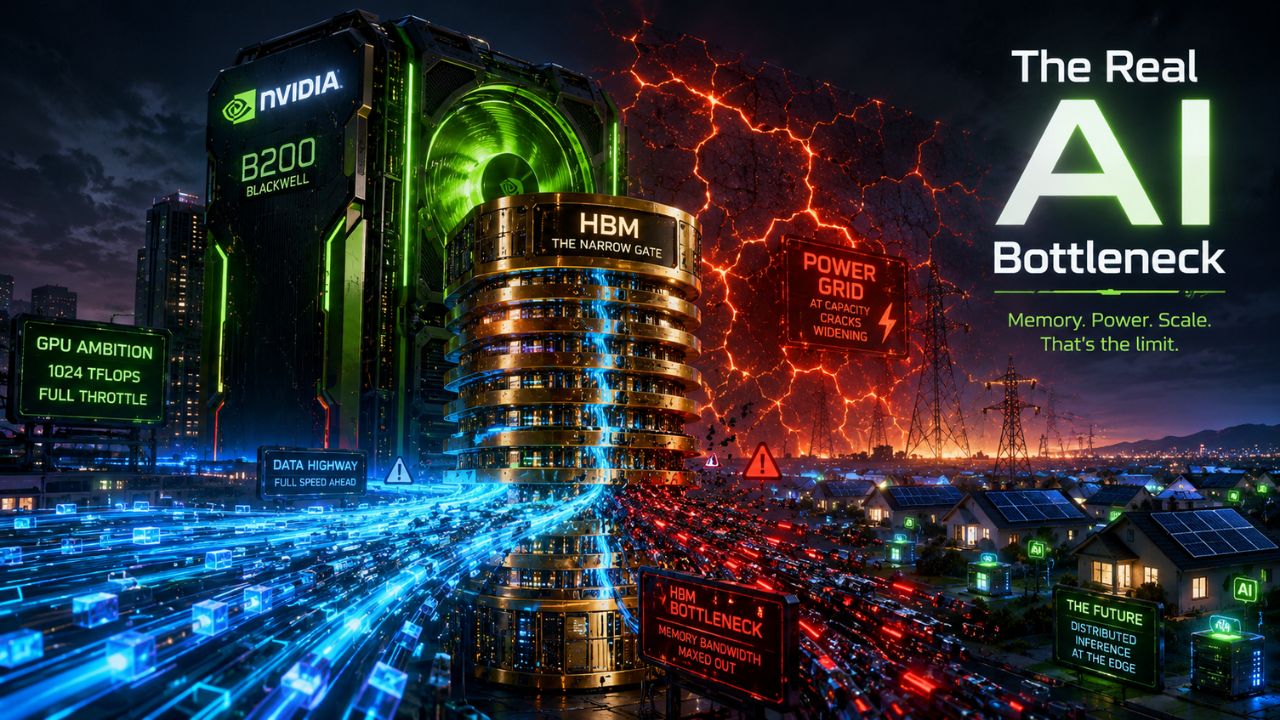
Every H100, B200, and GB300 depends on one company's memory. Nvidia just lost $1 trillion. The bottleneck moved from GPUs to HBM, and nobody is ready.
SK Hynix raised $26.5 billion in the largest foreign IPO in US history. The company controls the High Bandwidth Memory market that every AI GPU depends on. Nvidia lost over $1 trillion in market cap as investors realized GPU dominance is not enough when memory supply is the chokepoint. Microsoft's carbon emissions jumped 25 percent last year, driven entirely by AI data center buildout, even as the world's largest renewable energy buyer. Sunrun is proposing distributed AI compute nodes in residential homes, turning solar customers into edge infrastructure hosts. The centralized data center model is showing cracks. The next decade of AI infrastructure belongs to whoever solves memory and energy first.
You Are Chasing GPUs While Memory Starves Your Cluster
SK Hynix just raised $26.5 billion in the largest foreign IPO in US history. That is not a software valuation. That is a memory chip company being priced like the gatekeeper to all modern AI, because that is exactly what it is.

HBM, or High Bandwidth Memory, is stacked memory sitting right next to the GPU die, feeding data at terabytes per second. It is not a luxury component. It is the physical layer that determines whether your trillion-parameter model can actually train or whether your GPUs sit idle waiting for data they cannot reach fast enough.
Here is the critical fact: every H100, every B200, and every GB300 GPU depends on HBM from SK Hynix. No HBM, no training run. End of story.
The public obsession is GPU count. Headlines scream about ten-thousand-GPU clusters and hundred-billion-dollar data centers. But the silent reality is that memory bandwidth, not compute, is what limits model scale. FLOPs are only half the story. If you cannot feed the GPU fast enough, the compute sits idle. Memory bandwidth, not compute, is the wall modern transformers hit first.
We covered this from the distribution angle in "The Compute Illusion" back in May. That piece showed where the GPUs actually live. This article goes one layer deeper, into the memory stack that makes those GPUs worth having in the first place.
When you plan a cluster, you evaluate three things: how many FLOPs you can buy, how fast you can move data to those FLOPs, and whether the power grid can sustain both. Most teams only plan for the first. That is why their clusters underperform on paper specs.
The Nvidia Correction Is Not About GPUs. It Is About Bottlenecks.
Nvidia lost over $1 trillion in market capitalization. The stock is trading at pre-boom prices. The headlines will tell you this is about competition from Meta, AMD, and custom chip startups. That is partially true, but it misses the structural point.
Investors are recalibrating. The GPU shortage narrative is giving way to the realization that AI infrastructure has deeper constraints. Meta, AMD, and every custom chip startup on the planet are building alternatives, but none of them can bypass the HBM supply chain. They all need SK Hynix. That is not a competitive landscape. That is a dependency chain.
SK Hynix is being urged by US officials to build fabrication plants on American soil under the CHIPS Act. This is not a routine industrial incentive. This is the US government recognizing that HBM is a strategic vulnerability and trying to onshore production before geopolitical friction severs the supply line.
A trillion-dollar wipeout is not panic. It is the market pricing in a supply chain reality that engineers have been ignoring. The signal is infrastructure, not sentiment. When the world's most valuable chip company loses a third of its value in months, the message is that compute abundance does not matter if memory scarcity chokes it.
The Energy Wall Is Higher Than the Memory Wall
Microsoft's annual sustainability report is out. Carbon emissions are up 25 percent year-over-year, driven almost entirely by AI data center expansion. This is Microsoft, the world's largest corporate purchaser of renewable energy, and it still cannot keep up.
Even if you solve the HBM shortage, you still need to power the cluster. The grid is the next bottleneck. We have covered this before. "The Grid Can't Save You" in May and "The $130 Billion Blockade" in June both pointed to the same structural problem: renewable energy deployment is linear, and AI compute demand is exponential. You cannot solve an exponential problem with a linear solution.
The Microsoft report is not a PR stumble. It is a physics report dressed as a sustainability document. Every new data center is a load the grid was not designed to carry. Every training run is a spike that baseload generation cannot absorb. Even with the most aggressive renewable procurement on Earth, Microsoft is losing ground.
When you plan AI infrastructure, evaluate three bottleneck layers: compute (GPU), memory (HBM), and energy (grid). Most teams only plan for the first. The ones that survive the next five years will be the ones that plan for all three.
The Distributed Experiment. AI Infrastructure in Your Living Room.
But what if the solution is not bigger data centers at all? Sunrun is proposing a "nationwide compute network." Small AI inference nodes installed in customers' homes, powered by rooftop solar. Homeowners compensated for electricity and space. Residential solar becomes distributed compute infrastructure.
This is not incremental. It is a topology shift. The internet moved from centralized data centers to edge nodes. AI may follow the same path, not because it is elegant, but because the centralized model is hitting physical limits.
The economic model is straightforward. Sunrun has 1.1 million customers with solar and battery systems. Those rooftops generate power that currently feeds back into the grid at wholesale rates. If instead that power runs inference workloads for enterprise buyers, the homeowner gets a cut, Sunrun gets a new revenue stream, and the AI industry gets compute capacity that does not require a fifty-acre campus and a substation upgrade.
The risks are real. Security. Latency. Reliability. Regulatory framework for residential compute hosting. A node in a garage is not a tier-3 data center. But the question is not whether this is perfect. The question is whether the centralized alternative is sustainable.
The concept of "infrastructure topology" matters here. Centralized versus distributed is not just an architecture choice. It is a fundamental constraint on what AI can scale to. If every inference request has to round-trip to a hyperscaler campus in Northern Virginia, you are building a system with a single point of failure and a single point of congestion. Distributed compute is messier. It is also more resilient.
Is this a genuine solution or a PR stunt? The evidence is mixed. Sunrun says it ran a successful proof of concept, but details are thin. The pilot will run over the coming months. If it works, it opens a new category of edge infrastructure. If it fails, it still proves that the industry is desperate enough to try living-room compute.
The Bottom Line
Compute is being solved by competition. Memory is being addressed by geopolitics and the CHIPS Act. Energy remains unsolved, and the demand curve is exponential.
The real competitive moat in AI is no longer who has the best model. It is who has access to memory and power. A frontier model on paper is worthless if you cannot feed it data fast enough or keep the lights on while it trains.
For production teams, audit your cloud spend. Ask what percentage goes to idle GPU time caused by memory bandwidth starvation. Ask whether your provider has secured HBM supply for the next eighteen months. Ask whether your cluster's power contract scales with your compute contract. Most teams have never asked these questions. That is why most clusters are oversized on paper and underperforming in practice.
You can have ten thousand GPUs. But if you cannot feed them, they are just expensive space heaters.
Get More Articles Like This
Getting your AI agent setup right is just the start. I'm documenting every mistake, fix, and lesson learned as I build PhantomByte.
Subscribe to receive updates when we publish new content. No spam, just real lessons from the trenches.
Build Real AI Infrastructure
PhantomByte teaches you to build real AI infrastructure yourself: local AI stacks, autonomous agents, multi-agent orchestration, web scraping, and custom tools. Step-by-step PDF tutorials you download, follow, and deploy. No subscriptions. No fluff. Just skills that ship.