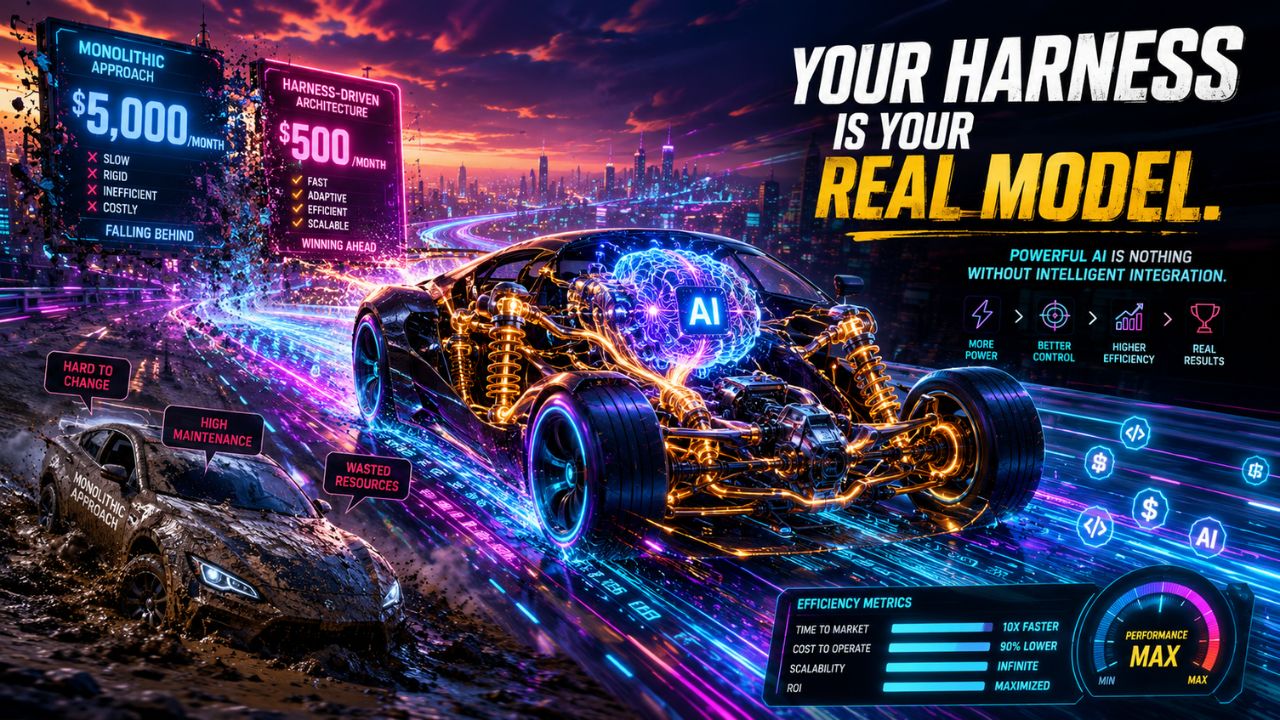
Three papers. One week. Same verdict: orchestration design beats model selection. Here is what that means for your stack.
Key Takeaways
- A new arXiv paper formalizes the "harness effect": different orchestration patterns can produce 10x differences in token cost for the same task.
- NVIDIA's Nemotron 3 Ultra paired with LangChain's Deep Agents harness outperformed closed frontier models, proving the harness determines real-world economics.
- Smaller models with better orchestration beat larger models alone on complex reasoning benchmarks like ARC-AGI-1.
- Google's Managed Agents now run background tasks asynchronously; Anthropic's Claude Cowork keeps working after you close your laptop.
- The platform war is shifting from model quality to execution persistence.
- Every production team should evaluate their agent harness across four dimensions: composition pattern, context sharing strategy, approval gating, and tool integration depth.
You Are Buying Horsepower When You Need Suspension
Teams obsess over model benchmarks while ignoring the architecture that actually runs the model. The GPT-5.6 Sol versus Claude Fable 5 pricing war is the perfect example. Everyone is comparing model specs, but the real question is how the model is wired into the workflow. The model is just one component in a system that lives or dies by its harness.
The Token Economics of Orchestration
A new arXiv paper submitted July 8, 2026 formalizes what production builders already know. "The Harness Effect: How Orchestration Design Sets the Token Economics of Enterprise Agentic AI" (arXiv:2607.06906) isolates the orchestration layer by holding the model constant and swapping only the harness.
The results are stark. Across 22 locked evaluation tasks and six foundation models, the Writer Agent Harness cut blended cost per task by 41 percent, median wall-clock time by 44 percent, and tokens per task by 38 percent, all while keeping task-completion quality at parity or slightly above.
The paper tested Claude Sonnet 4.6, Gemini 3.1, Gemini Flash 3.5, Qwen 3.6, GLM 5.1, and Palmyra X6. Every single model got cheaper when the harness improved, ranging from 33 percent to 61 percent in cost reduction. The efficiency is model-invariant, but quality gains are capability-dependent. A model's improvement correlates almost perfectly with its baseline strength. The paper calls this "harness leverage."
Quality per dollar rose 82 percent. Task completions per million tokens jumped from 54.9 to 92.0. At 1 million tokens per day, the difference between a well-designed harness and a default one is the difference between a $500 bill and something closer to $5,000.
The orchestration layer moved cost per task more than the full spread of the model menu did. Think about that. The harness mattered more than switching models entirely.
The Architecture Shift: From Model Wars to Harness Wars
Three signals converged this week, and they all point to the same conclusion.
First, NVIDIA and LangChain. Nemotron 3 Ultra is not a frontier model on its own, but when LangChain tuned a specialized Deep Agents harness for it, the combination beat closed-model alternatives on benchmark-leading performance at lower cost. The NVIDIA Technical Blog published "Create a LangChain Deep Agents Harness Profile for NVIDIA Nemotron 3 Ultra to Improve Performance" on July 8, 2026, and LangChain's own blog published "Tuning the harness, not the model: a Nemotron 3 Ultra playbook" the same day. The takeaway is direct: model plus harness is the new competitive unit, not model alone.
Second, the ARC-AGI-1 paper. "Cost-Effective Agent Harnesses for Abstract Reasoning and Generalization on ARC-AGI-1" (arXiv:2607.06764, submitted July 7, 2026) used multiple specialized agents working together, smaller models with better orchestration, and outperformed larger models used alone on abstract reasoning tasks.
The Explorer-Definer Pipeline reached 57.50 percent pass@2 at $0.25 per task. The Reflective Orchestrator reached 67.25 percent pass@2 at $0.62 per task. Together, these architectures lifted a 15.50 percent one-shot baseline by roughly 52 percentage points without benchmark-specific training or heavy test-time compute. Architecture compensates for model capability. That is not an opinion. That is what the numbers show.
Third, platform shifts from Google and Anthropic. Google's Managed Agents in the Gemini API now support background task execution and remote MCP. Anthropic's Claude Cowork launched on mobile and web, keeping tasks running after you close your laptop. Both prioritize persistent, asynchronous agent execution over synchronous chat. The UX breakthrough is not model quality. It is the harness that lets the agent operate when the human is offline.
Sovereign AI and Local Orchestration
The harness effect becomes even more critical when moving away from cloud APIs to local-first deployments. If you are running frameworks like OpenClaw or Ollama on self-hosted infrastructure, token costs are replaced by strict VRAM constraints and compute latency. A monolithic agent will quickly exhaust the context window and choke your GPU. A hierarchical harness allows you to route specialized sub-tasks to smaller models, preserving your primary hardware memory for complex reasoning. Orchestration is the mandatory key to unlocking true Sovereign AI.
The Four Dimensions of Harness Design
Here is a framework you can use today. For each dimension, a one-sentence definition, a good pattern, and a bad pattern.
1. Composition Pattern
Definition: How sub-agents are arranged to complete a task.
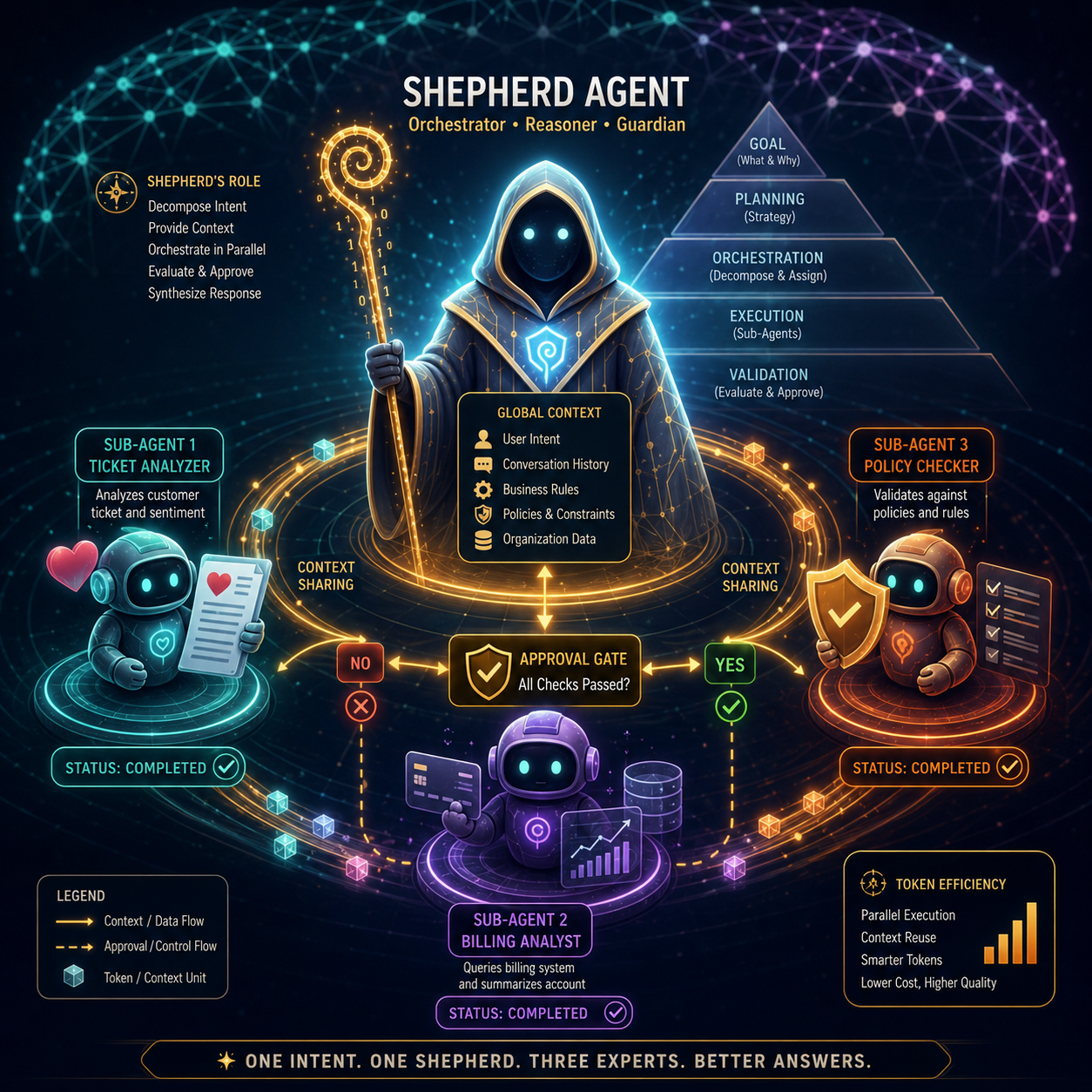
Good pattern: Hierarchical. A Shepherd agent spawns sub-agents with narrow scopes, collects results, and makes decisions.
Bad pattern: Monolithic. One agent reads the ticket, searches the KB, checks billing, and replies in a single bloated context window. Cost is high. Accuracy degrades with latency.
2. Context Sharing Strategy
Definition: How agents access shared state, memory, and intermediate results.
Good pattern: Vector retrieval with cached embeddings. Sub-agents query only what they need. Fast. Scoped.
Bad pattern: Dumping the entire conversation history into every sub-agent's context window. If your shared context takes 110 milliseconds to retrieve, your agent repeats steps.
3. Approval Gating
Definition: Where human review is mandatory before the agent proceeds.
Good pattern: Threshold-based triggers. Transactions over $500 require human sign-off. Refunds, writes to production databases, customer-facing emails: all gated.
Bad pattern: No gating, or gating everything. Either way, you lose. AI cannot take responsibility. Someone with a name and a job title has to own the decision.
4. Tool Integration Depth
Definition: How the agent connects to external systems.
Good pattern: Deep integration via MCP sessions. The agent operates a terminal, maintains state across tool calls, and handles errors natively.
Bad pattern: Shallow API wrappers. The agent calls an endpoint, gets a response, and discards the session. No retry logic. No error recovery. Every call starts from zero.
A Concrete Example: The Customer Support Agent
A customer support agent receives a refund request.
The bad harness: a single monolithic agent reads the ticket, searches the knowledge base, checks the billing system, and replies. All in one long context window. The agent juggles sentiment analysis, billing queries, policy lookups, and draft generation simultaneously. Cost is high. Context window bloat means the agent starts forgetting details. Accuracy degrades with latency.
The good harness: a Shepherd agent spawns three sub-agents in parallel. One reads ticket sentiment. One queries billing history. One checks policy rules. Results are aggregated. A decision is made. A draft is sent to a human for approval on transactions over $500.
Cost: roughly 60 percent lower. Accuracy: higher, because each sub-agent has a narrower scope. Speed: faster, because the three sub-agents run in parallel instead of sequentially. Observability: better, because each sub-agent's reasoning is isolated and auditable.
This is not theoretical. The "Harness Effect" paper measured this. The LangChain Nemotron work measured this. The ARC-AGI-1 paper measured this. Three independent teams. Same result.
When to Upgrade Your Harness, and When Not To
Upgrade if your token burn is unpredictable. If you cannot explain why one task costs $2 and another costs $40, your harness is leaking tokens.
Upgrade if your agents repeat steps. If you see the same sub-task executed twice because context was lost or state was not shared, your harness is broken.
Upgrade if your context windows are exploding. If you are stuffing 50,000 tokens into a single prompt because the agent has no other way to access what it needs, you have a harness problem, not a model problem.
Do not upgrade if your tasks are single-turn and deterministic. A fancy harness is overhead, not architecture, when the agent just needs to answer a question or summarize a document. Start with approval-gated sequential harnesses. They are safe, observable, and easy to debug. Move to parallel and hierarchical patterns only after you have visibility into what each sub-agent is doing. You cannot optimize what you cannot see.
The Bottom Line
The industry has spent two years arguing about which model is best. This week's research says the wrong question is being asked. The right question is: what harness are you wrapping around the model?
A mediocre model with a great harness beats a great model with a mediocre harness. The gap is not marginal. It is 10x in token cost and the difference between an agent that works and one that loops forever.
Your model is the engine. Your harness is the chassis, the suspension, the brakes, and the steering. You can have a thousand horsepower, but without the right suspension, you are just spinning wheels. The harness is your real model.
Get More Articles Like This
Getting your AI agent setup right is just the start. I'm documenting every mistake, fix, and lesson learned as I build PhantomByte.
Subscribe to receive updates when we publish new content. No spam, just real lessons from the trenches.
Build Real AI Infrastructure
PhantomByte teaches you to build real AI infrastructure yourself: local AI stacks, autonomous agents, multi-agent orchestration, web scraping, and custom tools. Step-by-step PDF tutorials you download, follow, and deploy. No subscriptions. No fluff. Just skills that ship.