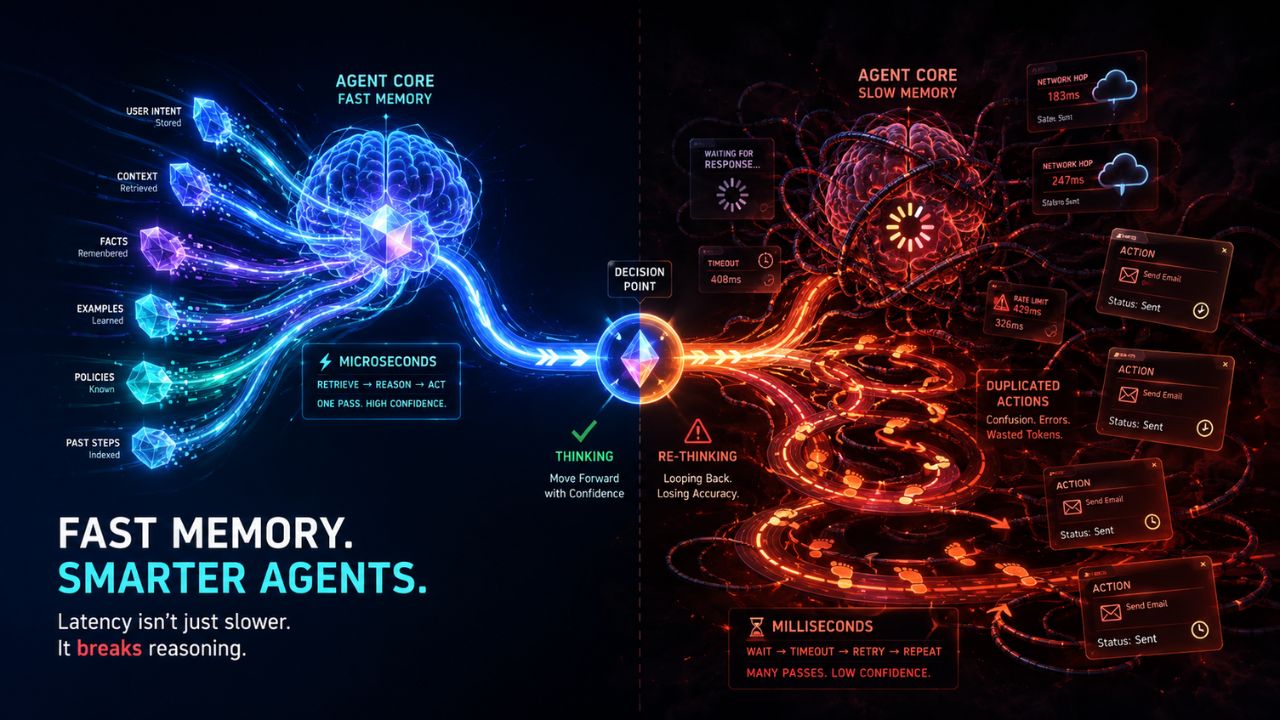
A new research paper proves what production agent builders already suspected: memory latency is not just a performance issue. It is an accuracy issue. At 100-microsecond retrieval speed, agents make zero redundant mistakes. At 110 milliseconds, they make 7.2 out of 12. The difference between a working agent and a broken one might be three orders of magnitude in memory speed.
KEY TAKEAWAYS
- Redundant agent actions rise monotonically with memory latency: 0.0 of 12 at 100 microseconds versus 7.2 of 12 at 110 milliseconds.
- The "Memory in the Loop" paper demonstrates that in-process retrieval at microsecond speeds turns memory from a consulted tool into extended working memory.
- Trace, a new open-source Python library, implements self-organizing episodic memory for LLM agents with microsecond-speed retrieval.
- Akashic's MemAttention achieves up to 10.2 points higher task accuracy and 1.21x throughput compared to systems that recompute context from scratch every turn.
- The next generation of agent architectures will treat memory as an in-process, per-step resource rather than a networked service.
The Problem: Your Agent Has Amnesia by Design
What is the impact of memory latency on AI agents? Every millisecond of latency above in-process speeds directly degrades agent accuracy, resulting in repeated steps and forgotten constraints.
Current agent memory architectures treat memory as a database. The agent finishes a step, formats a query, sends it over the network, waits for a response, and continues. That network round trip is invisible during demos. It is catastrophic in production.
The "Memory in the Loop" paper (arXiv:2607.05690, July 2026) tested agents under controlled memory-latency conditions. The results are unambiguous. At in-process speeds (roughly 100 microseconds), agents made 0.0 redundant actions out of 12 trials. At cloud round-trip speeds (110 milliseconds), they made 7.2 redundant actions out of 12.
The agents were not slower. They were wrong. They repeated steps, forgot constraints, and re-derived conclusions they had already reached, all because the memory store was too slow to be part of their working thought process.
The dose-response curve is where this gets ugly. At +15 milliseconds, redundant actions hit 1.4 to 1.6 out of 12. At +30 milliseconds, 4.0 to 4.4. At +50 milliseconds, 6.2. The degradation is continuous. There is no safe threshold above in-process speed. Every millisecond costs you accuracy.
The economic angle is simple. If your agent burns tokens re-deriving facts it already knew, you are paying for compute twice. If it repeats tool calls because the prior result never reached its working state, you are paying for API calls twice. Latency is not just a UX problem. It is a cost problem dressed in UX clothing.
The Architecture Shift: From Passive Retrieval to In-Process Memory
Memory systems today expose memory through passive retrieval: query, then results, then agent processes, then next step. The new paradigm is active, in-process memory: the agent reads and writes memory on every step without leaving the process boundary.

Trace, a new open-source Python library, implements this with a hybrid B+Tree and vector RAG architecture. Unlike traditional RAG systems that treat memory as a flat retrieval store, Trace organizes memories into a temporal-episodic structure. Agents recall sequences of events, not just isolated facts.
That distinction matters. A flat RAG store can tell you that a user likes dark mode. An episodic store can tell you that the user asked for dark mode after complaining about eye strain during a late-night session three weeks ago. Context changes meaning.
Trace runs entirely in-process with microsecond-speed retrieval, making it suitable for per-step memory access in agent loops. The self-healing index reorganizes as new memories are added, preventing the degradation that plagues fixed-index approaches. Fixed indices accumulate noise. Self-organizing indices adapt.
This is not a marginal improvement. It is a category change: memory moves from infrastructure to architecture. This builds directly on the argument from PhantomByte Note #117: persistent notebooks beat context windows because memory is the architecture, not an afterthought. The new research takes that further. Memory is not just the architecture. Memory speed is the architecture.
Why This Matters for Production
If you run agents that hold long conversations, execute multi-step tasks, or maintain state across sessions, memory latency is already affecting your output quality. The symptoms look like agent stupidity: repeating questions, ignoring previously established facts, re-executing tools with identical inputs.
Most teams blame the model. The paper says blame the memory architecture. At 110 milliseconds, the agent's context window has already moved on. By the time the memory response arrives, the agent is processing the next token and the retrieved information arrives too late to influence the current decision.
At microsecond speed, memory retrieval happens inside the same inference step. The agent can reference prior events, user preferences, and task constraints without interrupting its reasoning flow.
The cost implications are secondary but real. Akashic's MemAttention system demonstrates that organizing context into bounded chunks and modeling semantic relationships across them improves task accuracy by up to 10.2 points and throughput by up to 1.21x compared to systems that recompute context from scratch every turn. In agentic workflows, much of the context is repeated across turns. MemAttention exploits this redundancy. Memory optimization and inference optimization become the same problem.
A Concrete Example: The Customer Support Agent
Imagine an AI support agent handling a refund request. The agent needs to know: the customer's order history, prior interactions, account tier, and the company's refund policy. With a traditional networked memory store, the agent retrieves this information in a separate step. The retrieval takes 80 milliseconds. The agent writes a response. Then it needs to check whether the refund exceeds the policy limit. Another retrieval. Another 80 milliseconds.
At each step, the agent risks drifting from the facts. If a retrieval arrives late, the agent might confidently state the wrong policy. If the retrieval fails silently, the agent might hallucinate a policy that feels right but costs the company money.
With in-process memory, all of that information lives inside the agent's working state. The refund policy, the order history, and the prior interaction notes are available at microsecond speed during every token generation. The agent does not just remember faster. It remembers continuously. That is the architectural difference.
The customer does not see a microsecond-speed retrieval. They see an agent that never asks the same question twice. They see an agent that honors constraints established in the first message. They see an agent that feels competent.
When to Use In-Process Memory (And When Not To)
Use it when: your agent makes decisions across multiple turns, maintains long-running state, or executes tasks where consistency matters more than speed.
Use it when: you are building sovereign stacks and cannot tolerate cloud dependency or network variance for memory access.
Do not use it when: your agent is a stateless pipeline and handles single-turn queries. A retrieval-augmented generation pipeline over a document store is still the right tool for that job.
Do not use it when: you need cross-process or cross-machine memory sharing. In-process memory is fast because it is local. That is also its limitation.
How to Start Building This Today
Step 1: Audit your current agent loop. Measure memory retrieval latency as a separate phase. If it is above 1 millisecond, it is probably affecting accuracy.
Step 2: Evaluate Trace for Python-based agent stacks. It provides self-organizing episodic memory with microsecond-speed retrieval.
Step 3: If you cannot switch memory architectures yet, at least colocate your memory store with your inference server. Every network hop is a latency tax.
Step 4: For context optimization, study MemAttention-style approaches. Reusing attention states and chunking context across turns is one of the highest-impact optimizations available for multi-turn agent systems.
Step 5: Design your agent loop to read memory before every decision, not just at session start. The architecture only works if the agent actually uses it.
Step 6: Measure redundant actions in your agent traces. If your agent repeats steps, re-asks questions, or re-invokes tools, count them. Those are latency symptoms, not model failures.
The Bottom Line
A memory store too slow to be part of the agent's working thought process is not memory. It is a separate system the agent occasionally consults, and the latency gap between consultation and cognition is exactly where agents fail. The tools exist today. The research is published. The only question is whether your stack treats memory as a database query or as part of the agent's mind.
Get More Articles Like This
Getting your AI agent setup right is just the start. I'm documenting every mistake, fix, and lesson learned as I build PhantomByte.
Subscribe to receive updates when we publish new content. No spam, just real lessons from the trenches.
Build Real AI Infrastructure
PhantomByte teaches you to build real AI infrastructure yourself: local AI stacks, autonomous agents, multi-agent orchestration, web scraping, and custom tools. Step-by-step PDF tutorials you download, follow, and deploy. No subscriptions. No fluff. Just skills that ship.