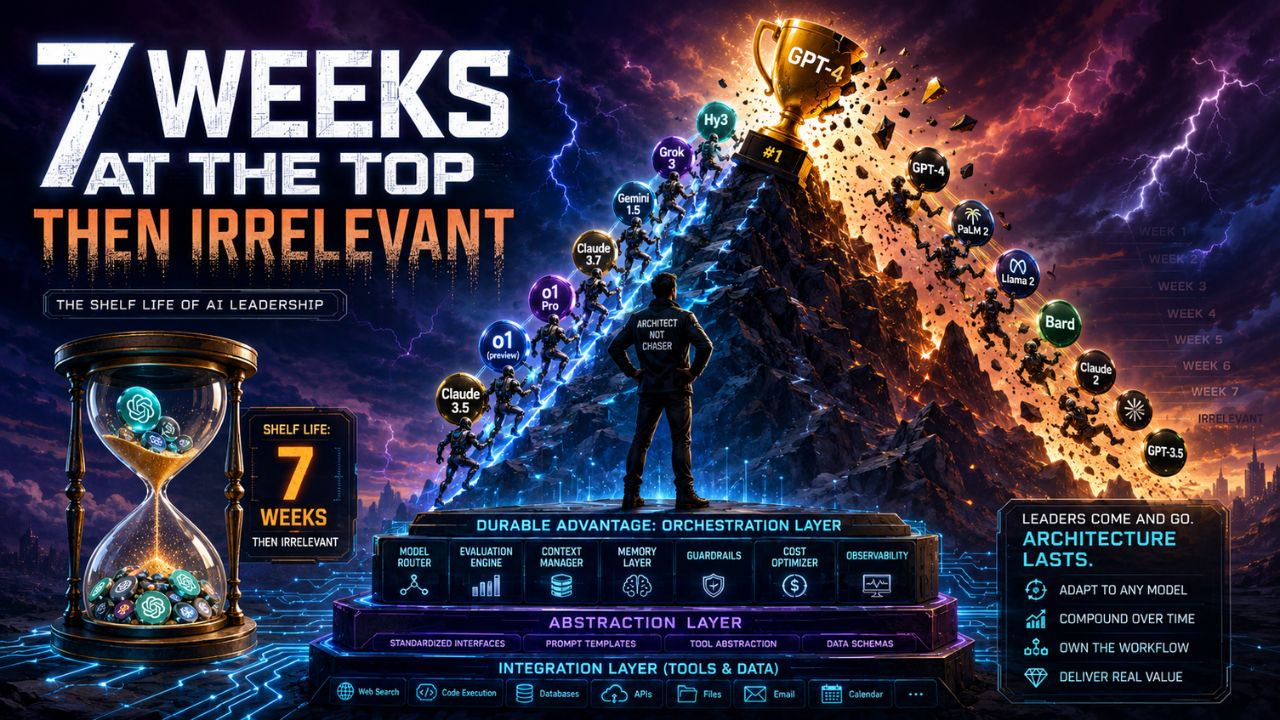
A new analysis published on July 6, 2026, reveals that the shelf life of frontier AI models has collapsed from roughly twelve months during GPT-4's reign to just seven weeks in 2026. Anthropic, Google, Meta, Mistral, and a dozen Chinese labs are releasing models at a pace that means no single model holds the leaderboard long enough to build a business around. This has profound implications for startups building on top of specific APIs, for enterprise procurement cycles that move slower than model releases, and for the entire concept of the frontier model as a durable competitive moat. The era of model dominance is over. The era of model churn is here.
This article will teach you why model churn is not a temporary trend but a permanent structural shift, what it means for your building and buying decisions, and how to architect a stack that treats models as interchangeable components rather than fixed foundations.
The Numbers in Context
GPT-4 led the Epoch Capabilities Index for about a year. That was an anomaly, not a baseline.
According to Epoch AI researcher Jaeho Lee, no model since has come close. OpenAI's o1 held the second-longest lead at just over three months, less than a third of GPT-4's reign. Since Claude 3 Opus dethroned GPT-4 in February 2024, the lead has changed hands 17 times. The median stay at the top per model was about seven weeks.
Think about what "shelf life" means in practice. It is the window during which a model is considered state-of-the-art. It is the window during which startups can raise money on it, during which enterprises can evaluate and deploy it, during which developers can build integrations that will not be obsolete before the pull request merges.
Seven weeks is not enough time for any of that.
This is not "models are getting better faster." It is "the concept of a stable foundation for building has disappeared." The era of model dominance is over, and the era of model churn is here.
Why Model Churn Destroys Old Business Models
Startups built on a single API are now racing against the next release. If your product's core value is "we use the best model," your moat evaporates every seven weeks.
Enterprise procurement cycles take 6 to 18 months. By the time a company evaluates, pilots, and deploys a model, three better models have already shipped. The procurement process is structurally mismatched with the release cadence. This is not a process problem you can fix with better project management. It is a fundamental incompatibility between how enterprises buy technology and how AI labs ship it.
Your evaluation was obsolete before you finished writing the report.
There is a parallel here to cloud infrastructure. Companies that built on a single cloud provider learned about vendor lock-in the hard way. Model lock-in is the same mistake, compressed from years into weeks. The difference is that cloud migration takes months. Model migration, in theory, should be faster. In practice, it is not, because your prompts are tuned for that specific model, your evals are calibrated to its failure modes, your entire application architecture assumes its token limits and tool-calling schema. You are locked in. You just do not call it that.
The implications are profound for startups building on top of specific models, for enterprise procurement cycles, and for the entire concept of the frontier model as a durable moat.
The Economics Are Shifting Under Your Feet
The commoditization is not just about speed. It is about economics.
Tencent released Hy3 on July 6, 2026, an open-source model with 295 billion total parameters but only 21 billion active at any given time. Tencent claims Hy3 matches the performance of models two to five times its size. In a blind evaluation by 270 experts, Hy3 scored 2.67 out of 4, beating GLM-5.1 at 2.51. Internal testing showed the hallucination rate dropped from 12.5 percent to 5.4 percent.
If those benchmarks hold, this changes the economics of running frontier AI. A model that matches 5x its parameter count means frontier-level performance on consumer hardware. That is not incremental improvement. That is a structural shift in who can run competitive models and where.
On the same day, Chinese lab Zhipu launched ZCode, a coding agent built around GLM-5.2 that competes directly with Claude Code and OpenAI Codex. The pricing undercuts Western competitors by 5 to 10 times, continuing the pattern of Chinese AI labs commoditizing developer tools.
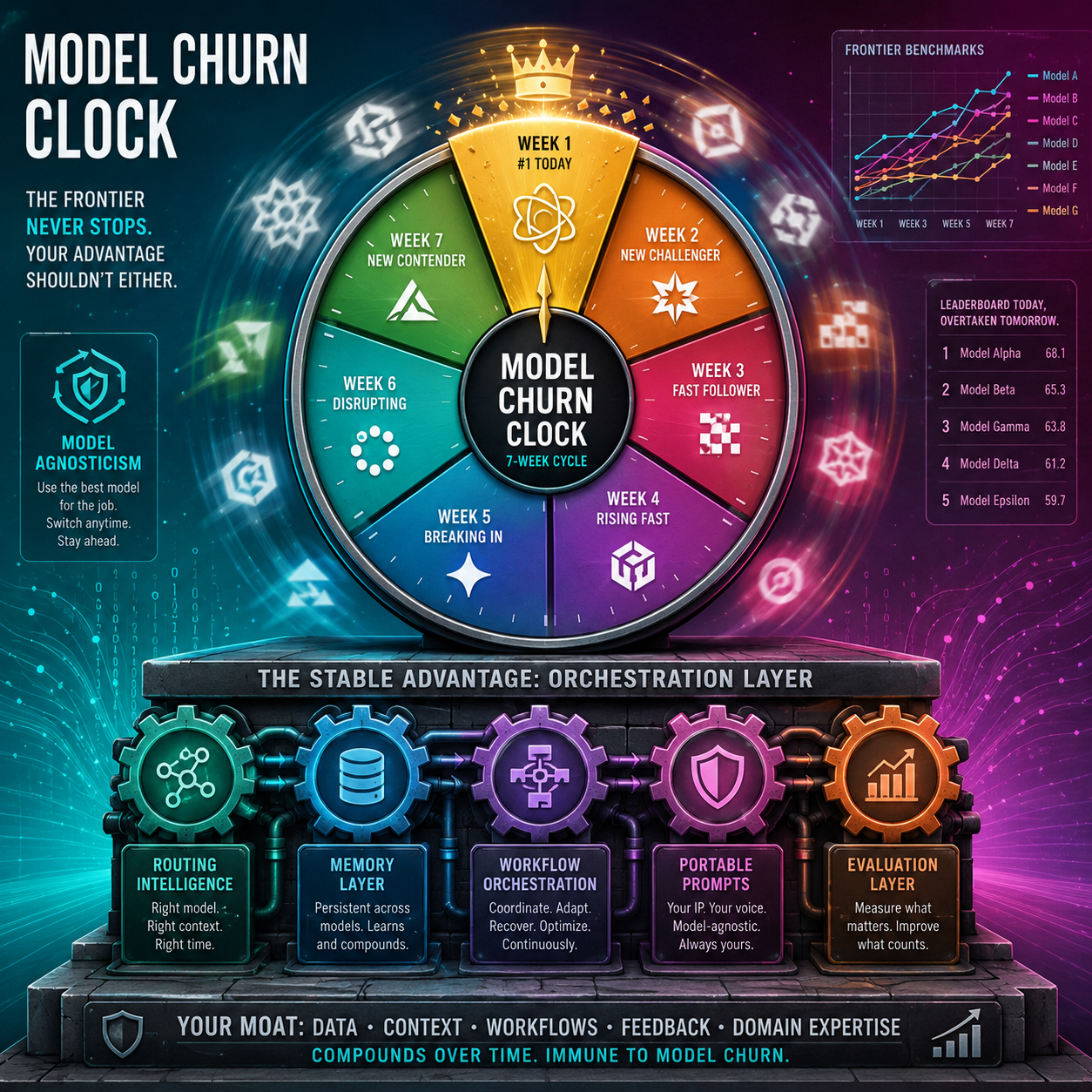
When multiple labs can deliver comparable capability at dramatically different price points, the model itself stops being the differentiator. The value shifts to what you build on top of the model: orchestration, memory, tooling, user experience, domain expertise.
This is where the engineering layer becomes the competitive advantage. Edgee AI's Compressor V2, released July 2, 2026, achieved a 50 percent cost reduction on SWE-bench Lite through three orthogonal compression strategies: Brevity (compressing output tokens), Tool Surface Reduction (trimming repetitive MCP tool catalogs), and Tool Result Trimming (cleaning verbose tool outputs). The engineering is not in the model. It is in the wrapper.
That is where the durable advantage lives now.
Architecting for Model Agnosticism: A Practical Playbook
This is the core teaching section. Here is how to build for a world where your foundation changes every seven weeks.
Abstraction layers. Use frameworks like LiteLLM, LangChain's model-agnostic routers, or internal gateway APIs that swap models without changing application code. If your application calls OpenAI's API directly, you are not building software. You are building a wrapper around a vendor. Build a gateway. Route through it. Make the underlying model an implementation detail.
Benchmark-driven routing. Automatically route requests to the best-performing model for each task type, rather than defaulting to one model for everything. Summarization might favor one model. Code generation might favor another. Reasoning tasks might need a third. Your router should make this decision based on live benchmarks, not brand loyalty.
Feature flags for model versions. Treat model upgrades like software deployments. A/B test them. Monitor for regression. Roll back if needed. A model swap in production should be as routine as a code deploy, not a three-month project.
Local and open-source fallbacks. Maintain a pipeline for running quantized open-source models locally so you are not dependent on API availability or pricing. Hy3 is open-source. Gemma runs on a tiny board. The tools exist. Use them. Your fallback is not a luxury. It is insurance.
Builders must now architect for model agnosticism or face constant migration costs. The cost of migrating a production system from one model to another can range from weeks to months of engineering time. An abstraction layer pays for itself in a single migration.
Here is your architecture review checklist:
- Do you call model APIs through an abstraction layer, or directly?
- Can you swap models without changing application code?
- Do you route tasks to different models based on benchmark performance?
- Do you A/B test model upgrades before full deployment?
- Can you fall back to local or open-source models if APIs fail or prices spike?
- Are your prompts portable across models, or tuned for a specific tokenizer?
- Does your evaluation suite test across multiple models, or just your current one?
If you answered "no" to more than two of these, your stack is fragile. Fix it before the next model release breaks it for you.
The Orchestration Layer Is the New Moat
If models are commodities that churn every seven weeks, the durable value is in the orchestration layer. That is the system that coordinates models, tools, memory, and user workflows.
The signals are everywhere this week. MCP (Model Context Protocol) is reshaping how agents interact with external tools, creating standardized interfaces that do not care which model is driving them. Station F's F/ai accelerator, backed by AMD, Anthropic, AWS, Google, Meta, Microsoft, Mistral, and OpenAI, is teaching European startups to build revenue-generating AI products rather than model-dependent demos. A fintech CEO just raised $110 million to build an agent-first banking platform, signaling that investors believe the orchestration layer, not the model layer, is where the money is.
The model is the engine. The orchestration is the car. Everyone can buy the same engine. The winner is whoever builds the better car.
At PhantomByte, the IronPulse system was designed for model churn from day one. It uses multiple models and sources, routing tasks based on capability, cost, and availability. That is not optional architecture for us. It is survival infrastructure. It should be for you too.
Your prompts should be portable, not model-dependent. If your entire system depends on the quirks of a single tokenizer, you have built a brittle system on a shifting foundation. The seven-week churn rate will break you. Portability is resilience.
Will This Ever Stabilize?
Here is the honest assessment.
Arguments for stabilization: training costs are rising. Data scarcity is real. The returns on each new generation of models may diminish. We might hit a wall where throwing more compute at the problem stops producing proportional gains.
Arguments for acceleration: Chinese labs are releasing at increasing frequency. Open-source models are proliferating. Efficient architectures like Hy3 lower the barrier to training competitive models. The supply of capable models is expanding, not contracting.
The rapid cadence of model releases from Anthropic, Google, Meta, Mistral, and a dozen Chinese labs means no single model holds the leaderboard long enough to matter.
Plan for churn. Whether it stabilizes at seven weeks or accelerates to three, the architecture principle is the same: never bet your business on a single model's temporary dominance.
Your stack should outlast your model. Build it like your business depends on it, because it does.
Actionable Takeaways
GPT-4's year-long reign was an anomaly, not a baseline. Seven weeks is the new normal, and builders must adjust their expectations accordingly.
Startups that bet their entire product on a single model API are now running a constant migration marathon. The competitive advantage is not which model you use. It is how quickly you can switch.
Enterprise procurement must adapt or become irrelevant. Evaluating models on 12-month cycles in a market that turns over every seven weeks is organizational malpractice.
The abstraction layer is not optional architecture. It is survival infrastructure. The cost of building it once is far less than the cost of rebuilding your stack every quarter.
Models are becoming commodities. Orchestration, memory, tooling integration, and domain expertise are where durable competitive advantage lives. Build your moat there.
Get More Articles Like This
Getting your AI agent setup right is just the start. I'm documenting every mistake, fix, and lesson learned as I build PhantomByte.
Subscribe to receive updates when we publish new content. No spam, just real lessons from the trenches.
Build Real AI Infrastructure
PhantomByte teaches you to build real AI infrastructure yourself: local AI stacks, autonomous agents, multi-agent orchestration, web scraping, and custom tools. Step-by-step PDF tutorials you download, follow, and deploy. No subscriptions. No fluff. Just skills that ship.