
AI agents were losing at Slay the Spire 2. The game is brutal. Long-horizon strategy, resource management, deck building, turn-by-turn decisions that compound over dozens of rounds. The agents kept failing. Then researchers did one thing: they stopped dumping every interaction into a growing chat log and replaced it with structured memory. The agents started winning.
Not because the model got smarter. Because the memory got organized.
Most production agents today handle memory by dumping everything into the context window and hoping the model sorts it out. Every interaction, every tool call, every intermediate result gets appended to the transcript. The window grows. The model has to parse more and more text to find what matters. That is not memory. That is hoarding.
Memory structure matters more than memory size. The Slay the Spire 2 result proves it. The Nemotron 3 Ultra + LangChain result proves it again from a different angle. And the token budget optimization techniques prove it a third time from a cost perspective. Three independent data points this week, same conclusion.
Here is the line that matters: your agent does not need a bigger brain. It needs a better filing system.
The Problem With Growing Chat Logs
Growing chat log memory means exactly what it sounds like. Every turn, every tool call, every intermediate result gets appended to the context window. The window fills with noise. The signal-to-noise ratio drops. The model spends its attention budget on irrelevant past turns instead of the current decision point.
In Slay the Spire 2, this meant the agent forgot its own strategy mid-run because it was drowning in turn-by-turn history. It had every card ever played, every enemy encounter, every damage calculation in front of it. And it could not find the one fact that mattered for the next decision.
Your production agent does the same thing. It reads through fifty turns of conversation to find the one fact it needs. Every token costs money. Every irrelevant token also costs accuracy. You are paying for noise.
Researchers replaced the growing chat log with what they called a "compressed, structured memory format that preserved only the most strategically relevant information." The result was "a dramatic improvement in long-horizon decision-making and game-winning performance." Not bigger context. Better-organized context.
What Structured Memory Actually Means
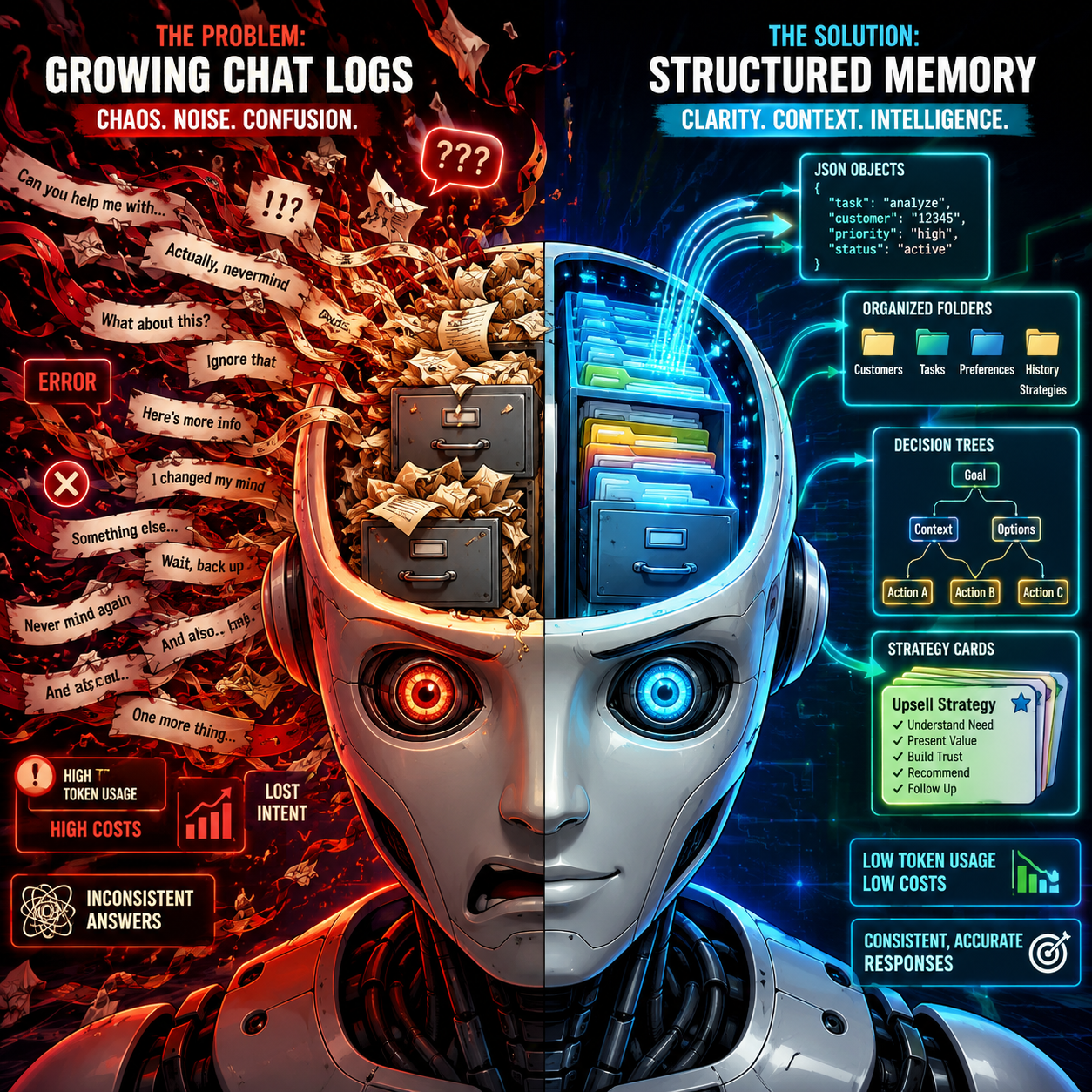
Structured memory is the difference between a stack of raw meeting notes and a typed agenda with action items. Instead of a flat transcript, the agent stores information in a structured format: key facts, entity relationships, state transitions, decision points. When the agent needs to make a decision, it queries the structured memory, not the full history.
In the Slay the Spire 2 case, the agent maintained a compressed representation of game state, strategy, and relevant past decisions. Not every card played. Not every enemy encounter. Just the strategically relevant information. The agent queried that compressed representation when it needed to decide what to play next.
This challenges the "more context is better" dogma that dominates current LLM architecture thinking. The dominant assumption is that bigger context windows solve memory problems. The Slay the Spire 2 result says the opposite: better-organized context beats bigger context. You do not need more room. You need better filing.
The Nemotron 3 Ultra Proof: Engineering the Harness, Not the Model
NVIDIA's Nemotron 3 Ultra, paired with LangChain's Deep Agents harness, achieved the highest accuracy among open models while running at 10x lower inference cost than leading closed models. No model retraining was required. Every gain came from engineering the environment around the model.
LangChain CEO Harrison Chase put it plainly: "the way to build better agents is to keep improving the system around the model."
This connects directly to PhantomByte #124, "Your Agent's Harness Is Your Real Model" (July 10, 2026). The argument was that your agent harness matters more than your model. The Nemotron result is fresh proof. The harness is where the gains are. Memory structure is a harness decision, not a model decision.
Ten times lower inference cost is not a marginal optimization. That is the difference between a system that scales and one that bankrupts you. And it came from orchestration, not from a bigger model.
The Token Budget Connection: Structure Saves Money
A practical guide from AI News (July 10, 2026) covers techniques for cutting token usage by 30-60% without sacrificing quality: prompt compression, structured output formatting, caching strategies, selective context inclusion.
Structured memory is selective context inclusion. You are not sending the full history. You are sending the structured representation. Fewer tokens, same or better signal. The math is straightforward. If your agent's context window holds 10,000 tokens of raw history and you replace it with 500 tokens of structured memory, you just cut your per-turn inference cost by an order of magnitude. And because the noise is gone, your accuracy goes up while your cost goes down. That is not a tradeoff. That is a free lunch.
The GPT-5.6 migration case study confirms the pattern. A production AI agent migrated to GPT-5.6 achieved 2.2x faster response times and 27% lower costs. The gains came from system-level optimization, not just the model swap. When you optimize the system around the model, you get compounding returns.
The pattern across all three data points is the same. The system around the model, memory structure, orchestration, token optimization, delivers bigger gains than the model itself. This is an engineering insight, not a research insight. You can implement it today.
How to Apply This to Your Production Agent
Step 1: Audit your current memory approach. Are you sending raw chat history to the model on every turn? If yes, you are paying for noise.
Step 2: Identify what information the agent actually needs to make its next decision. Not everything that happened. The relevant state, the key entities, the current decision point.
Step 3: Build a structured memory layer. This can be as simple as a JSON object that gets updated each turn with the current state, key facts, and relevant context. Or as complex as a graph database for entity-relationship memory. Start simple. A JSON object that tracks the current game state, the player's health, the enemy's intent, and the last three strategic decisions is infinitely more useful than a transcript of every turn.
Step 4: Replace the raw history in your prompt with the structured representation. Measure token usage before and after. Measure accuracy before and after. The Slay the Spire 2 result says you will see improvement on both.
Step 5: Cache where possible. If the structured memory has not changed, do not resend it. The token budget guide lists caching as a primary cost-saving technique. This sounds obvious, but most production agents resend the entire context window on every turn even when 90% of it is unchanged.
The Objection: "But My Agent Needs the Full History"
Some builders will say their agent needs to see everything that happened. The Slay the Spire 2 result says no, it does not. It needs to see the relevant things that happened. The difference is structure.
You do not re-read every email you ever sent before writing a new one. You remember the key facts, the current state of the conversation, and the decision you need to make. Your agent should do the same.
If you are doing audit, compliance, or debugging, you need the full log. But that is storage, not context. Store the full history in a database. Send the structured representation to the model. These are two different systems with two different jobs.
The Bottom Line
Three independent results this week proved the same thing. Slay the Spire 2 agents won when they stopped using growing chat logs. Nemotron 3 Ultra hit benchmark-leading accuracy at 10x lower cost through harness engineering, not model training. Token budget optimization guides confirm that selective context inclusion cuts costs 30-60%.
The conclusion is not subtle. Memory structure beats memory size. The harness beats the model. And the engineering decisions you make around your agent matter more than which frontier model you pick.
Stop feeding your agent its own chat log. Give it something it can actually use.
Your agent does not need a bigger brain. It needs a better filing system.
Get More Articles Like This
Getting your AI agent setup right is just the start. I'm documenting every mistake, fix, and lesson learned as I build PhantomByte.
Subscribe to receive updates when we publish new content. No spam, just real lessons from the trenches.
Build Real AI Infrastructure
PhantomByte teaches you to build real AI infrastructure yourself: local AI stacks, autonomous agents, multi-agent orchestration, web scraping, and custom tools. Step-by-step PDF tutorials you download, follow, and deploy. No subscriptions. No fluff. Just skills that ship.