
The era of unlimited inference is over. The companies that ration compute will win. Everyone else will burn capital until there is nothing left.
Meta's Adam Mosseri just said what every tech leader is thinking but afraid to admit. Companies will soon need to cap AI token usage per engineer. This is not a hypothetical. This is the first public admission from a major tech leader that unlimited AI inference is economically unsustainable. DeepSeek closed a $7 billion round weeks ago and is already back for more cash. Reflection just signed a $1 billion compute deal with Nebius to lock in GPU capacity for years. The message is unmistakable. AI inference and training costs are far higher than most organizations anticipated, and the era of free, unlimited AI access is ending. Companies are being forced to make hard choices about where to deploy AI resources. The industry is moving toward a model of AI rationing, budgeting, and cost governance. If you are not thinking about token economics, you are burning money you do not have.
The Admission
When the company that runs some of the largest AI infrastructure in the world says it cannot afford unlimited AI access for its own engineers, the math has changed for everyone.
In a recent interview on Lenny's Podcast, Instagram head Adam Mosseri said he can see a time, perhaps only a year or two away, when limiting Meta employees' AI token spend will become necessary. "I think that you can imagine, at least in a year or two, that the burn rate of a strong engineer might be the same as their salary, or their cost of employment," Mosseri said. "And in that world, you're going to probably need to put in some caps."
He compared token costs to any other finite resource. Payroll. GPUs. Storage. Labeling budgets. Token budgets will be the same, he added, with caps proportional to the company's trust in an engineer's ability to use tokens in an ROI-positive way.
Meta does not currently have token caps, but Mosseri believes their use could be healthy in the future. He also noted that it is "not that hard to build a token incinerator, and that doesn't create a lot of value." Meta shut down an internal AI token spend leaderboard after costs put the company on track for billions of dollars in 2026.
Uber had its own reckoning after blowing through its 2026 AI coding budget by April. Microsoft canceled Claude Code licenses for many engineers, consolidating around its own Copilot CLI tool instead.
This is not a startup problem. This is a scale problem. And it is coming for every company deploying AI.
The $1 Billion GPU Lease
Reflection AI, a U.S. startup developing open models, signed a $1 billion compute deal with Nebius, the European AI infrastructure company spun out of Yandex. Nebius will provide Reflection access to Nvidia's latest chips over multiple years. The deal comes just weeks after Reflection signed a similar agreement to access SpaceX computing resources.
Reflection is currently valued at $8 billion. It has raised close to $2.6 billion from backers including Nvidia, Sequoia Capital, and Lightspeed Venture Partners.
A billion-dollar GPU lease is not a flex. It is a hedge. Reflection is paying upfront to guarantee it will have compute when the shortage hits. This is the infrastructure equivalent of an oil lease. If you are renting GPUs on the spot market, you are exposed to price spikes and availability crises that long-term contractors have already insulated themselves against.
Nebius itself has been busy. Shortly after securing a $2 billion investment from Nvidia, Nebius signed a five-year infrastructure deal with Meta worth up to $27 billion. Last year, it signed a multi-year deal with Microsoft worth up to $19.4 billion. Nebius is emerging as a major player alongside CoreWeave and Lambda.
Large contracts provide capacity certainty, but they also lock startups into substantial infrastructure obligations. That is the trade-off. Compute procurement is now a strategic financing decision, not an IT purchase.
DeepSeek's Cash Incinerator
DeepSeek closed its first round in late May at roughly $7 billion, valuing the company at $52 billion, according to the Financial Times. Now the Hangzhou-based startup is in early talks with new investors for a round at a pre-money valuation of about $71 billion. The money would go toward building its own data centers and buying AI chips.
Founder Liang Wenfeng put in about $3 billion himself, making him the largest backer. Other investors include CATL, Tencent, JD.com, NetEase, and China's state-backed AI fund.
The need for capital is tied directly to DeepSeek's aggressive expansion. The company recently released V4-Pro and V4-Flash, the largest open-weights models with up to 1.6 trillion parameters. The rock-bottom V4-Pro prices have been made permanent and come in at roughly eleven times cheaper than GPT-5.5 on input.
That cheap pricing demands deep pockets. If a $7 billion round is not enough to keep a frontier lab running for more than a few weeks, the economics of frontier model development are broken. This is not a story about DeepSeek. It is a story about the cost curve. Every company that thinks it needs to train its own frontier model should look at DeepSeek's burn rate and reconsider.
The Open Model Escape Hatch
If you cannot afford to train frontier models or pay unlimited token fees, open models give you a way out.
Hugging Face CEO Clem Delangue argues the real AI race has shifted from frontier model development to open model deployment and customization. Chinese open-weight models accounted for 41% of downloads on Hugging Face this spring, surpassing U.S. models. Running these models on platforms like Ollama Cloud makes them even more cost-effective, eliminating per-token fees entirely while keeping inference local and private. On OpenRouter, the top six most popular models are all open models from Chinese firms. Anthropic's Claude Opus 4.7 trails in seventh place.
Data from Vercel shows that open-weight models are absorbing much of the volume-heavy infrastructure of AI apps, while closed models operate as the higher-cost, premium layer. Open models handled nearly a third of AI requests on the platform in June. Half of all Fortune 500 firms are using Hugging Face to deploy their own private and open-source models.
"If you're an AI company or a technology company, you don't want to outsource your core capabilities to another company, to a black box API that you don't control, don't have any visibility on, and don't really have any sort of ownership," Delangue said.
NVIDIA launched Nemotron Labs for open-source enterprise AI, offering sovereignty, security, and customization that proprietary models cannot match. The initiative includes training tools, fine-tuning pipelines, and deployment frameworks designed for government and enterprise use cases. Companies like Abridge, Glean, and H Company are already customizing Nemotron for their domains.
You control the deployment. You control the costs. You are not sending your proprietary data to someone else's API. The moat moved from the model to the system built around it. That system is where your engineering investment should go. Open models plus sovereignty is the same thesis behind the Sovereign AI Stack Blueprint.
The Squeeze Is Real
IBM warned that the AI boom is squeezing software budgets, contributing to a sector selloff. Enterprise spending is shifting toward AI infrastructure and platforms at the expense of conventional software categories. SaaS companies without a clear AI value proposition are getting squeezed. Anthropic localized Claude pricing for India, acknowledging that cost matters more than capability in many markets. Even frontier model providers are feeling price pressure.
The token budget is not just an engineering problem. It is a budget problem. If your company is spending on AI tokens, that money is coming from somewhere. The question is whether your AI spending is generating enough value to justify the reallocation.
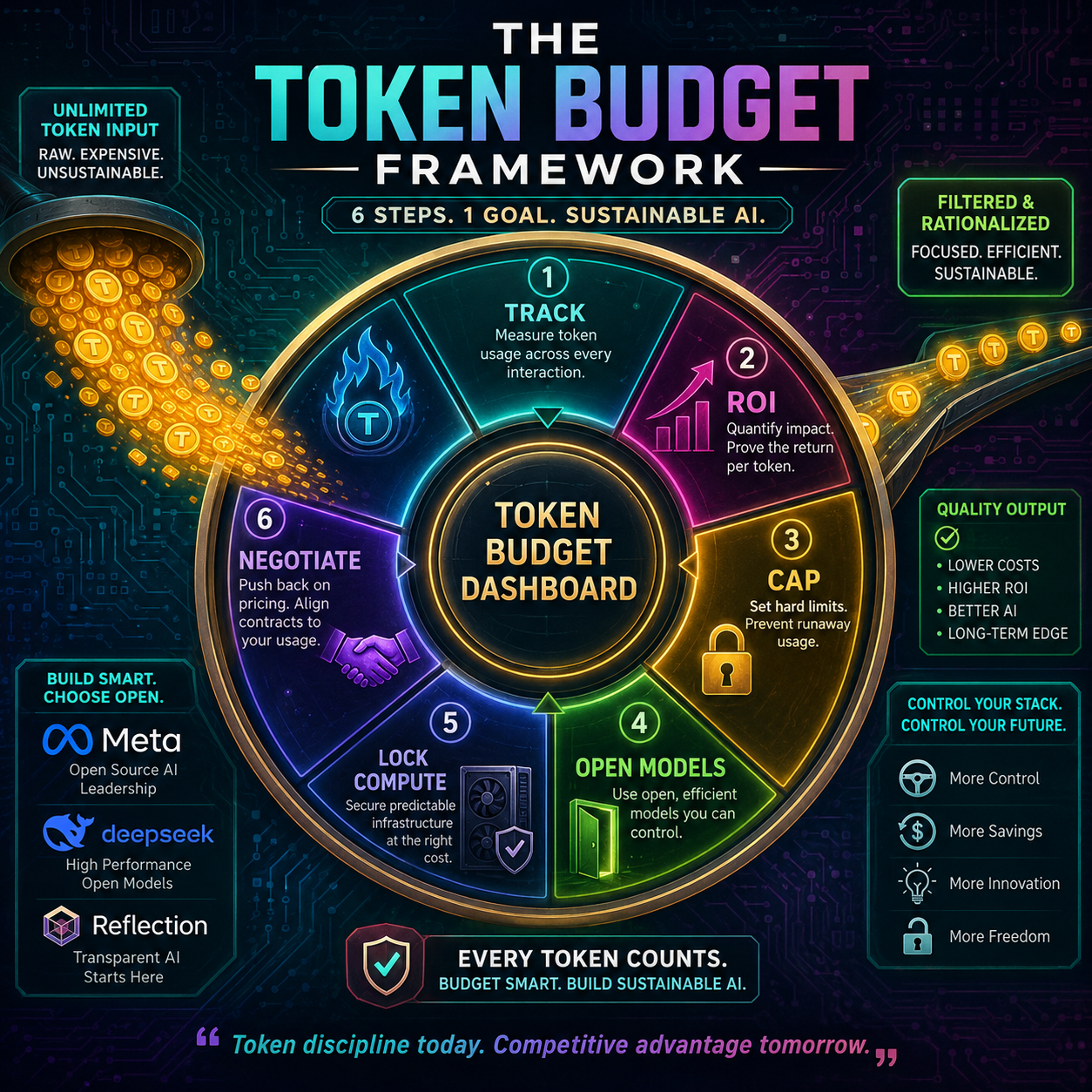
The Token Budget Framework
Here is how to implement token governance before the bill arrives.
Step one: Track token usage per engineer, per project, per use case. You cannot manage what you do not measure.
Step two: Identify measurable ROI. Customer support automation, code generation with measurable output, and document processing with clear throughput gains are examples of high-value usage. Experimentation without output is a token incinerator.
Step three: Cap or redirect spend on low-value usage. Mosseri's proposal treats tokens like any other finite resource. Allocated. Tracked. Rationed. Build the tracking infrastructure now, not when the bill arrives.
Step four: Evaluate open models for high-volume, low-differentiation workloads. Delangue's thesis, validated by Nemotron Labs and the Vercel data, shows that open models are already handling the volume layer.
Step five: Lock in compute capacity before the next shortage. Reflection's Nebius deal is the model. Long-term contracts hedge against spot-market price spikes and availability crises.
Step six: Negotiate. Even frontier model providers are feeling price pressure. Use that leverage.
Why This Matters More Than Model Selection
You can pick the best model in the world. If you cannot afford to run it at scale, it does not matter.
The TensorFeed report identifies the agent infrastructure layer as its own engineering discipline, separate from model development. PhantomByte's July 10 article, "Your Agent's Harness Is Your Real Model," argued orchestration design beats model selection by 10x in token cost.
The cost governance angle is the logical extension. If the harness matters more than the model, then the budget matters more than the harness. Token governance is the engineering discipline that determines whether your AI investment compounds or collapses.
The Bottom Line
Free AI is dead. Budgets are coming. The companies that build token governance into their engineering culture now will survive the transition. The ones that keep treating inference as an unlimited resource will hit a wall when the bill arrives.
You cannot do anything in AI without solid engineering. Solid engineering now means knowing exactly what every token costs and what it returns. Ration compute like it matters, because it does.
Get More Articles Like This
Getting your AI agent setup right is just the start. I'm documenting every mistake, fix, and lesson learned as I build PhantomByte.
Subscribe to receive updates when we publish new content. No spam, just real lessons from the trenches.
Build Real AI Infrastructure
PhantomByte teaches you to build real AI infrastructure yourself: local AI stacks, autonomous agents, multi-agent orchestration, web scraping, and custom tools. Step-by-step PDF tutorials you download, follow, and deploy. No subscriptions. No fluff. Just skills that ship.