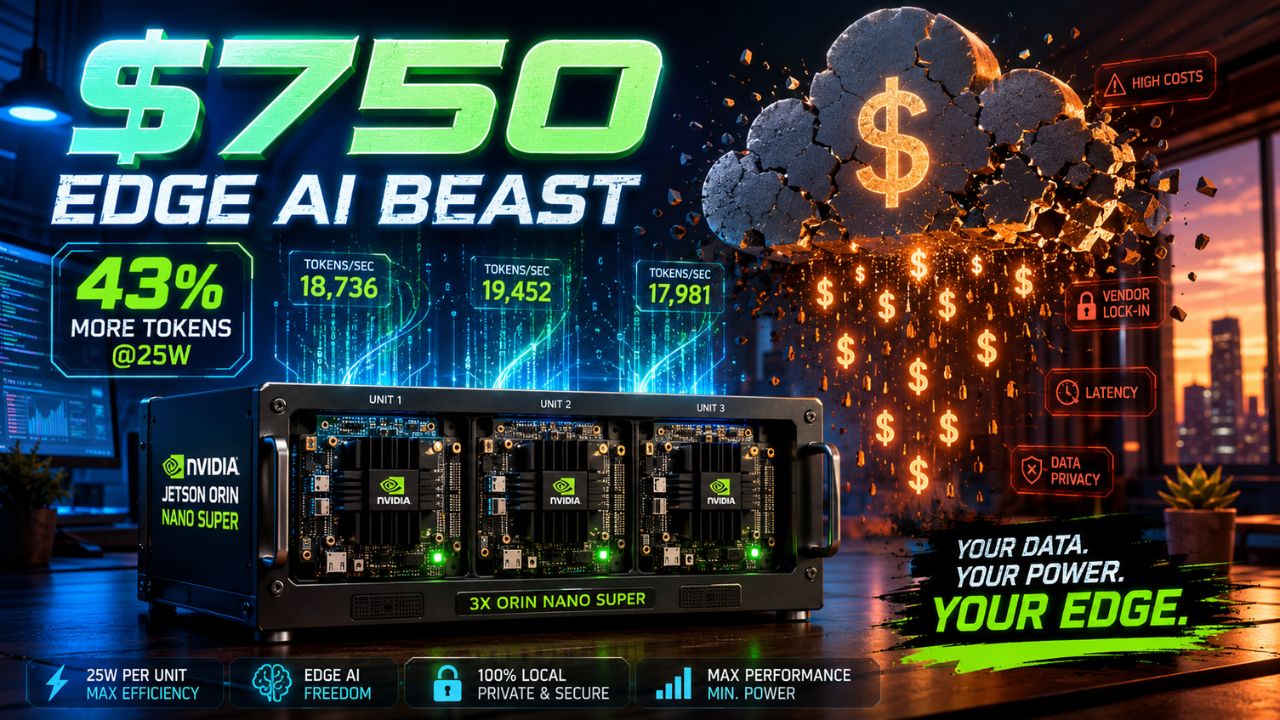
For years, the AI infrastructure conversation has been about who can rent the biggest GPU cluster. But a new benchmark just proved the most interesting compute is not in the cloud at all. It is sitting on your desk, drawing 25 watts, and it costs less than a month of API access.
Executive Summary:
- Hardware: 3x NVIDIA Jetson Orin Nano Super (8GB) in a mini rack setup.
- Cost: $750 total upfront capital expenditure.
- Performance: Peaked efficiency at 25W, delivering 43% more tokens per second than 15W modes.
- Architecture: Mixture-of-Agents (MoA) utilizing Hermes Agent to outperform monolithic cloud models.
Yuvraj Singh built a mini rack with three NVIDIA Jetson Orin Nano Super units for $750 total. He tested eight tiny LLMs across four power modes with 20 requests per combination, published the full data on Hugging Face with tegrastats logs and server logs, and the results are devastating for cloud inference.
At 25 watts, the Jetson delivers 43% more tokens per second than 15W while beating MAXN on energy efficiency. The sweet spot is not where anyone expected it. And it changes the math for every builder making infrastructure decisions today.
The cloud inference monopoly is ending. Here is why, where it matters, and where it does not.
The Cloud Monopoly Has Cracks
The default assumption has been simple. Bigger cloud model equals better result. Rent more compute, get more capability. The entire industry optimized around this premise.
But the cracks are showing.
Cost is the first crack. API dependency means every token carries a marginal cost that scales with usage. The adlrocha analysis of AI economics found that 91% of one user's token spend went to expensive closed models they could not run locally, while open models they could self-host cost only $30 over two months. Apple has already started passing AI chip costs to consumers, raising MacBook Pro prices by $300. The subsidy is ending.
Control is the second crack. API rate limits, provider lock-in, export controls, and sudden model deprecations are all liabilities outside your infrastructure. When Anthropic's Mythos 5 was briefly restricted under US export controls, companies that built their products on Claude API calls had no recourse. The model they depended on could be gated or withdrawn at any time.
The cloud-only mindset is becoming a liability. And the alternative is not coming. It is already here, it is cheap, and it outperforms expectations.
The $750 Rack
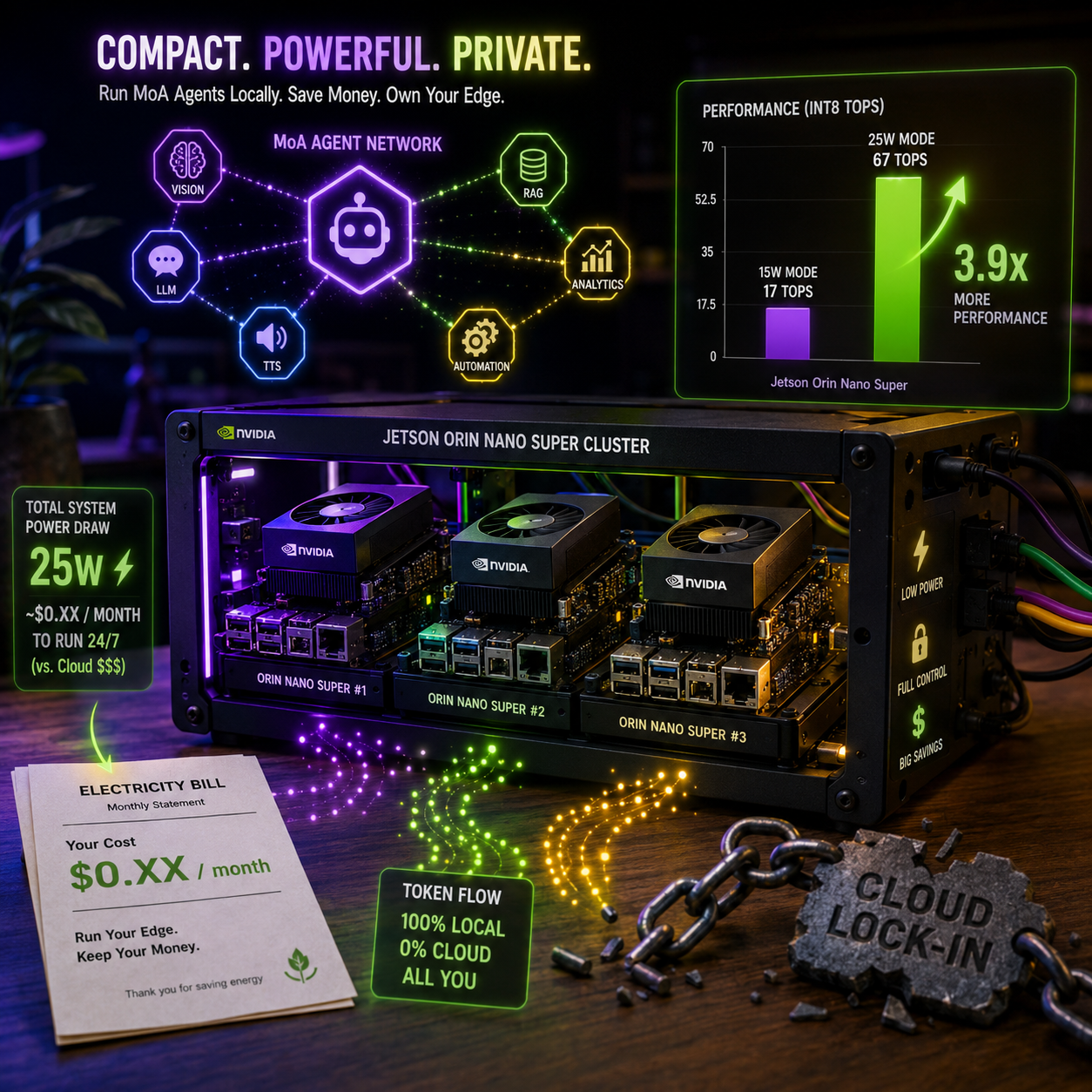
Singh's benchmark is one of the most thorough edge inference studies published to date. Eight non-reasoning models, llama.cpp versus Ollama, prompt lengths from 128 to 2048 tokens, generation lengths from 64 to 256 tokens, 33 metrics per cell, all tested on a device smaller than a paperback book.
The platform is the NVIDIA Jetson Orin Nano Super 8GB. A 6-core Arm device with an Ampere GPU, 1024 CUDA cores, 32 Tensor cores, and 8GB of shared LPDDR5 memory. It is not a data center GPU. It is a developer board.
The key finding is the 25W sweet spot. At 25W, the device delivers significantly more throughput than 15W without the efficiency penalty of running at maximum power. The tokens-per-joule metric, which measures actual energy efficiency during decode, peaks at 25W and degrades at MAXN. The device is not just faster at 25W. It is smarter about how it uses power.
Three of these units in a mini rack cost $750 total. That is less than one month of API access for a moderately busy application. Cloud inference charges per token. Edge inference charges once, upfront, and then runs indefinitely at the cost of electricity.
The raw data is published on Hugging Face under the YuvrajSingh9886 namespace with separate datasets for each power mode and backend. Reproducibility is usually missing from AI hardware benchmarks. Singh's work can be replicated, challenged, and extended by anyone with a $250 Jetson unit.
Apple Silicon and the Consumer Inference Revolution
Edge inference is not limited to developer boards. Modular's MAX 26.4 release now runs on Apple Silicon GPUs, unlocking consumer Mac hardware for high-performance inference. The release includes dedicated matrix-multiplication operations via Apple's Neural Accelerators. MacBook Pros and Mac Studios are suddenly viable as inference endpoints, not just development machines.
This is part of a broader consolidation play. Modular has entered an agreement to be acquired by Qualcomm for nearly $4 billion. Qualcomm's interest is clear: Modular's technology is expected to be integrated into mobile and edge computing chips, bringing advanced AI inference capabilities to smartphones, laptops, and IoT devices. The specialized AI chip architecture that Modular developed for optimized inference workloads is exactly what Qualcomm needs to compete with Nvidia, AMD, and Apple in the inference silicon market.
For Mac-based inference specifically, the acquisition raises questions about long-term Metal support. But in the near term, developers can already run MAX graphs on Apple Silicon via Mojo, and the simple_offline_generation example from the modular repo works today.
Between the Jetson rack and Apple Silicon Macs, consumer hardware is becoming a genuine AI platform. The gap between developer toy and production inference endpoint is closing.
MoA: Composition Beats Monoliths
Hardware is only half the story. The other half is architecture. And here, the shift is even more radical.
On June 26, 2026, Nous Research announced that Hermes Agent now exposes Mixture-of-Agents (MoA) presets as virtual models. These MoA presets score 8% higher than Claude Opus 4.8 and 11% higher than GPT 5.5 on Nous Research's upcoming internal benchmark. The announcement generated 1.6 million views and over 6,000 likes on X.
The mechanism is ensemble reasoning. Instead of routing every query to a single massive model, MoA distributes queries across multiple agent instances, each with different strengths, and synthesizes a composite output. The result outperforms any individual component. This is similar to how Mixture-of-Experts improves throughput in model architectures, but applied at the agent orchestration layer.
The implication is profound. You do not need access to a monolithic frontier model to beat frontier performance. You can compose smaller, cheaper, locally runnable models into a virtual model that outperforms the gated APIs. The strongest models are locked behind approval gates and enterprise contracts. But a distributed mesh of small agents, running on cheap hardware, can exceed their capabilities.
This is an architectural shift from one big model to many small models. It mirrors what we are seeing in hardware: distributed, efficient, composable units that beat centralized monoliths on cost, latency, and reliability.
For distributed agent meshes, the advantages compound. No single point of failure. No API rate limits. No provider lock-in. No export controls. If one agent instance goes down, the mesh reroutes. If one model is deprecated, another fills the gap. The system is antifragile by design.
Where Edge Still Loses
This article would be incomplete without acknowledging where edge inference does not work.
Training is the obvious one. You are not training a 70B parameter model on a Jetson. Fine-tuning small models is possible, but pre-training and large-scale fine-tuning still require data center GPUs. The cloud is not going away for training.
Massive batch jobs are another gap. If you need to process 10 million documents in an hour, a single Jetson cannot match the throughput of a cloud GPU cluster. Edge inference excels at real-time, low-latency workloads. It struggles with throughput-at-any-cost batch processing.
Model size is a constraint. The Jetson Orin Nano Super has 8GB of shared memory. You can run 7B and 8B parameter models comfortably. You are not running a 405B parameter model locally. The edge is for efficient, capable models, not frontier-scale behemoths.
And there is the operational overhead. Managing a distributed mesh of edge devices requires DevOps skills that a single cloud API call does not. You need monitoring, failover, update management, and physical hardware maintenance. To string these three Jetson units together effectively, a builder needs to implement lightweight load balancers like HAProxy or orchestration frameworks to manage request routing. The cloud abstracts all of that away.
What This Means for Builders
If you are building AI infrastructure today, the implications are concrete.
Privacy is the most immediate benefit. When inference runs locally, data never leaves the device. For healthcare, finance, legal, and any domain where data sovereignty matters, edge inference is not just cheaper. It is the only option that meets regulatory requirements without expensive compliance overhead.
Cost is the second benefit. A $750 Jetson rack running continuously can process millions of tokens for the cost of electricity. The upfront hardware investment amortizes over months, not years. For high-volume applications, edge inference is already cheaper than cloud APIs.
Reliability is the third benefit. API-dependent systems have external dependencies that can fail without warning. Rate limits, provider outages, model deprecations, and export restrictions are all risks you cannot control. Edge inference puts the control back in your hands. Your system runs when the internet is slow, when the API provider is down, and when geopolitics interfere with model access.
The architectural implications go deeper. If your inference is distributed across edge devices, your application architecture changes. Caching strategies, request routing, failover logic, and monitoring all need to account for a mesh topology rather than a single endpoint. But the payoff is a system that is faster, cheaper, more private, and more resilient than anything built on cloud APIs alone.
This is not an argument for abandoning the cloud entirely. Cloud inference still makes sense for training, for massive batch jobs, and for applications where edge hardware cannot meet capacity requirements. But the default assumption that cloud is the right place for inference is overdue for revision.
The inference monopoly is about to be disrupted by a distributed mesh of small, efficient models running on cheap hardware. The future of AI infrastructure is not in the cloud. It is on your desk, in your pocket, and in the rack under your office chair.
Get More Articles Like This
Getting your AI agent setup right is just the start. I'm documenting every mistake, fix, and lesson learned as I build PhantomByte.
Subscribe to receive updates when we publish new content. No spam, just real lessons from the trenches.
Build Real AI Infrastructure
PhantomByte teaches you to build real AI infrastructure yourself: local AI stacks, autonomous agents, multi-agent orchestration, web scraping, and custom tools. Step-by-step PDF tutorials you download, follow, and deploy. No subscriptions. No fluff. Just skills that ship.