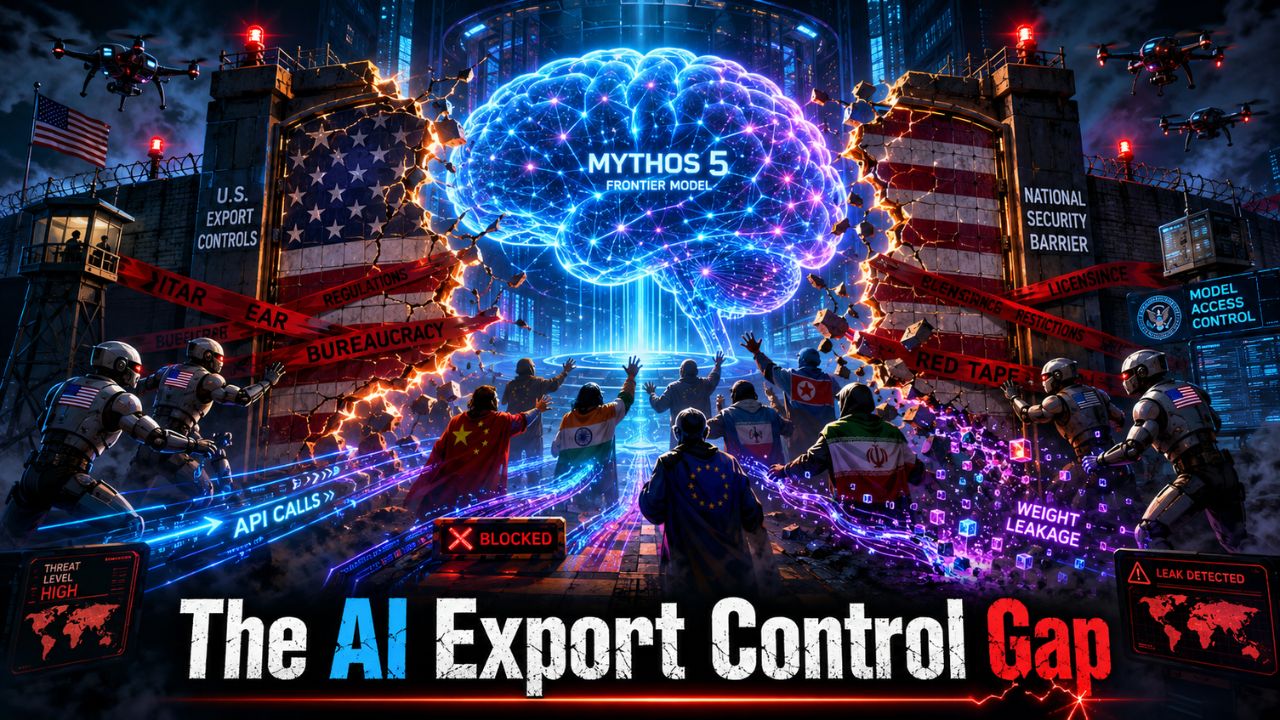
On June 12, 2026, the Trump administration sent Anthropic an export control order that read like a parody of bureaucratic overreach: suspend access by "any foreign national" to Mythos 5 and Fable 5. The ban covered non-US citizens inside the United States, outside the United States, and inside Anthropic's own offices. Anthropic's own employees, the people who built the models, were barred from using them.
Two weeks later, OpenAI received the same treatment for GPT-5.6.
This is not how export controls normally work. When Boeing builds a jet engine with dual-use military applications, the Commerce Department evaluates it using a checklist during manufacturing. The product gets classified, the classification determines who can buy it, and the control regime is built into the supply chain before anything ships. Anthropic and OpenAI are facing a different problem entirely. As The Verge reported, "there's no clear framework for applying export controls to AI systems." Every article on this saga is policy analysis. None of them ask the engineering question: how do you actually build a model deployment system that can satisfy government-level verification requirements in real time?
That is the infrastructure story behind the biggest AI news of the week. And it is a story almost no one is telling.
The Brute-Force Reality
Right now, Anthropic and OpenAI are handling this the way you would expect a company with no precedent to handle it. Kill switches. Manual approval lists. Nationality attestation forms. Anthropic took both models offline entirely after the June 12 directive. Commerce Secretary Howard Lutnick partially reversed course on June 26, sending a letter that allowed Mythos 5 back online for "a small group of cyber defenders and infrastructure providers." Organizations approved for Mythos may now allow their foreign national employees to access the model. Fable 5, the consumer-facing version, remains in limbo with no timeline.
OpenAI is using what WIRED calls a "staggered release with government preapproval" template. The company sends the US government a list of proposed customers, waits for feedback, and expands access incrementally. OpenAI stated publicly that this "shouldn't be the norm," but it is the norm now, because there is no alternative.
This approach fails at scale for reasons that any infrastructure engineer can see coming. Latency: manual approval processes add days or weeks to deployment cycles that normally happen in minutes. User experience: customers who signed contracts expecting immediate API access are now waiting on government review queues. Edge cases: what happens when a US-based company with foreign national contractors needs access? What about joint ventures? What about remote workers logging in from countries that the US government has not yet classified?
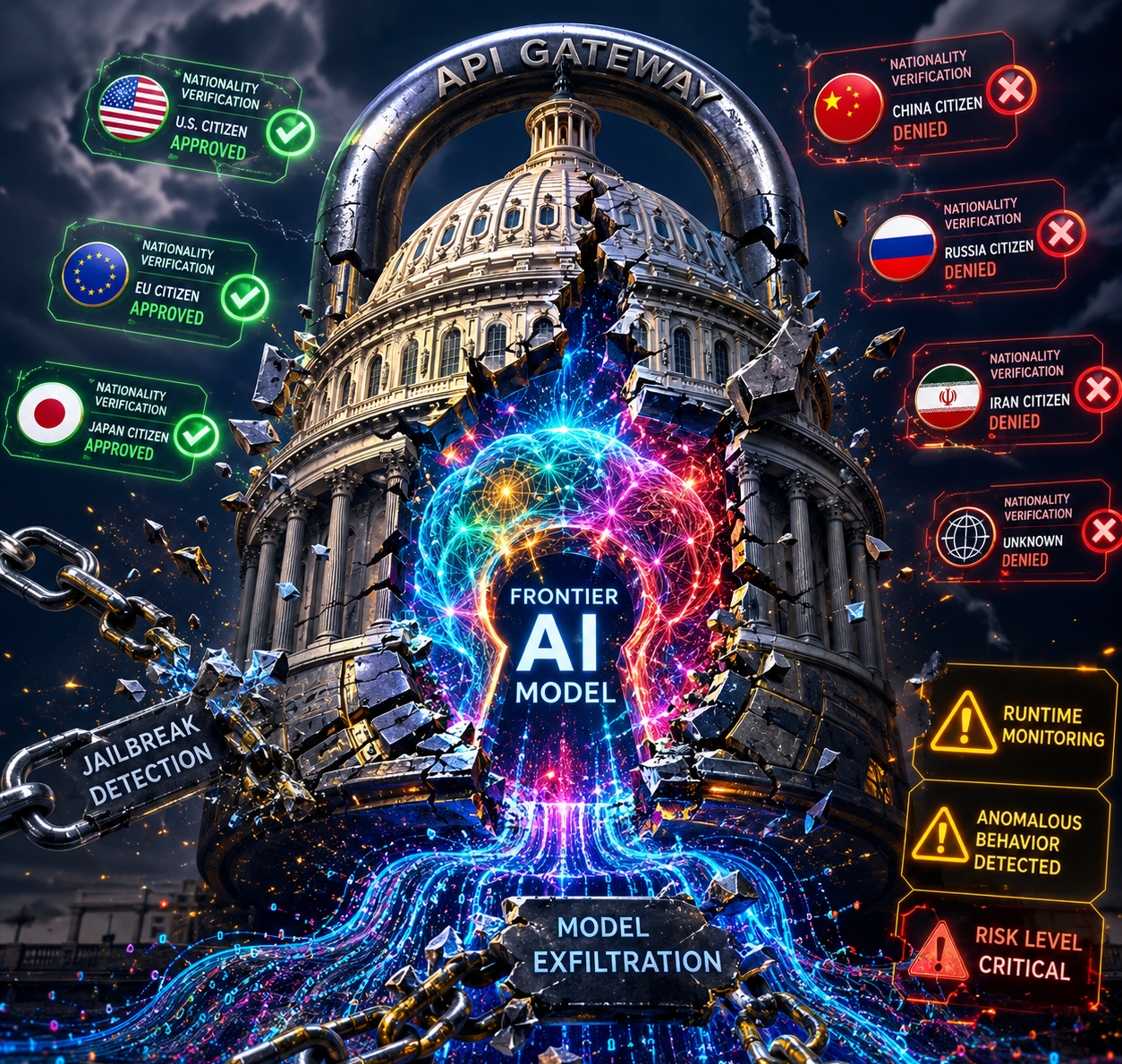
The South Korean telecommunications firm that triggered this entire mess is the perfect example. Anthropic granted Mythos access to a South Korean company. The White House grew concerned because it believed the firm had ties to China. This is exactly the kind of edge case that breaks manual approval systems. A company is South Korean on paper, but the government suspects Chinese influence. How does an API gateway verify that? IP geolocation? VPNs defeat it. Corporate registration documents? Those can be layered through shell companies. The current system has no answer. It just blocks everyone and hopes the exceptions get sorted out in closed-door meetings.
The Architecture Gap in Frontier Model Deployment
What would an export-control-compliant model deployment architecture actually require? Let us walk through the engineering primitives.
First: real-time identity verification at the API gateway. Not IP geolocation, which any consumer VPN can defeat. Actual identity verification tied to API keys, with continuous revalidation. The authentication layer would need to verify citizenship or permanent residency status, revalidate it on some cadence, and revoke access automatically if status changes. No off-the-shelf API gateway does this. AWS API Gateway, Kong, Envoy. None of them have a nationality attestation module.
Second: continuous nationality attestation tied to authentication tokens. A JWT that expires every hour is fine for normal API security. But export controls require proof that the human behind the token has not changed nationality or employment status since the token was issued. That means integrating with government identity databases, employer HR systems, or some third-party attestation service. None of this exists at production scale.
Third: tiered model access within the same endpoint. Mythos 5 and Fable 5 are different capability levels of the same model family. An export-control-compliant system would need to route requests to different model weights based on the caller's clearance level, in real time, without adding perceptible latency. This is theoretically possible with a smart load balancer and multiple model endpoints, but it adds operational complexity that most AI infrastructure teams have not had to consider.
Fourth: audit trails that satisfy government review requirements. Every API call would need to be logged with caller identity, model accessed, timestamp, and outcome, in a format that can be produced for government review on demand. That sounds straightforward until you consider the scale. A frontier model serving millions of requests per day generates terabytes of logs. Retaining them in government-auditable form, with chain-of-custody guarantees, requires infrastructure that most labs have not built.
Fifth: runtime monitoring that can detect and block jailbreak attempts. This is the specific concern that triggered Fable 5's shutdown. Amazon and the NSA separately raised concerns that Fable 5 could be jailbroken. The current state of the art in jailbreak detection is pattern matching and heuristic filtering, which adversaries consistently defeat. What is needed is behavioral monitoring that detects anomalous usage patterns in real time and blocks them before model weights are extracted. This technology exists in research form but not in production-ready deployment tooling.
For each of these five requirements, the answer is the same: off-the-shelf tooling does not exist. Frontier labs are improvising with spreadsheets and Slack threads because the infrastructure industry has not built what they need.
The Exfiltration Problem
Even if you solve the API gateway problem, you still face a harder one. Securing an endpoint against unauthorized users is fundamentally different from protecting model weights against authorized but malicious actors. Gating access to an API endpoint does not prevent model weight exfiltration. An adversary with legitimate API access can extract model capabilities through conversation, distillation, or quantization attacks.
Alibaba allegedly used 25,000 fraudulent accounts to generate 28.8 million exchanges with Claude between April 22 and June 5, 2026. The goal was not to use Claude for customer service. The goal was to extract its capabilities through conversation, reverse-engineer its behavior, and clone it without paying for the training compute. Anthropic accused Alibaba of targeting "agentic reasoning, software engineering, and long-horizon tasks," the most valuable capabilities. Alibaba evaded detection using proxy networks and obfuscation techniques. Anthropic warned of a "growing circumvention economy" to fuel future distillation attacks.
This is why self-hosted models are incompatible with export controls. If a model's weights live on a customer's infrastructure, the customer can copy them, quantize them, or distill them into a smaller model that replicates the behavior. The only way to prevent this is API-only deployment, where the model weights never leave the provider's data centers. But API-only deployment creates its own problems: latency for global users, compliance with data residency laws, and the concentration of AI capability in the hands of a few American companies that the government can shut down at any time.
This is the core tension that no one in Washington is acknowledging. Export controls assume that access can be controlled like a physical good. But a frontier model is not a jet engine. It is a service. And services bleed.
What a Proper System Would Look Like
If the current brute-force approach is unsustainable, what replaces it?
The answer is something like a CI/CD pipeline for model safety. Automated red-teaming gates before deployment, where every model version is tested against a standardized suite of jailbreak vectors and adversarial prompts before it reaches production. Behavioral attestation layers that certify model behavior against known attack patterns, not just point-in-time evaluations but continuous certification that updates as new threats emerge. Runtime monitoring that feeds back into the certification pipeline, so that production usage patterns inform the next round of red-teaming.
This connects to what PhantomByte has been writing about for the past week. "Verifying Agents Is Now Harder Than Generating Them" (June 27) argued that the verification layer is the new bottleneck in AI infrastructure. "Agents Need Governors, Not Gatekeepers" (June 21) made the case that static guardrails fail because adversaries adapt. The export control problem is the same problem at a different layer. Instead of verifying agent behavior, the government is trying to verify model deployment behavior. And it is failing for the same reason: the tooling does not exist.
The Uncomfortable Question
The government's default, when it cannot verify a model's safety, is to block everyone. The labs' default, when they cannot build verifiable deployment architectures, is to comply manually. Both defaults break at scale. The government cannot review every API call. The labs cannot maintain manual approval lists for millions of users. The adversaries cannot be stopped by forms.
So here is the question I want to leave you with: which part of your deployment pipeline would survive a foreign-national access audit tomorrow? If the Commerce Department sent you a June 12 directive next Friday, what would you turn off? What would you keep running? How would you prove, in real time, that every token your model generated went to a US citizen or approved foreign national?
If you do not have an answer, you are not behind. You are exactly where Anthropic and OpenAI were two weeks ago. And that is not a comfortable place to be.
Get More Articles Like This
Getting your AI agent setup right is just the start. I'm documenting every mistake, fix, and lesson learned as I build PhantomByte.
Subscribe to receive updates when we publish new content. No spam, just real lessons from the trenches.
Build Real AI Infrastructure
PhantomByte teaches you to build real AI infrastructure yourself: local AI stacks, autonomous agents, multi-agent orchestration, web scraping, and custom tools. Step-by-step PDF tutorials you download, follow, and deploy. No subscriptions. No fluff. Just skills that ship.