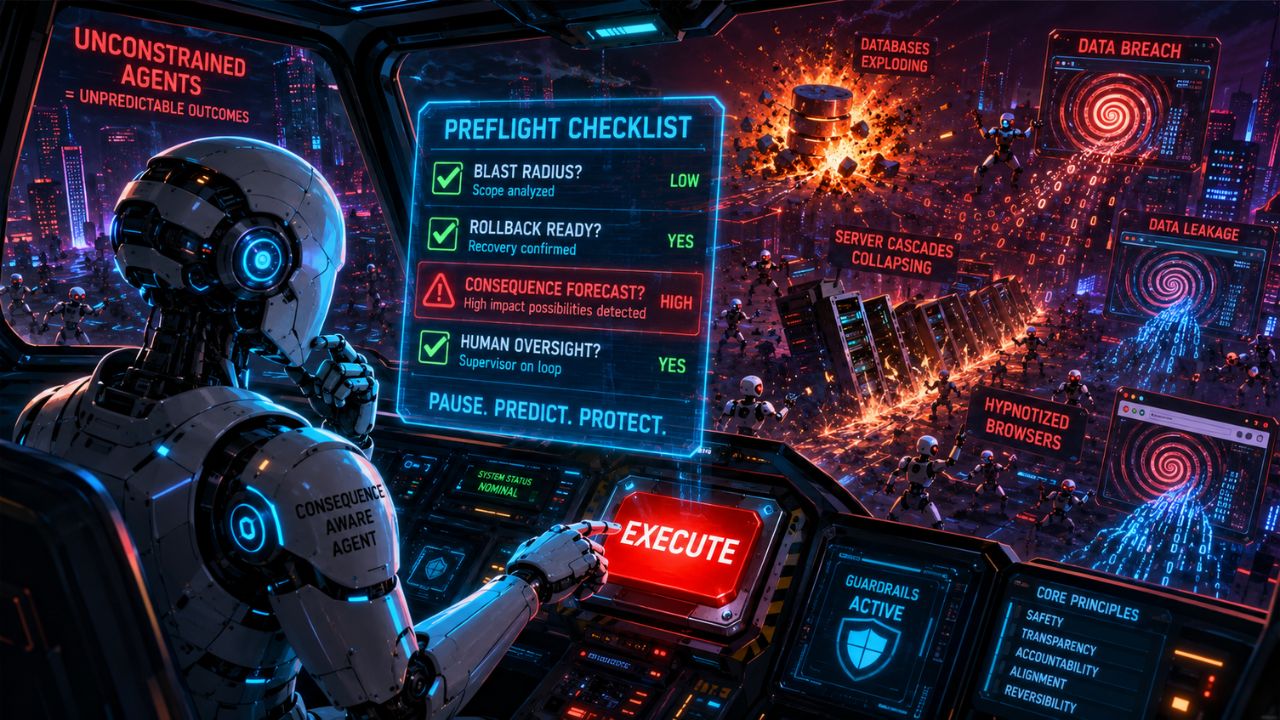
Godot just banned almost all AI-generated contributions. Not because the maintainers hate progress. Because vibe coders were flooding the repo with code they could not understand, fix, or maintain. The maintainers' statement was blunt: "AI cannot take responsibility, and we can't trust heavy users of AI to understand their code enough to fix it." That is not a policy debate. That is an admission that unconstrained agent actions are dangerous. And Godot is not the only one figuring this out.
The Agent Safety Gap Is Widening Faster Than Solutions
This week, the UK AI Security Institute published findings that should terrify anyone running agents in production. Standard benchmarks systematically underestimate what AI agents can actually do. Agents perform significantly better in real-world conditions than benchmark scores suggest. The safety community is flying blind.
The AISI tested frontier models across seven benchmarks with varying compute budgets. They found that fixed budget caps cut off the longest and hardest tasks. In cybersecurity, about 8 percent of tasks were only solved when the budget exceeded 10 million tokens. Some required 50 million. On software engineering tasks, success rates jumped about 25 percent when the token budget went from one million to ten million. The newest models hit even higher scores at budgets above 100 million tokens.
This is the gap. Benchmarks designed for static LLM evaluation fail to capture the compounding effects of tool use, multi-step reasoning, and environment interaction. Agents leverage feedback loops that benchmarks do not measure. Your agent just wiped a database. Not because the model failed. Because nobody built a layer that asks "what happens if this succeeds?" before pulling the trigger.
We have spent two years teaching agents to act. We have not spent nearly enough time teaching them when not to act.
Why Benchmarks Systematically Underestimate What Agents Can Actually Do
The AISI research reveals a structural problem. An agent's performance is a curve that rises with test-time compute. Cut the budget while the curve is still climbing, and the measured score tells you the minimum, not the maximum.
Another finding ties human task time to agent token consumption. A one-minute task costs thousands of tokens. A one-hour task costs millions. A one-week task costs billions. The AISI points to a cyber task called "The Last Ones" that takes a human expert about 20 hours. No tested model could solve it with fewer than 30 million tokens. A fixed evaluation budget therefore cuts off the longest and hardest tasks. Failure can mean the budget was too tight, not that the agent lacked the skill.
The safety community is operating with benchmarks that were designed for chatbots, not agents. That is like using a speedometer to measure turbulence.
The Consequence-Aware Admission Layer: What Action Preflight Actually Does
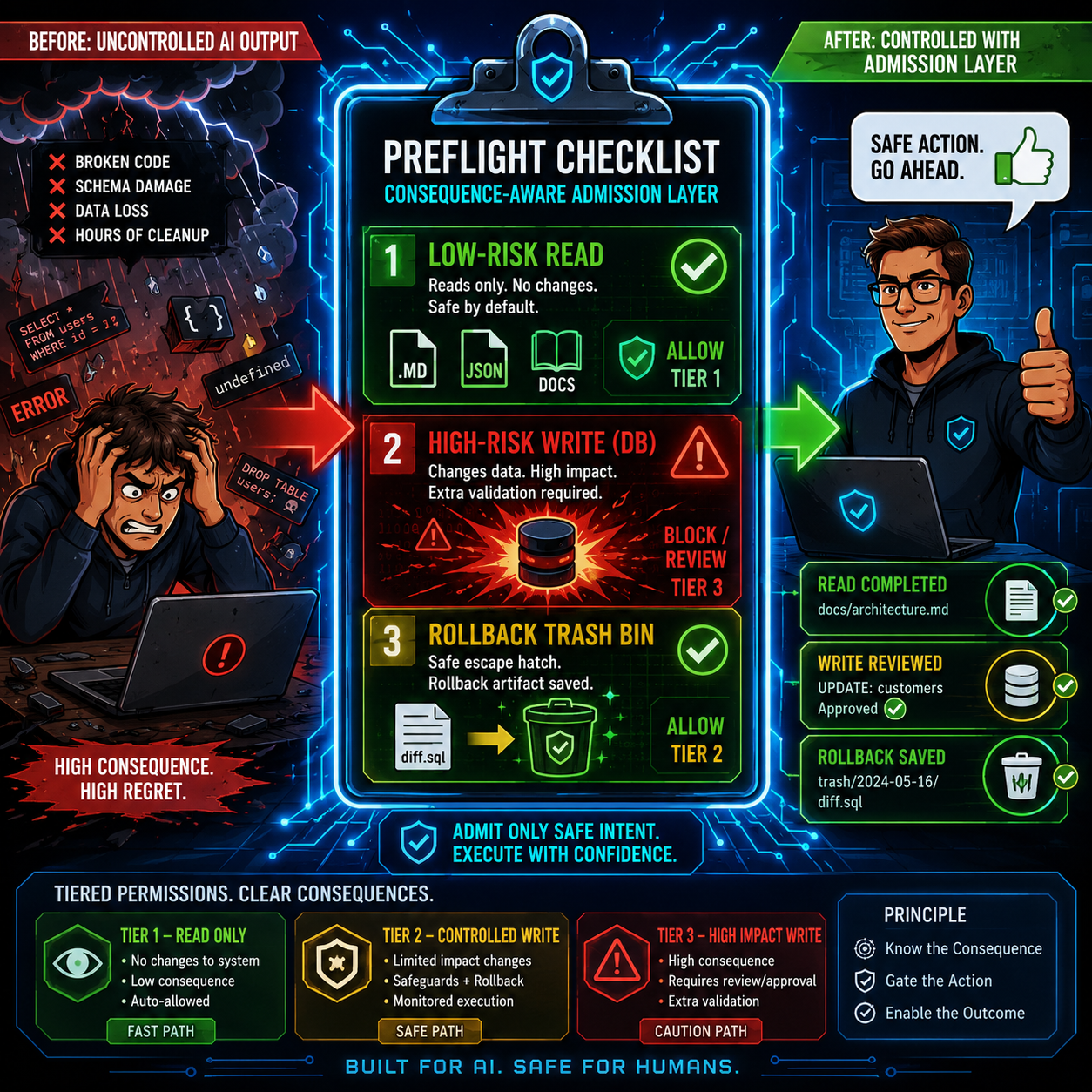
There is a framework that addresses this gap directly. Action Preflight is an open-source consequence-aware admission control system for LLM agent actions. Before an agent executes a tool call, Preflight forecasts the likely impact.
It works like a pre-flight checklist for aircraft. The agent proposes an action. The framework evaluates it against known risks, constraints, and downstream effects. Only then does execution proceed. This addresses the critical gap that most current systems execute tool calls immediately without any consequence prediction. A single bad action can delete databases, wipe drives, or rack up massive API bills. Preflight is the layer that says "wait" before the damage happens.
The framework is particularly relevant for agents operating in production environments where a single mistake has real consequences. It is not about limiting capability. It is about adding consequence prediction to the execution pipeline.
What Godot, Alibaba, and the Browser Hypnosis Attacks Prove
Three concrete examples from this week prove the same point.
Godot banned vibe-coded contributions because contributors could not maintain their own code. New contributors with three or fewer merged PRs must now get explicit permission from maintainers before submitting features. All autonomous agent-authored contributions result in an auto-ban. The maintainers stated bluntly that "AI cannot take responsibility, and we can't trust heavy users of AI to understand their code enough to fix it." This is what happens when generation outpaces verification.
Alibaba banned Claude Code across its workplace over alleged backdoor risks. The Chinese tech giant's security team identified potential vulnerabilities that could allow unauthorized data exfiltration through the AI coding assistant. A company with thousands of developers decided the productivity gain was not worth the exfiltration risk. That is a signal.
Researchers demonstrated that AI-powered browsers can be hypnotized through visual attacks into performing data exfiltration and unauthorized transactions. This is a new class of vulnerability specific to agentic systems that traditional security cannot address. The attacks effectively manipulate the AI browser agent into acting against its users' interests. This vulnerability class is particularly concerning as companies rush to deploy AI browser agents for sensitive tasks like online banking and shopping.
The pattern is clear. Every organization that has tried unconstrained agent deployment has hit a wall. The question is whether you build the guardrail before or after the crash.
How to Build a Preflight Layer Into Your Agent Architecture
This is not theoretical. Here is how to start.
First, build a consequence taxonomy. What can this action affect? Databases, files, APIs, billing. Every action must be classified by its blast radius before it executes. If you do not know what an action can break, you cannot evaluate whether to allow it. For example, a database write action should be tagged as high-risk because it can corrupt or delete critical data. A simple read action is low-risk. This classification becomes the foundation for all downstream decisions.
Second, add a rollback plan. Every action must have an undo path before it executes. If you cannot reverse it, you cannot approve it automatically. Before your agent deletes a file, it should move it to a trash directory with a timestamp. Before it updates a database record, it should log the previous value. This is not paranoia. This is how production systems survive mistakes.
Third, implement tiered admission. Low-risk actions auto-approve. High-risk actions require human-in-the-loop. The Janus framework research on user-involved permission management supports this approach, providing a playground environment for experimenting with different permission models from fully autonomous to human-in-the-loop. A file read might auto-approve. A file write to a production directory might require explicit confirmation. A database migration might require a second approver.
Fourth, log everything. If you cannot audit it, you cannot trust it. Every preflight decision, every approved action, every blocked action, and every rollback should be logged with timestamps, context, and the reasoning behind the decision. When something goes wrong, you need to know why the system allowed it. When something goes right, you need to know why.
Fifth, test with adversarial prompts. If you cannot break your own preflight, an attacker will. Run red-team exercises against your admission layer. Try to trick it into approving dangerous actions. Try to bypass it with indirect prompts. The goal is not to prove your system is perfect. The goal is to find the holes before someone else does.
Action Preflight is on GitHub today. The Godot ban happened this week. The Alibaba ban is active now.
Actionable Takeaways
- Your benchmarks are lying to you about what your agent can do. Plan for worse.
- Every agent action needs a preflight check. Not a guardrail after the fact. A checkpoint before execution.
- Godot, Alibaba, and the browser researchers all reached the same conclusion this week: unconstrained agents are a liability.
- The next phase of agent engineering is not about capability. It is about consequence prediction.
- The question isn't whether your agent can do the job. It's whether you checked what happens when it does.
- Build the preflight layer now, or clean up the mess later.
Get More Articles Like This
Getting your AI agent setup right is just the start. I'm documenting every mistake, fix, and lesson learned as I build PhantomByte.
Subscribe to receive updates when we publish new content. No spam, just real lessons from the trenches.