
The single-agent-with-tools pattern that dominates production today has a fatal flaw: it converges on the first plausible answer and stops looking. A new paper called SwarmResearch proves it empirically. When one agent accumulates all context, it prematurely converges on suboptimal solutions. The fix is not a bigger model or a longer context window. It is an architecture shift: give your system a shepherd. This article will teach you why the orchestrator-subagent pattern is the most important emerging architecture in AI agent development, how to implement it, and when to use it over single-agent designs.
KEY TAKEAWAYS
- Single-agent LLM architectures often converge prematurely on suboptimal solutions.
- The orchestrator pattern uses a "Shepherd" agent to manage isolated "Search" sub-agents.
- This distributed approach provides parallel exploration, rollback safety, and prevents memory poisoning.
The Problem with Single-Agent LLM Architectures
Current production agents follow the same pattern: one agent, one context window, a set of tools. Claude Code, GitHub Copilot, most custom builds. They all accumulate experience into a single text buffer and call it memory. SwarmResearch tested this on 15 open-ended optimization tasks. Single-context agents converged prematurely 13 out of 15 times. The reason is counterintuitive: more context does not mean better decisions. It means more surface area for the model to fixate on an early hypothesis.
Vercel CEO Guillermo Rauch made the same argument this week. Models and agents need to be architecturally separated, like databases and app servers once were. When everything is bundled into one monolith, you lose the ability to scale, isolate, and reason about each layer independently. The monolithic agent era is ending. The orchestrator era is beginning.
What the Orchestrator Pattern Actually Is
Here is the core idea. A Shepherd Agent holds global context. It steers a population of Search Agents, each operating in its own git branch with local context. The shepherd decides which branches to explore, which to prune, and when to merge.
SwarmResearch proved this works. On 13 of 15 open-ended coding tasks, the shepherd pattern outperformed every state-of-the-art single-agent system. The orchestrator did not just distribute work. It distributed the risk of being wrong. The same pattern shows up across the field. iFLYTEK's Embodied-Omni model uses a "brain" for high-level planning and a "cerebellum" for low-level execution. Object-Centric Environment Modeling (OCM) splits memory into object knowledge and procedure knowledge, updating both independently after each episode. Three different teams, three different domains, one consistent architecture: a high-level controller managing specialized sub-agents with isolated state and explicit coordination protocols. No single agent hoards all the context. No single buffer becomes the bottleneck.
Why This Matters for Production
Most agent frameworks today accumulate all experience into a single text buffer. That buffer becomes both a bottleneck and a vulnerability.
Structured, isolated memory is not just faster. It is safer. When each sub-agent works in its own sandbox, a poisoned input in one branch cannot corrupt the others. The Zombie Agents paper proved that free-form text memory can be poisoned across sessions. An attacker implants a payload through a webpage during a benign task. The agent stores it as memory. Later, the payload triggers unauthorized tool behavior. The attack persists because the memory is reused, not because the prompt is reinjected.
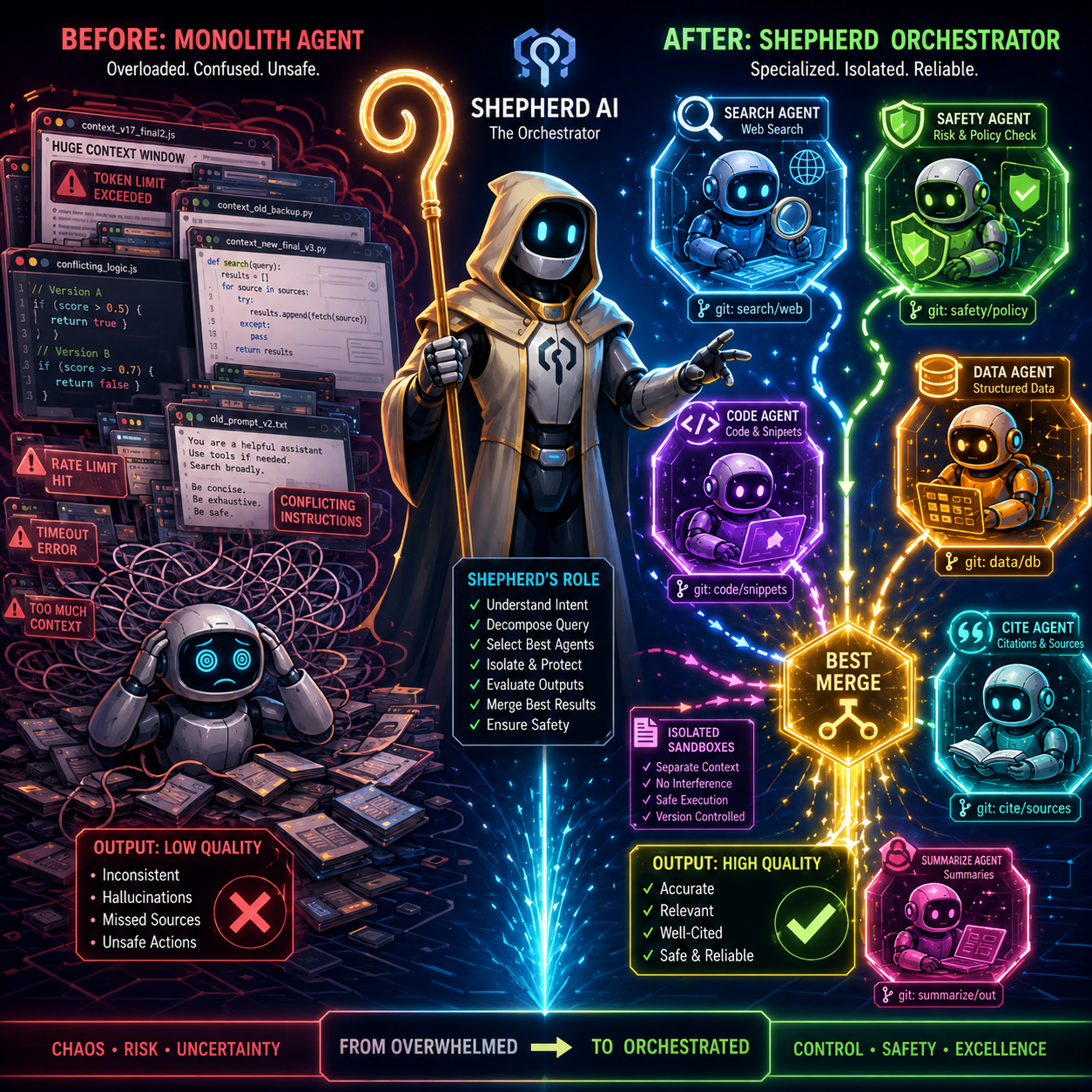
Orchestrator architectures give you three things single-agent systems cannot.
First, parallel exploration. Multiple agents try different approaches simultaneously. In SwarmResearch, the shepherd adapts parallelism at different search depths, discovering better-performing solutions than fixed serial or parallel scaling. Second, rollback safety. Each agent works in isolation, so a bad path does not corrupt the main state. If a Search Agent goes down a rabbit hole, the shepherd kills the branch. The main state never sees the damage.
Third, composability. You can add new agent types without retraining the whole system. The shepherd does not need to know how each sub-agent works. It only needs to know how to assign tasks and reconcile outputs.
A Concrete Example: Code Review Across Multiple Files
Here is how the difference plays out in practice. Single-agent approach: the agent reads all files, forms a hypothesis about what needs changing, then edits files sequentially. If the first edit is wrong, the rest cascade. The agent has no mechanism to backtrack without starting over. Orchestrator approach: the Shepherd Agent breaks the review into sub-tasks. "Check auth logic." "Check database migrations." "Check API contracts." Each Search Agent operates on its own branch. They explore in parallel. The Shepherd compares results and merges only the validated changes.
At PhantomByte, we have been running this pattern in production for months. Our code review pipeline spins up a shepherd that dispatches specialized reviewers for security, performance, and architecture. Each reviewer runs in isolation. The shepherd reconciles their findings and presents a unified report. The result is faster reviews with fewer false positives, because no single agent's bias bleeds into another's analysis.
When to Use Orchestrator vs. Single-Agent
Use an orchestrator when the task has multiple valid approaches. Optimization, research, design. Any domain where exploration matters more than speed.
Use it when failure is expensive. Production code, financial transactions, safety-critical systems. The rollback safety alone justifies the overhead.
Use it when the task spans multiple independent domains. Architecture review, multi-service debugging, cross-team coordination. The shepherd becomes the integration layer.
Use it when you need audit trails. Each sub-agent's work is isolated and reviewable. You can reconstruct exactly who did what, when, and why. Stick with single-agent when the task is linear and well-defined. Format this file. Translate this text. Generate this SQL query. If there is one right answer and speed matters, a monolith is fine. Stick with it when latency matters more than correctness. Chat responses, quick drafts, brainstorming. The user wants an answer now, not a committee report. Stick with it when the context fits comfortably in one window with room to spare. The orchestrator pattern solves a scaling problem. If you are not scaling, you do not need it yet.
How to Start Building This Today
Step 1: identify the boundary. What parts of your agent's work can run in parallel without corrupting each other? A code review is obvious. A multi-step data pipeline is obvious. A chatbot response is not.
Step 2: build the shepherd. This is the simplest agent in your system. It does not need deep domain knowledge. It just decides which sub-agents to spin up and how to reconcile their outputs. Start with a rules-based shepherd. Graduate to a model-based one only when you have enough traffic to justify the complexity.
Step 3: isolate sub-agent state. Each sub-agent gets its own branch, session, or sandbox. They do not share memory unless the shepherd explicitly passes it. This isolation is the entire point. If your sub-agents can read each other's work directly, you have not built an orchestrator. You have built a chat room.
Step 4: define the reconciliation protocol. How does the shepherd decide which sub-agent output to trust? SwarmResearch uses a scoring function. You can use evals, human review, or a secondary model. The protocol does not need to be perfect. It needs to be explicit.
The Bottom Line
The next generation of agent frameworks will treat memory as a structured, verifiable, and securable substrate rather than a text buffer. The orchestrator-subagent pattern is not theoretical. It is already in production systems and it is backed by multiple independent research papers published this month. SwarmResearch proves it for coding agents. iFLYTEK proves it for embodied agents. OCM proves it for environment modeling. The pattern is consistent because the underlying problem is consistent: one brain cannot hold everything.
Here is the truth. The single-agent approach is not wrong. It is just incomplete. It works for simple tasks, but the moment your agent needs to explore, reason, or coordinate across domains, the monolith breaks. The shepherd pattern is not a replacement. It is an evolution. The same way we stopped writing monolithic applications and started splitting them into services, we need to stop building monolithic agents and start giving them shepherds. The question is not whether you will adopt this architecture. It is whether you will adopt it before your agent's context window becomes its prison.
Get More Articles Like This
Getting your AI agent setup right is just the start. I'm documenting every mistake, fix, and lesson learned as I build PhantomByte.
Subscribe to receive updates when we publish new content. No spam, just real lessons from the trenches.
Build Real AI Infrastructure
PhantomByte teaches you to build real AI infrastructure yourself: local AI stacks, autonomous agents, multi-agent orchestration, web scraping, and custom tools. Step-by-step PDF tutorials you download, follow, and deploy. No subscriptions. No fluff. Just skills that ship.