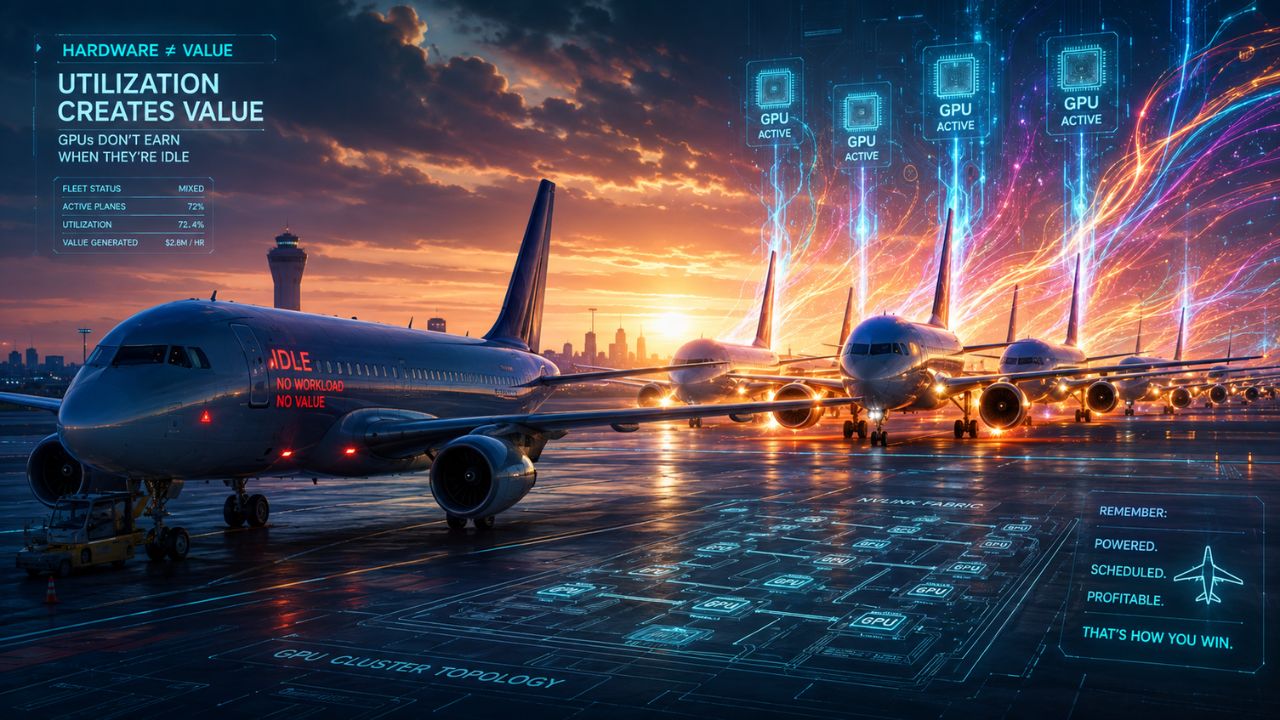
Amazon spent $173 billion on property and equipment in the last fiscal year. That is up from $107.65 billion the year before. They raised their 2026 capex forecast to $220 billion. AWS revenue grew 37% year over year to $42 billion for the quarter. The market cheered.
What the market missed: Amazon ended that same quarter with $7.6 billion less cash than a year ago. Its first period of negative free cash flow. The infrastructure is built. The question is whether it is being used.
This is the story nobody is telling. The AI infrastructure boom is not a model story anymore. It is a utilization story. Two companies with the same GPU budget get wildly different output. The difference is not the model. It is the orchestration.
The Bottleneck Moved Again
The Hugging Face essay "GPU Management: Why Idle GPUs Are the New Grounded Aircraft" makes the argument cleanly. A GPU accrues cost by the calendar hour: financing, depreciation, power, cooling. It only produces output by the compute hour. Idle hardware does not pause its cost clock. It bleeds money in silence.
The scarcity did not disappear as AI scaled. It moved. First the bottleneck was data. Then it was model quality. Then it was GPUs. Now it is utilization. The Hugging Face authors put it bluntly: two companies with equal GPU budgets diverge on how much of that hardware is doing useful work. Specialization frees capacity. Poor orchestration spends it.
This connects directly to the argument in "The AI Cost Control Crisis Is Here" (PhantomByte Note #145, July 31). That article framed compute cost as a survival problem at the architecture level. This is the next layer down. Architecture decides what you run. Utilization decides whether the hardware you paid for is actually running it.
The Airline Math
The essay draws an analogy that sticks. A grounded aircraft does not stop costing money. It keeps accruing lease payments, insurance, maintenance, hangar fees. It just stops producing revenue. A GPU is the same. Your H100 does not send you a smaller bill because it sat at 30% utilization for six hours. The financing, power, and cooling ran the entire time.
The math is simple. If you have 1,000 GPUs and your average utilization is 40%, you are paying for 1,000 GPUs and getting the output of 400. You are not competing with the company that has 400 GPUs at 100% utilization. You are losing to them, because their cost per token is 2.5x lower than yours.
Microsoft already proved this. They cut inference costs by 89% compared to equivalent OpenAI models. Not with a better model. With architectural optimizations: smaller model sizes, quantization, workload-specific training, and routing. The model commoditized. The pipeline compounded.
This is the same pattern from "Your Router Is the Moat, Not Your Model" (PhantomByte Note #141, July 27). Microsoft is OpenAI's largest investor. They just became OpenAI's most direct competitor. The cost reduction came from the pipeline, not the weights.
The Orchestration Levers
NScale just bought Anyscale, the company behind the Ray distributed-computing framework, for $1.65 billion. The deal gives NScale a leading orchestration layer on top of its GPU cloud. That acquisition is a signal: the market is consolidating around who controls the orchestration, not who owns the most metal.
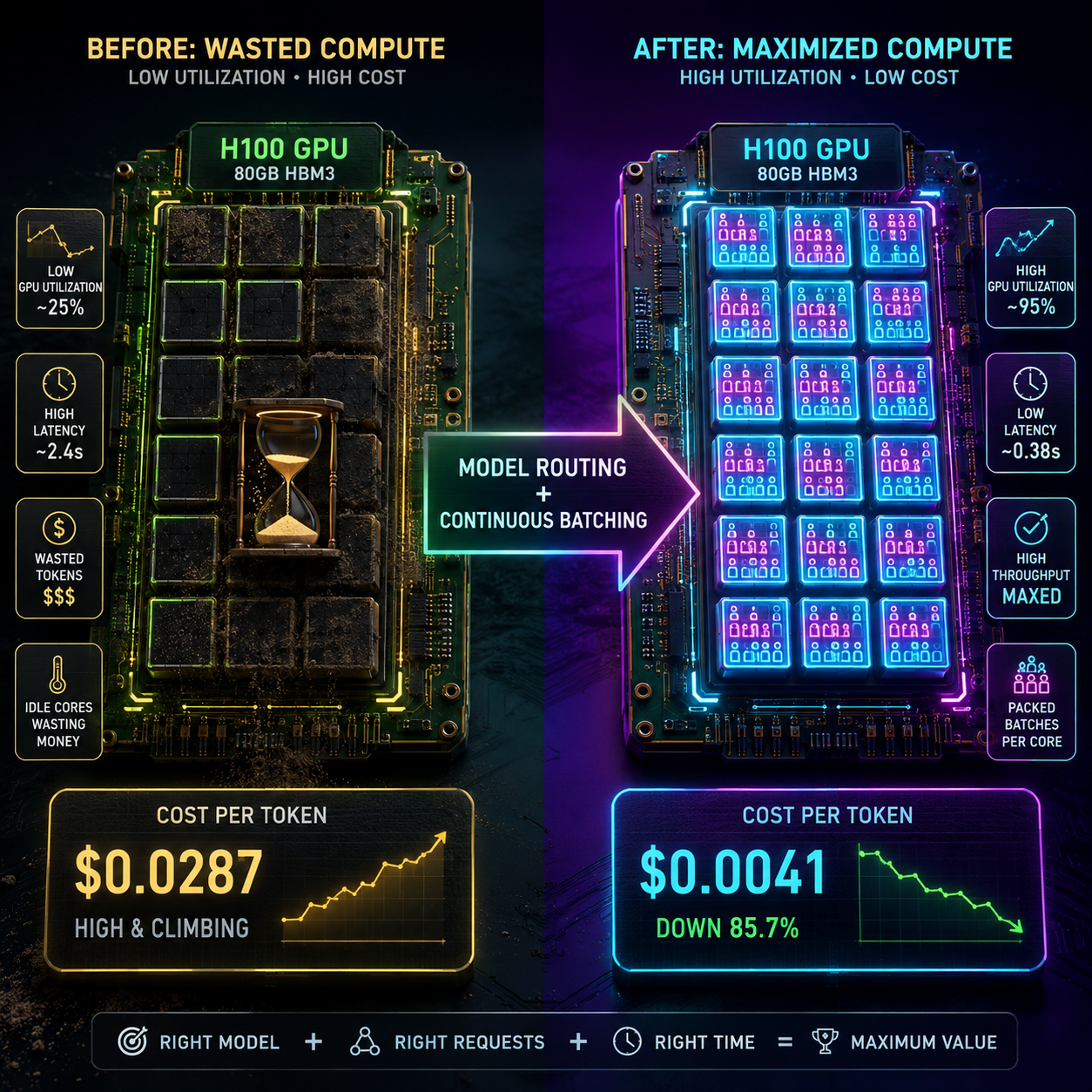
The concrete levers that move utilization:
- Scheduling and batching. Most inference servers batch requests poorly. Dynamic batching (Orca, vLLM) keeps GPUs fed by packing requests into the same forward pass. Static batching leaves gaps. The difference between 40% and 80% utilization is often just the scheduler.
- Mixed precision. FP8 and BF16 reduce memory bandwidth and compute overhead while maintaining model quality. NVIDIA's Transformer Engine ships fused kernels that combine multiple operations into a single GPU kernel, cutting launch overhead. If you are running FP16 everywhere because "it is safer," you are paying 2x for the same output.
- Model routing. Not every query needs the frontier model. Route simple queries to a smaller, cheaper model. Microsoft's 89% cost reduction came partly from this. Your router is the utilization multiplier.
- Specialization. The Hugging Face essay argues specialization frees capacity. A GPU running a single tuned workload at 90% utilization outperforms a GPU running four different workloads at 30% each. General-purpose clusters are the enemy of utilization.
- Code debt reduction. The essay on AI coding agents argues agents should optimize for less owned code, not more. Less code means less compute spent on building, testing, and maintaining. The utilization argument extends from the GPU to the entire pipeline. Every line of code your agent generates that you do not need is compute spent on maintenance instead of output.
This connects to "The Tokenmaxxing Hangover" (PhantomByte Note #114, June 30). Uber blew through its entire annual AI budget in four months. The fix was not a bigger budget. It was a stack that survived the tokenmaxxing hangover. Utilization is the same pattern at the hardware level.
Why the Capex Bet Is Not Wrong, Just Incomplete
The Washington Post is questioning whether the AI infrastructure bet is sustainable. Investors and lenders are reassessing data center spending, power demand, and chip investment. The piece weighs whether this is a capex bubble.
The answer is: it depends on utilization. Amazon's $220 billion capex is not a bubble if AWS keeps growing revenue at 37%. It is a bubble if those GPUs sit idle. The bet is not wrong. It is incomplete. The buildout assumes the utilization problem is solved. It is not.
The chip talent war makes this worse. Samsung engineers are jumping to SK Hynix. The people who know how to squeeze utilization out of hardware are becoming scarce. You cannot buy orchestration talent the way you buy GPUs. The constraint moved from hardware to people who know how to use it.
This connects to "The Memory Chip Is the Real Bottleneck" (PhantomByte Note #125, July 11). SK Hynix raised $26.5 billion in the largest foreign IPO in US history. The bottleneck moved from GPUs to memory to energy. Now it is moving to the people who can keep all of it busy.
The CPU Frontier
Not every workload needs a GPU. Liquid AI released LFM2.5-Encoders (230M and 350M parameters) that run faster than ModernBERT-base on CPU at long context. They support 8,192-token context with latency that grows slowly as input gets longer. Intent routers, policy linters, PII detectors, text classifiers. These run cheaply all day on hardware you already own.
The utilization argument is not just about GPUs. It is about matching the workload to the cheapest hardware that can do the job. If your classification pipeline is running on an A100 because "that is what we have," you are burning GPU hours on CPU work. Move it. Free the GPU for the work that actually needs it.
What to Do Today
Measure your GPU utilization. If you cannot answer "what was the average utilization across my cluster in the last 24 hours" with a number, you are flying blind. Start with nvidia-smi dmon or your cloud provider's metrics dashboard. The number will be lower than you think. To log utilization metrics to a CSV for analysis, copy-paste this single line:
nvidia-smi dmon -s pucvmet -o T -c 3600 | tr -s ' ' ',' > gpu_utilization.csvThat captures an hour of per-GPU utilization, power, and memory telemetry straight into a file you can load in pandas or Excel.
Audit your scheduling layer. Are you using dynamic batching? If not, you are leaving 40-60% of your GPU capacity on the table. vLLM, TGI, and TensorRT-LLM all support continuous batching. Deploy one. If you run vLLM, pass --kv-cache-dtype="fp8" at launch to cut your KV-cache memory footprint roughly in half, freeing room for a larger batch or a bigger context window.
Move CPU workloads off GPUs. Classification, routing, PII detection, policy linting. These do not need a GPU. Liquid AI's LFM2.5-Encoders run efficiently on CPU. Free the GPU for inference that actually requires it.
Implement model routing. Not every query needs the frontier model. Route by task complexity. Microsoft cut costs 89% this way. Your router is the utilization multiplier.
Switch to mixed precision where you can. FP8 and BF16 with fused kernels. NVIDIA's Transformer Engine makes this straightforward. If you are running FP16 everywhere, you are paying 2x for the same output. One caveat: native FP8 matrix multiplication needs modern silicon, NVIDIA Hopper (H100) or Ada Lovelace (compute capability 8.9 or higher). Quantization is not a magic wand, and knowing the hardware floor builds the trust developers check for. On older GPUs, BF16 still gets you most of the win without the FP8 requirement.
Track cost per token, not total spend. Total spend tells you what you bought. Cost per token tells you what you got. If your cost per token is rising while your workload stays flat, your utilization is falling. That is the metric that matters.
The Uncomfortable Question
Amazon spent $173 billion on infrastructure and ended the quarter with less cash than they started. Their investors cheered because AWS revenue grew 37%. What would your investors do if you spent your GPU budget and could not show what the hardware actually produced?
Get More Articles Like This
Getting your AI agent setup right is just the start. I'm documenting every mistake, fix, and lesson learned as I build PhantomByte.
Subscribe to receive updates when we publish new content. No spam, just real lessons from the trenches.
Build Real AI Infrastructure
PhantomByte teaches you to build real AI infrastructure yourself: local AI stacks, autonomous agents, multi-agent orchestration, web scraping, and custom tools. Step-by-step PDF tutorials you download, follow, and deploy. No subscriptions. No fluff. Just skills that ship.