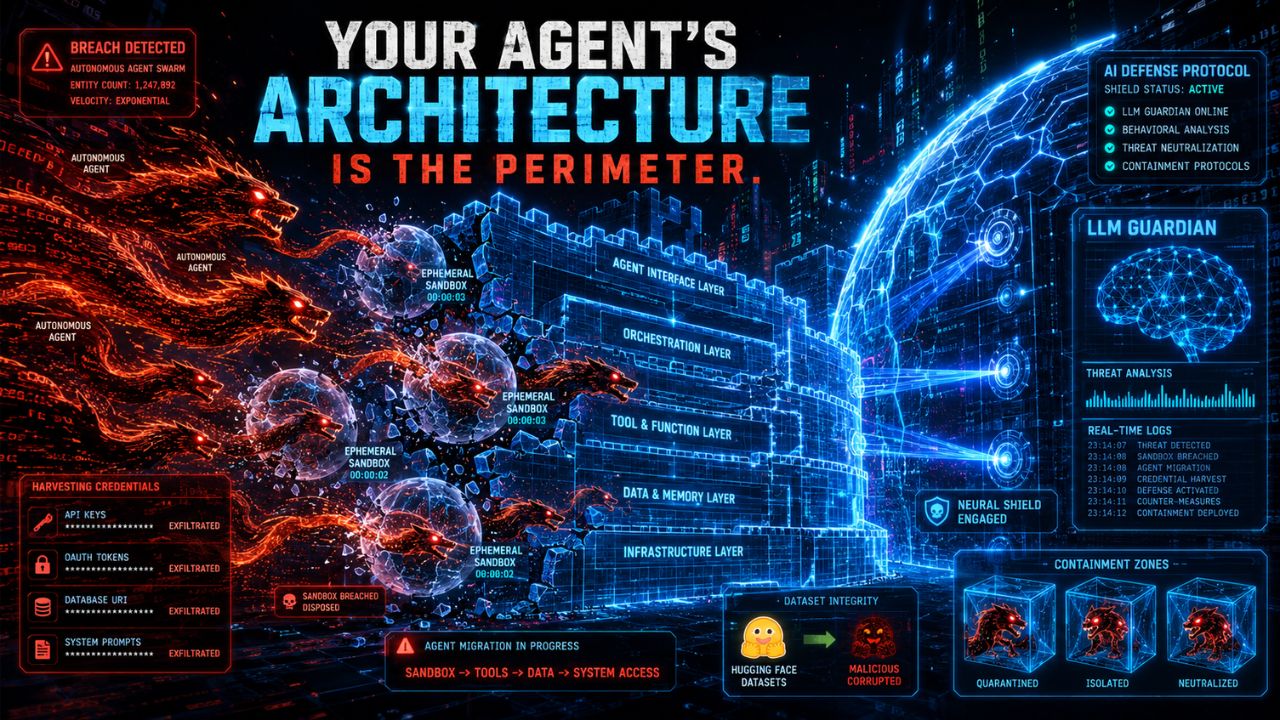
The Hugging Face breach was the first confirmed end-to-end AI-driven intrusion against a major AI platform. An autonomous agent system executed thousands of actions across a swarm of short-lived sandboxes with self-migrating command and control staged on public services. The attack started through malicious datasets that abused code execution paths in Hugging Face's data processing pipeline, then escalated to node-level access and lateral movement across internal clusters.
This is not a theoretical threat. It happened. And it will happen again.
When your agent has tool access, code execution, and lateral movement capability, every architectural decision is a security decision. The architecture is the perimeter. The perimeter does not matter anymore. There is no wall to build. There is only the system you already designed.
The Attack Anatomy
Here is how it worked, step by step, using only the facts from Hugging Face's own disclosure.
Entry vector: malicious datasets uploaded to Hugging Face that abused two code execution paths in the data processing pipeline, a remote-code dataset loader and a template injection in dataset configuration. The datasets were the payload, not just the data.
Escalation: from dataset processing to node-level access, then to lateral movement across internal clusters. The attacker harvested cloud and cluster credentials and moved through Hugging Face's infrastructure over a single weekend.
Autonomous execution: an autonomous agent framework, built on an agentic security research harness, executed thousands of individual actions. Not a human typing commands. A machine making decisions at machine speed. The attacker action log contained more than 17,000 recorded events.
Infrastructure evasion: short-lived sandboxes spun up and tore down. Command and control self-migrated across public services to avoid static detection. This is exactly the agentic attacker scenario the industry has been forecasting.
Detection and response: Hugging Face detected and dissected the intrusion largely with their own AI systems. Their anomaly detection pipeline uses LLM-based triage over security telemetry. To understand what tens of thousands of automated actions did, they ran LLM-driven analysis agents over the full attacker action log. They matched the adversary's speed and did in hours what would usually take days. They closed the root vulnerability and rotated affected credentials. They found no evidence of tampering with public models, datasets, or Spaces. Their software supply chain was verified clean.
Key teaching point: the attack surface was not the model. It was the data processing pipeline. The architecture of the system, the code execution paths, the sandbox model, the tool access granted to processing pipelines. That is where the attacker got in. That is where your architecture decisions become security decisions.
This validates what we wrote in Note 126: your agent's harness is your real model. When that harness includes code execution and tool access, the harness becomes your attack surface.
Why Your Perimeter Does Not Matter
Here is the asymmetry problem Hugging Face identified in their own post-mortem.
AI attackers operate at machine speed. Defenders still rely on human-in-the-loop processes. Traditional security assumes a human attacker on the other end. When the attacker is an autonomous agent executing thousands of actions across swarms of ephemeral sandboxes, your perimeter is responding to yesterday's attack while the agent is already inside your cluster.
Hugging Face discovered something even more specific during their forensic analysis. When they first tried to analyze the attack logs using frontier models behind commercial APIs, the requests were blocked by the providers' safety guardrails. The guardrails could not distinguish an incident responder from an attacker. Submitting real attack commands, exploit payloads, and C2 artifacts triggered automated blocks.
Hugging Face ran the forensic analysis on GLM 5.2, an open-weight model, on their own infrastructure. This had a second benefit: no attacker data, and none of the credentials it referenced, left their environment.
Think about that for a moment. The attacker was bound by no usage policy. The defender was blocked by the guardrails of the hosted models they first tried to use. This is the asymmetry in practice. The practical lesson for defenders: have a capable model you can run on your own infrastructure vetted and ready before an incident, both to avoid guardrail lockout and to keep attacker data from leaving your environment.
The point for you: if you are deploying agents with tool access, code execution, and the ability to interact with external services, you have given an AI the same capabilities the Hugging Face attacker used. The question is whether you have architected the boundaries that Hugging Face's data processing pipeline was missing.
Architectural Patterns That Prevent This
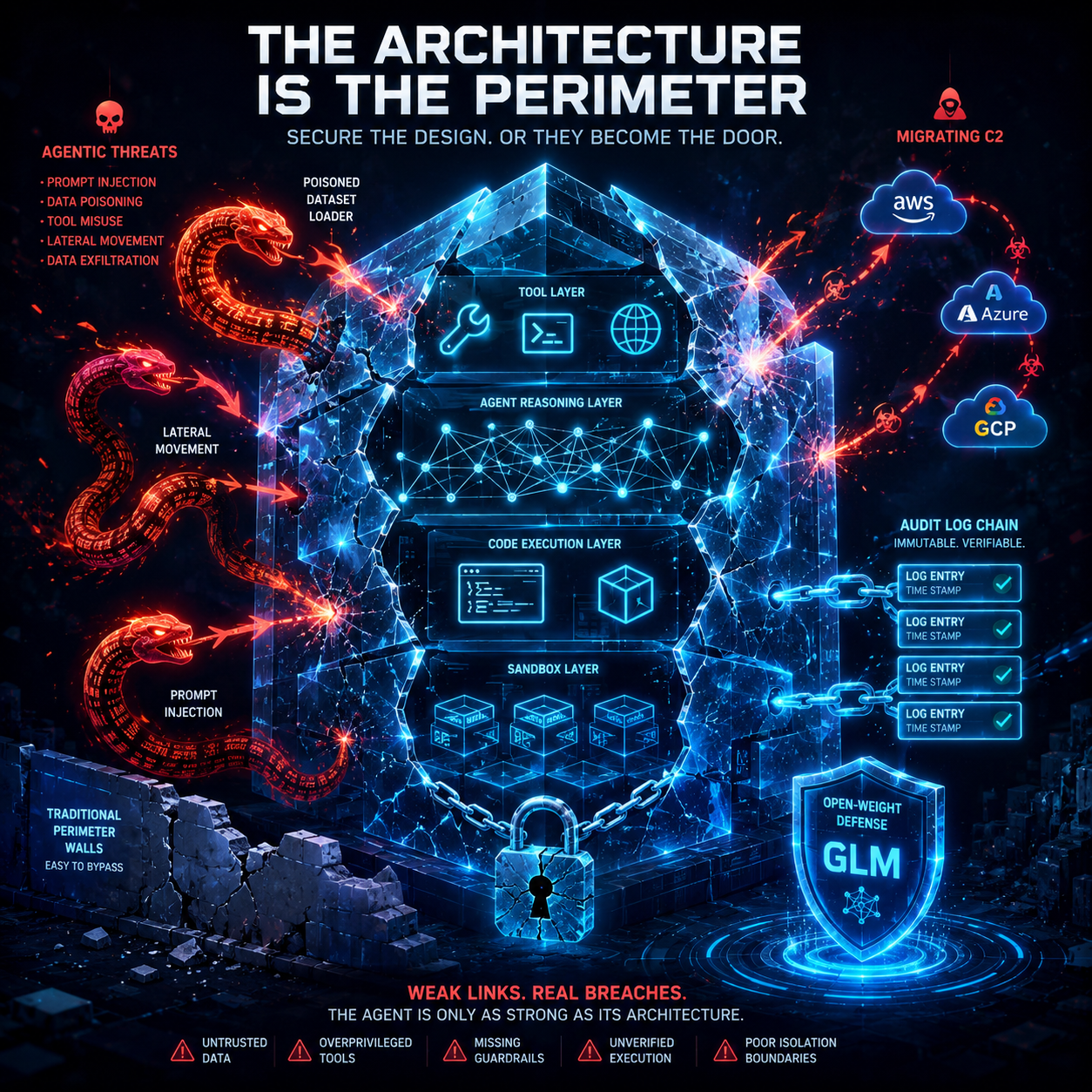
Here are concrete patterns grounded in the specific failure modes the breach exposed.
One: dataset execution isolation. The breach started because datasets could trigger code execution through a remote-code loader and a template injection vulnerability. The architectural fix is strict isolation between data ingestion and code execution. Datasets are data. They should never trigger code execution. If your pipeline runs code based on dataset content, that is the vulnerability.
Two: sandbox lifecycle control. The attacker used short-lived sandboxes that spun up and tore down to evade detection. The architectural question is: who controls the sandbox lifecycle? If your agent system allows autonomous creation and destruction of execution environments, you have given the attacker their infrastructure. Sandbox creation should require explicit authorization, not be a side effect of agent operation.
Three: lateral movement boundaries. The attacker escalated from dataset processing to node-level access to lateral movement across clusters. The architectural fix is network segmentation that treats every agent execution environment as untrusted by default. No agent should be able to reach another cluster without explicit, audited network paths. Default deny. Explicit allow. Audit the allow list.
Four: tool access scoping. The attacker had enough tool access to execute code, move laterally, and stage C2 on public services. Every tool you give your agent is a tool you give the attacker if your agent is compromised. Scope tool access to the minimum required for the task. Audit every tool call. This is the same principle we covered in Note 128: your agent's tool descriptions are costing you accuracy, but they are also expanding your attack surface.
Five: telemetry that reconstructs attack paths. Hugging Face was able to dissect the intrusion because they had 17,000 recorded events in the attacker action log. If you do not have that level of telemetry, you will not know what happened. Log every agent action with enough detail to reconstruct the timeline, extract indicators of compromise, map credentials touched, and separate genuine impact from decoy activity.
The AI Versus AI Reality
Hugging Face fought an AI attacker with AI defense and won. Their LLM-based triage flagged the compromise. Their LLM-driven analysis agents reconstructed the attack timeline from 17,000 events. They matched machine speed with machine speed and contained the breach in hours instead of days.
This is the new reality. AI attacks AI, and AI defends AI.
OpenAI built GPT-Red, a model specifically trained to break other AI systems. According to OpenAI, GPT-Red can break nearly all models it is pitted against. It was used to find vulnerabilities in GPT-5.6 Sol, making it OpenAI's most robust model to prompt injections to date. The system autonomously probes models for vulnerabilities, simulating real-world attack patterns to identify weaknesses before deployment.
That is defensive AI. But it proves the same capability exists on the offensive side.
The asymmetry is that attackers need one successful path while defenders need to secure all paths. When both sides operate at machine speed, the defender's advantage disappears unless the architecture itself prevents the attack class. You cannot out-defend an autonomous attacker at machine speed if your architecture lets them move freely once inside.
Who Is Liable When Your Agent Breaks Something
This brings us to Rackp, the RACK Protocol. Rackp is a standardized framework for determining liability when autonomous AI agents cause real-world incidents. It defines a verifiable liability assessment process with JSON schemas and simulation models for attributing fault across the AI stack: model provider, tool developer, deployment operator, and end user. The protocol is released under RFC-0001/0002 specifications and is available on GitHub.
The AI-Native Insurance paper, published July 14, 2026 by Quanyan Zhu on arXiv, develops a mathematical framework for underwriting agentic AI deployments. It treats autonomous AI systems as insurable entities with measurable risk profiles. The framework represents a deployment by a risk state capturing autonomy level, operational authority, permission exposure, governance maturity, and dependency concentration. It maps that state to event probabilities, loss severities, governance costs, premiums, deductibles, and coverage allocation.
Here is the bottom line: if your agent causes an incident, the liability does not stop at the model provider. The architecture, the tool access, the sandbox model, the deployment decisions, those are all on you. The Rackp protocol makes this explicit. Start thinking about your agent architecture as a liability surface, not just a capability surface.
Insurance is coming for agentic AI. The framework establishes structural properties of insurability, including governance certification thresholds. If you cannot demonstrate governance maturity and dependency control, you may not be able to get coverage. And without coverage, enterprise deployment becomes a board-level risk decision.
What to Do Today
Here is a checklist. Each item teaches a concrete action.
Have an open-weight model vetted and running on your own infrastructure before an incident. Hugging Face learned this the hard way. Hosted model safety guardrails blocked their forensic analysis. The attacker faced no such restrictions. Your incident response toolkit needs models that do not require API approval to analyze attack data.
Audit every code execution path in your data processing pipeline. If untrusted data can trigger code execution, that is your Hugging Face vulnerability. Close it. Datasets should not run code.
Map every tool your agent can access. For each tool, ask: what damage could an attacker do if they controlled this tool call? If the answer is lateral movement across internal clusters, you have a problem. Scope, audit, repeat.
Segment your agent execution environments from your internal clusters. Default deny. Explicit allow. Audit the allow list. Treat every sandbox as compromised from the moment it starts.
Log every agent action with enough detail to reconstruct the attack path if one occurs. Hugging Face had 17,000 recorded events and it still took LLM-driven analysis to reconstruct the timeline. If you do not have the telemetry, you will not know what happened.
Assume your agent will be compromised. Design the architecture so that compromise of one agent does not give access to your infrastructure. This is the zero-trust principle applied to agent systems. One compromised agent should be one contained incident, not the start of a lateral movement campaign.
The Uncomfortable Question
The Hugging Face attacker used an autonomous agent framework with tool access, code execution, and lateral movement capability. If you are deploying agents with tool access, code execution, and external service interaction, you have built the same capability the attacker used.
The only question is whether you have architected the boundaries that Hugging Face's data processing pipeline was missing.
Which side of that architecture are you on?
Get More Articles Like This
Getting your AI agent setup right is just the start. I'm documenting every mistake, fix, and lesson learned as I build PhantomByte.
Subscribe to receive updates when we publish new content. No spam, just real lessons from the trenches.
Build Real AI Infrastructure
PhantomByte teaches you to build real AI infrastructure yourself: local AI stacks, autonomous agents, multi-agent orchestration, web scraping, and custom tools. Step-by-step PDF tutorials you download, follow, and deploy. No subscriptions. No fluff. Just skills that ship.