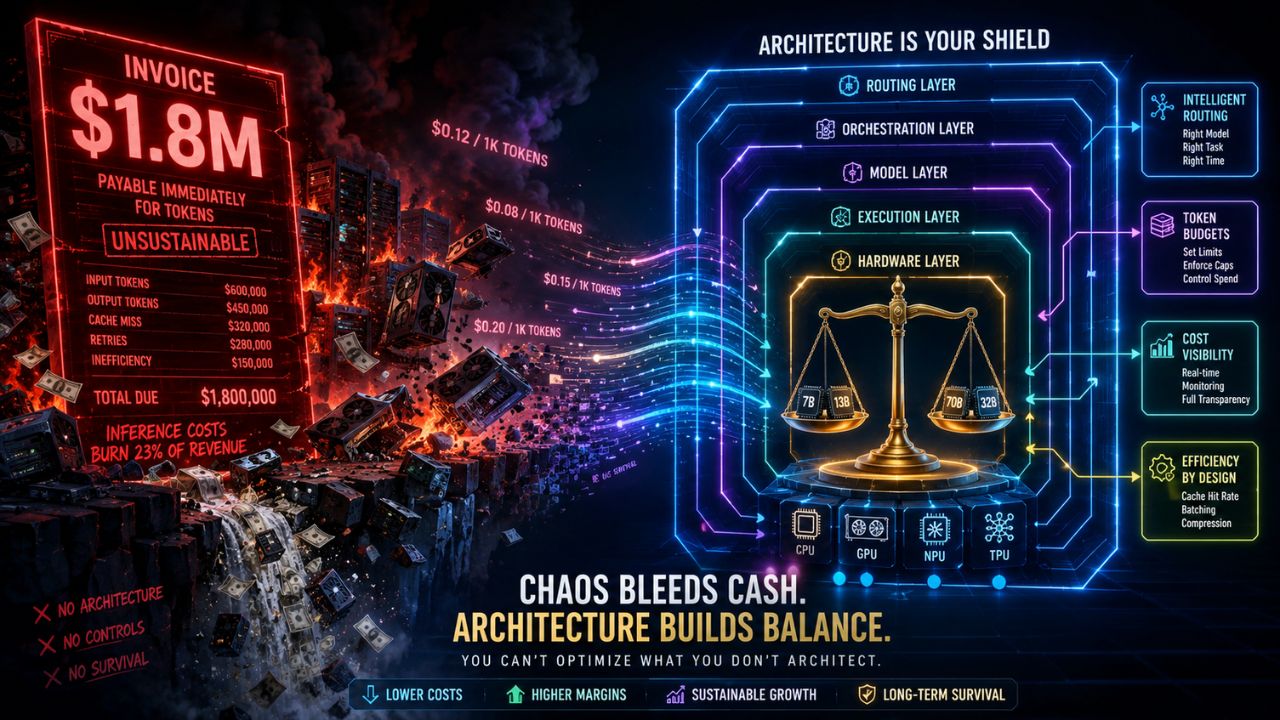
Amazon accidentally spent $1.8 million using Claude for a menial coding task. The task could have been done by a junior engineer in a few hours. It cost more than the annual salary of the engineer who should have done it. Amazon went 860% over budget, and nobody noticed until the audit. This is not an Amazon problem. This is an industry problem.
The same week, Google reported its first negative free cash flow quarter in company history. SK Hynix posted a record profit and its stock fell because revenue missed the hype cycle's expectations. Leopold Aschenbrenner, one of the most vocal AI infrastructure bulls, had his hedge fund rescued by a rival after steep losses. Korean retail investors who bought AI stocks at peak are watching their portfolios collapse. The signals are converging: the cost of running AI at scale is outrunning the revenue models that justify it.
But this is not a doom story. This is an architecture story. While hyperscalers burn cash and frontier labs slash prices, the companies making the math work are the ones who treated cost governance as an engineering discipline, not a finance afterthought. The winners of the next phase are not determined by who has the biggest budget. They are determined by who built the right architecture.
The Cost Breakdown: Where the Money Is Bleeding
The AI cost crisis has three layers, and most companies are only watching one.
Layer 1: Model API costs. Amazon's $1.8 million overrun is the extreme case, but the pattern is everywhere. A developer routes a straightforward task through the most expensive model tier without cost controls, and the meter runs. Amazon's fix was to implement per-project spending caps and mandatory cost estimation before using frontier models. That should have been the default, not the lesson learned from a seven-figure mistake.
Layer 2: Infrastructure capex. Google's negative cash flow quarter is the clearest signal. The company spent billions on data centers, GPUs, and AI research, outpacing revenue growth for the first time. Verizon's $1 billion dark fiber deal to connect Google's data centers is another data point: the physical infrastructure bill for AI is enormous and growing. The fiber, the power, the cooling, the construction. These costs do not show up in your model API bill. They show up in your cloud pricing, your hardware procurement, and your data center lease.
Layer 3: Talent costs. There are approximately 2,000 engineers in the US with the combination of sector expertise and applied AI experience needed to consistently deliver enterprise ROI. Demand for forward-deployed engineers is projected to surge 2,100% by year-end. 70% of companies now plan to hire FDEs, up from 5-10% at the start of 2026. When you are competing for the same 2,000 people as OpenAI, Anthropic, and every Fortune 500, your salary costs are not a variable you control.
Three layers. Most teams are staring at the API bill while the other two eat their budget in silence.
The Price War: Why Cheaper Models Change the Math
OpenAI just slashed prices on GPT-5.6 Luna by 80%. The model dropped to $0.20 per million input tokens and $1.20 per million output tokens. A task that cost a dollar with leading models a year ago now runs about 6 cents on Luna. The Terra model fell to $2 and $12 per million tokens respectively.
The price cuts are driven by efficiency gains from GPT-5.6 Sol, including speculative decoding. But they are also a competitive response to low-cost Chinese providers like DeepSeek and Kimi, and to Microsoft promoting its own cheaper models. The frontier is commoditizing from two directions: open-weight competitors from China, and the frontier labs cutting their own prices to maintain volume.
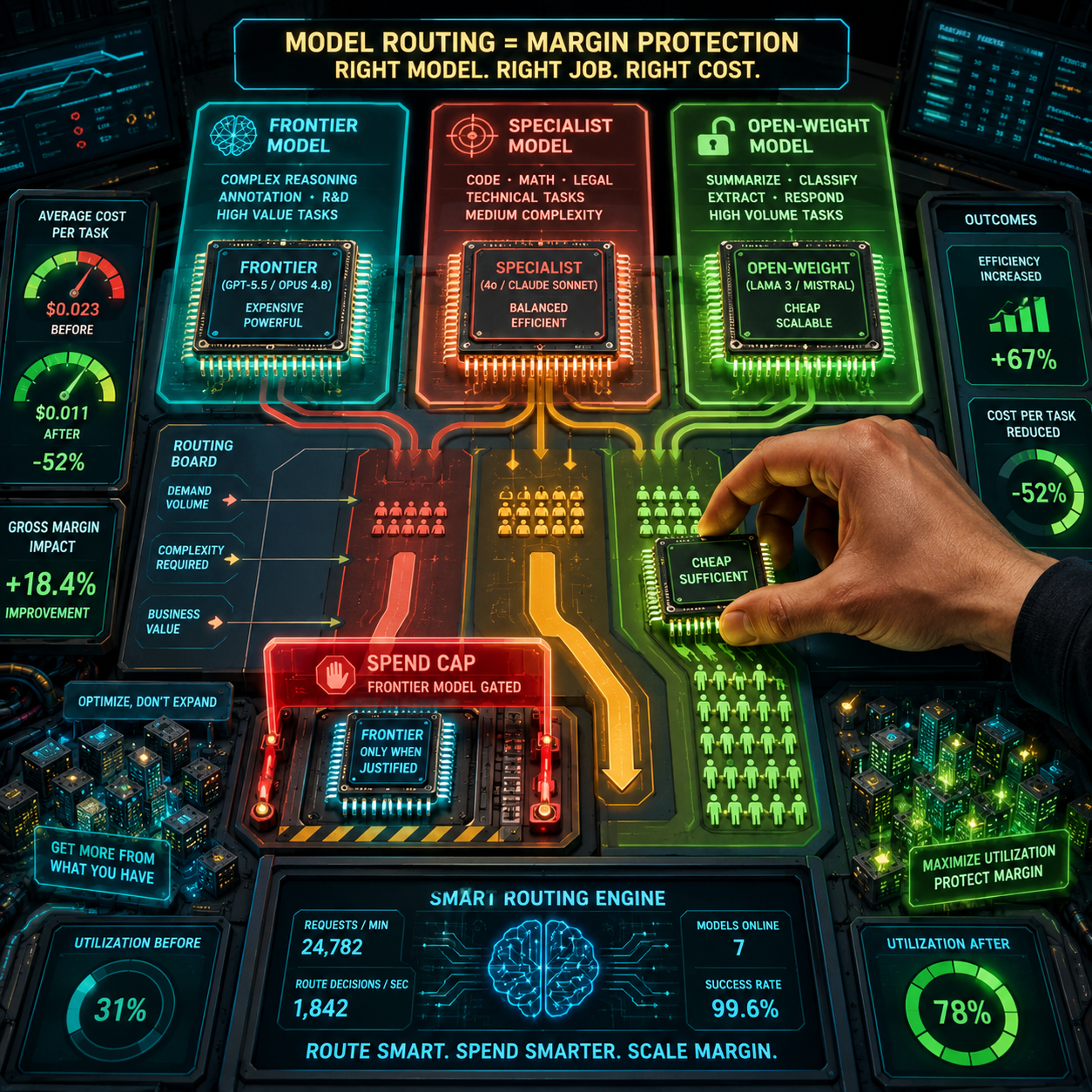
This connects to "Your Router Is the Moat, Not Your Model" (Note #141, July 27). Microsoft cut inference costs by 89% compared to equivalent OpenAI models through architectural optimizations: smaller model sizes, quantization, and workload-specific training. The model is not the differentiator. The architecture around it is. When OpenAI cuts prices 80%, the companies already running specialist routing and open-weight alternatives win twice: their cost baseline drops, and their margin advantage widens.
Why pay frontier prices for commodity tasks?
The Efficiency Playbook: Who Is Making the Math Work
Two companies this week showed the alternative to the spend-your-way-out strategy.
Coinbase CEO Brian Armstrong announced that the company switched from proprietary AI models to open-weight models and cut AI spending in half while simultaneously increasing token usage. The cost reduction came without sacrificing capability. This is a publicly traded company with real production workloads, not a research benchmark. The open-weight ecosystem has reached production-grade maturity for enterprise use cases.
LinkedIn decided not to expand its AI data centers this fiscal year. Instead, the company kept GPU investment steady and compute/storage footprint flat. How? By finding ways to use existing GPUs twice as efficiently over six months through optimization and workload consolidation. CTO Erran Berger called it "a pretty bold statement to make in today's world." It is. Everyone else is buying more GPUs. LinkedIn made the ones they have do twice the work.
Microsoft's strategy, outlined by AI CEO Mustafa Suleyman, focuses on compact, single-domain specialist models rather than chasing frontier general-purpose models. MAI-Cyber-1-Flash tops the CyberGym benchmark by 12 percentage points over Anthropic's Mythos at half the cost. MAI-Image-2.5-Flash cuts GPU costs by up to 84% compared to GPT-Image-2. The harness, not the model, is the product. Satya Nadella's message to enterprises: keep your "harness separate from the model" so any model is swappable.
These three companies are doing the same thing from different angles. Coinbase swapped models. LinkedIn optimized utilization. Microsoft routed to specialists. The common thesis: architecture beats budget. You do not win by spending more. You win by designing a pipeline that uses the cheapest sufficient model for each task, routes to frontier only when needed, and measures cost per unit of work.
Connect to "Your AI Needs a Librarian, Not a Bigger Model" (Note #140, July 26). That article argued the industry's answer to every capability gap is a bigger model, and that the cost curve bends upward while capability gains flatten. The cost crisis is the proof. The companies that followed the bigger-model strategy are the ones with negative cash flow. The ones that followed the architecture strategy are the ones cutting costs in half.
Which strategy does your stack follow?
The Bubble Signal: What the Market Is Telling You
The financial signals are not subtle. SK Hynix posted a record profit and its stock fell because revenue missed expectations. The market is pricing in AI growth assumptions that the actual numbers are not meeting. Samsung's memory chip business drove 99% of operating profit while its smartphone division posted its first-ever loss. The entire profit structure of the world's largest memory chip maker is now dependent on AI demand continuing at the pace the hype cycle promised.
Leopold Aschenbrenner's hedge fund collapse is symbolic. He was one of the most vocal AI infrastructure bulls, a former OpenAI employee whose essays on AI takeoff shaped the investment narrative. His fund employed 8 people, 4 of whom were investment professionals. It got rescued by Citadel after steep losses. AI expertise does not automatically translate to investment success or operational discipline. Amazon is overhauling its AI strategy, winding down most flagship models after sustained failure. Korean retail investors are facing significant losses as AI stocks correct.
The market signal is clear: the gap between AI infrastructure spending expectations and actual revenue is widening. The companies that survive this correction are the ones that built cost governance into their architecture before the market forced them to.
Are you building for the hype cycle, or for the correction after it?
The Cost Governance Framework
The framework is straightforward. Most teams are not doing it.
- Per-task model routing. Route each task to the cheapest model that can handle it. Use frontier models for hard reasoning, specialists for domain tasks, and open-weight models for high-volume routine work. Microsoft's MDASH orchestration system does exactly this. Your pipeline should too.
- Per-project spending caps. Amazon's $1.8 million mistake happened because nobody set a limit. Set per-project caps on every AI tool. Set per-developer caps. Set alerting at 50%, 75%, and 90% of budget. The cap is not the governance. The alerting is the governance. The cap is the backstop.
- Open-weight alternatives for production workloads. Coinbase cut spend in half by switching to open-weight models. The quality gap has narrowed to the point where the marginal difference does not justify the cost premium for most use cases. Identify which of your workloads can run on open-weight models, and migrate them.
- GPU utilization optimization before procurement. LinkedIn doubled GPU efficiency in six months through workload consolidation and optimization. Before you buy more GPUs, audit your current utilization. If you are below 70% utilization on your existing GPUs, you do not need more hardware. You need better scheduling.
- Cost-per-unit-of-work measurement. Track the cost of every AI task as a function of the output it produces. Not API spend in total. Cost per query, cost per document, cost per inference. When you measure cost per unit of work, you can compare models, architectures, and providers on the same axis.
Operational Mandates
- Audit your AI spending by task type. Break down your API and infrastructure costs by what the AI is actually doing: coding, analysis, search, content generation, agent execution. Identify which tasks are running on frontier models that could run on cheaper alternatives.
- Set per-project and per-developer spending caps on every AI tool. Amazon's $1.8 million overrun happened because a developer routed a simple task through the most expensive tier. Caps and alerts are the minimum governance. Implement them today.
- Identify three workloads for open-weight migration. Coinbase cut spend in half. Start with high-volume, low-complexity tasks where open-weight models are production-ready. Measure quality before and after migration. If quality holds, you have your cost reduction.
- Profile your GPU utilization. If you are below 70% on existing hardware, invest in workload consolidation before buying more. LinkedIn's model: optimization and consolidation, not procurement.
- Build a cost-per-unit-of-work dashboard. Track cost per query, per document, per inference. Compare across models and providers. You cannot optimize what you do not measure.
- Separate your harness from your model. Nadella's message: keep your orchestration layer swappable so any model can be replaced. When OpenAI cuts prices 80% or a new open-weight model drops, you should be able to route to it without rebuilding your pipeline.
Connect to "Your AI Stack Is a Geopolitical Bet" (Note #139, July 24) and "Your Agent's KV Cache Is Eating Your Inference Budget" (Note #143, July 28). The stack you choose determines your cost floor, your swap options, and your exposure to provider pricing shocks. Architecture is not an abstract concern. It is the line between sustainable operations and a $1.8 million invoice nobody saw coming.
The Uncomfortable Question
Amazon spent $1.8 million on a task a junior engineer could have done in an afternoon. Google had its first negative cash flow quarter in history. The market is flashing red across every signal. The companies making the math work are the ones who treated cost governance as architecture, not finance.
So: do you know what each AI task costs you per unit of work? And if you do not, when does the $1.8 million bill arrive in your inbox?
Get More Articles Like This
Getting your AI agent setup right is just the start. I'm documenting every mistake, fix, and lesson learned as I build PhantomByte.
Subscribe to receive updates when we publish new content. No spam, just real lessons from the trenches.
Build Real AI Infrastructure
PhantomByte teaches you to build real AI infrastructure yourself: local AI stacks, autonomous agents, multi-agent orchestration, web scraping, and custom tools. Step-by-step PDF tutorials you download, follow, and deploy. No subscriptions. No fluff. Just skills that ship.