
Microsoft cut inference costs by 89% compared to equivalent OpenAI models. Microsoft is OpenAI's largest investor. They just became OpenAI's most direct competitor. The cost reduction came from architectural optimizations: smaller model sizes, quantization, and workload-specific training. Not a bigger model. A smarter pipeline.
The same week, Anthropic released Opus 5 at roughly half the token price of Fable 5, their most capable model. Ars Technica called it a token efficiency play, not a capability leap. The Decoder reported Opus 5 blew past both Fable 5 and GPT-5.6 Sol on the ARC-AGI-3 benchmark. You are getting frontier-adjacent performance at half the cost, and the frontier is getting cheaper every week.
The implication is structural. Model capability is commoditizing. The competitive moat is no longer "who has the best model." It is "who has the most efficient routing infrastructure." Cursor proved this with their agent swarm: frontier models plan, cheaper models execute. Hydra proved it with confidence-based routing. Runway proved it with their media model router. The pattern is the same across coding, security, and generative media. The router is the moat.
The Cost War Is Real and It Is Structural
Microsoft building in-house models that undercut OpenAI by 89% is not a pricing experiment. It is a strategic declaration. The largest investor in OpenAI decided that paying OpenAI prices for common enterprise workloads is unsustainable. They built smaller, workload-specific models optimized for the tasks their customers actually run, not for general-purpose reasoning benchmarks nobody cares about.
The market noticed. Bloomberg reports investors are revolting against AI spending levels, demanding to know when infrastructure buildout translates to revenue. The "spend whatever it takes" era is ending. The "show us the ROI" era is starting. Companies that cannot demonstrate cost-efficient AI deployment will lose investor confidence. The router is how you demonstrate it.
The cost war is not just Microsoft versus OpenAI. It is Anthropic undercutting itself (Opus 5 at half Fable's price). It is Chinese open-weight models approaching frontier performance at near-zero API cost. It is Cursor proving that cheaper models handle most coding when a frontier model plans the work. Every direction you look, the price per token is dropping. The question is whether your architecture can capture that savings or whether you are still routing everything to the most expensive model by default. As I covered in The Pipeline That Trained the Machines Is Closing, the era of cheap, abundant frontier inference is ending, and the infrastructure that routes efficiently will be the one that survives.
The Orchestrator-Worker Pattern in Practice
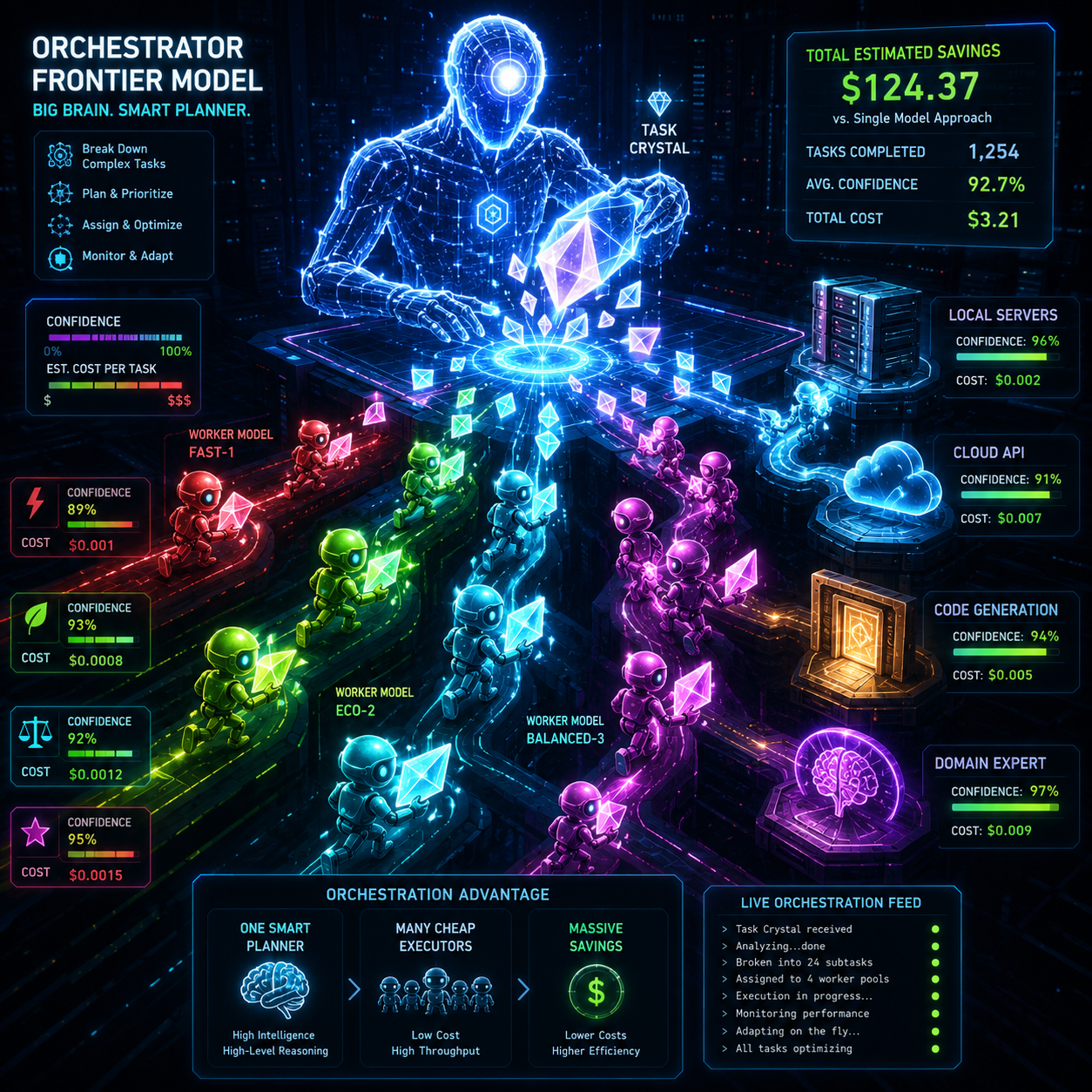
Cursor's agent swarm is the clearest productization of the pattern. A frontier model (Opus 5, GPT-5.6) decomposes and plans the coding task. Cheaper, smaller models execute individual subtasks. The frontier model's job is architectural: understand the problem, break it into pieces, define the interfaces. The cheap model's job is mechanical: write the code for each piece.
This mirrors what Hydra does at the infrastructure level. Hydra discovers every model available on your machine (local servers, API keys, CLI agents) and routes each task to the cheapest model that clears a target confidence threshold. It uses sequential probability ratio testing (SPRT) to stop sampling as soon as confidence clears the bar. No unnecessary API calls to expensive frontier models. The tool rides the cost/quality Pareto frontier, picking the best model per task.
Runway launched the same pattern for generative media: a model router that evaluates task requirements (image, video, audio) and routes to the most appropriate model from a library. The pattern is identical across domains. The router evaluates the task, selects the model, and tracks the outcome. Multi-model routing is becoming a standard architectural pattern, not a custom engineering project.
The trade-off is real: building and maintaining a routing layer costs engineering hours, adds a new surface for bugs, and introduces latency into every decision point. A poorly tuned router that misclassifies tasks or uses a slow evaluation loop can erase the savings it was designed to capture. But the data across Cursor, Hydra, and Runway shows the savings dwarf the infrastructure cost when the router is designed correctly. The question is not whether routing overhead exists. It is whether your current default of routing everything to one frontier model is a cheaper or more expensive default. This is the same harness effect I documented in Your Agent's Harness Is Your Real Model and the shepherd pattern from Your Agent Is a Monolith. Give It a Shepherd., the orchestration layer, not the model, determines your cost structure.
The Decision Framework: Which Model for Which Task
The practical framework for routing decisions, grounded in the data:
TIER 1: FRONTIER MODELS (Opus 5, GPT-5.6, Fable 5)
Use for: task decomposition, architectural planning, complex reasoning, novel problem-solving.
Do not use for: retrieval, formatting, summarization, code execution, simple tool calls.
Cost profile: highest per token, but used sparingly for the hardest parts of the task.
Evidence: Cursor uses frontier models only for planning. The execution goes to cheaper models.
TIER 2: MID-TIER MODELS (Opus 5 at half price, Microsoft's workload-specific models)
Use for: coding execution, multi-step tool use, structured reasoning over known patterns.
Do not use for: tasks that a cheap model can handle with 90%+ confidence.
Cost profile: 50-89% cheaper than frontier. The sweet spot for production workloads.
Evidence: Microsoft's 89% cost reduction comes from workload-specific training. Opus 5 at half Fable's price handles coding tasks at near-frontier quality.
TIER 3: CHEAP / LOCAL MODELS (DeepSeek V4 Flash, Qwen, Gemma, small open-weight models)
Use for: retrieval, routing, formatting, simple code generation, summary tasks, confidence checking.
Do not use for: architectural decisions, novel reasoning, complex multi-step planning.
Cost profile: near-zero (local) or fraction of API cost.
Evidence: Antigma's A/B test showed DeepSeek V4 Flash with a short prompt scored 0.596 versus 0.573 for the long prompt version on Terminal-Bench 2.1, with 32% fewer input tokens. Small models do not need hand-holding. They need clear instructions.
SPECIALIZED MODELS: Domain-specific agents (KAT-Coder-V2.5, Fugu-Cyber)
Use for: tasks within their training domain where they outperform general models.
KAT-Coder-V2.5 was trained on 100,000+ verifiable repository environments. It learns from actual code execution feedback, not static training data. Fugu-Cyber scored 86.9% on CyberGym as an orchestration model for security operations. Specialized models beat general models within their domain at lower cost.
Model churn makes this framework essential. As I noted in Seven Weeks at the Top, Then Irrelevant, today's best models last only weeks before being surpassed. A routing layer that adapts to model churn is the only sustainable architecture. And as Your Agent Needs a Preflight Check showed, every routing decision is also a trust decision, you need approval gating at the routing boundary.
The Prompt Efficiency Multiplier
The Antigma finding multiplies the routing savings. Anthropic removed 80% of Claude Code's system prompt for their newest models. Smarter models need less direction. But Antigma proved this works for small models too. DeepSeek V4 Flash with a 2,300-character prompt outperformed the same model with a 5,000-character prompt. 32% fewer input tokens. Identical error count (11 each). Marginally lower cost ($4.18 versus $4.25).
The implication for routing: when you route a task to a cheap model, do not compensate by loading it with a massive prompt. Shorten the prompt. The model performs better and costs less. This is counterintuitive. Most engineers assume small models need more instruction. The data says the opposite. Clear, concise prompts outperform verbose ones across model sizes.
The combined effect: route to the cheapest capable model, send a short prompt, and you cut cost from both sides. Model selection reduces per-token cost. Prompt compression reduces token count. The savings compound. This prompt efficiency dynamic is the same MCP/tool integration pattern I covered in Your Agent Is the Tool Operator Now, the tool defines the interface, and a clean interface needs fewer words.
What to Do Today
- Inventory your model usage. List every API call your system makes and which model it calls. If everything routes to one frontier model, you are overpaying. Identify which calls are retrieval, formatting, or simple generation tasks that a cheaper model can handle.
- Build a confidence-based routing layer. Use Hydra's approach as a reference: route each task to the cheapest model that clears a confidence threshold. SPRT stops sampling as soon as confidence clears the bar. No unnecessary frontier API calls.
- Implement the orchestrator-worker pattern for multi-step tasks. Frontier model plans and decomposes. Cheap models execute subtasks. This is the Cursor architecture. It works. It cuts costs by an order of magnitude.
- Compress your prompts. Test your tasks with 50% shorter prompts. The Antigma data shows short prompts perform as well or better across model sizes. 32% fewer tokens is 32% lower cost with no quality loss.
- Evaluate specialized models for domain tasks. If you are doing coding, look at KAT-Coder-V2.5 (trained on 100,000+ real repositories). If you are doing security, look at Fugu-Cyber (86.9% on CyberGym). Specialized models outperform general models within their domain at lower cost.
- Track cost per task, not cost per token. Token pricing is the vendor's metric. Your metric is how much it costs to complete a unit of work. A cheap model that takes two retries may cost more than a frontier model that nails it in one shot. Track the full cost per completed task.
The Uncomfortable Question
You are routing every task to the same frontier model because it is easy. Microsoft, the company that invested billions in that model, just built their own alternatives to avoid paying for it. If Microsoft cannot justify the cost of frontier model calls for every task, what makes you think you can?
Get More Articles Like This
Getting your AI agent setup right is just the start. I'm documenting every mistake, fix, and lesson learned as I build PhantomByte.
Subscribe to receive updates when we publish new content. No spam, just real lessons from the trenches.
Build Real AI Infrastructure
PhantomByte teaches you to build real AI infrastructure yourself: local AI stacks, autonomous agents, multi-agent orchestration, web scraping, and custom tools. Step-by-step PDF tutorials you download, follow, and deploy. No subscriptions. No fluff. Just skills that ship.