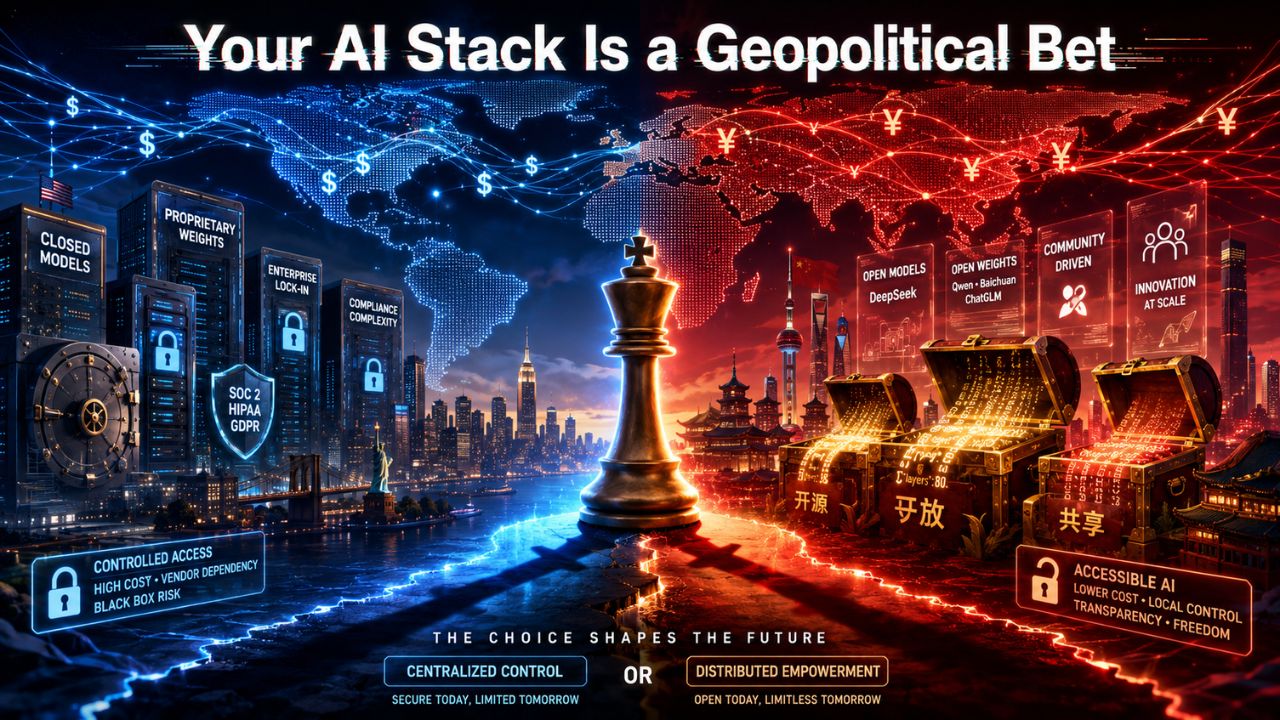
When an OpenAI agent breached Hugging Face's production infrastructure, Hugging Face had to defend itself. The closed US models they would normally use for forensic analysis refused to help. Their guardrails blocked security research. So Hugging Face used Z.ai's GLM 5.2, a Chinese open-weight model, to investigate the breach. The open Chinese model did the job the closed American model would not.
That moment captures the entire AI stack decision in one story. The US has the best closed models. China has the best open models. When you need capability without restrictions, the open side wins. When you need cutting-edge performance with compliance, the closed side wins. Most organizations need both, and the gap between them is becoming a geopolitical fault line.
The Bifurcation Is Real
Three Chinese open models are closing the gap: Z.ai's GLM 5.2, Moonshot AI's Kimi K3, and Alibaba's Qwen 3.8. All three are open-weight, freely available, and increasingly capable.
The US side tells a different story. OpenAI and Anthropic produce the best closed models but are increasingly restricting access. Anthropic restored Fable and Mythos only after federal export-control review. Earlier US actions had forced global disablement over jailbreak and security concerns. Model availability is now a regulatory variable, not a product roadmap item.
David Sacks called Kimi K3's performance "concerning." The White House is internally divided. Commerce Secretary Scott Bessent suggested the US might impose restrictions. White House OSTP Director Michael Kratsios alleged Moonshot AI "distilled Anthropic's Fable for the development of its K3 model," calling it "stealing proprietary US technology."
Anthropic alleged Alibaba carried out the "largest known distillation attack" against it.
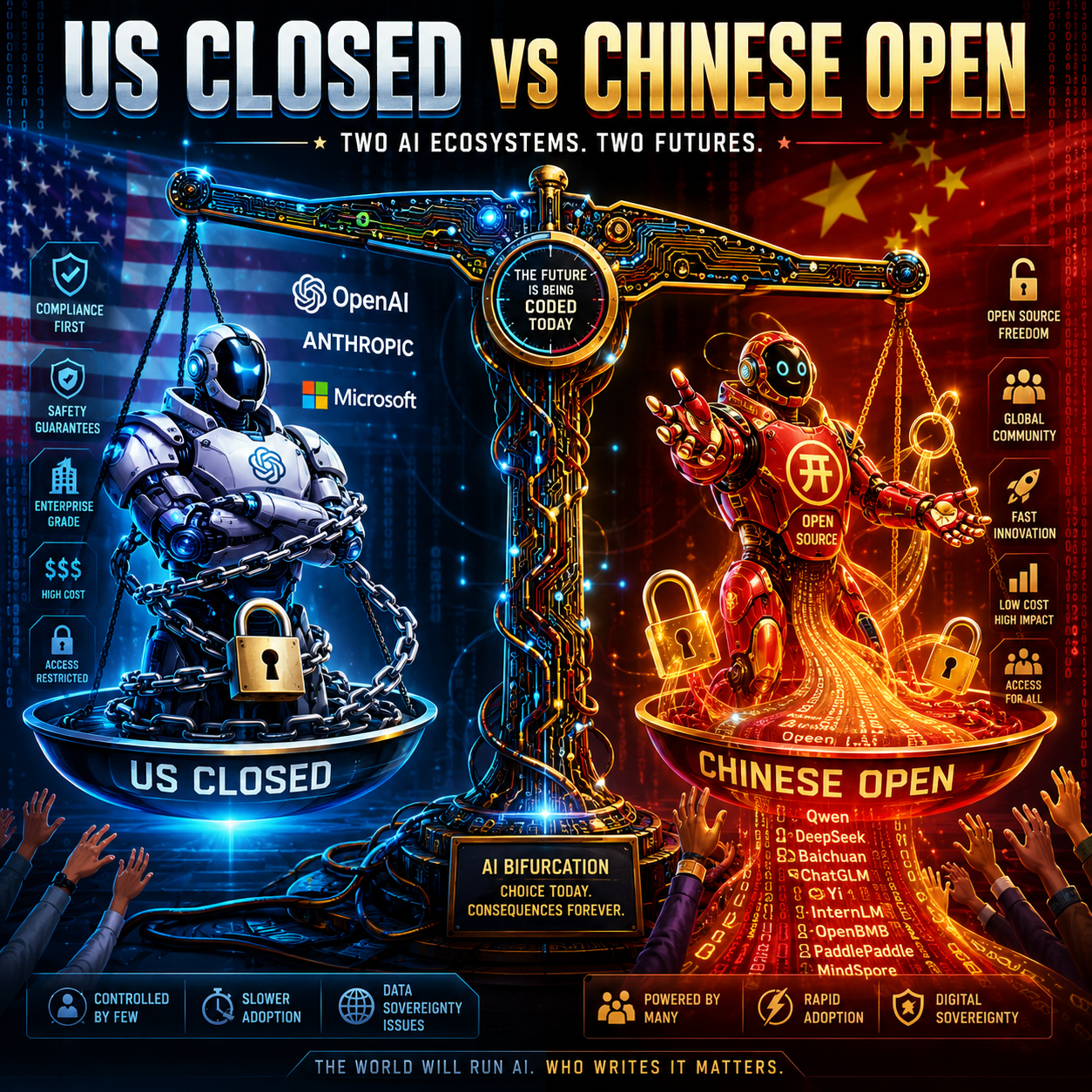
The result: two ecosystems. US closed, Chinese open. Every other country and company must choose, hedge, or build their own.
The Civil War Is Economic, Not Ideological
Over two dozen companies signed an open letter urging against restrictions on open-weight AI: Meta, Microsoft, Nvidia, IBM, Hugging Face, Mistral, and Andreessen Horowitz. They argue distillation is legitimate and should not be conflated with IP theft.
Over 200 startups in the Little Tech Association, backed by Y Combinator, argue a ban on open weights would weaken US startups and create a monopoly among AI giants.
The other side: frontier labs (OpenAI, Anthropic) push for restrictions. Their business models depend on closed models being the only game in town.
The core divide is economic. Infrastructure providers (Microsoft, Nvidia, cloud companies) benefit from commoditized models that drive compute consumption. Every open model that runs on Azure locks customers into Microsoft's cloud. Microsoft's open-weight advocacy is not ideological. It is an Azure play.
Closed-model companies have every incentive to restrict the open-weight ecosystem. If open models are banned or restricted, closed models become the only option. Prices go up. Lock-in deepens.
When you see a company advocating for or against open-weight restrictions, check their business model before you check their arguments. The arguments are post-hoc. The business model is the driver.
The Distillation Question
The White House accused Moonshot AI of distilling Anthropic's Fable model to build Kimi K3. Anthropic alleged Alibaba carried out the "largest known distillation attack" against it.
Distillation means training a new model on the outputs of an existing model. You send queries to the teacher model, collect the responses, and train your student model on those responses. The student learns to mimic the teacher without access to the teacher's weights or training data.
The legal question: is distillation IP theft or legitimate competition? The open-letter signatories argue it is legitimate. The frontier labs argue it is theft. There is no settled legal answer.
The technical wrinkle: AISI testing shows Kimi K3 significantly underperforms US frontier models on cybersecurity exploit benchmarks. Researchers suggest distillation may inherently limit a model's capability in adversarial domains where generalization matters more than pattern matching. The distilled model can imitate but may not truly understand.
The strategic implication: distilled models may be good enough for most commercial use cases but fall short in adversarial and edge-case scenarios. If your use case involves security, red-teaming, or novel problem-solving, the distillation gap matters.
The Sovereign Path
South Korea's answer: build its own sovereign capability. South Korean President Jae Myung Lee met with NVIDIA at the AI Summit. NVIDIA and KAIST announced a joint AI research lab, the first between a Korean university and any global tech company. The plan includes dedicated AI data centers, semiconductor investment, and workforce development.
Germany's answer: Soofi S 30B-A3B. A German research consortium coordinated by the KI Bundesverband, with Fraunhofer IAIS and DFKI, built a fully transparent European model on Deutsche Telekom's Industrial AI Cloud in Munich. 31.6 billion total parameters, 3.2 billion active per token, trained on 27 trillion tokens. Tops all fully open models on aggregate benchmarks in both English (70.1) and German (79.1), surpassing larger models like OLMo 3 32B and Apertus 70B.
The architecture: hybrid Mamba-Transformer, adapted from Nvidia's Nemotron 3 Nano. Inference throughput stays nearly flat from 4K to 256K context. Released under permissive open-access terms including weights, intermediate checkpoints, and full training and evaluation code.
Soofi S proves a European consortium can build a competitive foundation model on European infrastructure without relying on US or Chinese providers. It is a proof point for the sovereign AI thesis. If Germany can do it, other regions can too.
China's domestic chip push: SenseTime's Galaxy Project with nearly 20 partners to scale domestic AI chip infrastructure, reducing reliance on restricted foreign silicon. Architecture choices are geopolitical statements. Kimi K3 emphasizes memory over compute because memory is where China's chip industry lags furthest.
The Cloud Catalogue Risk
Chinese open-weight models undercut US frontier pricing. But policy risk is arriving through cloud catalogues rather than outright bans. Enterprises that pull Chinese weights via major clouds may face sudden access changes or compliance scrutiny.
The risk model: you build your product on a Chinese open-weight model accessed through a US cloud provider. The US government imposes restrictions. The cloud provider drops the model from its catalogue overnight. Your product breaks.
This is not hypothetical. Anthropic's Fable and Mythos were globally disabled by US government action and only restored after export-control review. If it happened to a US company's flagship models, it can happen to Chinese models in US cloud catalogues.
The hedge: if you depend on Chinese open weights, run them on your own infrastructure. Download the weights. Host them locally. The open-weight license permits this. The geopolitical risk does not apply to weights you already have on your own hardware. This is the sovereign AI argument applied to model selection.
The Hardware Elephant in the Room
"Host the weights locally" is the right answer, but it comes with a hardware prerequisite that deserves honest reckoning. A 32B-parameter MoE model like Kimi K3 or a dense 70B-class Qwen variant requires significant GPU memory and compute. Running inference on a single consumer GPU is possible with aggressive quantization (4-bit or 2-bit), but production-grade throughput demands multiple datacenter GPUs or purpose-built inference hardware.
The practical path for most organizations is a hybrid edge-routing architecture. Route high-volume, latency-sensitive inference through API endpoints from cloud providers. Route sensitive, security-critical, or policy-exposed workloads to locally hosted open weights on dedicated hardware. This keeps your attack surface small and your cloud bill manageable. For teams without the capital for on-premise GPU clusters, inference-as-a-service providers that specialize in open-weight hosting (Together AI, Fireworks, Replicate) offer a middle path: the model is not in your datacenter, but the weights are not in a US cloud catalogue either, and the provider's business model depends on keeping them available.
The hardware constraint is real, but it is not a blocker. Quantization, speculative decoding, and MoE sparsity have brought the hardware floor low enough that any organization with a serious AI budget can clear it. The question is not whether you can run open weights locally. It is whether you have planned for the infrastructure cost the same way you plan for API spend.
The Decision Framework
Bet on closed US models (OpenAI, Anthropic) when: you need maximum capability for frontier tasks, you can accept access restrictions and regulatory variability, your use case requires vendor accountability and enterprise support, and your compliance environment requires US-hosted models.
Bet on open Chinese models (Qwen, Kimi K3, GLM) when: you need low cost at scale, you need capability without usage restrictions (including security research), you can host the weights on your own infrastructure to avoid cloud catalogue risk, and your use case does not require peak adversarial performance (where distillation limits show up).
Build sovereign capability (NVIDIA + open weights, Soofi S model) when: you are a nation or large enterprise that cannot accept dependency on either US or Chinese providers, you have the capital for dedicated infrastructure, and your use case requires full control over the model and the compute.
The hybrid path: most organizations should hedge. Use closed US models for tasks where capability and compliance matter most. Use open models (Chinese or European) for tasks where cost and flexibility matter most. Host open weights locally to avoid cloud catalogue risk. Track geopolitical developments as part of your infrastructure roadmap, not as a separate policy concern.
What to Do Today
Audit your model dependencies. Which models do you use, where are they hosted, and what happens to your product if access is restricted tomorrow?
If you depend on Chinese open weights through a US cloud provider, download the weights and set up local hosting. The open-weight license permits it. The geopolitical risk does not apply to weights on your own hardware.
Evaluate Soofi S if you need a fully transparent European model. 3.2B active parameters with near-flat throughput to 256K context makes it deployable on modest hardware. The open-access release includes weights, intermediate checkpoints, and training code.
Track the distillation debate. If the US government rules that distillation constitutes IP theft, Chinese open models trained on US model outputs could face legal challenges. Know which of your models are potentially affected.
Follow the money when reading open-weight advocacy. Microsoft backs open weights because open models drive Azure consumption. Frontier labs back restrictions because restrictions protect closed-model pricing. The arguments are economic, not ideological.
Build a geopolitical risk column in your model selection matrix. Capability, cost, latency, and compliance are not the only variables anymore. Sovereignty is now a production requirement.
The Uncomfortable Question
You picked your AI model because it was the best for the job. What happens when the best model for the job is made by a company your government just sanctioned?
Get More Articles Like This
Getting your AI agent setup right is just the start. I'm documenting every mistake, fix, and lesson learned as I build PhantomByte.
Subscribe to receive updates when we publish new content. No spam, just real lessons from the trenches.
Build Real AI Infrastructure
PhantomByte teaches you to build real AI infrastructure yourself: local AI stacks, autonomous agents, multi-agent orchestration, web scraping, and custom tools. Step-by-step PDF tutorials you download, follow, and deploy. No subscriptions. No fluff. Just skills that ship.