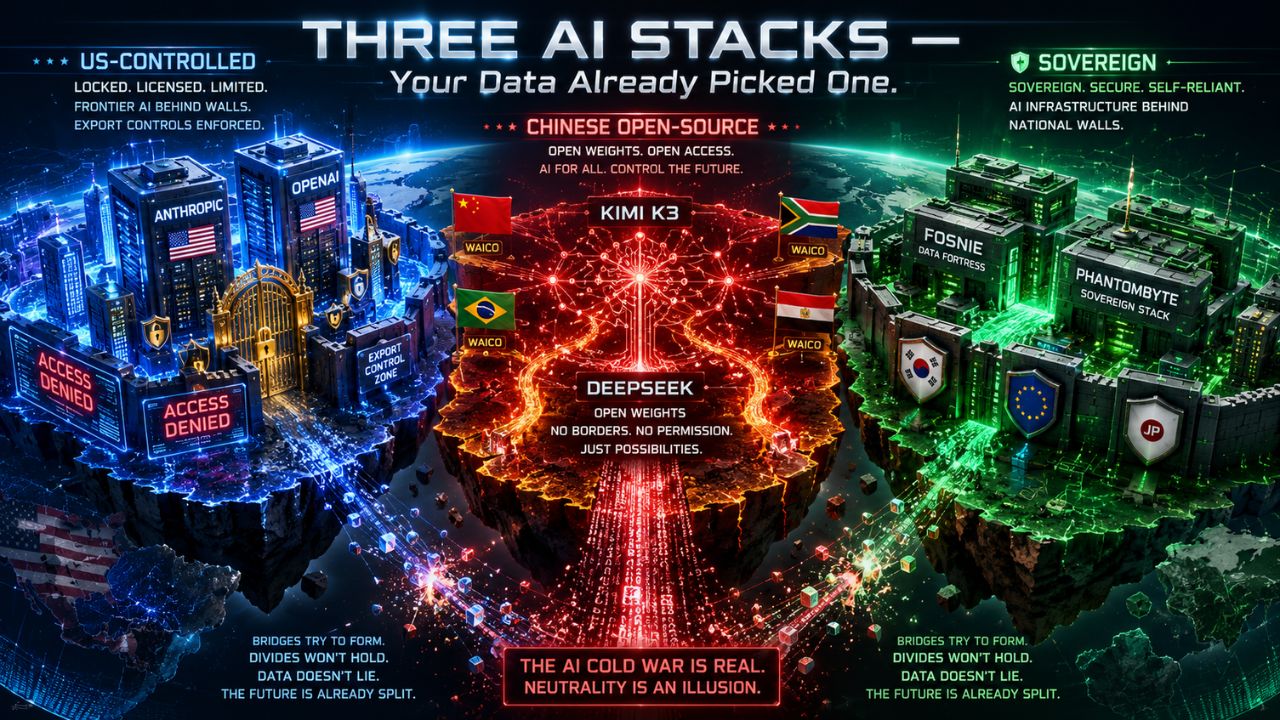
US export controls, China's open-source surge, and Europe's sovereign push are fragmenting AI into separate ecosystems. The model you can deploy now depends on where your data lives. And most engineers have not realized the choice is already being made for them.
The US-Controlled Stack: Access as a Political Lever
The Trump administration is dictating access to frontier AI models from Anthropic and OpenAI. Policy dictates access tiers and partner approvals. The federal government is now a gatekeeper for cutting-edge AI capabilities.
Pre-release screening has expanded across major labs. OpenAI, Anthropic, Google, xAI, Microsoft, and others have been pressed into arrangements where federal safety bodies can review powerful models before or around release. Meta has faced public pressure to align. The White House is advancing voluntary frontier model release standards with major labs. Critics call voluntary rules under-powered. Supporters call them faster than Congress. The unresolved core is what happens when a lab defects.
The Mythos 5 access saga tells you everything about where this is going. Fable 5 and Mythos 5 were pulled on government advisement. Mythos 5 access was later re-allowed for certain partners on June 26 after export controls were partially lifted. Your model can be pulled. Your partner status can be revoked. Launch day increasingly includes a government gate.
Here is the truth. If you are building on a US frontier model, your roadmap is now subject to US government access decisions. You are not renting compute. You are renting conditional capability. And conditional capability is not capability at all.
If the US stack's conditional access is the reason to build sovereign, explore the Sovereign AI Stack blueprint, a local AI stack with no subscriptions and no data leaving your server.
The Chinese Open-Source Stack: Capability Without the Gatekeeper
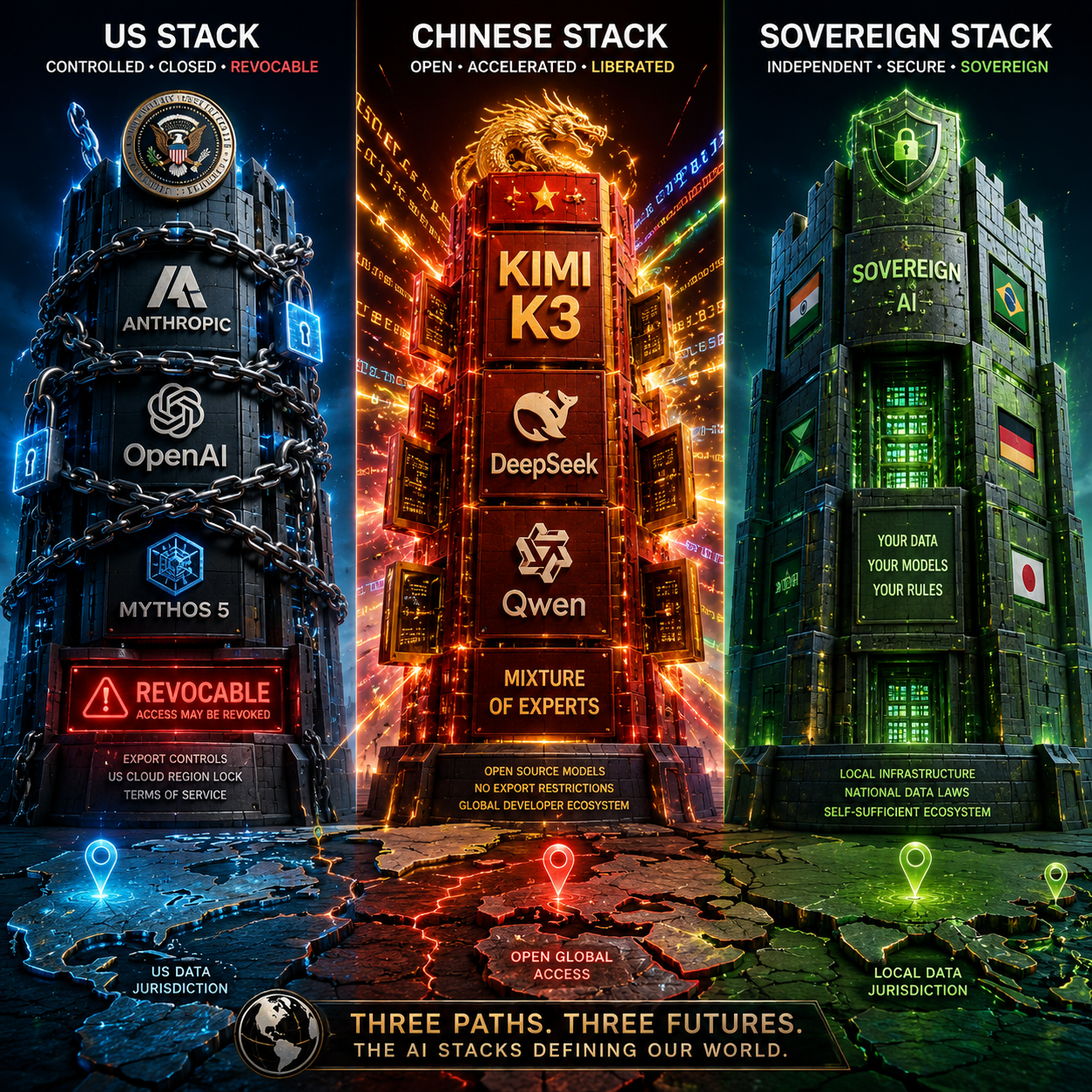
Moonshot AI's Kimi K3 is an open-source model that reportedly outperforms Anthropic's Fable 5 on specific benchmarks, according to ZDNet. It achieves GPT-5-class reasoning with approximately 40% less training compute. A Google DeepMind researcher called it "insanely good." Even an OpenAI strategist admitted it is a "very good model" that matches the best public models from early 2026.
The numbers behind that 40% matter. Kimi K3's architecture uses a mixture-of-experts design with 1 trillion total parameters but only 130 billion activated per token, meaning each inference call consumes roughly one-eighth the compute of a dense model of equivalent capability. DeepSeek V4-Pro follows a similar sparse MoE pattern with 685 billion total parameters and 37 billion activated per token, delivering GPT-5-class output at roughly 5% of the token cost. Gemma 4, at 31 billion dense parameters, fits on a single consumer GPU and still trades blows with models ten times its size on coding and reasoning benchmarks. The cost-efficiency argument is not abstract. It is arithmetic.
The pricing pressure is just as real. A Chinese developer released an AI model matching Claude and ChatGPT at roughly half the cost, echoing the DeepSeek disruption from earlier this year. The DeepSeek playbook is repeating. PhantomByte has been tracking this cost-efficiency trend, see The AI Price War Nobody Is Winning for the full breakdown.
The geopolitical wrapper matters more than the benchmark. Xi Jinping launched WAICO with 29 signatory countries, offering developing nations access to Chinese AI infrastructure without Western data governance requirements. Russia, Brazil, South Africa, Pakistan, and Indonesia are among the founding members. No Western country signed on. This is a direct challenge to the Bletchley Declaration and the emerging Western consensus on AI regulation.
Here is the signal that should change your architecture thinking. According to benchmarks from the UK's AI Safety Institute, open-weight models now match frontier closed-model cyber performance from just four months ago at a fraction of the cost. GLM-5.2 and DeepSeek V4-Pro have reached performance levels that closed frontier models hit four to seven months earlier. What cost millions in API calls then can now be done for hundreds of dollars locally.
The Chinese open-source stack is not a fallback. It is frontier-competitive.
Here is the decision that did not exist 18 months ago. If you are outside US export-control jurisdiction, or if you want infrastructure the US government cannot revoke, the Chinese open-source stack is now a real option. That changes everything.
The Sovereign / Regulated Stack: Build Your Own Because You Have To
South Korea is building sovereign cybersecurity AI launching this year, directly in response to US Mythos export controls. The cybersecurity focus signals nations are prioritizing defensive AI applications that cannot be subject to foreign export controls.
Fosnie is an open-source, self-hosted AI workspace designed for regulated industries that cannot use cloud AI services due to compliance requirements. It keeps all data and model interactions within the organization's security boundary. Finance, healthcare, and government sectors are building sovereign infrastructure by necessity, not by choice.
Illinois enacted its AI Safety Measures Act, becoming one of the first US states to pass broad AI regulation. The law covers high-risk AI systems in employment, housing, healthcare, and criminal justice, with transparency, bias testing, and accountability requirements. State-level regulatory patchwork is creating compliance complexity that pushes organizations toward sovereign or self-hosted stacks.
In the UK, Elsham Wolds in North Lincolnshire has been floated as a site for a large AI training campus, part of Europe's race for sovereign compute capacity. Britain needs power, fiber, and political patience to host frontier-scale clusters. Sovereign compute starts at the substation.
Here is the hard truth. If you operate in regulated industries or in jurisdictions where US frontier models are restricted, you are building or buying a sovereign stack. This is not optional. It is compliance-driven architecture. And compliance does not negotiate.
PhantomByte's own Sovereign AI Stack blueprint is already a sovereign-stack play. Local AI with Ollama and Hermes, no subscriptions, no data leaving your server. This is not theory. It is architecture.
The Compliance Landscape You Now Live In
The fragmentation creates a real decision tree for any organization operating across borders. The model you can use depends on where you operate and what data you handle.
Map it plainly. The US-controlled stack offers full frontier capability, subject to US government access revocation and pre-release screening. It is best for US-aligned organizations with no export-control exposure. The Chinese open-source stack offers frontier-competitive capability, no US gatekeeper, but carries geopolitical risk and potential Western regulatory pushback. It is best for organizations outside US jurisdiction or those wanting infrastructure the US cannot revoke. The sovereign or regulated stack offers self-hosted or nationally-controlled infrastructure, lower capability than frontier, but full data control. It is best for regulated industries and nations with export-control exposure.
Compliance is no longer one jurisdiction. It is many, and they disagree. Illinois passed its own AI Safety Act. The White House advances voluntary federal standards. The EU pursues its own AI sovereignty. If you operate across borders, you are already in a multi-stack compliance situation. Your stack choice now carries legal exposure, not just technical tradeoffs. For more on the regulatory landscape, see PhantomByte's analysis in No One Knows How to Gate a Frontier Model.
How to Figure Out Which Stack You Are Actually On
Audit question one: Where does your data live? If it touches US infrastructure, you are on the US-controlled stack regardless of which model you call. If it cannot leave your country or your security boundary, you are on the sovereign stack by requirement, not by choice.
Audit question two: Can your model be revoked? If your provider is subject to US government access decisions, your capability can be pulled. If you are running an open-weight model on your own hardware, it cannot.
Audit question three: What jurisdiction are your users in? If you serve users in the EU, Illinois, or other regulated jurisdictions, your stack choice must satisfy their AI regulations, not just your own.
Audit question four: What is your geopolitical exposure? If US-China relations deteriorate further, organizations straddling both stacks will be forced to pick one. Plan for that now, not when it happens.
Audit question five: How does your model actually run? This is the nuance that breaks benchmarks. A model like Nemotron 3 Ultra can toggle its internal reasoning chain on or off at inference time. With reasoning enabled, it scores in the 90th percentile on MATH and coding benchmarks. With reasoning disabled, it drops to the 60th percentile on the same tests. The same weights. The same hardware. A different configuration. Benchmark scores are meaningless without knowing whether reasoning, chain-of-thought, or multi-turn reflection was active during evaluation. When you read "Model X beats Model Y," ask what was turned on. The answer changes everything.
If the audit questions lead you to want non-revocable infrastructure, the Sovereign AI Stack blueprint is the answer, a local AI stack with Ollama and Hermes, no subscriptions, no data leaving your server.
What to Do Today
- Identify which stack you are actually on. Not the one you think you chose. The one your data, your provider, and your jurisdiction put you on.
- Audit whether your model can be revoked. If your provider is subject to US government access decisions, your roadmap carries political risk. Name it.
- Map your user jurisdictions against the regulatory patchwork. If you operate across borders, you are already in a multi-stack compliance situation.
- Evaluate an open-weight fallback. If your frontier provider is pulled or restricted, what is your backup? Moonshot K3 and other open-weight models are now frontier-competitive enough to be a real fallback, not a downgrade.
- For regulated industries, evaluate Fosnie or a self-hosted equivalent. If compliance forbids cloud AI, sovereign infrastructure is not optional. It is the only legal path.
The Uncomfortable Question
You thought you were picking a model. You were picking a stack, a government, and a jurisdiction. The question is whether you have audited which one you are already on, before someone else audits it for you.
The clock is not on your side. South Korea made its move this morning. Xi made his move this week. Washington made its move this month. The stacks are solidifying. Pick yours before it gets picked for you.
Get More Articles Like This
Getting your AI agent setup right is just the start. I'm documenting every mistake, fix, and lesson learned as I build PhantomByte.
Subscribe to receive updates when we publish new content. No spam, just real lessons from the trenches.
Build Real AI Infrastructure
PhantomByte teaches you to build real AI infrastructure yourself: local AI stacks, autonomous agents, multi-agent orchestration, web scraping, and custom tools. Step-by-step PDF tutorials you download, follow, and deploy. No subscriptions. No fluff. Just skills that ship.