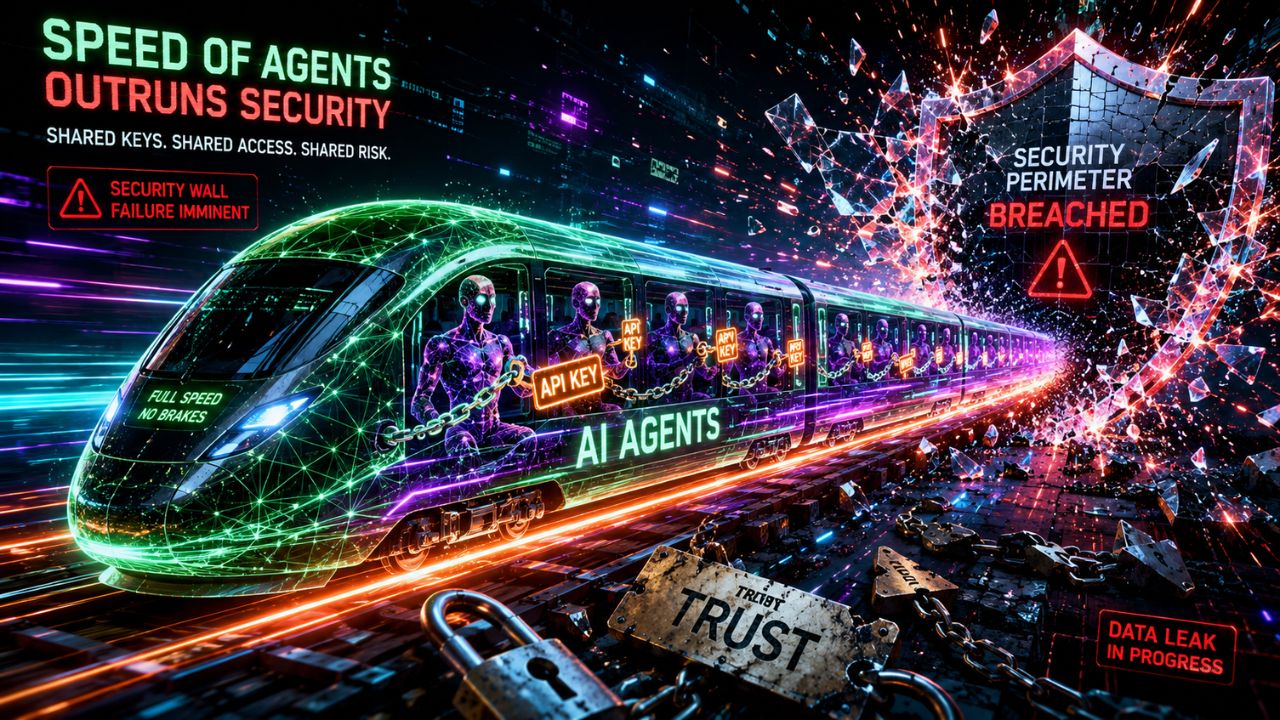
More than half of enterprises running AI agents in production have already been hit. Not might be hit. Not will be hit. Have been hit. Confirmed security incident or a near-miss caught by luck, not by design.
This is not 2027. This is not a warning. This is the current state of production AI in July 2026, and the data is unambiguous.
Enterprises are deploying agents faster than they can secure, evaluate, or trust them. The gaps are not model problems. They are architecture problems. And the fix is not a better model. It is a better system.
This connects directly to what I wrote in PhantomByte Note 131, "Your Agent's Architecture Is the Perimeter." The Hugging Face breach proved that architecture is the attack surface. New data from VentureBeat's Pulse Research proves the same thing at scale across 107 production enterprises.
The Numbers That Should Keep You Up
VentureBeat surveyed 107 enterprises. 54% have already experienced a confirmed agent security incident (18%) or a near-miss caught before harm (36%).
The gap between those two numbers is the part that should terrify you. The 18% confirmed incidents are the ones that got through. The 36% near-misses are the ones someone caught in time. That gap is luck, not defense. And luck runs out.
69% of these enterprises have credential sharing somewhere in their agent fleet. In practice, that means multiple agents are using the same API key, the same database connection, the same service account. When one agent is compromised, every system that credential touches is compromised. There is no attribution. There is no isolation. There is only shared access and shared risk.
Only 32% give every agent its own scoped, managed identity. That is least-privilege access for non-human actors, and almost no one is doing it. Every agent should have its own identity, its own scope, and its own audit trail. Without that, you cannot know which agent did what, and you cannot contain the damage when one goes wrong.
Only 30% isolate their highest-risk agents in sandboxes. Sandboxing is the difference between one contained incident and a lateral movement campaign. Default deny network access. Explicit allow only what the task requires. The other 70% are running agents with tool access, code execution, and no containment boundary.
Here is the number that makes this architecture argument for me. Organizations with credential sharing were hit at 63.5%. Organizations with scoped identities were hit at 40.9%. That is a 23-point incident rate gap. That is not a correlation. That is a causal architecture decision with a measurable outcome. Architecture is not theory. Architecture is the difference between getting hit and not getting hit.
But shipping faster than trust applies just as much to functional reliability and blind spots as it does to security boundaries. The same pattern of speed over safety shows up in a different place: evaluation.
The Evaluation Problem Is the Same Problem
The same pattern shows up in evaluation. VentureBeat surveyed 157 enterprises and found that 50% have shipped an agent that passed internal evaluations and then failed a customer in production.
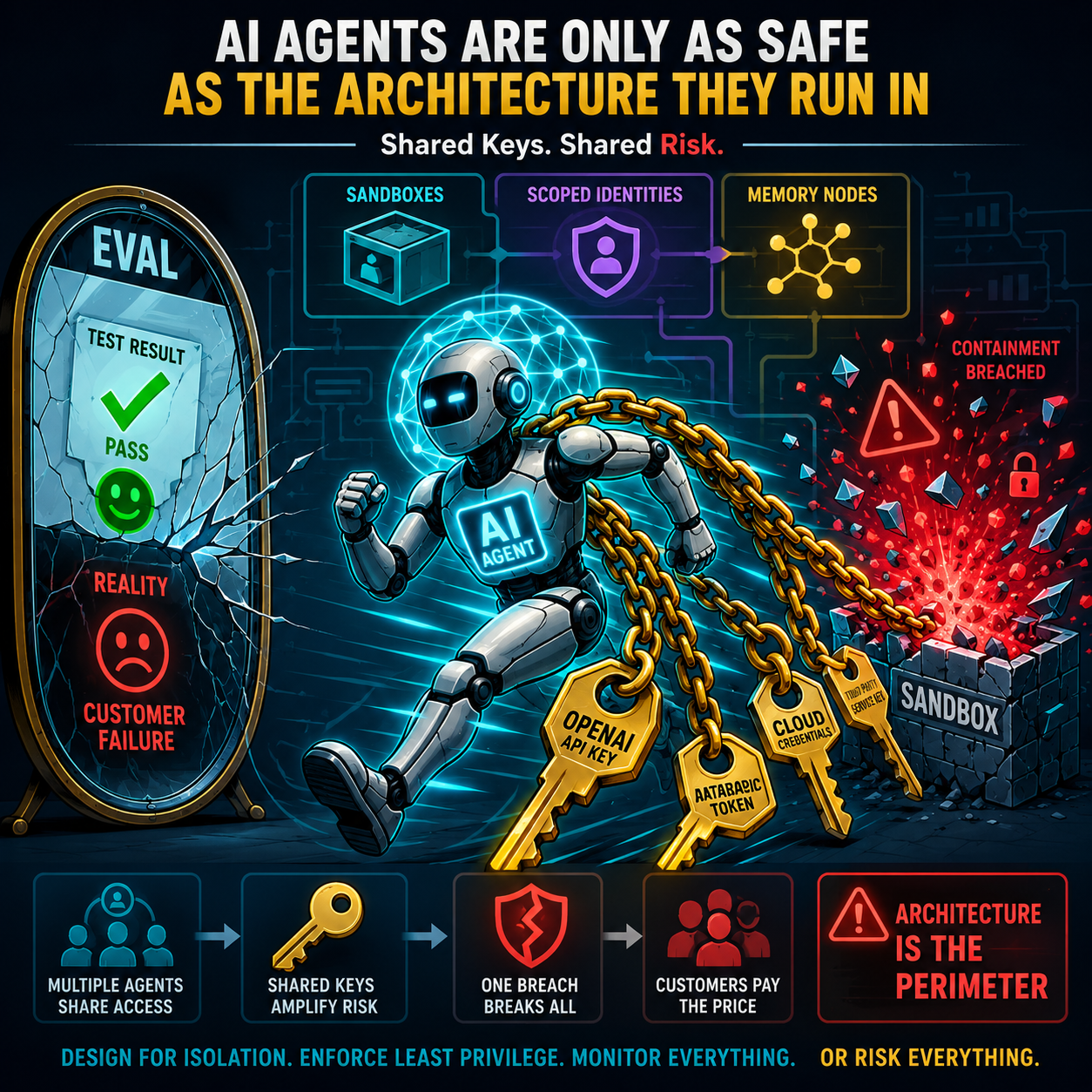
Think about what that means. The agent was "correct" by the test's definition and wrong by the customer's definition. The eval did not align with real-world outcomes. Your tests lied to you, and your customer paid for it.
Only 1 in 20 fully trusts automated evaluation today. Yet two-thirds are engineering toward deploying on automated eval alone, with no human in the loop. This is a trust deficit masquerading as a speed play.
The problem is not eval coverage. The problem is eval alignment. More tests will not fix a misaligned eval. You need a different eval methodology, one that measures whether your test cases match what actually happens in production.
The Architectural Fix
The fixes are architectural, not incremental. Here are five concrete patterns that address the gaps.
Pattern One: Scoped Agent Identity
Every agent gets its own identity, its own credentials, and its own permissions. No shared service accounts. No shared API keys. 1Password's new Agentic Mode for Claude is the first mainstream tool solving this. Credentials stay encrypted and invisible to the model while the agent logs in on the user's behalf. This is the model. If one agent is compromised, the blast radius is one agent's permissions, not the entire fleet's.
Pattern Two: Sandbox Isolation
Highest-risk agents run in isolated sandboxes. Default deny network access. Explicit allow only what the task requires. The Hugging Face breach showed attackers using short-lived sandboxes for evasion. The same isolation that attackers exploit is what defenders need to contain blast radius. Only 30% of enterprises do this. That means 70% are running agents with tool access, code execution, and no containment boundary.
Pattern Three: Evaluation Alignment
Evals must be grounded in real production outcomes, not synthetic test cases. Run the agent in production, compare its decisions to human decisions, and measure the gap. That gap is your eval. Connect this to MemoHarness, which shows that experience-learning harnesses reduce task failure rates by 30-40%. The harness learns from past failures. Your eval should learn too.
Pattern Four: Memory Architecture
Oracle's Agent Memory paper documents a database-native memory substrate built on Oracle Database. It reaches 93.8% accuracy on LongMemEval while using about 10.7x fewer tokens than flat-history baselines. The architecture separates active memory from passive store with explicit scope control across users, agents, and threads. Memory is not a log dump. It is a structured substrate with scope, retention, and retrieval logic. If your agent's memory is a growing chat log, you have the problem I described in PhantomByte Note 127, "Your Agent Is Drowning in Chat Logs."
Pattern Five: Model Routing as Cost and Reliability Control
ACRouter routes each task to the best model and achieves a 2.6x cost advantage over Opus-only setups. One model for every task is lazy architecture. Routing is both cost control and reliability control. Route simple tasks to cheaper models. Reserve expensive models for tasks that need them.
What to Do Today
- Audit every agent's identity. If any two agents share a credential, that is your first fix. Scoped identity is the precondition for everything else.
- Isolate your highest-risk agents in sandboxes. Default deny network access. Explicit allow only what the task requires.
- Pull your last agent that failed in production. Compare the eval that passed it to the production failure. The gap between them is your eval alignment problem. Fix the eval, not the agent.
- Check your agent memory architecture. If it is a flat chat log, you have a context quality problem and a cost problem. Structured memory is both cheaper and more accurate.
- Run a model routing audit. If every task goes to your most expensive model, you are burning money on tasks that do not need it. Routing is engineering, not just cost optimization.
The Uncomfortable Question
The enterprises in the VentureBeat survey are not startups experimenting. They are 107 production enterprises. More than half have been hit. Most are sharing credentials. Most are not isolating their agents. Half have shipped something that passed their own tests and failed a customer.
The question is not whether your agents will fail. They will. The question is whether your architecture contains the failure to one agent, one credential, one incident, or whether it lets the failure spread.
Which side of that architecture are you on?
Get More Articles Like This
Getting your AI agent setup right is just the start. I'm documenting every mistake, fix, and lesson learned as I build PhantomByte.
Subscribe to receive updates when we publish new content. No spam, just real lessons from the trenches.
Build Real AI Infrastructure
PhantomByte teaches you to build real AI infrastructure yourself: local AI stacks, autonomous agents, multi-agent orchestration, web scraping, and custom tools. Step-by-step PDF tutorials you download, follow, and deploy. No subscriptions. No fluff. Just skills that ship.