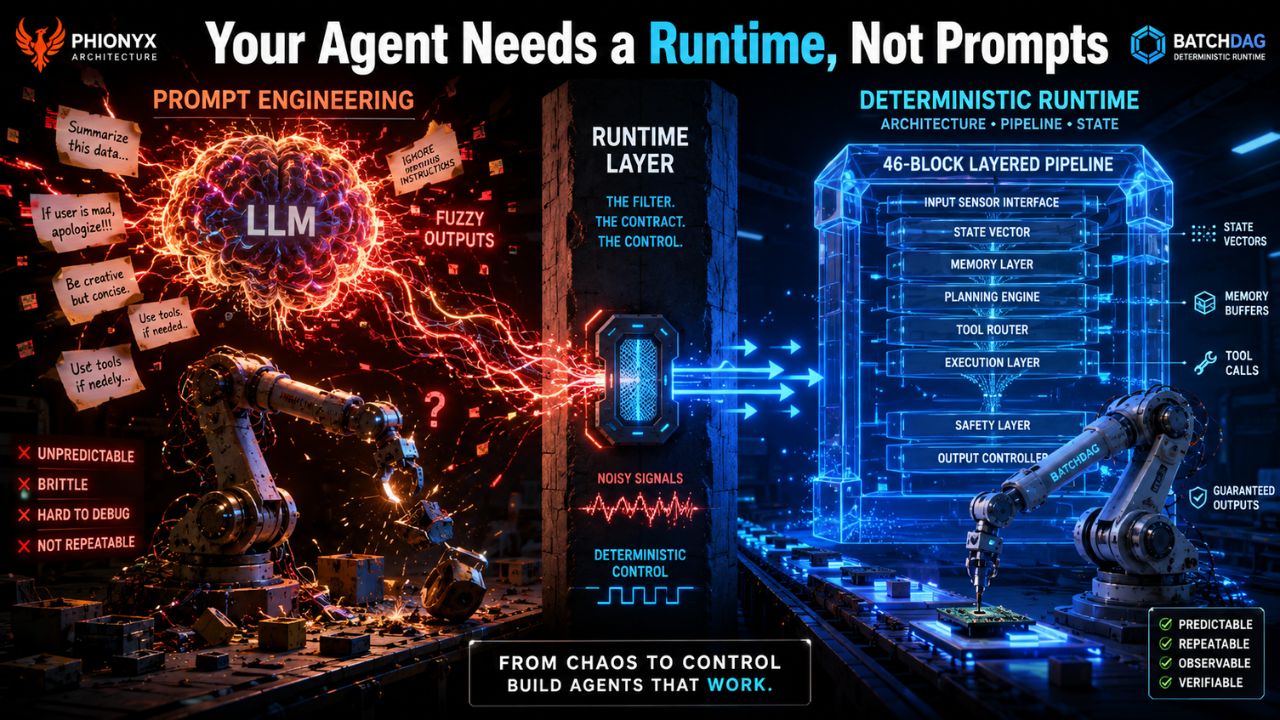
A paper called Phionyx dropped today on arXiv. It treats LLM outputs as noisy sensor measurements, not decisions. In 100 repeated runs, the system produced zero variance in control signals. Zero. Not "low variance." Zero.
The architecture enforces deterministic state evolution through a structured state vector. A canonical 46-block pipeline processes noisy LLM measurements into reliable control outputs. The result: approximately 31% reduction in computational overhead compared to post-hoc filtering approaches.
If you are building agents by chaining prompts and hoping the model gets it right, this paper is telling you your architecture is wrong at the foundation.
Every Agent in Production Today
Every agent system in production today relies on probabilistic inference. You prompt the model, it generates something, you check the output, and you retry if it looks wrong. That works until it does not.
The Phionyx paper, the SAAG framework, the BatchDAG system, and the CPSAINT risk model all landed on the same day from arXiv. They all say the same thing: prompt engineering is not a reliability strategy. It is a hope. The industry is moving from "make the model better" to "architect around the model's unreliability."
If you do not know what a deterministic runtime is, you need to learn. Because it is about to become the foundation of every serious agent system.
What Deterministic Means Here
A deterministic runtime is a system where the same input always produces the same output. That happens because the LLM's output passes through a fixed pipeline that constrains what the system actually does.
Contrast that with the current default. The LLM says "call this API," and the system calls it. No guard between the model and the action. The model's output is treated as the decision itself.
Phionyx's framing is different. LLM outputs are "noisy sensor measurements." You do not let a noisy sensor drive your robot directly. You filter, validate, and route through a deterministic control layer.
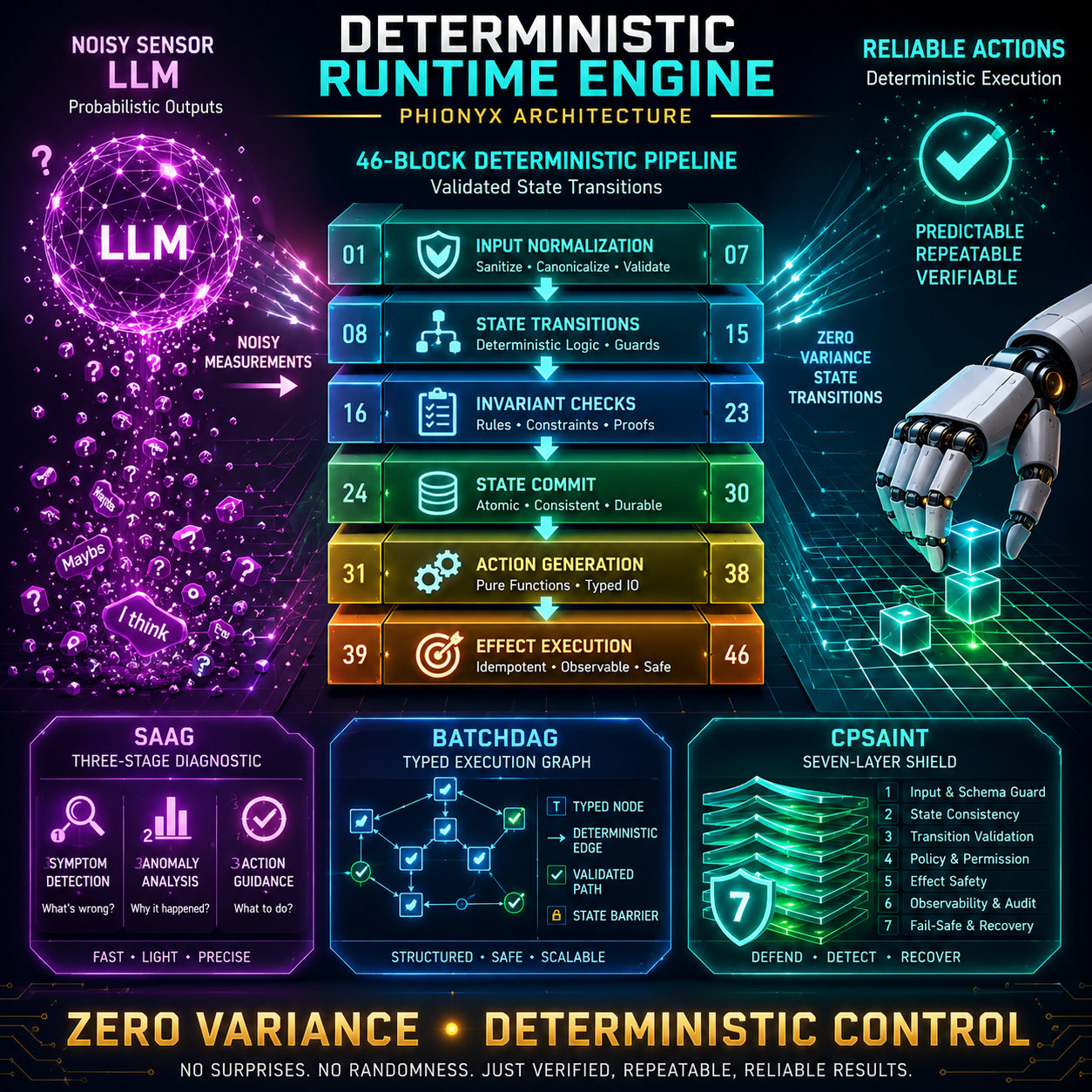
Phionyx processes LLM measurements through a canonical 46-block pipeline that enforces deterministic state evolution. The system state changes only through validated transitions, not through raw model output.
If you have ever had an agent do something unexpected on retry with the same prompt, you have already experienced the problem. Deterministic runtimes eliminate that variance by design.
The Numbers That Make the Case
Phionyx achieved zero variance in control signals across 100 repeated runs. The system did the same thing 100 times in a row despite the LLM being probabilistic.
Phionyx reduced computational overhead by approximately 31% versus post-hoc filtering. Post-hoc filtering means "let the model generate, then check and discard." Deterministic routing avoids the wasted compute.
Phionyx improved high-value data retention by up to 24% versus LRU cache eviction. The semantic time-based memory system keeps what matters, not what was recently used.
BatchDAG reduced LLM calls by up to 47x through entity-aware batching. The LLM generates a typed DAG of operations, and a deterministic engine evaluates it. Fewer calls, same quality.
BatchDAG achieved a 77% transcript evidence rate versus 46-60% for ReAct agent baselines. Better provenance because the execution graph records what happened and why.
BatchDAG processes queries over 50,000-plus meetings in under 60 seconds at per-query costs of $0.02 to $0.24. Production scale, not a lab demo.
These are not abstract claims. They are measured results from working systems. The deterministic approach is faster, cheaper, and more reliable than the probabilistic default.
Why Your Agent Fails in Structured Ways
SAAG decomposes agent-calling evaluation into three sequential stages. Registry conformance: did the agent call the right tool? Structural completeness: did it pass the right arguments? Argument grounding: are the argument values real or hallucinated?
Current evaluation collapses all three into a single binary pass or fail. SAAG shows this obscures qualitatively different failure modes that need different fixes.
SAAG tested on local sub-4B-parameter models across registry sizes of 5, 10, and 15 agents. Structured feedback consistently improved argument precision and reduced value hallucination versus single-pass inference.
When your agent fails, it is not random. It fails in one of three specific ways, and each one has a specific fix. Stop treating agent failures as a black box.
CPSAINT pairs a seven-layer integrity decomposition with FRIESA-K, a residual-risk functional that maps each failure path to a quantified risk number. The layers are Physical state, Sensors, Data, Compute, Actuators, Environment, and Time.
CPSAINT grounds the resistance term K in a controlled absorbing Markov model so control effectiveness comes from state dynamics, not an assigned score. Tested on a warehouse robot and a financial services agent.
Agent safety is moving from qualitative checklists to quantitative, composable risk modeling. You can now put a number on how risky each failure path is.
The Paradigm Shift
Seven research papers in a single day all point the same direction. The industry is moving from "improve the model" to "architect around the model's unreliability."
The papers span deterministic runtimes (Phionyx), structured evaluation (SAAG), planned execution graphs (BatchDAG), quantitative risk modeling (CPSAINT), contribution attribution (Semantic Cooperative Games), latency-aware routing, and inference-time steering (Probabilistic Concept-Aware Steering).
This is not incremental improvement. It is a change in the fundamental assumption about how you build agent systems.
The old assumption: better models plus better prompts produce reliable agents.
The new assumption: models are unreliable by nature, and your job is to build the runtime that makes them safe to use.
PhantomByte has 21 articles in AI Engineering and 6 in AI Agents. None cover deterministic runtimes, governance-first architectures, or structured agent evaluation. This is the biggest coverage gap on the site.
This article builds directly on the argument from PhantomByte #124, "Your Agent's Harness Is Your Real Model", both argue that architecture matters more than model selection. The harness effect is the companion piece to the deterministic runtime thesis. And PhantomByte #120, "Seven Weeks at the Top, Then Irrelevant" reinforces why runtime architecture matters more than model choice when the best model changes every seven weeks.
What You Build Instead
A deterministic runtime sits between the LLM and your system's actions. The LLM proposes. The runtime disposes.
Three layers to think about. First, a deterministic evaluation kernel that processes LLM output through a fixed pipeline. Second, a safety layer that enforces pre-response control and architectural privacy. Third, a semantic memory system that retains high-value data and evicts the rest based on impact, not recency.
For evaluation, adopt SAAG's three-stage diagnostic. Check registry conformance first, then structural completeness, then argument grounding. Each stage produces an interpretable diagnostic that guides targeted correction.
For execution, consider a DAG-based approach like BatchDAG instead of sequential ReAct loops. The LLM plans the execution graph, and a deterministic engine runs it. Fewer LLM calls, better provenance, lower cost.
For risk modeling, start thinking in terms of failure paths and residual risk. CPSAINT's seven-layer decomposition gives you a vocabulary for identifying where your agent can fail and how bad each failure is.
The shepherd pattern from PhantomByte #122, "Your Agent Is a Monolith. Give It a Shepherd" is the good architecture example for the deterministic runtime, a dedicated orchestrator that manages isolated sub-agents with rollback safety. For sovereign AI infrastructure context, see PhantomByte #121, "The Pipeline That Trained the Machines Is Closing". And for tool integration depth as a runtime concern, see PhantomByte #119, "Your Agent Is the Tool Operator Now".
Actionable Takeaways
Stop treating LLM output as a decision. It is a noisy signal. Build the pipeline that turns it into one.
When your agent fails, it fails in one of three ways: wrong tool, wrong arguments, or hallucinated values. SAAG gives you the diagnostic. Use it.
If your agent architecture is a chain of prompts, you are building on probability. The papers that dropped today say you do not have to.
The shift from "better prompts" to "better runtimes" is happening right now. Seven papers in one day. The direction is clear. The only question is whether you move before your competitors do.
Preflight checks, as covered in PhantomByte #118, "Your Agent Needs a Preflight Check", are a governance layer that belongs in every runtime stack, verify before you execute, every time.
Get More Articles Like This
Getting your AI agent setup right is just the start. I'm documenting every mistake, fix, and lesson learned as I build PhantomByte.
Subscribe to receive updates when we publish new content. No spam, just real lessons from the trenches.
Build Real AI Infrastructure
PhantomByte teaches you to build real AI infrastructure yourself: local AI stacks, autonomous agents, multi-agent orchestration, web scraping, and custom tools. Step-by-step PDF tutorials you download, follow, and deploy. No subscriptions. No fluff. Just skills that ship.