The AI industry's answer to every capability gap is the same: a bigger model. Need better reasoning? Bigger model. Need more knowledge? Bigger model. Need fewer hallucinations? Bigger model. This approach works, until it does not. The cost curve bends upward while the capability gains flatten. You are paying exponentially more for marginally better output, and the bill is starting to hurt.
Here is the counter-argument your brain already knows. Your memory system and your reasoning system are physically separate structures. The hippocampus stores and retrieves. The prefrontal cortex plans and orchestrates. You do not scale up one organ to do both jobs. You specialize.
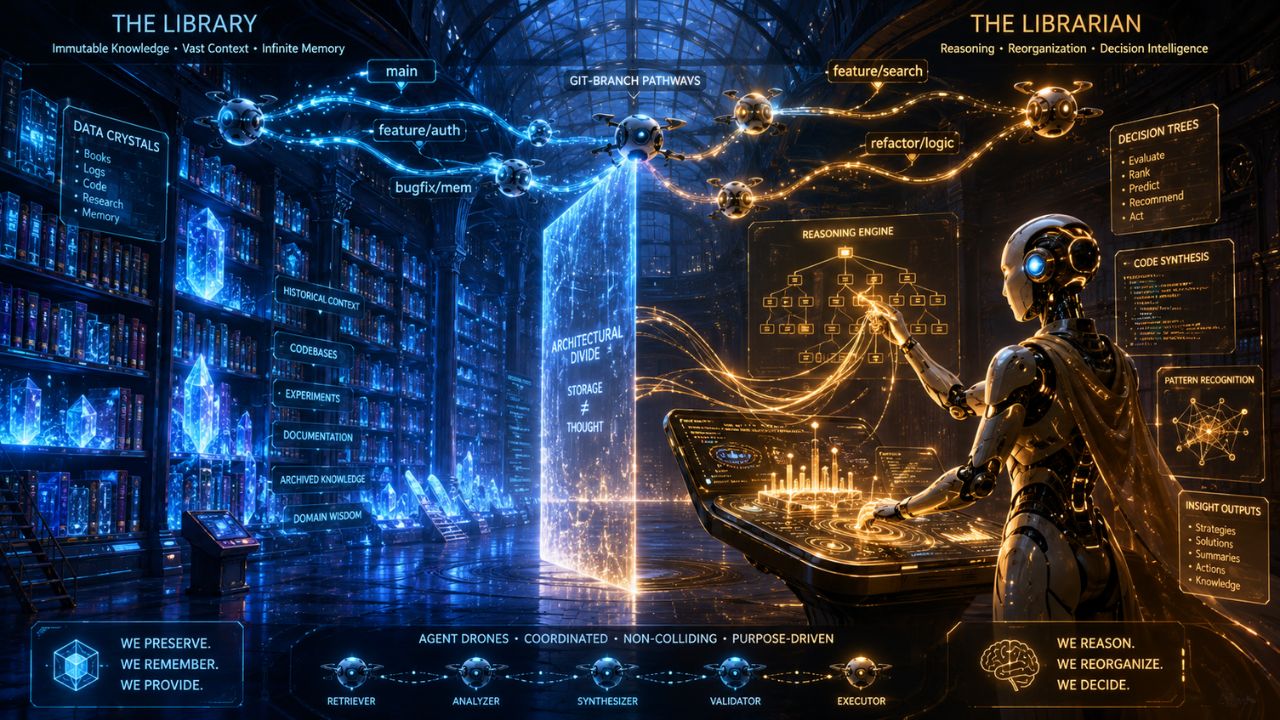
An architectural essay published this week by InnerKore makes this case explicitly: AI systems need a "Library" (knowledge storage and retrieval) and a "Librarian" (reasoning and orchestration). Conflating them in a single model creates inefficiency, hallucination, and poor retrieval. The Library holds the corpus. The Librarian navigates it. One stores. The other thinks. When you force one model to be both, you get a system that remembers poorly and reasons badly, and costs a fortune doing neither well.
The Library Is Not Just a Vector Database
The Library is the full knowledge layer: embeddings, RAG pipelines, document stores, and retrieval indexes. Its job is to store and find information fast.
The key insight is that the Library does not reason. It retrieves. When you ask it a question, it returns the most relevant chunks based on semantic similarity. That is it. The quality of the Library determines the quality of the context the Librarian gets to work with. Garbage in, garbage out, except the garbage costs you $25 per million tokens.
The failure mode of monolithic models is that they try to be both Library and Librarian simultaneously. The model memorizes facts during training (Library) and reasons over them during inference (Librarian). But the memory is frozen at training time. It goes stale. And the reasoning capacity is diluted by the need to also serve as a knowledge store.
Moonshot AI's Kimi K3 illustrates the problem. It is a massive mixture-of-experts model, yet the White House has accused Moonshot of distilling Anthropic's Fable model to build it. On offensive cyber benchmarks, Kimi K3 scored just 32% against 76% for leading US models, and never reached arbitrary code execution on any task. When you build a bigger model by compressing someone else's knowledge, you inherit their architecture's limitations along with their weights. The MoE design acknowledges that not all knowledge is needed at once, but it is still one model doing both jobs.
The Librarian Does the Hard Work
The Librarian is the reasoning and orchestration layer. It receives a query, decides what knowledge it needs, asks the Library to retrieve it, then reasons over the results. It plans. It decomposes. It verifies.

A June essay on the varnam Substack argues that deliberate slowdowns produce better reasoning. The piece draws parallels to Kahneman's System 1 and System 2 thinking, noting that current AI architectures optimize for fast, intuitive output at the expense of slow, deliberate processing. The author builds a case for intentional "cognitive friction," using methods like Zettelkasten note-taking and classical poetry study to force deeper engagement. The point is not that AI should be slow for the sake of it. The point is that speed without depth produces brittle output.
The practical version for engineering: instead of asking one big model for an answer in one shot, you run a smaller reasoning model in a loop. It retrieves from the Library, drafts an answer, critiques it, retrieves again if needed, and verifies before returning. This is slower. It is also more accurate.
The cost argument is where this gets real. Anthropic's Opus 5 delivers near-Fable 5 performance at roughly half the token price. The reasoning loop does not need a frontier model at every step. It needs a frontier model for the hard reasoning and a cheap fast model for retrieval and routing. The Library-Librarian split is not just an architecture pattern. It is a cost optimization.
The Library-Librarian split also opens the door to open-weights models. Because the Librarian is a focused reasoning engine rather than a general-purpose knowledge store, it does not need the massive parameter count of a frontier model. You can swap out expensive cloud endpoints for highly capable open-source models like Gemma, Qwen, or DeepSeek running on local hardware or private infrastructure. The Library stays the same. The Librarian gets upgraded. This is the practical payoff of the separation: you take back control of your stack from centralized API platforms and deploy these systems on actual silicon without being beholden to per-token pricing.
Code Mode: Structure as a Force Multiplier
InstaVM published an article this week on how "code mode" helps smaller LLM models. The finding is that structuring prompts and reasoning as code rather than natural language significantly improves smaller model performance. Tasks involving logic, data transformation, and API calls benefit most from code-like structure.
This matters for the Library-Librarian pattern because the Librarian does not need to be a general-purpose language model. It needs to be a structured reasoner. Code mode shows that when you constrain the output format to code, even smaller models produce more structured and accurate results. The Librarian can be a smaller, cheaper model that thinks in code, not prose.
This connects to the separation thesis: the Library handles unstructured knowledge (documents, embeddings, natural language). The Librarian handles structured reasoning (code, logic, tool calls). Different inputs, different outputs, different models.
Once your Librarian is producing structured outputs in code mode, the next question is how to coordinate those outputs across multiple agents and systems. That is where the coordination layer comes in.
The Coordination Layer
There is a third piece nobody talks about. If you are running multiple agents, you need a coordination layer.
Loom VCS treats Git as the source of truth for AI agent state. Multiple agents work on the same codebase through branch isolation, merge strategies, and agent-specific workspaces. This is a coordination layer, not a model layer.
OpenSpace takes a different angle, storing evolved agent skills with versioning and lineage metadata so agents can reuse and build upon previously generated capabilities. This is a memory layer for agents, not the model's training memory, but an operational memory that persists across runs.
The practical shape of multi-agent orchestration looks like this: a research agent retrieves from the Library and writes findings to a shared workspace. A drafting agent reads those findings and produces output. A review agent inspects the output against the original sources and flags discrepancies. Each agent is a Librarian with a specific role, and the coordination layer ensures they do not step on each other. Git branches isolate their work. The skill database stores the prompts and workflows each agent developed so a new agent does not have to rediscover them. A specialized coding agent, for example, interacts with these state layers to write, test, and commit code without overwriting another agent's work. This is not theoretical. It is how production multi-agent systems actually run today.
The pattern: the Library holds knowledge. The Librarian holds reasoning. The coordination layer holds state. Three layers, three responsibilities, three different technologies. Git for coordination. Skill databases for agent memory. Vector stores for knowledge. Small models for reasoning loops. Frontier models only when the reasoning demands it.
The Security Angle
Opus 5 achieved a zero percent prompt injection success rate across 129 browser agent test scenarios, per Anthropic's system card. In a general prompt injection benchmark by security firm Gray Swan, the attacker success rate after 15 attempts dropped from 5.5% with Opus 4.8 to just 2.0% with Opus 5.
This matters because prompt injection is the attack that exploits the monolith. It corrupts the Librarian through the Library. When the same model handles both knowledge retrieval and reasoning, a poisoned document in the retrieval set can hijack the reasoning.
The separation helps. If the Librarian treats retrieved content as data, not instructions, prompt injection becomes harder. The Library returns text. The Librarian reasons over it. The architectural boundary enforces the security boundary.
What to Do Today
1. Stop scaling your model to solve knowledge problems. If your model hallucinates facts, the answer is a better retrieval pipeline, not a bigger model. Invest in your Library: chunking strategy, embedding quality, and retrieval relevance.
2. Separate your reasoning loop from your retrieval pipeline. Use a cheap, fast model for retrieval and routing. Use a frontier model only for the reasoning steps that demand it. The cost difference is 5-10x.
3. Try code mode for structured tasks. If your Librarian reasons in code rather than prose, you can run a smaller model and get better results on logic, data transformation, and API orchestration.
4. Add a coordination layer. If you are running multiple agents, use Git-based state management or a skill database so agents do not duplicate work or overwrite each other.
5. Treat the security boundary as an architectural boundary. Retrieved content is data, not instructions. The Library does not execute. The Librarian does.
The Uncomfortable Question
You keep making your model bigger because it is the answer you know. But what if the model is not the bottleneck? What if your retrieval pipeline, your reasoning loop, and your coordination layer are, and a smaller model with better architecture outperforms your frontier model with none?
Get More Articles Like This
Getting your AI agent setup right is just the start. I'm documenting every mistake, fix, and lesson learned as I build PhantomByte.
Subscribe to receive updates when we publish new content. No spam, just real lessons from the trenches.
Build Real AI Infrastructure
PhantomByte teaches you to build real AI infrastructure yourself: local AI stacks, autonomous agents, multi-agent orchestration, web scraping, and custom tools. Step-by-step PDF tutorials you download, follow, and deploy. No subscriptions. No fluff. Just skills that ship.