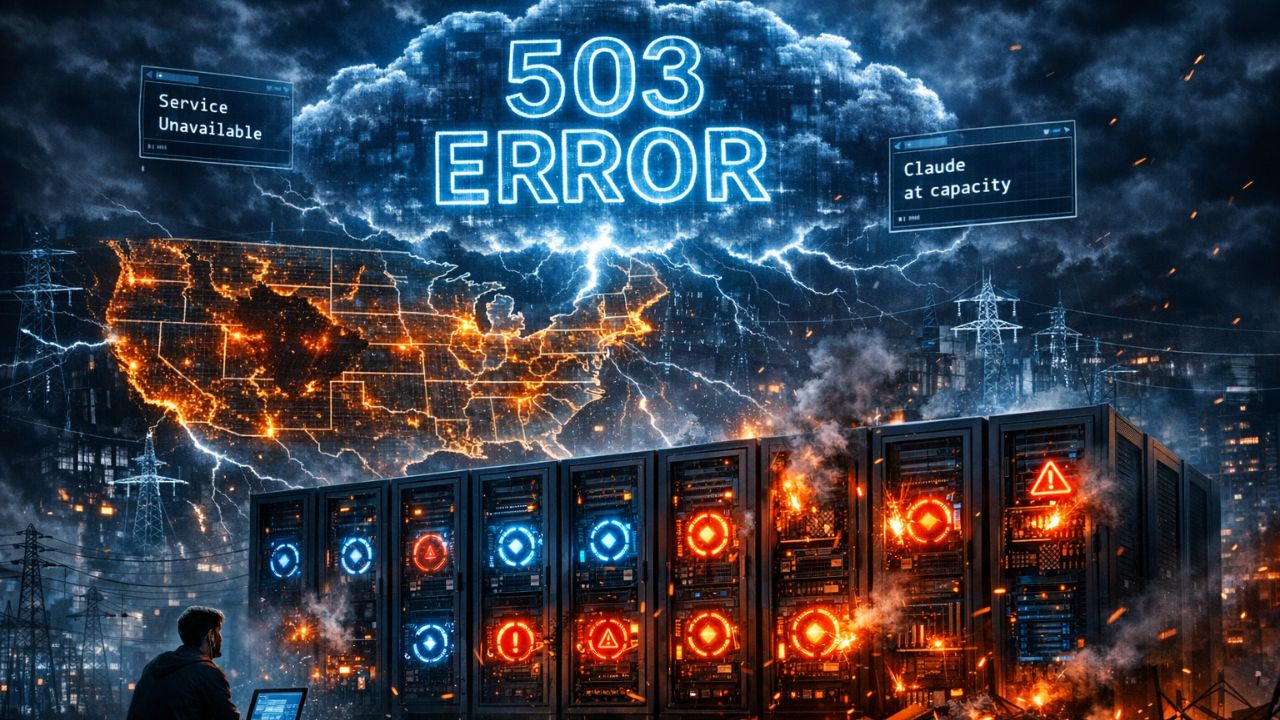
It is 2 AM. Your terminal is glowing. ChatGPT just hit "at capacity." Claude timed out mid-conversation. Your own API returned a 503 with zero explanation in the logs.
You restarted the instance. You checked the rate limiter. You blamed your code.
It is none of those things.
There are not enough electrons to go around, and your AI application is last in line. Yesterday I broke down the AGI Bottleneck Triad and explained why the entire industry is hitting a wall. Today I am telling you what to do about it.
This is not a bug report. It is a field guide to building AI apps that survive a crumbling grid.
Your 503 Is Not a Bug. It Is a Power Shortage Symptom.
In the context of modern AI applications, a 503 Service Unavailable error is frequently a symptom of regional power grid scarcity throttling GPU availability rather than a software bug.
Here is the invisible pipeline nobody diagrams: user request, API gateway, inference server, GPU cluster, data center, substation, regional grid. When any link in that chain is stressed by power scarcity, the error surfaces at the top as a 503. Not a grid alert. Not a voltage sag warning. Service unavailable.
I have been tracking this correlation for weeks. The Anthropic status page tells a story nobody wants you to piece together. In the last 30 days, Claude logged 15 separate incidents. April 28 alone featured a major outage where users could not reach claude.ai, API authentication failed, and Claude Code login remained broken for over an hour. April 30 showed elevated error rates during peak PT hours. April 29 had two incidents within 24 hours. April 25 brought Claude Code crashes and Opus 4.7 errors. April 24 saw three blips. April 23, April 20, and April 19 all had documented drops.
The pattern is not subtle. The clustering during peak afternoon hours, during spring heat events, and during documented grid stress periods is too consistent to ignore. A 503 is infrastructure telling you we are out of electrons and your request could not draw the power it needed.
OpenAI's ChatGPT sits at 99.82% uptime over 90 days. Claude is at 98.69%. Those numbers sound great until you unpack them. In a 90-day window, Claude was down or degraded for more than a full day. Every major incident in April coincided with periods of documented grid stress.
Now consider what happened to Ubuntu this week. A sustained DDoS knocked Canonical's entire web infrastructure offline for more than 24 hours. Forums, status pages, and internal communications all went dark. A pro-Iran group using a stressor service called Beam took credit. The same group hit eBay in the exact same window.
Here is the part that should terrify you: Ubuntu could not even tell anyone about it. They could not publish their CVE disclosure about CopyFail (CVE-2026-31431). This is the most severe Linux kernel vulnerability in years, featuring a single Python script that gives unprivileged users root access on virtually every distribution. Canonical could not warn users because their infrastructure was being bludgeoned offline.
One failure cascades. Grid stress browns out a data center. Your status page does not load. You cannot tell users what is happening. Trust evaporates.
That is the real cost, and it compounds.
So when power is scarce, and it is getting scarcer, who actually gets the tokens? Spoiler: not you.
The Multi-Tenant Power Problem
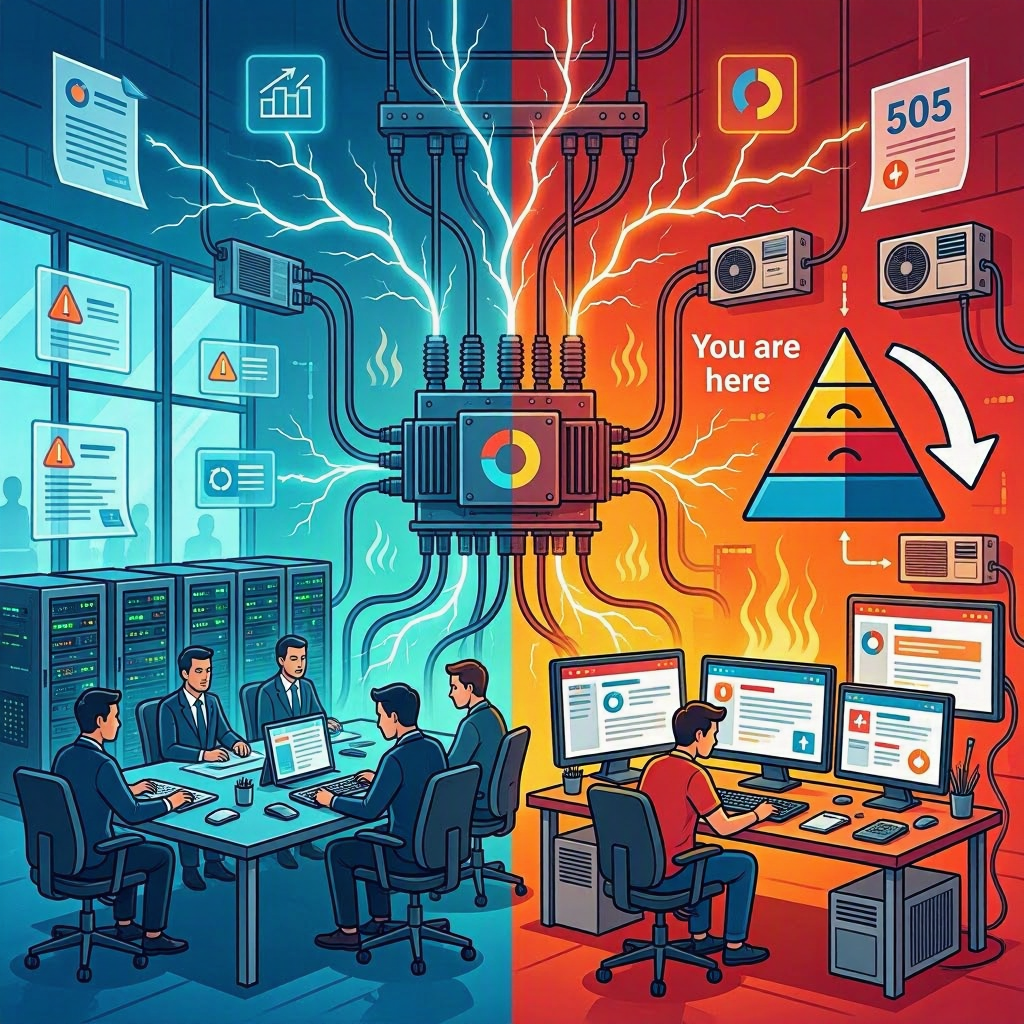
Hyperscalers buy power in bulk and allocate it across tenants. During scarcity, they triage. There is a pecking order nobody publishes but everyone in ops understands.
Tier 1: Enterprise contracts with reserved capacity. Banks, hospitals, and defense contractors. These are never cut.
Tier 2: High-revenue inference workloads. Paid API tiers. Quarterly earnings line items.
Tier 3: Free-tier users, startups, indie hackers, and anyone on spot instances.
That is you.
Cloud bursting during brownouts is the scenario nobody's disaster recovery plan covers. When AWS us-east-1 enters a brownout during a July heat wave, your auto-scaling group tries to spin up instances that cannot get power. The orchestration layer retries, queues, and fails. The root cause is a substation in Loudoun County, Virginia, running 12 percent above rated capacity because every AC unit within 50 miles is running at maximum.
Your code is fine. AWS just decided your workload is less important than JPMorgan's fraud detection pipeline.
If you think power scarcity is the only threat, look at what happened two months ago. Iranian drone strikes destroyed three AWS data centers in the UAE and Bahrain. The ME-CENTRAL-1 and ME-SOUTH-1 regions are still not operational. Amazon waived all usage charges for March 2026, an estimated $150 million loss. AWS strongly recommended that customers migrate resources to other cloud regions. Dubai-based Careem, a ride-hailing and delivery super app, had to perform an overnight migration to stay online. Full recovery is expected to take several months.
Three data centers. Destroyed. Months of downtime. Customers told to relocate.
The cloud is just someone else's computer. Sometimes that computer is in a war zone. You cannot Kubernetes your way out of a drone strike.
Even when the power is technically flowing, quality matters. Grid quality degrades in ways that directly hit your response times.
Heat Waves, Slow Responses, and the Electricity You Cannot See
GPUs throttle under reduced voltage. Your model still runs, but inference takes two to three times longer during grid stress. The chip protects itself by drawing less current and clocking down. The effect is measurable and it is happening right now.
Why is your AI slower during West Coast afternoons? It is not peak traffic. It is the air conditioning load. Data centers in California, Texas, and the Mid-Atlantic compete with millions of residential AC units pulling from the same substation. When the grid hits 95 percent capacity, voltage droops. When voltage droops, GPU clock speeds adjust. When clock speeds adjust, inference latency spikes.
People notice. Reddit threads ask, "Is Claude always slow during heat waves?" The pattern is there. Nobody connects the dots publicly because the providers will not admit it. "Our model is running at half speed because the local transformer is thermal-throttled" is not a status page update you will ever read.
Hyperscalers already route inference based on real-time grid availability. They brand this as cost optimization. What it actually means is your request takes the scenic route. It gets bounced to a different state, adding 50 to 80ms of network latency because the closest GPU cluster is under a CAISO flex alert.
Your inference speed literally depends on geography and season. A developer in Portland during spring hydro season gets faster and cheaper inference than a developer in Austin during a July afternoon. Same model. Same API. Same price tier. Different physics.
The CAISO flex alert system, ERCOT grid dashboards, and PJM's real-time pricing data are all public. Almost nobody integrates them into AI application routing.
That is the gap we are going to fix.
Building Fault-Tolerant AI Apps That Survive Grid Crises
How to Build Fault-Tolerant AI Applications:
Multi-Region Failover: Route traffic based on real-time grid status and power availability, not just standard latency metrics.
Graceful Degradation: Implement fallback chains using smaller quantized models or cached responses instead of returning 503 errors.
Variable Pricing Batching: Schedule heavy, non-urgent inference tasks during off-peak hours when electricity is cheap and stable.
Circuit Breakers: Automatically trip and route to alternative fallbacks when an AI API endpoint error rate exceeds your acceptable threshold.
Here are the four patterns in detail. You can implement them this week. They are built around a simple premise: the grid is unreliable, you are last in line, and your latency answers to the weather.
Pattern 1: Multi-Region Failover Based on Power Availability
Current practice routes to the lowest-latency region. That is wrong. Latency means nothing when the region is under a flex alert and throttling your requests.
New practice: check regional grid status before routing. If us-east-1 is under a PJM warning or real-time prices have spiked dramatically, route to us-west-2 even at a 50ms penalty. That 50ms is dwarfed by the massive inference slowdown on a voltage-drooped GPU cluster.
The decision tree is a simple weighting function:
async function routeRequest() {
    const regions = ['us-east-1', 'us-west-2', 'eu-west-1'];
    let bestRegion = null;
    let lowestScore = Infinity;

    for (const region of regions) {
        const latency = await measureLatency(region);

        // Fetch real-time data from PJM, CAISO, or ERCOT wrapper APIs
        const gridRisk = await gridMonitor.fetchRiskScore(region); // Returns 0.0 to 1.0

        // Penalize risky regions heavily
        const score = latency + (gridRisk * 200);

        if (score < lowestScore) {
            lowestScore = score;
            bestRegion = region;
        }
    }
    return bestRegion;
}
You already do latency-based routing. This is just one additional data source. Update the penalty every 60 seconds and ship it.
Pattern 2: Graceful Degradation Instead of 503s
A 503 trains users to leave. Build a three-tier fallback chain instead.
Level 1: Smaller model fallback. If Claude Opus is returning errors, switch to a 4-bit quantized Llama 3.3 70B on whatever capacity is available. You get slightly lower quality but provide an answer instead of an error.
Level 2: Cached responses. Semantic caching using tools like GPTCache or Redis with vector similarity is not just a cost tool. It is an availability tool. If you have a 92 percent semantic match sitting in Redis, serve it. Label it cached if you want absolute transparency. Do not serve a 503.
Level 3: Queue with transparency. Display a message stating, "We are running on backup capacity. Your result will arrive in approximately 8 minutes. We will notify you." Stripe and Airbnb do this in degraded mode. The difference between a broken app and an app working through a grid event is entirely in how you communicate.
Pattern 3: Batching During Variable Electricity Pricing
Real-time electricity prices swing from $25/MWh at 3 AM to $120/MWh at 5 PM on a hot day. Hyperscalers pass these costs directly through.
Counter-strategy: batch non-urgent inference during off-peak hours locally between 3 AM and 5 AM. Bulk embeddings, dataset analysis, and model evaluation should all be scheduled for cheap, stable electrons. Save real-time requests during peak hours only for when they are strictly necessary.
Your job scheduler should know what electricity costs right now. PJM, CAISO, and ERCOT pricing APIs make this entirely automatable. Your infrastructure costs can fluctuate significantly by time of day. Stop ignoring that arbitrage.
Pattern 4: Circuit Breaker Architecture for AI APIs
The circuit breaker pattern is decades old. Almost nobody applies it to AI API calls. Fix that.
When your inference API error rate crosses 10 percent over a 30-second window, trip the breaker. Stop sending requests to that endpoint. Route to your fallback chain. After a cooldown, enter a half-open state by sending a small test request, like a single-turn classification rather than a 100K-token context window. If it succeeds, close the breaker. If it fails, stay open.
Look into open-source libraries like Resilience4j, Polly, or failsafe-js. The hard part is not the technical implementation. It is admitting that AI APIs are unreliable by default and architecting accordingly.
Bonus: Cost Optimization
Your inference bill fluctuates wildly based on time-of-day electricity costs passed through as variable pricing and spot instance availability. Recognizing this is not just about reliability. It is about not overpaying.
Sovereign AI Is Not Philosophy. It Is Reliability.
The cloud reliability promise is breaking. Three nines is a marketing claim rather than a physics claim when the grid cannot deliver.
Local inference decouples your uptime from everything you cannot control:
Regional grid stress: Your local hardware draws from your circuit. If your office has power, your model runs.
Hyperscaler priority tiers: There is no triage queue on your own hardware. You are Tier 1 by default.
Geopolitical events: Iranian drones cannot hit a server in your basement.
Multi-tenant resource competition: Nobody's fraud detection pipeline is fighting your RTX rig for watts.
The ROI of self-hosted AI is not just the $20 a month you spend on Ollama Pro instead of racking up cloud API fees. It is that your production application is not dead when a cloud region goes dark. Whether you are running OpenClaw orchestration locally or scaling up a private rack, your own hardware is fundamentally more reliable than the cloud during a crisis.
HPE is making this bet at nation-state scale by deploying Cray exascale systems as "AI Factories" for governments. Fortune 500 companies and sovereign nations are investing in localized AI for exactly this reliability argument.
This is not about abandoning the cloud entirely. It is about hybrid architecture. Use the cloud for scale when conditions permit, and use local hardware for baseline reliability when they do not.
Circle back to Ubuntu. When their entire cloud infrastructure was pounded offline by a DDoS, they could not even tell users about a critical CVE. If your communication infrastructure depends on the same cloud that is currently failing, you have no communication infrastructure at all.
The Grid Is 100 Years Old. AI Is 3 Years Old.
One of these things is not ready for the other.
You have been blaming your code for infrastructure failures. You blamed yourself for the 503s, the inexplicable latency spikes, and the "at capacity" messages that arrive without warning and vanish without explanation.
Now you know what is actually happening. The grid is overloaded. Hyperscalers are triaging. Developers without reserved capacity are getting dropped.
The choice is not whether to acknowledge this problem. The problem is already eating your uptime whether you acknowledge it or not.
The choice is whether you keep shipping on infrastructure you cannot control or start building fault tolerance from day one.
Your model is ready. The grid is not.
Build accordingly.
Get More Articles Like This
AI infrastructure reliability is the defining challenge of this decade. I'm documenting every bottleneck, fix, and lesson learned from the trenches.
Subscribe to receive updates when we publish new content. No spam, just real lessons that ship.