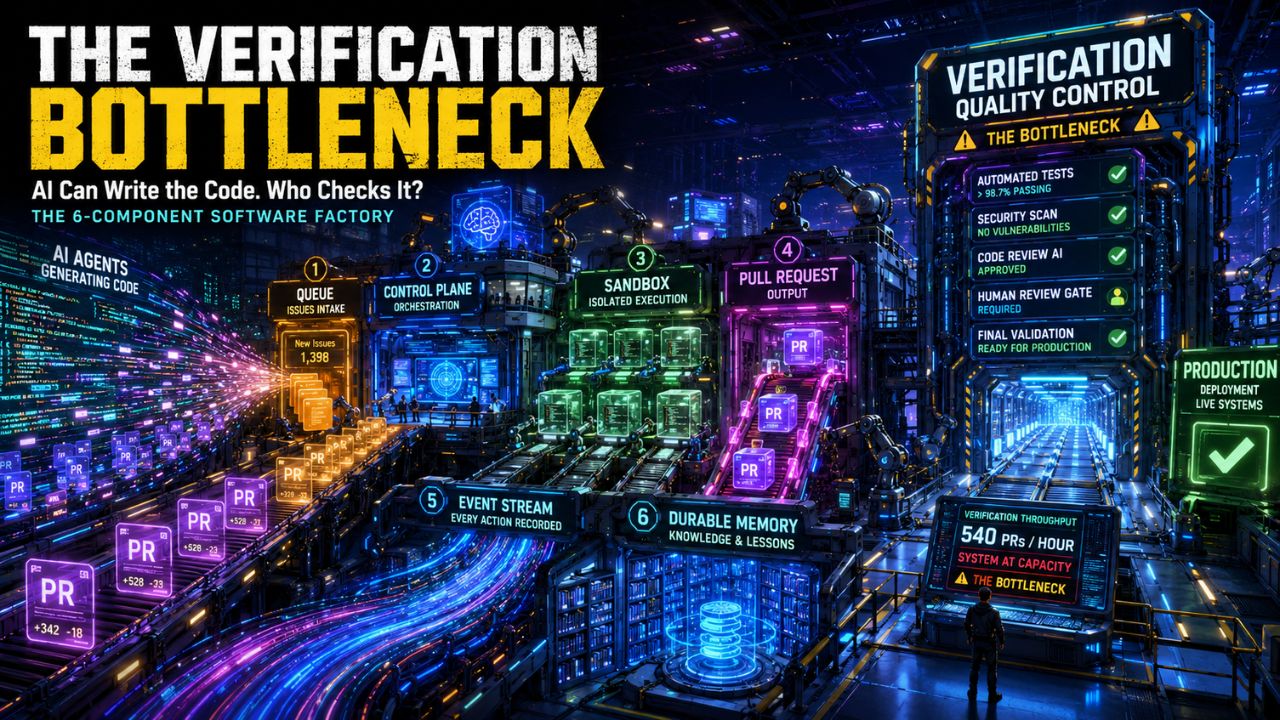
Anthropic, Cognition, Cursor, Factory, Google, GitHub, OpenAI, and Ramp independently built the same six-component machine to ship AI-generated code. A queue that takes work as an issue. A durable control plane. A per-task sandbox destroyed after each run. A pull request as the output unit. An event stream that logs every action. Durable memory. Eight companies, same architecture. That is not coincidence. That is the market discovering the production pattern.
Then look at the money. Blacksmith, an AI code-testing startup, saw its valuation jump nearly tenfold to $550 million in under a year because it sits in the verification layer. CodeRabbit raised $143 million at a $1.5 billion valuation for the same reason. Cognition, the company behind Devin, is reportedly in talks to raise at a $40 billion valuation on the premise that AI coding agents are the new development stack. Lovable, the European vibe-coding startup, hit $500 million in annualized run rate revenue with 1 million new projects a week and 60 million projects total attracting 900 million monthly visitors. The capital is not flowing into the infrastructure that generates code. It is flooding into the infrastructure that checks it.
Code generation is solved. The model writes the code. The bottleneck moved. Verification is now the hard part, and the industry has converged on a production pattern to handle it. I covered this diagnosis in Verifying Agents Is Now Harder Than Generating Them and The Verification Gap: Why Your Agent Pipeline Is Flying Without Instruments. Those pieces identified the problem. This piece covers the architecture that solves it.
WHY THE FACTORY CAME BACK
The software factory concept is not new. It is a production pattern that automates validating, testing, and mass-producing applications. It existed decades ago. It faded because human-written code was slow enough that manual review could keep pace with the output. One engineer, one pull request, one human reviewer. That equilibrium held for a generation.
AI-generated code broke it. CloudBees CEO Moritz Plassnig argues the daily release cadence of AI-generated code means humans can no longer validate everything manually. The volume outpaced the review capacity. When an AI agent writes 50 pull requests a day, a human with a checklist becomes the bottleneck. The factory pattern returned because checking at scale requires a production system, not a person with a GitHub tab open.
Here is the simple version. When one engineer writes code, a pull request review works. When an AI agent writes 50 pull requests a day, you need a factory. The factory is not about making code faster. It is about making verification systematic.
THE SIX COMPONENTS
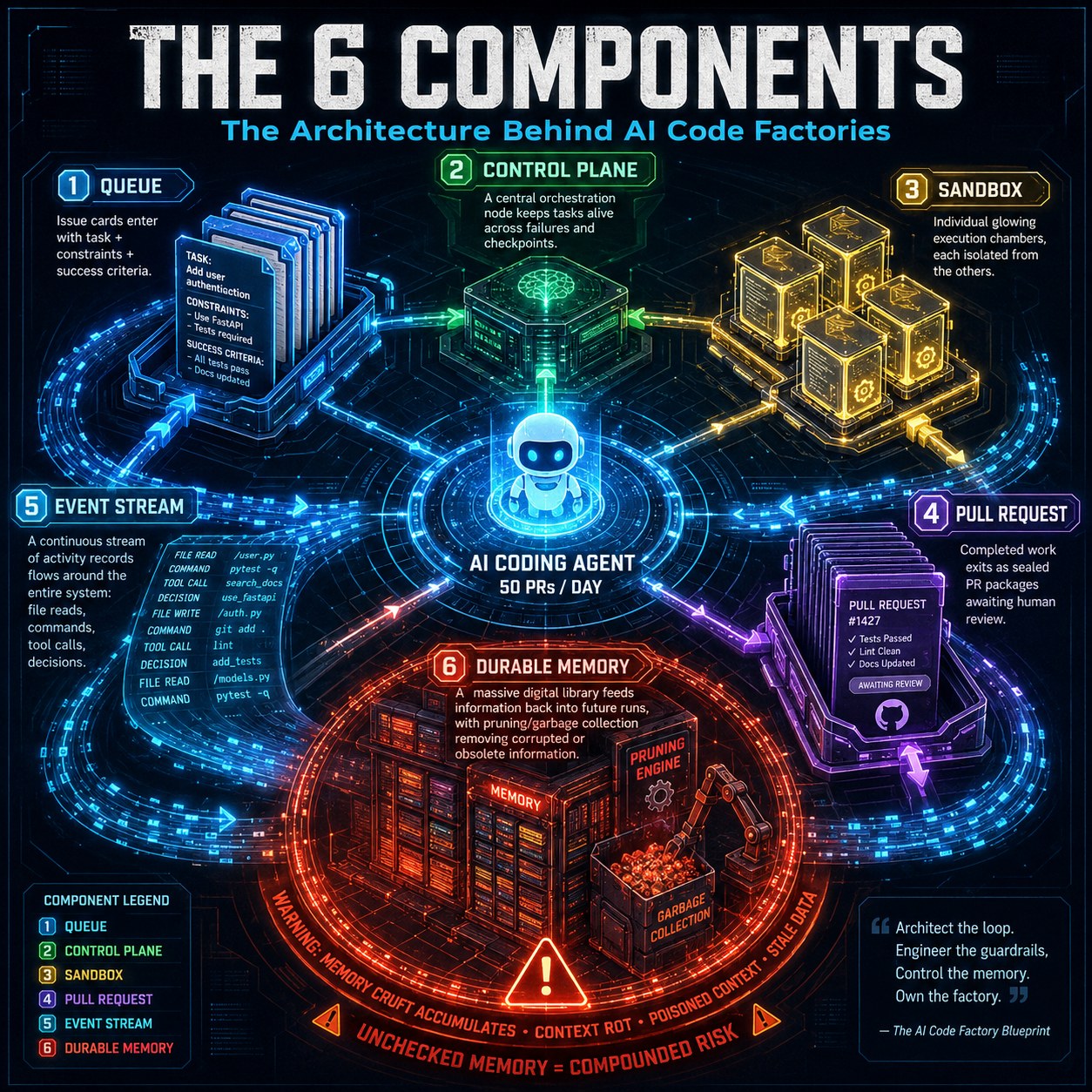
The converged architecture has six components, and every one of the eight companies named above has built something that maps to all six. That is the pattern.
| Component | Core Role |
|---|---|
| The queue | Work enters as an issue, not a prompt. The issue defines the task, the constraints, and the success criteria. This is the interface between human intent and machine execution. The queue enforces discipline. No work starts without a defined issue. |
| The durable control plane | The orchestrator that manages task lifecycle, tracks state across runs, and coordinates between components. It survives individual task failures and can restart from a checkpoint. |
| The per-task sandbox | An isolated environment destroyed after each run. No state leaks, no dependency contamination, no side effects. The containment boundary that makes autonomous agents safe to run at scale. I covered this in Why AI-Generated Code Is Silently Destroying Your Architecture. |
| The pull request as output | A reviewable, reversible unit of change. The PR is the contract between the machine and the human. No direct commits, no auto-merge. |
| The event stream | Every action is logged: every file read, every command run, every tool call, every decision. The audit trail that makes autonomous agents debuggable. I wrote about this gap in "The Verification Gap." |
| Durable memory | The factory remembers across runs: lessons, patterns, corrections. The most dangerous component, because unbounded accumulation degrades performance. I argued for this in Your AI Needs a Librarian, Not a Bigger Model. |
THE CONVERGENCE EVIDENCE
This is not one company's opinion. Anthropic, Cognition, Cursor, Factory, Google, GitHub, OpenAI, and Ramp all independently arrived at the same six-component architecture. That convergence is the strongest possible signal that the pattern is correct. When competitors in different market segments build the same thing, the market is telling you what the production architecture looks like.
The capital confirms it. Blacksmith at $550 million for AI code testing. CodeRabbit at $1.5 billion for automated code review. Cognition at $40 billion for AI coding agents. Lovable at $13.3 billion for vibe-coding. The money is betting that the verification layer is a durable, defensible part of the AI engineering stack. The generation layer is commoditizing. The verification layer is where value accrues.
THE AUTO MODE ACCELERANT
Anthropic just made Claude Code's auto mode the default. The coding agent now operates autonomously without waiting for explicit confirmation on each step. Longer-running, more autonomous agentic workflows are becoming the standard, not the exception. Auto mode is designed for tasks where the agent handles multi-step work and reports back rather than stopping for approval.
The connection to the factory is direct. Auto mode multiplies the volume of code an agent can produce, and more volume means more verification load. Without a factory pattern, auto mode is a fire hose pointed at a human reviewer. With a factory pattern, auto mode is a production line with quality control at every stage.
This is the uncomfortable math. Turning on auto mode without a verification architecture is the most expensive way to adopt AI coding. You get the volume of autonomous generation with the bottleneck of manual review, and the factory is what makes auto mode viable at production scale.
THE MEMORY DISCIPLINE
The CLAUDE.md paper is a concrete pitfall, not an abstract concern. Catastrophic remembering happens when agent instruction files grow unboundedly. As agents append rules and context, the files become bloated, contradictory, and eventually counterproductive. The paper documents how this bloat degrades agent performance and reliability over time.
The factory implication is clear. Durable memory is component six, but it is the most dangerous one. Without disciplined memory management, the factory accumulates cruft that degrades every subsequent run. The memory needs a garbage collector, a pruning policy, and a conflict-resolution mechanism. The CLAUDE.md paper is the warning. The factory architecture is the opportunity to build memory right, not just accumulate it.
WHAT TO DO TODAY
- Map your current AI-assisted development pipeline against the six components. Which do you have? Which are missing? The gap between your current pipeline and the factory pattern is your verification debt.
- If you do not have a per-task sandbox, build one first. Isolation is the containment boundary that makes autonomous agents safe to run at volume. Without it, every task is a risk to your environment.
- Instrument every agent action in an event stream. If a run fails and you cannot reconstruct what happened, you are debugging in the dark. The event stream is the prerequisite for systematic verification.
- Standardize on pull requests as the output unit for all AI-generated code. No direct commits. No auto-merge. The PR is the contract between the machine and the human reviewer.
- Evaluate NVIDIA NeMo Switchyard or a similar routing layer for your agent pipeline. Code generation, code review, and test generation are different tasks. Routing them to the right model is the cost lever. Partners like Ramp have cut costs 58 percent and runtime 33 percent on SWE-Bench using this approach.
- Implement a memory pruning policy for your agent's durable memory. The CLAUDE.md paper proves that unbounded accumulation degrades performance. Prune, archive, or compress on a schedule.
- If you are turning on Claude Code's auto mode (now the default), make sure your factory is in place first. Auto mode without verification architecture is a fire hose without a drain.
THE UNCOMFORTABLE QUESTION
Eight companies independently built the same six-component architecture to handle AI-generated code. Blacksmith is worth $550 million for sitting in the verification layer. CodeRabbit is worth $1.5 billion for the same reason. The market is telling you that verification is the new bottleneck.
Your AI agent is writing code faster than your team can review it. Do you have a factory, or do you have a human with a pull request queue?
Get More Articles Like This
Getting your AI agent setup right is just the start. I'm documenting every mistake, fix, and lesson learned as I build PhantomByte.
Subscribe to receive updates when we publish new content. No spam, just real lessons from the trenches.
Build Real AI Infrastructure
PhantomByte teaches you to build real AI infrastructure yourself: local AI stacks, autonomous agents, multi-agent orchestration, web scraping, and custom tools. Step-by-step PDF tutorials you download, follow, and deploy. No subscriptions. No fluff. Just skills that ship.