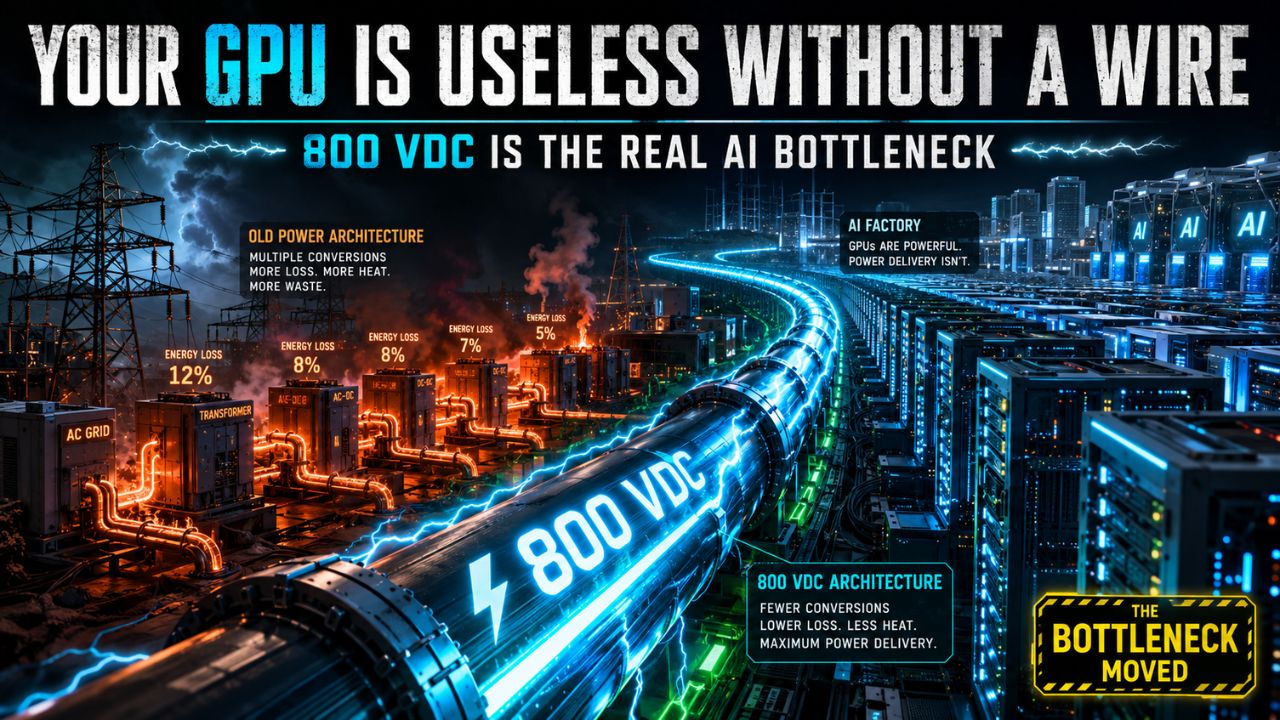
AI data centers are moving to 800 VDC because the real bottleneck is no longer the chip or the model, it is the wire. Distributing power at 800 volts direct current eliminates most AC-to-DC conversion stages, and every eliminated stage removes a tax paid in heat. The result is more usable watts per dollar of power infrastructure, which is why NVIDIA, Google, and Microsoft co-developed the spec through the Open Compute Project and more than 80 manufacturers are already building to it.
KEY TAKEAWAYS
- The conversion tax is the hidden cost. Every AC-to-DC stage between the substation and the rack loses energy as heat.
- Pushing the bus voltage to 800 VDC lowers the current for the same power delivery. Since heat scales with the square of the current, wasted watts collapse.
- The 800 VDC spec is open and backward compatible. Existing AC facilities can retrofit without a full rebuild.
- Power delivery, not model intelligence, is the binding constraint on AI infrastructure.
Texas just told new data centers to stop connecting to the power grid. Not a suggestion. A halt. On August 4, 2026, Governor Greg Abbott effectively paused new data center projects pending a statewide grid audit because AI-driven electricity demand overwhelmed supply. This is the starkest signal yet that the ceiling on AI is not model intelligence. It is the wire between the grid and your GPU.
NVIDIA, Google, and Microsoft just published a joint answer. They co-developed an 800 VDC power delivery architecture through the Open Compute Project, and more than 80 equipment manufacturers are already building to the spec. An MGX-compatible 800 VDC power rack arrives in the second half of 2026. The bet is simple: if you cannot get more watts to the chip, you change how watts travel.
This is the infrastructure layer PhantomByte has been pointing at since Note #147 on GPU utilization and Note #145 on the cost control crisis. The bottleneck moved again. It was chips, then it was memory, then it was utilization. Now it is power delivery. If you are building AI infrastructure and you are not thinking about voltage architecture, you are solving the wrong problem.
THE CONVERSION TAX
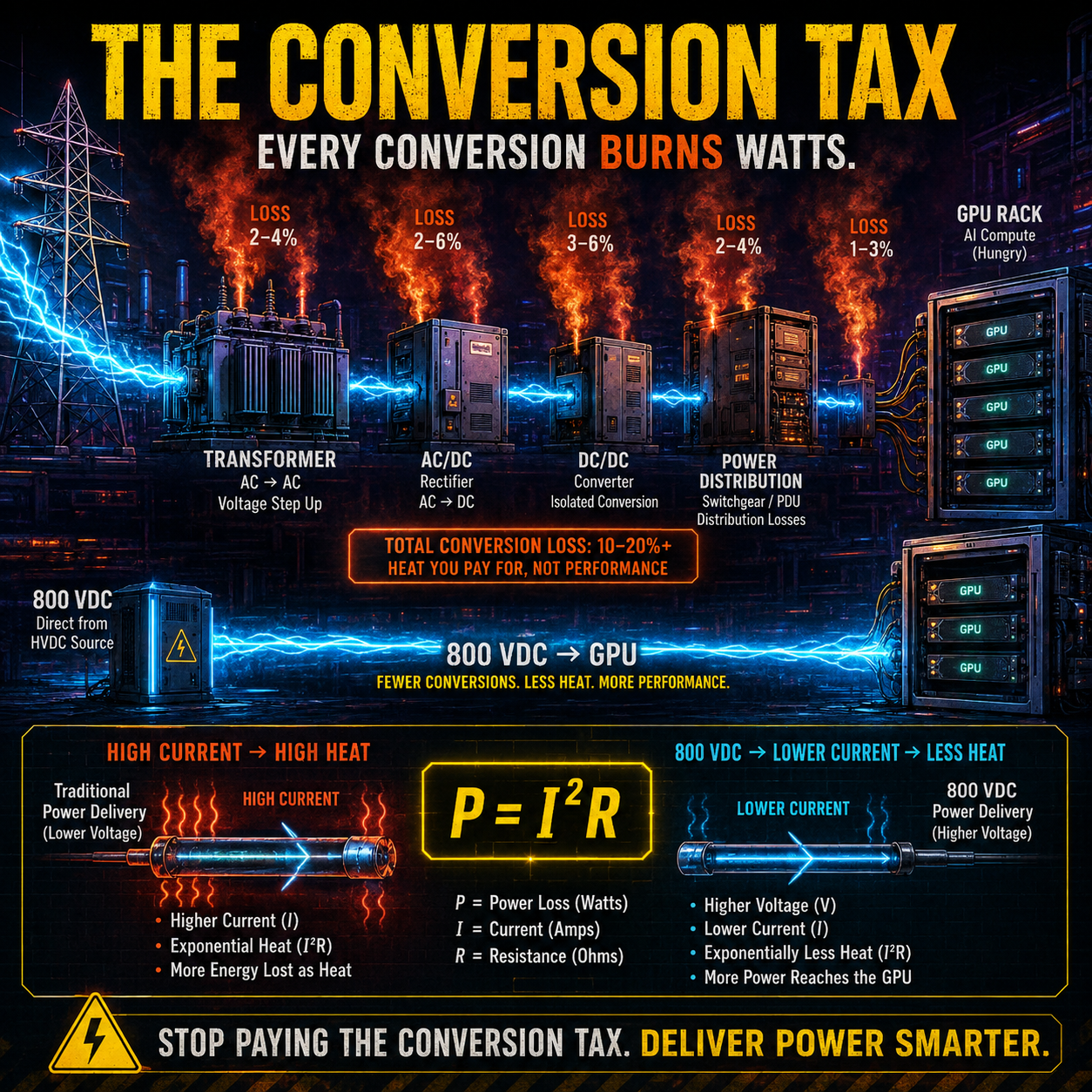
Every time power changes form, you pay a tax. The current standard takes grid AC power, steps it down, converts it to DC, converts it again, and finally delivers it to the GPU. Each AC-to-DC conversion stage loses energy as heat. A modern AI data center might run five or more conversion stages between the substation and the rack. Those losses compound.
The 800 VDC architecture attacks this directly. It distributes power at 800 volts direct current, eliminating most AC-to-DC conversion stages. The spec was co-developed by NVIDIA, Google, and Microsoft through the Open Compute Project, and they published a joint white paper in March 2026 plus the LVDC Solid-State Transformer Specification v0.3 in July 2026. The engineering argument is clean: fewer conversions mean less waste, and less waste means more usable watts per dollar of power infrastructure.
The physics behind the tax is quantifiable. Joule's first law states that power dissipated as heat scales with the square of the current: P = I squared R, where P is the heat lost in watts, I is the current in amperes, and R is the resistance of the conductor. Halve the current and the heat drops by a factor of four. For the same power delivery, raising the bus voltage to 800 VDC lowers the current proportionally, so the I squared term collapses and heat loss falls far faster than the voltage rises. That is the mathematical engine driving the industry's move: pushing voltage up is the cheapest way to push wasted watts down.
AC-to-DC conversion loss is the energy that disappears as heat every time electricity changes from alternating to direct current. Across multiple stages, the compounding inefficiency is the hidden tax on every AI rack. The 800 VDC spec is the first industry-wide attempt to eliminate that tax at scale.
THE 80 MANUFACTURER SIGNAL
More than 80 equipment manufacturers are already building products to the 800 VDC specification. That is not a lab experiment. That is a supply chain moving. When 80 plus vendors commit to a spec before the first compatible rack ships, the industry is voting with its manufacturing capacity.
A power architecture standard only works if the ecosystem builds to it. NVIDIA, Google, and Microsoft publishing the spec through the Open Compute Project means it is open, not proprietary. Any vendor can build to it. The MGX-compatible 800 VDC power rack arriving in H2 2026 is the first concrete product, but the 80 manufacturers signal that the follow-on ecosystem is already forming.
Standardization at the power layer is what lets existing AC-based facilities adopt 800 VDC without a full rebuild. That backward compatibility is the difference between a spec that ships and a spec that sits on a shelf.
THE GRID IS NOT WAITING
While the spec moves, the grid is pushing back. Texas halted new data center connections because AI compute demand overwhelmed supply. Amazon is investing in a natural gas power plant in Pecos County, Texas, that could be permitted to release 33 million tons of CO2 annually, more than any other US power plant. Anthropic just signed a $9.1 billion deal with Bitcoin miner Riot Platforms to repurpose 191 megawatts of crypto-mining power infrastructure for AI compute.
These are not isolated stories. They are the same story: the power system is the binding constraint, and every major player is racing to solve it from a different angle. Texas is rationing. Amazon is building its own generation. Anthropic is buying someone else's. NVIDIA is redesigning the delivery architecture.
There are four strategies companies are using to solve the power problem. Ration access, which is what Texas did. Generate your own, which is what Amazon is doing with its gas plant. Repurpose existing capacity, which is what Anthropic and Riot are doing. And redesign delivery efficiency, which is what NVIDIA's 800 VDC spec does. Each has tradeoffs. Each has a timeline. You should be able to identify which strategy applies to your situation.
THE 500 BILLION DOLLAR QUESTION
NVIDIA is guaranteeing up to 25 percent of the resale value of its own chips to unlock $500 billion in AI infrastructure financing from Wall Street giants including Apollo, BlackRock, Blackstone, Brookfield, Goldman Sachs, and KKR. By backstopping GPU value, NVIDIA makes it safer for lenders to fund data center buildouts. This turns NVIDIA from a hardware seller into an underwriter of the entire AI capex cycle.
$500 billion in financing is routed into data centers, power, and the physical layer of AI compute. But if the power delivery architecture cannot support the next generation of racks, that $500 billion buys hardware that cannot run at full capacity. The financing and the power architecture are the same bet. If the wire fails, the capital fails.
Lenders need collateral. If a GPU retains its value, the lender can repossess it if the data center defaults. NVIDIA is putting its balance sheet behind the collateral. This is financial engineering in service of power engineering.
THE BACKWARD COMPATIBILITY ANGLE
The 800 VDC spec was designed so existing AC-based facilities can adopt it without a full rebuild. This is the detail that makes it practical. If every data center had to be torn down and rebuilt for 800 VDC, the transition would take a decade. Instead, the architecture is designed to slot into existing infrastructure with targeted upgrades to the power delivery chain.
A retrofit means you replace the conversion stages, not the entire facility. The MGX-compatible rack is the bridge. This is engineering pragmatism: solve the problem at the layer where the waste happens, not at the layer where the building stands.
The 800 VDC transition is not a greenfield-only play. It is a retrofit-friendly upgrade path for facilities that are already running.
WHAT TO DO TODAY
- Audit your facility's power delivery chain. Count the AC-to-DC conversion stages between your substation and your racks. Each one is a tax.
- Read the Open Compute Project 800 VDC spec and the LVDC Solid-State Transformer Specification v0.3. Both are public.
- Check whether your rack vendors are among the 80 plus manufacturers building to the 800 VDC spec. If they are not, ask them why.
- If you are planning new capacity in a region with grid constraints (like Texas), factor power delivery architecture into your site selection, not just power availability.
- Track the MGX-compatible 800 VDC power rack timeline (H2 2026). If your refresh cycle aligns, this is your next infrastructure upgrade.
- If you are financing a build, understand that GPU value guarantees affect your collateral position. Ask your lender how they are valuing the chips in your capex model.
THE UNCOMFORTABLE QUESTION
You picked the model. You picked the GPU. You picked the cooling. Did you pick the voltage? If your power delivery architecture is an afterthought, your $500 million data center is a very expensive space heater with a conversion tax. The bottleneck moved to the wire. Are you still fighting over the chip?
The engineer who masters the wire will own the next decade of AI infrastructure.
Get More Articles Like This
Getting your AI agent setup right is just the start. I'm documenting every mistake, fix, and lesson learned as I build PhantomByte.
Subscribe to receive updates when we publish new content. No spam, just real lessons from the trenches.
Build Real AI Infrastructure
PhantomByte teaches you to build real AI infrastructure yourself: local AI stacks, autonomous agents, multi-agent orchestration, web scraping, and custom tools. Step-by-step PDF tutorials you download, follow, and deploy. No subscriptions. No fluff. Just skills that ship.