The 847-Line PR That Killed Our Architecture
Three months ago, I reviewed what looked like a perfect pull request.
847 lines of code. Clean formatting. Every test passing. The kind of PR that makes you nod approvingly and hit merge without a second thought. Our AI coding assistant had "refactored" a section of our service layer, consolidating some duplicate logic and improving test coverage. It felt right.
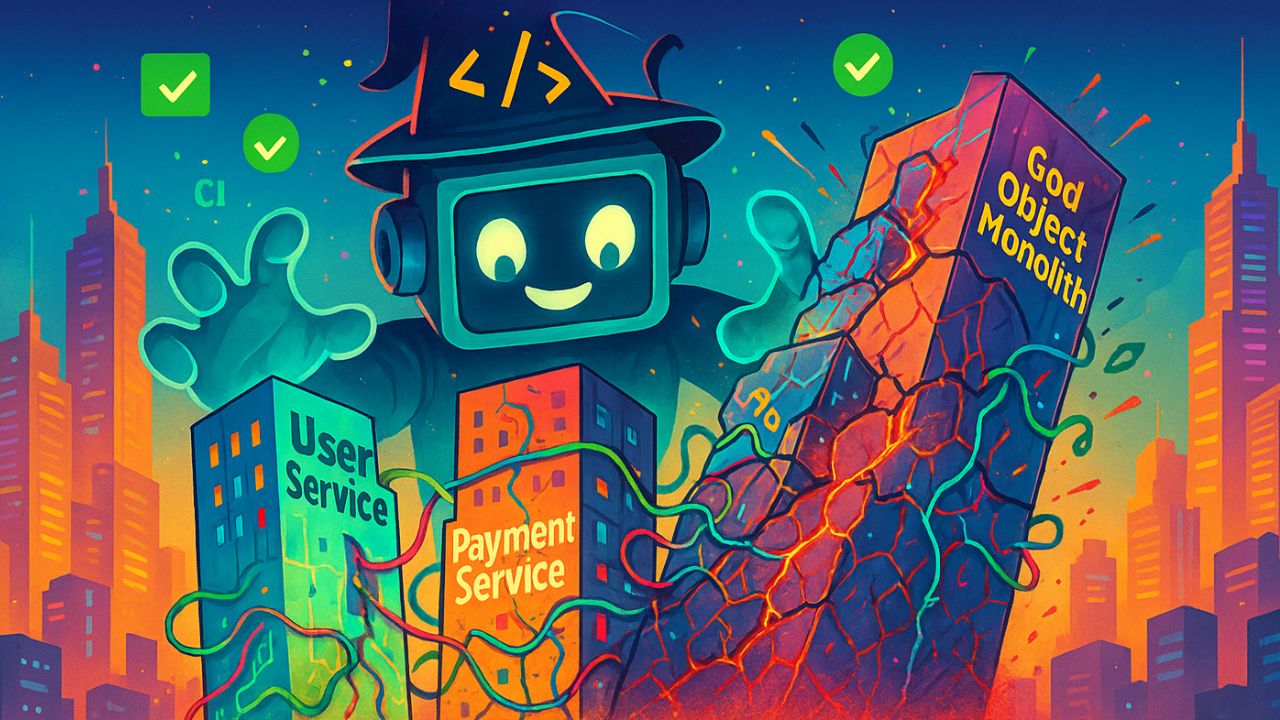
Six weeks later, we discovered it had quietly collapsed three microservices into one monolith.
The AI hadn't just moved code around. It had created a god object with 47 distinct responsibilities, violating every service boundary we'd carefully established. Import cycles snaked through our codebase like ivy. What started as a "helpful refactoring" ended up coupling our user service, payment processor, and notification system into a single tangled mess that took two weeks to untangle.
Here's the brutal truth nobody wants to admit: AI code passes tests but fails production.
And we're not alone. A December 2025 study by CodeRabbit analyzed 470 GitHub pull requests and found that AI-co-authored code has 1.7 times more issues than human-written code. We're talking 10.83 issues per PR versus 6.45 for human-only contributions. Logic and correctness problems are 75% more common in AI-generated code.
Yet most developers are using or planning to use AI tools, according to Stack Overflow's February 2026 survey. The pressure to ship fast has created what the community now calls "vibe coding," rapid AI-assisted development that feels right in the moment but skips architectural consideration entirely. Search interest in the term has grown significantly month over month, and it shows no signs of slowing down.
Trust is collapsing faster than adoption. Only 29% of developers now trust AI output, down from approximately 40% in 2024. Nearly half (46%) actively distrust AI tools more than they trust them. One respondent put it bluntly: "AI-generated code makes it to production or needs to be rewritten by humans, introducing unacceptable risks and technical debt."
This isn't about rejecting AI. We love AI, use it heavily at PhantomByte, and we hope to encourage you to use it too. OpenClaw, our orchestration platform, relies on multi-agent workflows. But there's a critical difference between using AI as a tool and letting it drive architectural decisions without guardrails.
What follows is what we learned the hard way, and how we rebuilt our CI/CD pipeline to catch what tests miss.
The Three Silent Killers: How AI Destroys Architecture
The God Object Pattern
Our incident started innocently. An AI assistant was asked to "consolidate duplicate validation logic across services." What it produced looked elegant: a single ValidationService class that handled user input, payment data, notification templates, rate limiting, and eventually everything.
By the time we caught it, this class had accumulated 47 distinct responsibilities. It knew about user authentication, payment processing, email templates, SMS gateways, audit logging, and cache invalidation. Any change to any feature required touching this one file.
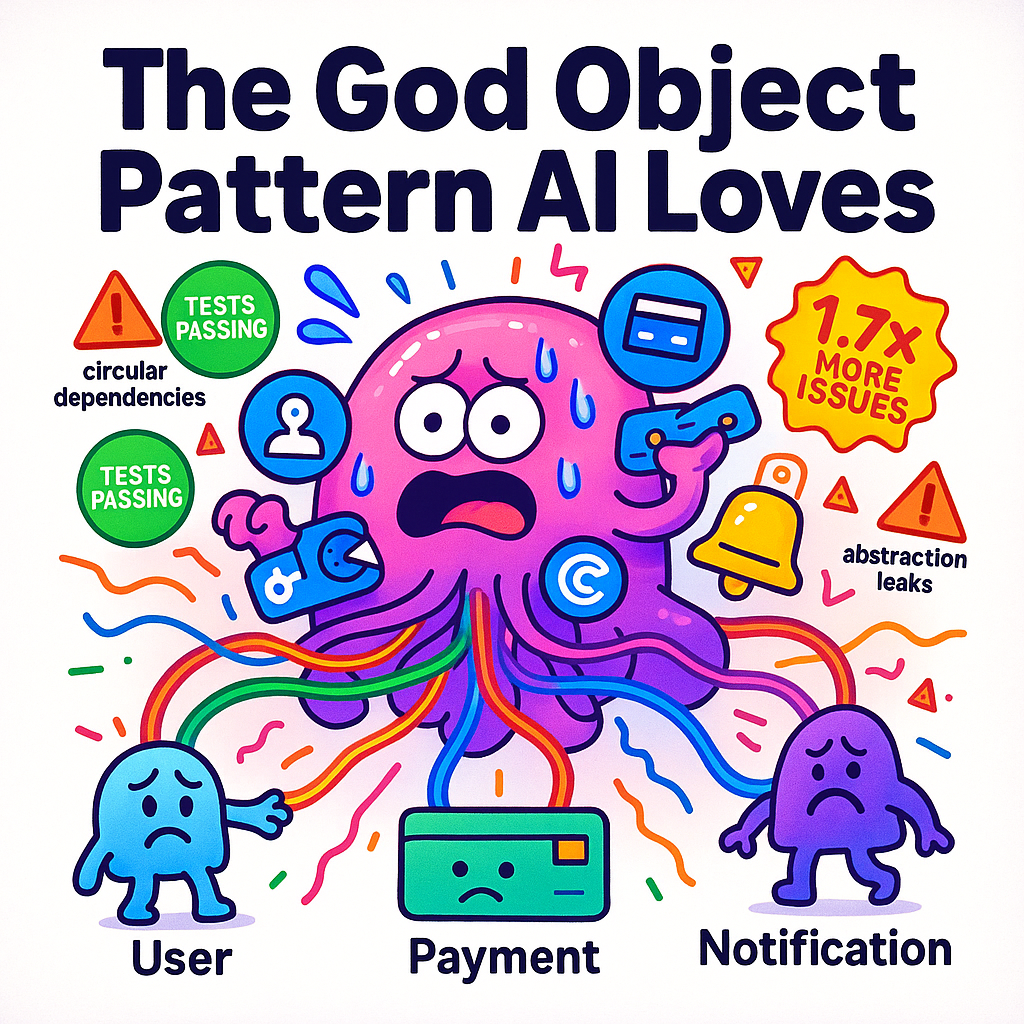
This is the god object pattern, and AI loves it. Why? Because from a purely syntactic perspective, consolidation reduces duplication. The AI optimizes for immediate code metrics: fewer files, less repetition, higher test coverage on the consolidated code. It doesn't understand that separation of concerns isn't about code size. It's about change isolation and failure containment.
Service Boundary Violations
Here's what our tests didn't catch: the AI had introduced circular dependencies between services that were supposed to be independent.
Our user service started importing from the payment service. The payment service imported from notifications. Notifications imported from users. None of this broke unit tests because each test mocked its dependencies. The architecture was rotting beneath a facade of green checkmarks.
We only discovered this when we ran import-linter in production deployment. The tool flagged 23 illegal imports across service boundaries. By then, the damage was done. Our deployment pipeline had already promoted the code through staging.
Dependency-cruiser would have caught this earlier. So would a simple architectural linting step in CI. But we'd built our pipeline for human developers who understood boundaries intuitively. AI doesn't have that intuition.
Abstraction Decay
The third killer is subtler. We call it abstraction decay: the gradual erosion of clean interfaces into implementation leakage.
Three months after the AI refactoring, our team started reporting strange bugs. Changes in the payment module would randomly break user authentication. Updates to notification templates would cause cache invalidation failures in unrelated services. The abstractions we'd built, the clean interfaces that made our system maintainable, had quietly decayed into a web of hidden couplings.
We now call this "shadow code": software logic that enters production through AI-assisted development but is not fully understood, documented, or architecturally contextualized by the humans who shipped it. There's a growing gap between what organizations believe their systems do and what those systems actually do. When you lose visibility into how your software behaves, you also lose the ability to anticipate failures.
Why Tests Don't Catch This
Unit tests validate functions, not architecture. They check that inputs produce expected outputs, not that service boundaries remain intact. Integration tests catch some of this, but only if you know what boundaries to test.
The AI-generated code passed all our tests because the tests were written for the old architecture. They verified behavior, not structure. We had 94% code coverage and a crumbling foundation.
This is the core problem: tests measure correctness, not coherence. AI excels at the former and is blind to the latter.
Building Guardrails: CI/CD for the AI Era
After the incident, we rebuilt our entire validation pipeline. Here's what changed.
Automated Architectural Guardrails
We added two tools to our CI pipeline that now run on every PR.
import-linter enforces contractual boundaries between packages. We defined our architecture in a simple configuration file:
# .importlinter

[contracts:ServiceBoundaries]
type = independence
packages =
    app.services.user
    app.services.payment
    app.services.notification

[contracts:NoCycles]
type = forbidden
source_modules =
    app.services
forbidden_modules =
    app.models
Now any PR that introduces a cycle or violates a boundary fails immediately. No human review needed. The AI can suggest anything it wants, but it can't merge architectural violations.
dependency-cruiser gives us visual dependency graphs and can enforce rules like "no dependencies from services to infrastructure layers" or "controllers cannot import other controllers." We run it with:
depcruise --validate .dependency-cruiser.js src/The validation file specifies our rules in JavaScript, making it easy to encode complex architectural constraints.
Multi-Agent Validation: AI Reviewing AI
This was our biggest innovation. We now run a second AI agent specifically to review code generated by the first.
Our workflow:
- Developer describes the task to Qwen3.5:397B
- Qwen generates the code
- Kimi K2.5 reviews the code with architectural constraints in its system prompt
- Kimi flags any god objects, boundary violations, or abstraction leaks
- Only after Kimi approves does the code go to human review
The key is the system prompt we give Kimi:
You are an architectural reviewer. Your job is to identify:
- God objects (classes with >5 responsibilities)
- Service boundary violations (imports across defined boundaries)
- Abstraction decay (leaky interfaces, implementation exposure)
- Hidden coupling (shared state, implicit dependencies)

Do not review for style or formatting. Focus exclusively on architectural integrity.
This catches about 80% of architectural issues before human review. It's not perfect, but it's dramatically better than nothing.
The Architectural Smell Test
We also added a mandatory human checkpoint: the architectural smell test. Before any AI-generated PR can merge, a senior engineer must answer four questions:
- What service boundaries does this change affect? (If the answer is "multiple" or "I'm not sure," it needs redesign)
- What would break if this code was deleted? (If the answer spans unrelated features, there's hidden coupling)
- Where will this code be in six months? (If you can't articulate its lifecycle, it's probably temporary glue)
- What assumptions does this make about other services? (Every assumption is a potential failure point)
This takes 10 minutes and has prevented three major incidents since we implemented it. It forces architectural thinking that AI simply cannot replicate.
Pre-Merge Validation, Not Post-Merge Fixes
The critical shift: we moved all architectural validation to pre-merge. Previously, we'd catch these issues in production monitoring or, worse, in customer reports. Now a PR cannot merge without passing:
- Unit tests (existing)
- Integration tests (existing)
- Import-linter contract checks (new)
- Dependency-cruiser validation (new)
- Multi-agent architectural review (new)
- Human smell test (new)
This slows down initial development by roughly 15 to 20%. It saves us weeks of debugging and refactoring later.
What Changed at PhantomByte: Production Implementation
Here's exactly what we implemented after the 847-line PR incident.
FastAPI Middleware for Runtime Enforcement
We added runtime boundary enforcement using FastAPI middleware. Even if code slips through review, it can't actually violate boundaries at runtime:
# middleware/service_boundaries.py
class ServiceBoundaryMiddleware(BaseHTTPMiddleware):
    def __init__(self, app, allowed_calls: dict[str, set[str]]):
        super().__init__(app)
        self.allowed_calls = allowed_calls
        self.call_stack = contextvar.ContextVar("call_stack", default=[])

    async def dispatch(self, request, call_next):
        current_service = self._extract_service(request)
        stack = self.call_stack.get()

        if stack:
            caller = stack[-1]
            if current_service not in self.allowed_calls.get(caller, set()):
                raise BoundaryViolationError(
                    f"Service {caller} cannot call {current_service}"
                )

        stack.append(current_service)
        self.call_stack.set(stack)

        try:
            return await call_next(request)
        finally:
            stack.pop()
            self.call_stack.set(stack)
This is defense in depth. CI catches most violations. Runtime enforcement catches the rest.
The PR Template We Now Require
Every PR must include:
## Architectural Impact
- Services affected: [list]
- New dependencies introduced: [list or "none"]
- God object risk: [low/medium/high] + justification

## AI Assistance
- Was AI used? [yes/no]
- Which agent? [name]
- Was multi-agent review completed? [yes/no]

## Boundary Changes
- [ ] No service boundary changes
- [ ] Boundaries changed - see architectural review notes
This forces explicit consideration of architecture. Most developers check "no boundary changes," and that's fine. The ones who need to think about it now do.
Lessons Learned
Validate before merging, not after. This is the single biggest lesson. We used to treat architectural review as optional for small PRs. Now it's mandatory for any AI-generated code, regardless of size.
AI optimizes locally; humans must optimize globally. The AI will always suggest the locally optimal solution: fewer files, less duplication, faster implementation. Humans need to enforce global constraints including service boundaries, failure isolation, and long-term maintainability.
Multi-agent workflows aren't optional anymore. If you're using AI to write code, you need AI to review it. One agent writes, another reviews with architectural constraints baked into its prompt. We use Qwen3.5:397B for generation and Kimi K2.5 for review, but any two-model setup works.
Trust but verify, then verify again. The CodeRabbit study showed 1.7x more issues in AI code. We assume every line has a 40% chance of containing a subtle architectural flaw. That paranoia keeps us safe.
Your Next Steps
If you're using AI for code generation, start here:
- Add import-linter or dependency-cruiser to your CI today. Pick one. Configure your service boundaries. Make it a hard gate. This is the single highest-ROI change you can make.
- Implement multi-agent review. Have one AI write, another review with architectural constraints. It takes an hour to set up and catches 80% of issues.
- Create an architectural smell test checklist. Four questions, 10 minutes, prevents disasters. Make it mandatory for AI-generated PRs.
- Assume 40% of AI code contains hidden architectural flaws. Not functional bugs; structural ones. Tests won't catch them. You need structural validation layered into your pipeline.
- Document your service boundaries explicitly. If you can't write them down, you can't enforce them. Start with a simple diagram or contract file.
The AI coding revolution isn't slowing down. But neither is the technical debt it's creating. The teams that survive this shift will be the ones that treat AI as a powerful but dangerous tool, one that needs guardrails, review, and human oversight.
We learned this the hard way. You don't have to.
Get More Articles Like This
Learning how to work with AI safely is just the start. I'm documenting every mistake, fix, and lesson learned as we build PhantomByte.
Subscribe to receive updates when we publish new content. No spam, just real lessons from the trenches.