
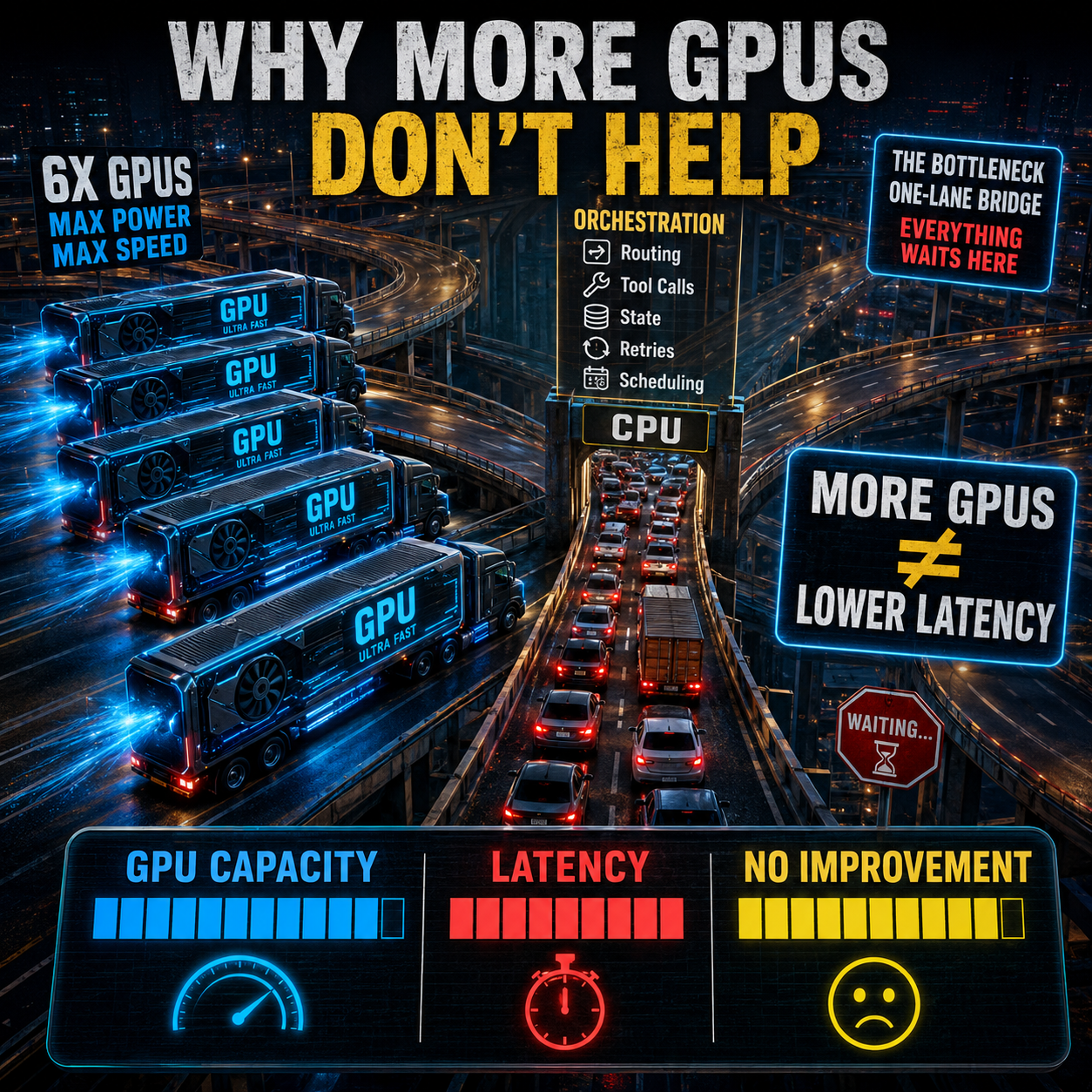
The first production-scale characterization of agentic AI workflows, measured across the Microsoft Azure fleet and published this month (arXiv 2608.04458), found something that breaks every assumption about AI capacity planning. The CPU, not the GPU, sits on the critical path. Orchestration runs on the host. Tool calls cross the CPU-GPU boundary repeatedly. Load stays low with sudden spikes. Your million-dollar GPU array is waiting for a host CPU to finish scheduling the next tool call.
If you are scaling agentic workloads by buying more GPUs, you are solving the wrong bottleneck. The paper calls this an architectural mismatch and proposes Agora, a prototype that harvests idle CPU cores and oversubscribes GPU memory to fix it. The improvement is real. The implication is bigger. Datacenter design for agentic AI is not a GPU problem.
This extends a thesis PhantomByte has been building for months. Note #147 established that GPU utilization is the new moat. Note #151 showed that energy per request is the real unit of AI economics. Those articles argued that idle hardware and energy waste are the silent cost drivers. This one goes deeper. Even with perfect utilization and energy efficiency, your agent latency is bottlenecked by the CPU orchestration layer, not the GPU compute layer.
What the Azure Production Study Actually Found
Agentic AI workloads are fragmented, heterogeneous, and CPU-bound at the orchestration layer. The GPU is not the bottleneck. The CPU is.
The paper (arXiv 2608.04458) combines a production study across Microsoft Azure’s fleet with a controlled study of open-source frameworks. The methodology is the key. This is not a synthetic benchmark. It is a production characterization of how agents actually behave at scale.
The findings are stark. Each user request expands into a workflow of LLM inferences, tool invocations, and orchestration decisions that repeatedly cross the CPU-GPU boundary. The execution structure keeps load low with sudden spikes. The CPU sits on the critical path because orchestration runs on the host. Conventional uniform servers are architecturally mismatched for this pattern.
Here is what that means in plain terms. An agent does not just run a forward pass and return. It calls a tool, waits for the result, decides what to do next, calls another tool, and so on. Each step involves CPU-side orchestration. Parsing the model output. Routing to the right tool. Managing state. Handling retries. The GPU finishes its inference in milliseconds and then sits idle while the CPU does the plumbing.
Traditional LLM serving is GPU-bound. Sustained utilization is high. A uniform server works fine. Latency is a function of GPU throughput.
Agentic AI workloads invert this. They are CPU-bound at the orchestration layer. Load is bursty. A uniform server is mismatched. Latency is a function of CPU orchestration plus GPU inference. The CPU is the gatekeeper.
Why Buying More GPUs Will Not Fix Your Agent Latency
Adding GPUs to a CPU-bottlenecked system increases your cost without reducing your latency. You are paying for idle silicon.
The logic is simple. If the CPU is on the critical path, more GPU capacity does not move the critical path. It just means the GPU finishes faster and waits longer. The bottleneck is upstream of the GPU.
AMD’s data center revenue hit $6.7 billion in Q2 2026, up 107% year over year, fueled by EPYC processors and Instinct GPU sales. That segment now accounts for 58% of total company revenue. CEO Lisa Su called it an excellent quarter with record revenue and profitability. The industry is placing a massive bet on GPU compute capacity. But if the Azure study is right, a significant portion of that spend is targeting the wrong layer of the stack.
This is not a knock on AMD or NVIDIA. It is a statement about workload characteristics. The hardware is fine. The architecture around it is wrong for agentic workloads.
The Azure paper authors put it directly. Fragmented execution strands resources. CPUs and GPUs remain underutilized on average yet experience short bursts of near-saturation. Homogeneous CPU provisioning cannot serve the three host roles efficiently: schedulers, orchestrators, and runners. Multiplexing many agents on shared cores degrades microarchitectural locality as they evict each other’s cache lines and branch-predictor state.
No single static configuration suits them all. The server must adapt to each workload.
The Agora Prototype: What Happens When You Fix the Mismatch
Agora harvests idle CPU cores and oversubscribes GPU memory on commodity servers. The result is improved utilization and server throughput for agentic workloads.
The design is built for commodity hardware, not custom silicon. It recognizes that agentic workloads have a complementary usage pattern. When the GPU is busy, the CPU is idle. When the CPU is busy orchestrating, the GPU is idle. Agora exploits this complementarity.
On the host side, Agora dynamically harvests idle CPU cores for co-located throughput work while protecting agents from sudden tool bursts. CPU harvesting recovers 95% of a co-located workload’s standalone throughput and increases host CPU utilization by 30% while limiting agent slowdown to under 3%.
On the accelerator side, Agora consolidates agents onto fewer GPUs, exploiting agents that share model state or are never active at the same time. It oversubscribes GPU memory by assigning more agent state than can reside simultaneously, then prefetches the next agent’s state to hide swap latency. For the Owl framework, Agora frees a third of the GPUs while raising generation throughput by 82%, completing 22% more tasks per hour, cutting tail latency by 2.5x, and improving energy efficiency by 51%.
Role-aware pooling is the third mechanism. Agora isolates and right-sizes the control plane and the bursty runner pool, then pins tasks within the runner pool to preserve cache and branch-predictor locality. This reduces tools’ CPU demand by up to 46% and worst-case tool latency by 13% while retaining 99% of serving throughput.
For operators running agentic workloads on the Sovereign AI Stack, this is directly applicable. If you are running agents on local hardware, you are already on commodity servers. Profile your CPU orchestration overhead. Identify idle cores during GPU phases. Schedule background work onto them. The Agora pattern is not theoretical. It is a production-validated design principle.
The same harvesting logic scales down to a single home server or a hybrid dev workstation. On a local box you typically have one GPU and a CPU with more cores than the inference workload ever saturates. While the GPU runs a forward pass, the CPU is mostly idle. That idle window is exactly what Agora harvests. You can apply it without any new infrastructure. Pin your orchestration process to a dedicated core set so tool calls and state management never contend with the inference thread. Then schedule background work, embedding jobs, log aggregation, or a second lightweight agent, onto the cores that go quiet during GPU phases. On a hybrid workstation, run the orchestration on the host CPU and let the GPU handle inference, then use affinity scheduling to keep the two from evicting each other’s cache lines. The result is the same complementarity Agora exploits at fleet scale: when the GPU is busy, the CPU works; when the CPU orchestrates, the GPU idles. You get the throughput gain without buying a second machine.
How to Profile Your Own Agent for CPU Bottlenecks
You can measure this on your own system. It takes a profiler and a stopwatch.
- Attach a CPU profiler. Run your agent workload with a CPU profiler attached. Use perf, py-spy, or cProfile for Python-based orchestration layers.
- Split the clock. Measure wall-clock time spent in GPU inference versus CPU orchestration. Count tool calls, state management, routing, and retry logic as CPU time.
- Look for the pattern. Low sustained GPU utilization with bursty spikes. High CPU utilization during orchestration phases.
- Compare the ratio. If CPU orchestration time exceeds GPU inference time per agent step, you are CPU-bottlenecked.
For a Python orchestration script, attaching py-spy is a one-liner. Start your agent in the background, then sample the running process:
py-spy record --pid $(pgrep -f your_agent.py) --output profile.svg --duration 30That captures 30 seconds of stack traces and renders a flame graph. The wide bars at the top are where the CPU actually spends its time. If the orchestration functions, tool routing, and state management dominate the flame graph while the inference calls are thin, you have confirmed the CPU bottleneck visually.
A simple profiling approach is to timestamp before and after each tool call, and before and after each model inference. The ratio tells you where the time goes. If orchestration dominates, you have confirmed the bottleneck. Do not buy another GPU until that ratio shifts.
This connects to a second paper published this month (arXiv 2608.04066): “The LLM Proposes, the Executive Disposes.” That work argues verification should be architectural, not post-hoc. A deterministic Executive owns all belief. A language model may only file typed proposals. Ablating the commitment mechanism flips goal-abandonment from 0.00 to 1.00.
The implication for infrastructure is clear. Verification and orchestration are architectural concerns that live on the CPU side. The deterministic Executive pattern is a CPU-side verification layer. Its ablation result shows how critical the orchestration layer is. Remove it and the agent collapses. This is not a model problem. It is an architecture problem that runs on the host.
The Connection to Prior PhantomByte Notes
This article extends a knowledge cluster PhantomByte has been building for months.
Note #147, “GPU Utilization Is the New Moat”, established that idle hardware is silent margin erosion. This article explains why agentic workloads leave GPUs idle. The CPU orchestration layer is the bottleneck, not the GPU.
Note #151, “Energy per Request Is the New AI Cost Moat”, showed that the unit of AI economics is the joule. If your CPU is the bottleneck, you are burning joules on idle GPU time while the CPU catches up.
Note #145, “The AI Cost Control Crisis Is Here”, argued architecture decides who survives cost pressure. This article identifies a specific architectural mismatch. Uniform servers for bursty CPU-bound workloads are sinking operators who do not see it.
Note #150, “Your Agent’s KV Cache Is Eating Your Inference Budget”, identified memory overhead as a hidden cost. The CPU orchestration bottleneck is the next layer up. Even with perfect KV cache management, your agent is slow if the CPU cannot schedule the next step fast enough.
The thesis chain is consistent. Model is not the moat. Infrastructure is the moat. GPU utilization is the moat. Energy per request is the moat. Now the CPU orchestration layer is the bottleneck within that moat. Each article takes the thesis one layer deeper.
What to Do Today
- Profile your agent workload. Measure CPU orchestration time versus GPU inference time per agent step. If the ratio is CPU-heavy, you have confirmed the bottleneck.
- Stop buying GPUs to fix agent latency. If the Azure study applies to your workload, and it probably does if you run tool-calling agents, more GPUs will not help. Invest in CPU-side optimization first.
- Audit your orchestration layer. Look at tool call overhead, state management, retry logic, and routing. These are CPU-bound operations. Optimize them before scaling GPU capacity.
- Evaluate co-located compute patterns. The Agora prototype shows that harvesting idle CPU cores during GPU phases improves throughput. Look at whether your orchestration can run on cores that are idle during inference.
- Monitor for quality drift. Tools like Stillsane, a Python library that detects silent quality drift in deployed LLM apps, monitor model outputs for gradual degradation that benchmarks miss. Drift detection is a CPU-side concern. If your CPU is already bottlenecked, monitoring adds load. Plan for it.
- Rethink your server architecture. Uniform servers are mismatched for agentic workloads. Consider role-aware servers with more CPU cores dedicated to orchestration and fewer GPUs per node, or affinity-scheduled co-located compute.
The Uncomfortable Question
You just spent seven figures on GPUs. Your agent latency did not improve. The Azure production study says the CPU was the bottleneck the whole time. How much of your infrastructure budget went to the wrong layer of the stack?
Get More Articles Like This
Getting your AI agent setup right is just the start. I’m documenting every mistake, fix, and lesson learned as I build PhantomByte.
Subscribe to receive updates when we publish new content. No spam, just real lessons from the trenches.
Build Real AI Infrastructure
PhantomByte teaches you to build real AI infrastructure yourself: local AI stacks, autonomous agents, multi-agent orchestration, web scraping, and custom tools. Step-by-step PDF tutorials you download, follow, and deploy. No subscriptions. No fluff. Just skills that ship.