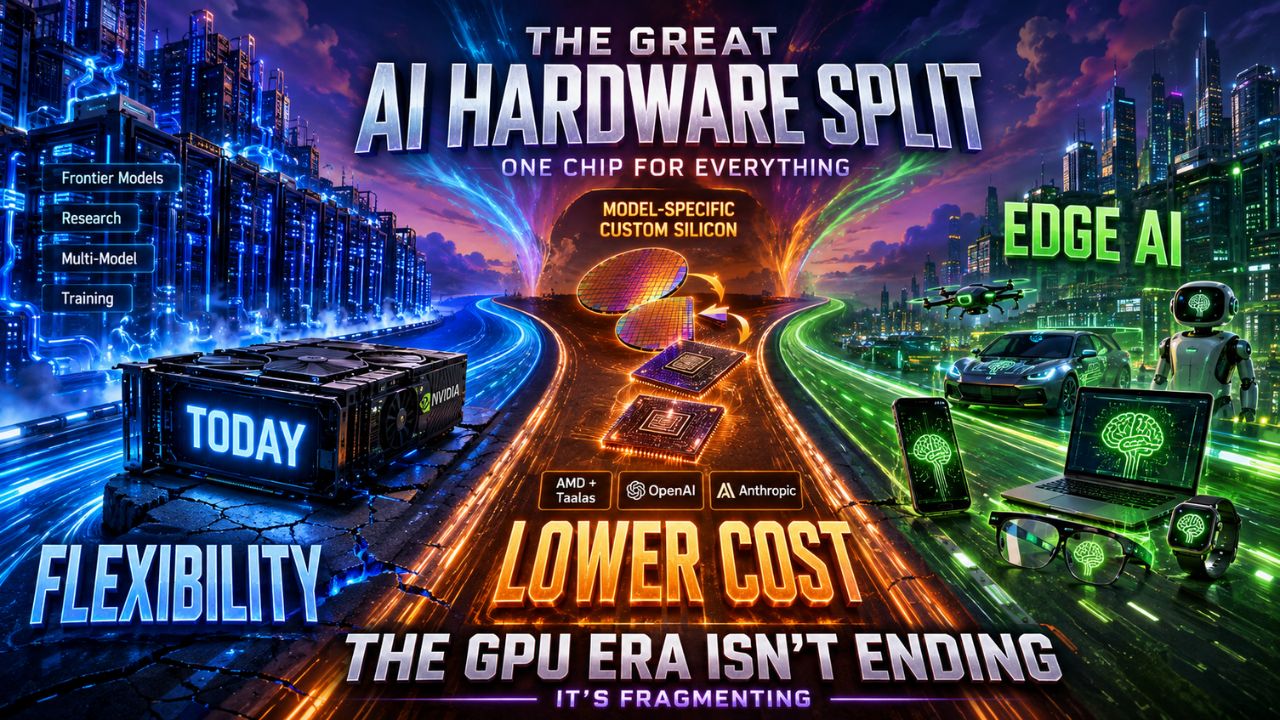
On August 6, 2026, AMD announced a definitive agreement to acquire Taalas, a Toronto-based startup that builds AI chips hard-wired to individual models. Two days earlier, TechCrunch reported that Anthropic was hiring an AI chip design team to build custom silicon for Claude. These are not isolated events. They are signals that the inference hardware market is splitting into three distinct tiers, and the operators still treating GPUs as the only option are about to pay for that assumption.
Reuters first reported the AMD-Taalas deal on August 7. AMD did not disclose the purchase price, but the company did say Taalas technology would be integrated into its accelerator roadmap and developed alongside AMD Instinct GPUs. Taalas was founded in 2023 and has raised $219 million from investors including Quiet Capital and Fidelity. Its pitch is straightforward: instead of running a general-purpose GPU that handles any model with reasonable efficiency, Taalas finalizes a chip’s last two metal layers around a specific model’s weights. The result is a processor with no high-bandwidth memory, no advanced packaging, no 3D stacking, and no liquid cooling. AMD’s senior vice president of AI, Vamsi Boppana, called it “differentiated inference performance and efficiency.” That is corporate speak for “we can serve the same model for less money per request.”
The second signal came from TechCrunch on August 5. Anthropic, a frontier lab that rents NVIDIA GPUs by the gigawatt, is now building its own silicon. Anthropic posted job listings for a “custom silicon team” and has reportedly scouted Samsung as a manufacturing partner. OpenAI already unveiled its Broadcom-built Jalapeño inference chip in June. Google has run on TPUs for years. Meta builds MTIA accelerators. When the companies that define frontier model capabilities all conclude that general-purpose GPUs are not enough for inference, the economics of the GPU-only era are officially breaking down.
Why Model-Specific Chips Threaten the GPU Economics You Know
A general-purpose GPU runs any model but optimizes for none. A model-specific ASIC tunes the silicon to one model’s architecture, trading flexibility for cost and efficiency. At inference scale, that cost difference compounds.
PhantomByte Note #147 showed that GPU utilization is the new moat. Note #151 showed that energy per request is the real cost unit. Model-specific chips attack both problems simultaneously: higher utilization because the silicon matches the workload exactly, and lower energy per request because the chip does not waste cycles on general-purpose overhead.
Taalas claims its first-generation chip, hard-wired with Meta’s Llama 3.1 8B, runs at 17,000 tokens per second per user while costing 20 times less to build and consuming 10 times less power than a comparable GPU setup. These are vendor numbers, not independent benchmarks, and the first-generation part achieves them partly through aggressive quantization to a custom 3-bit data type. Its second-generation silicon moves to standard 4-bit floating-point formats. But even if the real efficiency gain is half of what Taalas claims, the math still changes your procurement decision.
If a model-specific ASIC delivers even 1.5 times the inference throughput per dollar of a general-purpose GPU for a specific model, then any operator running that model at scale is burning money on GPUs. The GPU wins on flexibility. The ASIC wins on unit economics. Most large inference workloads do not need flexibility. They need throughput.
The Three-Tier Inference Stack Emerging Right Now
The inference hardware market is fragmenting into three tiers, each with different economics and use cases.
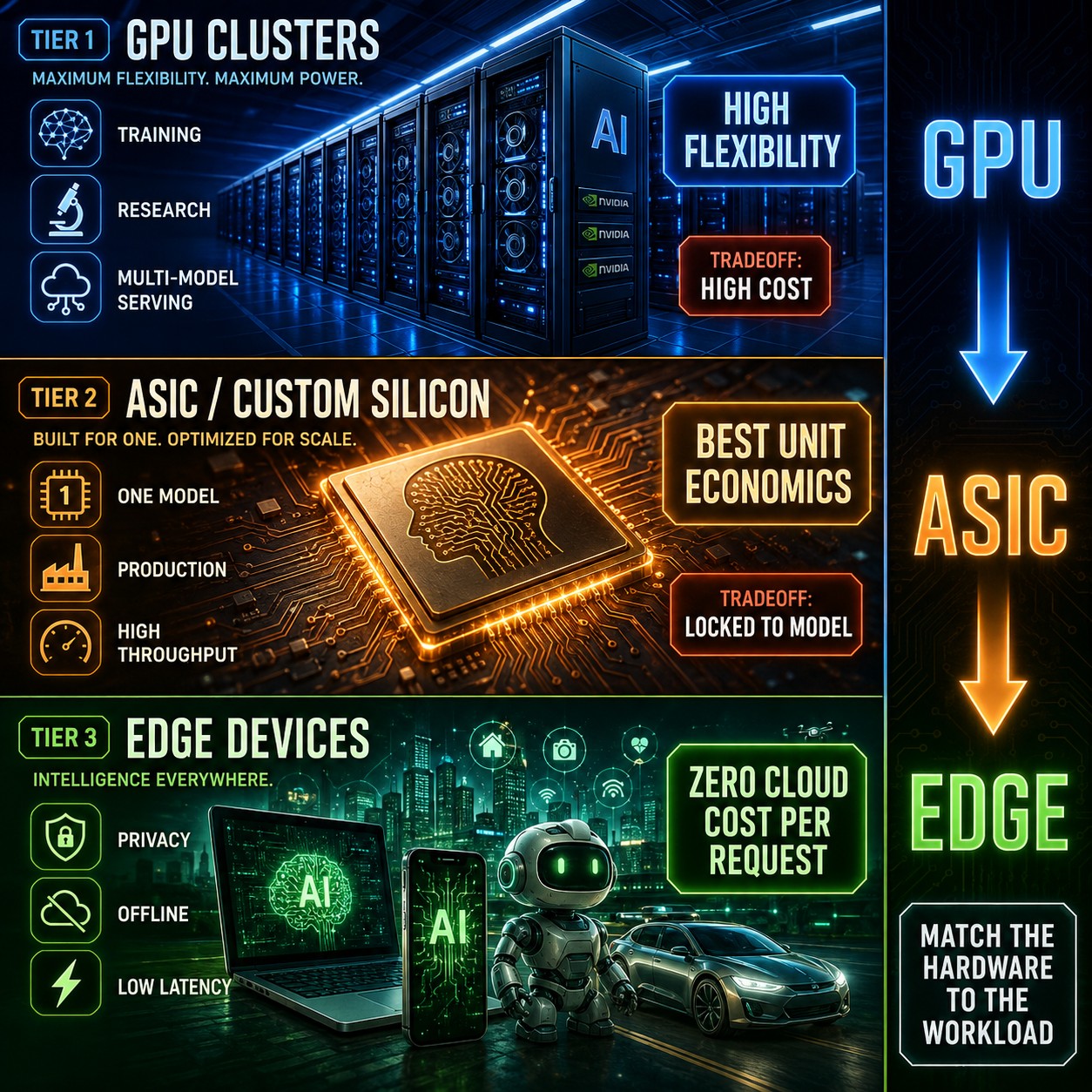
Tier One: General-purpose GPUs (NVIDIA H100, B200, AMD Instinct MI400). These are best for training, multi-model serving, research, and workloads that change weekly. The economics are the highest cost per request and the highest flexibility. Labs training frontier models and platforms serving many models still need this tier. It is not going away.
Tier Two: Model-specific ASICs (Taalas under AMD, Anthropic custom silicon, OpenAI Jalapeño). These are best for production inference of a specific model at scale. The economics are lower cost per request, but you are locked to one model architecture. Enterprises running one model in production at high volume are the target customer. The trade is flexibility for efficiency, and at scale, efficiency wins.
Tier Three: On-device edge models (Liquid AI LFM2.5-2.6B, NVIDIA Alpamayo 2 Super for robotaxis). These are best for privacy-sensitive workloads, low-latency inference, and offline operation. The economics are zero per-request cloud cost, with hardware cost amortized over the device lifetime. Consumer apps, autonomous vehicles, and privacy-first deployments belong here.
The implication is simple but uncomfortable: your inference architecture should not assume one hardware tier. It should match the workload to the tier. Running a 2.6-billion-parameter on-device model on an H100 is as wasteful as running a frontier model on a CPU.
On-Device Inference Is Production-Ready, Not Experimental
Liquid AI released LFM2.5-2.6B on August 6, 2026. It is a 2.6-billion-parameter agentic model with 128K context, tool calling, and open weights, designed to run on local hardware. It decodes 220 tokens per second on an Apple M5 Max and holds 30 tokens per second on a phone. On an NVIDIA H100, it reaches almost 15,000 output tokens per second at high concurrency.
MacPaw, the Ukraine-based developer behind the SetApp app store with over 150,000 paying users, announced a partnership with Liquid AI on August 5 to offer on-device inference to developers building for its platform. This is not a demo. It is a commercial deployment. MacPaw is building an AI assistant called Eney that runs entirely locally, and it wants other developers on its app store to do the same.
The NVIDIA signal is equally direct. NVIDIA released Alpamayo 2 Super on August 4, a 34-billion-parameter open vision-language-action model for autonomous vehicles, under the OpenMDW-1.1 license. It combines a 32-billion-parameter Cosmos 3 Super Reasoner with a 2-billion-parameter diffusion-based Action Expert, post-trained with reinforcement learning. It supports 360-degree perception from up to seven cameras and outputs future trajectories, chain-of-causation reasoning traces, high-level meta-actions, grounded scene answers, and structured reasoning auto-labels. This is a frontier-scale open model designed for physical AI, not a toy. It runs on dedicated hardware, not cloud APIs.
The Sovereign AI Stack Blueprint has argued for local, privacy-first inference since day one. The hardware is now catching up to the thesis. On-device agentic models with 128K context and tool calling are here. The question is no longer whether you can run agents locally. The question is why you are still paying cloud inference for workloads that could run on your device.
The Compute Deals Tell You Where the Money Is Going
Anthropic signed a $10 billion deal with AI cloud startup Volta, Bloomberg reported on August 4. The deal spans six years. Volta will deliver compute from a 133-megawatt data center in Norway, built with partner Bitdeer and powered by NVIDIA Vera Rubin systems. Anthropic also recently announced compute deals with SpaceX and Amazon.
What the $10 billion deal means is that Anthropic is locking in long-term cloud capacity because frontier model training and serving require guaranteed compute. But Anthropic is also hiring a chip design team. The pattern is hedge: rent cloud compute now, own the silicon later. When a company spends $10 billion on cloud capacity and simultaneously builds its own chips, the message is that cloud capacity is a bridge, not a destination.
On August 4, Texas Governor Greg Abbott announced that all new data center projects in the state must be audited by the Public Utility Commission and ERCOT, the grid operator. ERCOT is tracking 474 gigawatts of new connection requests, about 90 percent of them data centers. That queue represents more than five times ERCOT’s total peak demand. Abbott had previously tried voluntary surveys. Most operators did not respond. Now he is compelling compliance.
What Texas means is that data center buildout is hitting regulatory and energy constraints simultaneously. If you cannot build data centers fast enough, model-specific chips that get more inference per watt become more valuable. The regulatory pressure accelerates the shift to efficient silicon.
The Open-Weight Price Pressure Compounds the Hardware Shift
Alibaba’s Qwen3.8 Max now scores 56 on the Artificial Analysis Intelligence Index, on par with Claude Opus 4.8 and ahead of GLM-5.2 at 51. Kimi K3 still leads at 57 and runs 25 percent cheaper. These are open-weight models reaching frontier parity at lower cost.
Model-specific chips are most valuable when the model they are tuned for is open-weight. If you can download Qwen3.8 Max or Kimi K3 and run them on a chip optimized for their architecture, your inference cost drops on two axes simultaneously: cheaper model and cheaper hardware. This is the thesis that breaks the cloud inference business model. When the model is free and the hardware is tuned for it, the only remaining cost is electricity, and that is exactly what Texas is now regulating.
What to Do Today
- Audit your inference workload mix. What percentage of your requests go to a single model? If it is over 50 percent, you are a candidate for model-specific silicon. The GPU is costing you more than the ASIC would.
- Evaluate on-device models for privacy-sensitive workloads. Liquid AI’s LFM2.5-2.6B with 128K context and tool calling can handle classification, routing, and light agentic tasks on local hardware. Stop sending these to cloud APIs.
- Do not buy GPUs for inference-only workloads. If you are not training, you are paying for flexibility you do not use. Track the ASIC market. The AMD-Taalas deal and Anthropic’s chip team mean model-specific inference silicon will be available within 12 to 18 months.
- Factor energy constraints into your hardware roadmap. Texas halting data center approvals is a signal, not an isolated event. Energy per request, which PhantomByte covered in Note #151, is becoming a regulatory metric, not just a cost metric.
- Build your architecture to be hardware-agnostic at the orchestration layer. Your router, which PhantomByte covered in Note #141, should be able to direct traffic to GPUs, ASICs, or on-device models based on workload type. Do not lock yourself into one tier. The operators who architect for fragmentation will pay less per request than the operators who assume GPUs forever.
The Uncomfortable Question
You are buying GPUs because they are what you know. AMD is buying a model-specific chip company. Anthropic is designing its own silicon. Liquid AI is shipping on-device models with 128K context. The hardware layer is fragmenting, and the operators who treat GPUs as the only option will pay twice for the same inference. The question is not whether model-specific silicon will arrive. It is already here. The question is whether your architecture will be ready when it does.
Get More Articles Like This
Getting your AI agent setup right is just the start. I’m documenting every mistake, fix, and lesson learned as I build PhantomByte.
Subscribe to receive updates when we publish new content. No spam, just real lessons from the trenches.
Build Real AI Infrastructure
PhantomByte teaches you to build real AI infrastructure yourself: local AI stacks, autonomous agents, multi-agent orchestration, web scraping, and custom tools. Step-by-step PDF tutorials you download, follow, and deploy. No subscriptions. No fluff. Just skills that ship.