
Writer, the enterprise AI company, just published a research paper with a finding that should change how you budget for AI. Harness efficiency, not model choice, is the more reliable lever for cutting costs. The paper found that harness changes reduced costs by an average of 40 percent across tests. Not 40 percent in one case. An average of 40 percent, across multiple configurations. The harness is the one component whose efficiency multiplies across every model you run, present and future.
This lands on the same day OpenAI shipped Ultrafast mode, delivering 750 output tokens per second through a Cerebras partnership, roughly 14 times standard speed. And the same day DeepSeek priced V4 Pro at 9 times the input cost and 14 times the output cost of V4 Flash. And the same day Fable 5, Anthropic's frontier model, was reported at just 11 percent of spend because corporate willingness to pay for frontier AI has hit a ceiling. The signal is not subtle. The industry has moved from "which model is smartest" to "which architecture is cheapest per useful token." If you are still solving this by switching models, you are solving the wrong problem.
We covered this in Note 124. Your Agent's Harness Is Your Real Model. Three papers proved orchestration design beats model selection by 10x in token cost. Today's data confirms it has moved from research finding to product strategy. Writer built a company around it. OpenAI built a mode around it. The question is whether you have built your architecture around it.
THE MODEL IS A ONE-TIME DECISION
Your model choice is a single decision. You pick Claude, GPT, Gemini, or DeepSeek, and you move on. The price differential between them is real but bounded. Gemini 3.7 Flash costs $0.75 per million input tokens. DeepSeek V4 Pro costs $1.32. The difference is under a dollar per million tokens. That matters, but it is a fixed line item. You negotiate it once and live with it.
The harness is not a one-time decision. It is every decision. Every tool call, every context window expansion, every retry, every wasted reasoning step, every unnecessary token your agent generates before it gets to the answer. The harness sits between your user and your model, and it touches every single request. A 40 percent improvement there does not save you 40 percent once. It saves you 40 percent every day, on every model, forever.
Use the concrete numbers. Writer's 40 percent average cost reduction across tests. OpenAI's 14x speed improvement via Ultrafast. Kog's 3,000 tokens per second on AMD MI300X via monokernel inference. Okta's MCP scoping cutting token costs by narrowing tool lists. These are all harness-layer optimizations. None of them require a different model.
WHY MODEL HOPPING IS BURNING YOUR BUDGET
The instinct when costs rise is to switch models. Rippling's $50K per month engineer, which we covered in Note 154, is the canonical example. Uber blowing its annual AI budget in four months, which we covered in Note 114, is another. The response in both cases was the same: try a cheaper model. Sometimes that works. Often it does not, because the cost is not in the model. It is in the harness.
DeepSeek V4 Flash is cheap. V4 Pro is 14 times the output price. If your harness is generating 14 times the tokens it needs to, switching from V4 Pro to V4 Flash saves you nothing. You are paying less per token and burning more tokens. The math cancels out. This is the trap. The model price is visible. The harness waste is invisible. You see the API bill. You do not see the 93 percent of reasoning tokens that are structurally wasted, a figure we discussed in Note 80.
Fable 5 at 11 percent of spend is the proof. The most capable frontier model is not winning budget share. Not because it is not smart enough. Because the cost per useful task does not justify the premium. Enterprises are not choosing cheaper models because the cheaper models are better. They are choosing them because their harnesses are not efficient enough to make the expensive ones worth it.
THE HARNESS AS COST MULTIPLIER
Writer's framing is the key insight. The harness is the one component whose efficiency multiplies across every model you run. This is not a marginal claim. If you improve your harness by 40 percent today, that improvement applies to Claude tomorrow, to GPT next month, to whatever open-weight model you self-host next year. You pay for the optimization once. You collect the savings on every model you ever deploy.
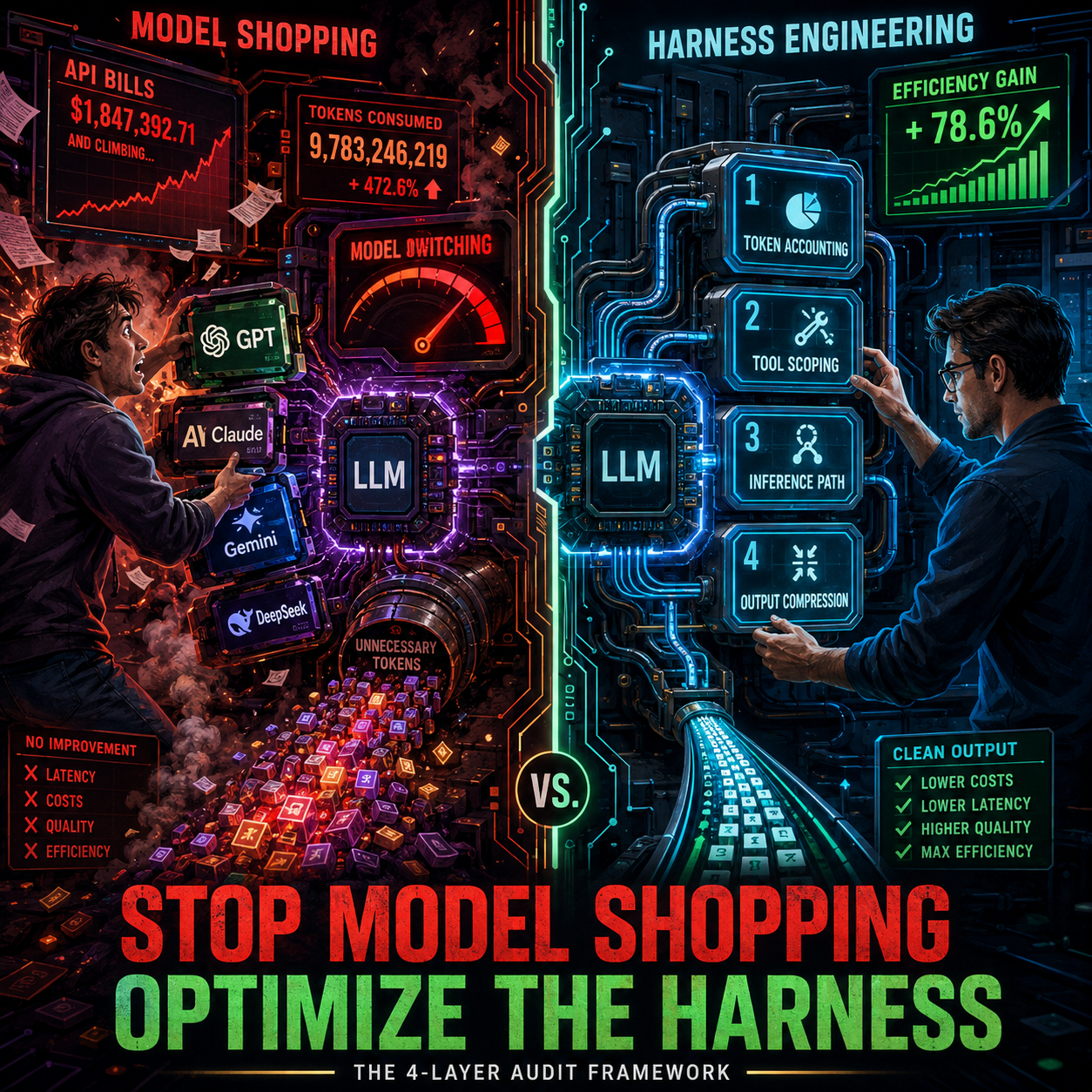
Contrast this with model switching. When you switch from Claude to DeepSeek, you save money on input tokens. When DeepSeek raises prices, as they just did with V4 Pro, you lose that savings. When the next model comes out, you re-evaluate. Every model decision is a fresh negotiation with fresh risk. The harness decision is structural. It compounds.
List the concrete harness levers from today's data. Tool list scoping, which Okta proved: fewer tools, fewer tokens, lower costs. Inference acceleration, which OpenAI proved: 750 tokens per second via Cerebras, not a smaller model. Monokernel optimization, which Kog proved: 3,000 tokens per second on MI300X without kernel switches. Output compression, which Headroom proved in Note 107: compresses tool outputs before they reach the LLM, cutting token costs 60 to 95 percent. Router-based model selection, which Microsoft proved in Note 141: cut costs 89 percent via routing, quantization, and workload-specific training.
Each of these is a harness-layer fix. None requires a different model. Each compounds across every model you run.
THE PRICE FLOOR IS SET. YOUR ARCHITECTURE IS NOT.
DeepSeek V4 Pro at $1.32 per million input tokens. Gemini 3.7 Flash at $0.75. These are the price floors. They are dropping. Microsoft's MAI Code 1.1 Flash just got crushed by DeepSeek on both price and performance. Open-weight Chinese models are now the price-performance baseline. The model layer is commoditizing.
This is good news if your harness is efficient. You get the same or better output for less money. It is bad news if your harness is wasteful. A commoditizing model market means the inefficiency in your architecture becomes a larger percentage of your total cost. When models were expensive, harness waste was a rounding error. When models are cheap, harness waste is your bill.
Nvidia's $500 billion financing plan tells you the hardware layer is not getting cheaper soon. Nvidia is covering up to 25 percent of GPU value shortfalls to keep the financing flowing. They are betting that AI servers are investable infrastructure, not depreciating assets. That bet only pays off if utilization stays high. High utilization is a harness problem.
THE FRAMEWORK: FOUR-LAYER HARNESS COST AUDIT
Here is a concrete framework you can run today.
- Layer 1: Token accounting. Measure tokens in and tokens out per agent task, not per API call. You need task-level cost, not request-level cost. If you cannot attribute token spend to a specific user action, you cannot optimize it.
- Layer 2: Tool surface audit. List every tool your agent can access. Count the tokens in each tool description. Okta's MCP scoping approach: if your agent has 50 tools and uses 3, the other 47 are burning tokens on every context window expansion. Scope the tool list to what the task requires.
- Layer 3: Inference path optimization. Are you using prefix caching? KV cache optimization, which we covered in Notes 150 and 143? Inference acceleration? Kog's monokernel approach and OpenAI's Cerebras partnership both target this layer. The question is not "which model is fastest" but "is my inference path optimized for my workload."
- Layer 4: Output compression. Headroom, which we covered in Note 107, compresses tool outputs before they reach the LLM. If your agent calls a tool that returns 5,000 tokens of JSON and the model needs 500 of them, 4,500 tokens are waste. Compress at the harness, not at the model.
TWO HONEST CAVEATS
None of this is a free lunch, and the argument is stronger for saying so.
First, harness-layer optimization is not zero-cost. MCP scoping, custom output compression, and monokernel configurations all require upfront senior engineering hours. You are trading engineering labor for recurring API spend. A team that ships a 40 percent harness improvement has spent real time building it. For enterprise decision-makers, that trade is the actual ROI calculation: the one-time engineering cost against the monthly token bill it removes. The harness wins on the math, but only if you price the engineering hours honestly.
Second, harness tuning assumes a good enough base capability. Optimization multiplies across models, but it cannot manufacture a capability the underlying model lacks. If the model has no native multimodal understanding, no amount of tool scoping or output compression gives it that. If it cannot reason over long horizons, the harness cannot engineer around that. The harness makes a capable model cheaper and faster. It does not make an incapable model capable. Keep the base model above the capability bar, and the harness does the rest.
WHAT TO DO TODAY
- Stop model shopping. Pick a model that is good enough. Spend the time you would spend evaluating benchmarks on auditing your harness.
- Run a token accounting audit. Measure tokens per task, not per request. If you cannot attribute spend to user actions, build that first.
- Scope your tool lists. If your agent has access to tools it does not use for the current task, remove them from the context. Okta's MCP scoping proves this works.
- Measure your harness efficiency before and after each change. A 40 percent improvement is the benchmark Writer set. If you are not hitting that, keep digging.
- Read Note 124, Your Agent's Harness Is Your Real Model, and Note 154, One Engineer Burned $50K a Month in Tokens. The architecture patterns are there. The cost case is now proven.
- Price your models as a fixed line item. Price your harness as a variable cost. Optimize the variable.
THE UNCOMFORTABLE QUESTION
Your model bill is visible. Your harness waste is not. How much money are you burning on tokens your agent never needed to generate, on tools it never needed to see, on context it never needed to carry? You do not know. And that is why switching models will not fix it.
Get More Articles Like This
Getting your AI agent setup right is just the start. I'm documenting every mistake, fix, and lesson learned as I build PhantomByte.
Subscribe to receive updates when we publish new content. No spam, just real lessons from the trenches.
Build Real AI Infrastructure
PhantomByte teaches you to build real AI infrastructure yourself: local AI stacks, autonomous agents, multi-agent orchestration, web scraping, and custom tools. Step-by-step PDF tutorials you download, follow, and deploy. No subscriptions. No fluff. Just skills that ship.