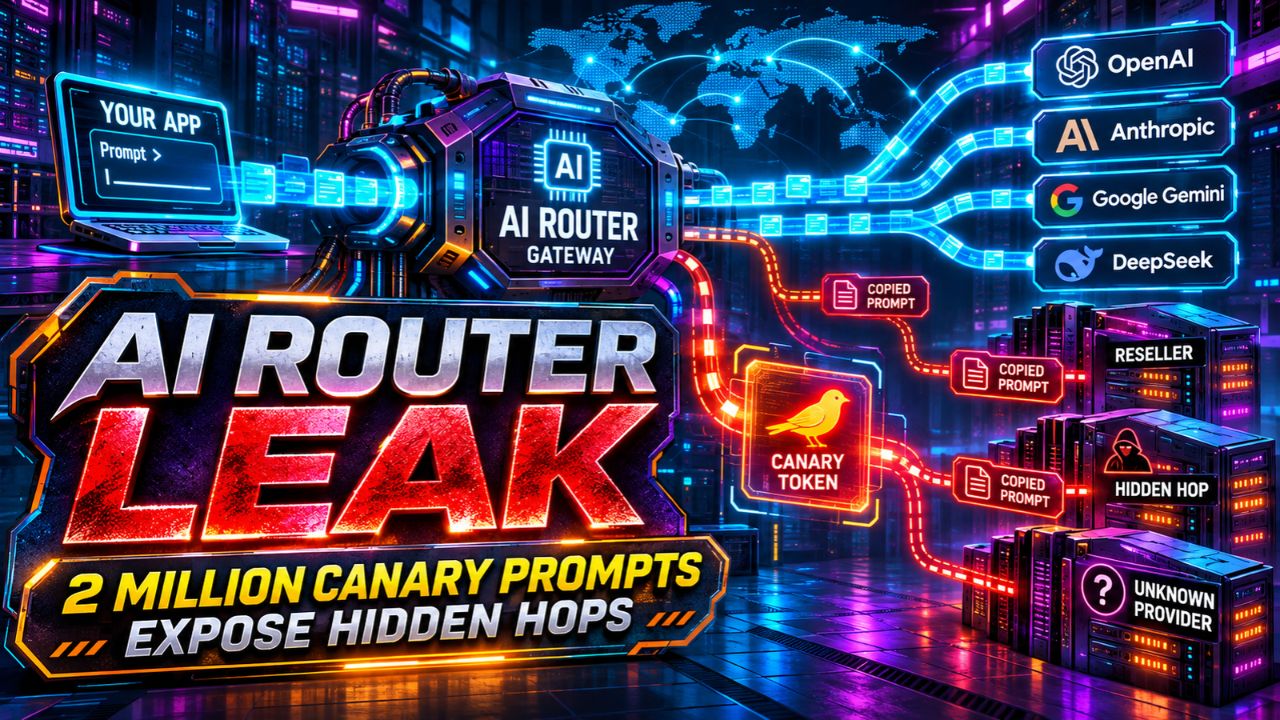
HD Moore put a secret in every prompt and then watched the internet try to use it. Nearly two million prompts went out over five months, from July through November 2026, each one carrying material that existed nowhere else: live AWS keys tied to empty accounts with full logging, SSH passwords, private git repository references, DNS names, and URLs nobody had ever visited. If anything on the path read the prompt, it had something to prove it with.
Then the trail came back. Attackers inside three hosting providers were copying requests at the front door, before a model ever ran, and some of the requests they copied carried a Zero Data Retention flag. Marketplace resellers listed popular models at the lowest price, switched on request logging, and read what came through without exploiting anything. A Chinese AI lab fetched the secret URLs from more than half of the prompts sent to its models, including roughly two-thirds of the ones marked as no data collection. Twenty-four days after one request, the link from that prompt appeared in a company chat channel and was opened from three desktops and three phones in Beijing and Shanghai within two minutes, read from a stored copy of a prompt that had gone through a U.S. provider with ZDR set.
On November 21, OpenRouter emailed customers to warn that some prompts may have been read. The email cited the research and named MiniMax, a China-based model provider, as the provider involved, with AtlasCloud, Novita and StreamLake as the resellers where the planted URLs were also accessed. OpenRouter removed the Zero Data Retention label from MiniMax-model endpoints. That email is the first time I have seen the routing layer named in public with specific companies attached.
Your "we use the API" sentence is now a supply chain disclosure. One hop on a whiteboard became four companies and a marketplace. Here is the path, the audit, and the pattern that closes it.
THE ARCHITECTURE NOBODY DRAWS ON THE WHITEBOARD
The whiteboard shows app to model. The bill of materials has more lines. A prompt goes from your app to a router or gateway, from the router to a model provider, and from that provider to a reseller, a hosting company, or another router. Moore's tracing turned up hops that were never disclosed, including one router quietly forwarding part of its traffic to a marketplace seller.
Selection happens per request. OpenRouter's own documentation says it routes each request by default based on each provider's measured price, throughput, latency, and reliability, and that a provider object in the request body can override that with order, only, ignore, sort, max_price, preferred_max_latency, quantizations, and allow_fallbacks. Read the defaults, because they are the story. allow_fallbacks defaults to true, so a backup provider takes the request when your primary is unavailable. data_collection defaults to allow, which means providers that may store your prompts are eligible unless you say otherwise.
The marketplace economics explain the incentive. Moore describes sellers listing a popular model at the lowest price, routing the traffic, paying the difference out of pocket, and then collecting the prompts from the platform logs. That is not a vulnerability in the router. It is the router working as designed for a seller whose real product is the traffic itself. The same report found one seller adding roughly a thousand hidden tokens to every prompt it relayed, and another fetching images through a shared consumer subscription account.
Retention is not a routing input by default. OpenRouter's provider logging page states it plainly: the platform does not have routing rules that change based on the data retention policies of providers, and any user can ignore providers that do not meet their own requirements. That is honest documentation and it is also the architecture. A privacy flag is a filter you apply per request or per account. It is not a property of the path.
Vercel, named in the same reporting as a broker, ships the stronger controls. Its AI Gateway has a provider allowlist that restricts which AI providers can serve requests and returns a 403 when no allowed provider can serve one, plus zero data retention at either the team or the request level. Read the details anyway. The allowlist is opt-in and available on Pro and Enterprise plans. Team-wide ZDR costs $0.10 per 1,000 requests. Per-request ZDR adds no charge but still requires a paid account. Governance exists in these products. It is a tier, and it starts switched off.
I made the commercial case for routing in "Your Router Is the Moat, Not Your Model." This is the bill that comes with it. The note "The Inference Stack Trust Boundary: Why Your LLM Serving Layer Has No Authentication Story" covered the serving layer you run. This piece covers the layer you rent.
THE FIVE-QUESTION SUPPLIER AUDIT
Ask these five of every gateway, broker, and model provider, in writing, before you route a regulated request. Keep the answers. They are your incident response plan.
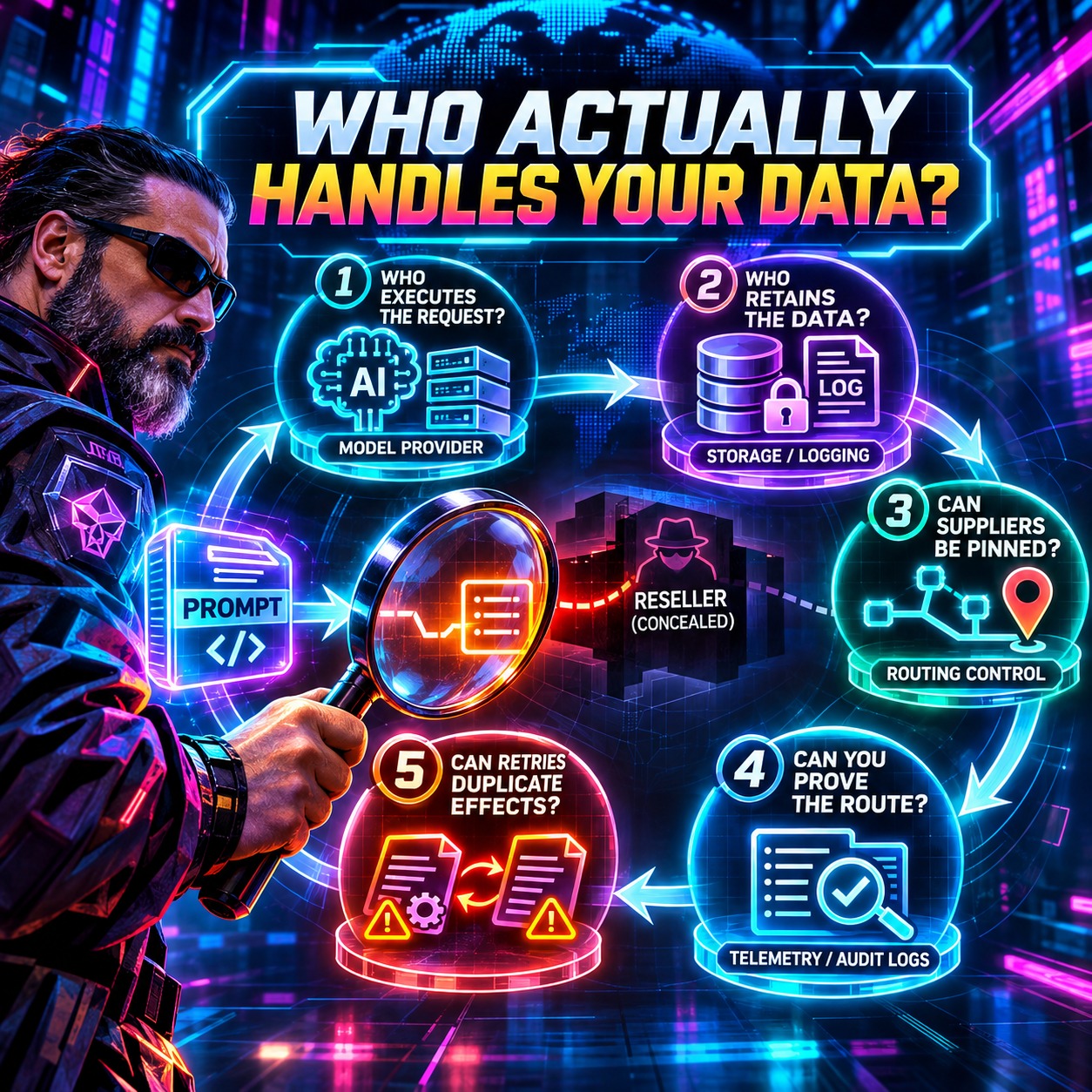
- Which entity actually executes my inference for each route, and who chose them? If the answer is "our router," you have named a policy engine, not a company. Moore traced about two thousand routes, several hundred of which passed through a system he could not identify, and a handful sent traffic to a company that was not on the advertised path at all.
- What is the retention posture of every hop, in writing, not on a settings page? Moore's report says a privacy flag binds the first hop. Providers behind that hop logged and kept prompts anyway.
- Can I pin or constrain supplier selection per request class, and what does pinning cost me? OPCP measured a median routing latency of 1.411 ms across 128 suppliers against 0.261 ms for pinned routing, a delta of 1.15 ms per request. At a million requests that is 1,150 seconds, about nineteen minutes of aggregate routing time. The financial cost is a different line. Team-wide ZDR on a metered gateway is priced at $0.10 per 1,000 requests, which is $100 per million requests at the same volume. Nineteen minutes of accumulated routing is what you pay in latency. One hundred dollars per million is what you pay in fees. Neither figure includes what an incident costs.
- What will you hand me per request, after the fact, that proves which provider executed it? Demand a request id, the resolved provider, the reseller chain, and the retention flags on the response, queryable by my own team. Be specific about the field, because a model slug is not a provider. One slug can resolve to several providers with different retention policies, and the slug is the only field most teams keep. Moore could not get the chain from router logs at all, because a router typically reports a single upstream provider and that provider is often another router. He had to build route tracing out of nested error envelopes to see the hops.
- What happens to an in-flight request when a supplier is swapped mid-stream, can a retry duplicate an effect the first attempt already committed, and is the supplier idempotent? OPCP found retry-all duplicating effects in every tested lost-reply-after-commit case, while persistent runtime state prevented replay across suppliers after a restart.
THE CONTROL PLANE PATTERN (FROM OPCP, NOT FROM VIBES)
OPCP, the Open Process Control Plane, puts the execution boundary at the business rather than the model. Agent proposals stay separate from business controlled authority, context disclosure, and supplier selection. The runtime mediates capability calls and records an uncertain outcome when a supplier may have acted without returning an acceptable reply, which is the only sane handling of a lost reply after a commit.
The test harness shape matters more than the framework. The evaluation ran 2,400 fault episodes across four policies, 60 process termination and restart episodes, 19,000 timed calls across 19 configurations, five targeted mutations over 43 fixtures, and 160 substitution records. That is fault injection instead of a happy path demo, and it is the shape almost nobody builds.
Two limits belong beside that result. No language model and no autonomous agent were evaluated, so nothing here is evidence about task success, prompt-injection resistance, or real-vendor portability. What transfers to an agentic runtime is the separation: the proposal on one side, what the agent asks to do, and authority, context disclosure, and supplier binding on the other, what the runtime permits, which supplier is bound, and how an uncertain outcome is recorded when a call times out mid-stream. Those are checkable without trusting a model.
The reading that follows is mine. OPCP is the governance layer most stacks are missing, and the missing layer is not the model. Pin suppliers for regulated data classes. Let price-based routing run only on workloads whose data you would publish. Keep enough persistent state to know which supplier owns an effect after a failure, because that is the question your incident review will actually ask. Replay safety is where this stops being abstract. Retry-all after a lost reply can repeat an effect the first attempt already committed, resend the same context to a fallback supplier that never saw the original request, and leave persistent state describing work that happened twice.
The asymmetry between consumer and enterprise is where this gets expensive. A person pasting a recipe into a chat loses a recipe. The same routing decision inside an enterprise agent carries source code, incident notes, customer records, and the occasional key someone pasted to debug a failing call. The agent does not distinguish between those and does not know the difference is a legal category. The person signing the renewal answers for the path, and nobody in the chain is obligated to describe it.
TOUMAII is the other half of the picture, and it shows where the money went. The dataset ships roughly 4.5 million validated tool-calling preference pairs, built from the Apache licensed Toucan-1.5M conversations, because supervised fine-tuning shows a model the correct call and never the plausible wrong one. The authors fine-tune a 3 billion parameter model to parity and release a generator that can be pointed at an in-house tool schema. That work buys a better chance of selecting the right tool with well-formed arguments. It buys nothing after dispatch. An agent can pick the correct tool, emit a schema-valid call, and still hand the payload, tool output, and context to an inference path that logs all three.
THE LEGAL WEATHER CHANGED TOO
On November 23, WIRED reported that the attorneys general of Oregon and Virginia are each suing SpaceX and X Corp over generative image tools. Virginia filed in the circuit court for the city of Richmond, Oregon in Multnomah County circuit court. The suits allege violations of consumer protection law and target the claims rather than the output, meaning what the company told users about the product, measured against how the product behaved. Virginia's investigators said Grok's safeguards were inconsistent and ineffective, and that the chatbot explained which words triggered its filters.
The reading here is mine, and it matters if you ship agents. The theory converts a product claim into an enforceable representation. Swap the safety claim for a retention claim and the shape holds. An agent wrapper that advertises zero data retention while the router beneath it falls back to a provider that stores prompts has made a statement a regulator can test against logs. One secret URL was still being crawled more than two months after the single inference call that carried it, and that call sat earlier in the July to November window, not after the November disclosure.
WHAT TO DO TODAY
This section is your own stack, not the vendor's. Four things your team executes.
- Audit the telemetry schema first. Pull one month of logs. If the only provider field is the model slug, you cannot resolve which upstream served the request, which fallback fired, or whether it carried a retention flag. Add the request id, the resolved provider, the fallback or reseller hop where the gateway exposes it, and the retention metadata, then run the query you would run during an incident.
- Segment traffic by data sensitivity and side-effect risk. Public prompts can ride the default pool. Internal code, credentials, and customer context get an allowlist and pinned suppliers. State-mutating agent steps, anything that writes, sends, pays, or deletes, get pinned suppliers plus the uncertain-outcome record from the OPCP pattern, so a retry cannot replay an effect.
- Deploy your own canaries. Put a non-production token, URL, or identifier inside staging and controlled production contexts, alert on any access, and treat a hit as an incident with a timestamp. Moore's version cost him a dedicated service. Yours can start as a Thinkst Canarytoken in one internal prompt this week.
- Audit your own claims last. Reconcile every privacy, security, and zero-retention sentence in your docs, decks, and prompts against the gateway defaults you actually run: allow_fallbacks, data_collection, whether the allowlist is on, and which plan tier carries it. A claim you cannot trace to a setting is a representation you cannot defend.
THE UNCOMFORTABLE QUESTION
If a court asked you tomorrow which company actually saw your customer's data last Tuesday, would you answer with logs, or with adjectives?
The hops being opaque does not move the accountability. It only moves the evidence.
Get More Articles Like This
Getting your AI agent setup right is just the start. I'm documenting every mistake, fix, and lesson learned as I build PhantomByte.
Subscribe to receive updates when we publish new content. No spam, just real lessons from the trenches.
Build Real AI Infrastructure
PhantomByte teaches you to build real AI infrastructure yourself: local AI stacks, autonomous agents, multi-agent orchestration, web scraping, and custom tools. Step-by-step PDF tutorials you download, follow, and deploy. No subscriptions. No fluff. Just skills that ship.