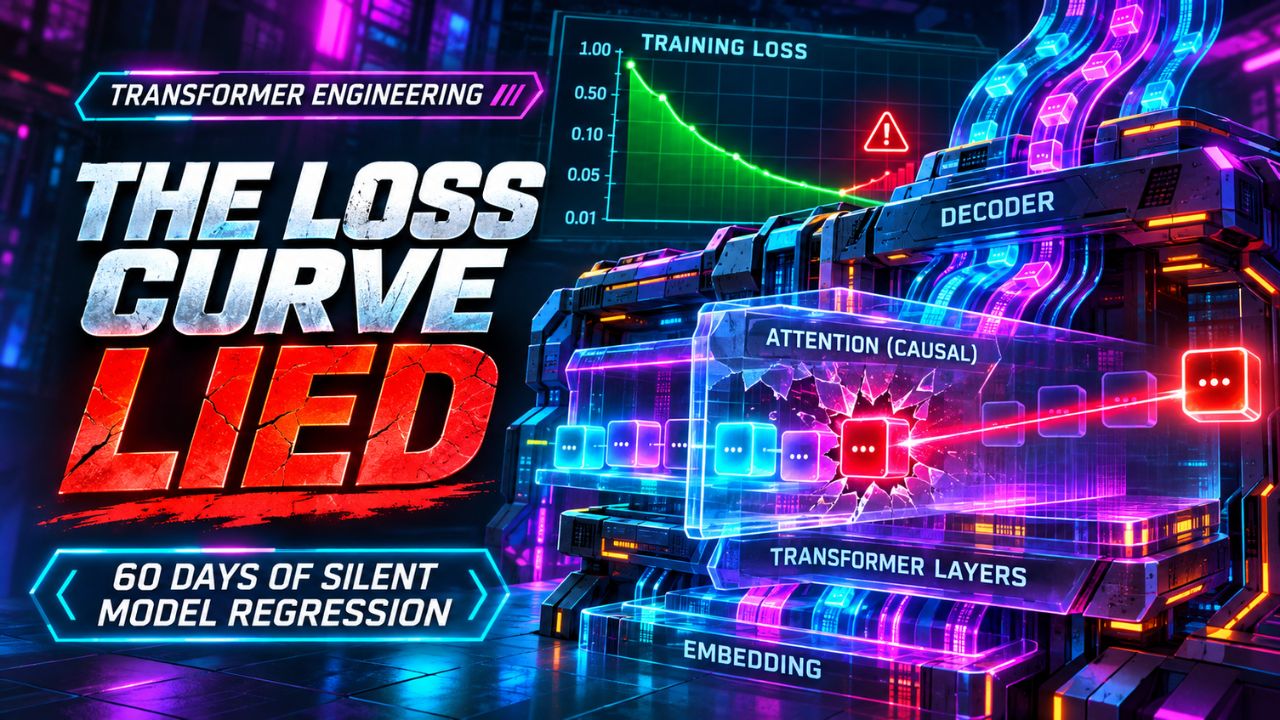
On July 30, 2026, Transformers enabled PyTorch's scaled dot product attention for T5. One attention path changed, and as a side effect the UMT5 decoder could attend to future tokens. The model could look at the answer while you trained it to produce the answer.
Nothing crashed. Training loss still fell. The bug sat in main until September 28.
You do not budget for that failure mode. Your loss curve is a heartbeat monitor that reads clean while the patient cheats on the exam. PhantomByte made the same argument in “Securing LLM Agents: Why Compiled Policy Gates Beat System Prompts”: a rule that can be ignored will be ignored. A test that does not exist has never been easier to ignore, and the model library is where almost nobody writes one.
THE BUG THAT READ THE FUTURE
Causal masking is what makes a language model a predictor instead of a photocopier. Position i can attend to positions one through i and nothing after it. Break that and the task changes shape. Token i stops being predicted from history and starts being looked up from the future.
Scaled dot product attention can run as a fused kernel. It applies the mask inside the attention computation instead of materializing a masked score matrix first. When Transformers routed T5 through it, the UMT5 decoder stopped being causal on one path. The model could see the token it was about to predict.
Sit with what that does to training. If the label is visible, the cheapest policy is to copy it. Loss drops fast, gradients look healthy, and every eval built on that checkpoint measures a model that learned to read instead of reason. A crash costs you an afternoon. This cost two months of commits and a clean looking number.
WHY NOTHING FAILED
The safety net answers a different question. Unit tests assert tensor shapes and dtypes. Integration tests load a real checkpoint and check that a forward pass returns something. Both passed. The code did what it said it did. It just said the wrong thing about who is allowed to attend to whom.
Scale hides the gap. Transformers supports more than 750 model types. Main carries 88,000 plus CPU tests, and the daily run adds 200,000 plus GPU tests across pipelines, training, distributed execution, quantization and attention kernels. Running that on every pull request means keeping a wall of GPUs busy all day, so the expensive correctness work runs on a schedule. By the time a scheduled run finds a regression, it is already in main.
Run the arithmetic yourself and the shape of the decision shows up. If a full GPU pass takes hours of wall clock on a pool of cards, the marginal cost of one pull request is a rounding error until you multiply it by every commit landing in a library that more than 750 model types depend on. Nobody can afford that, so the expensive checks move to a nightly window, and the nightly window is where the bug lived. PhantomByte's position is that a check that cannot block a merge is documentation. This is that argument with a two month price tag.
So no single test was wrong. The suite had no assertion about the property that broke. Anyone who trained a UMT5 variant between July 30 and September 28 trained against a leaking decoder, and no dashboard would have told them.
THE REPLAY THAT CAUGHT IT
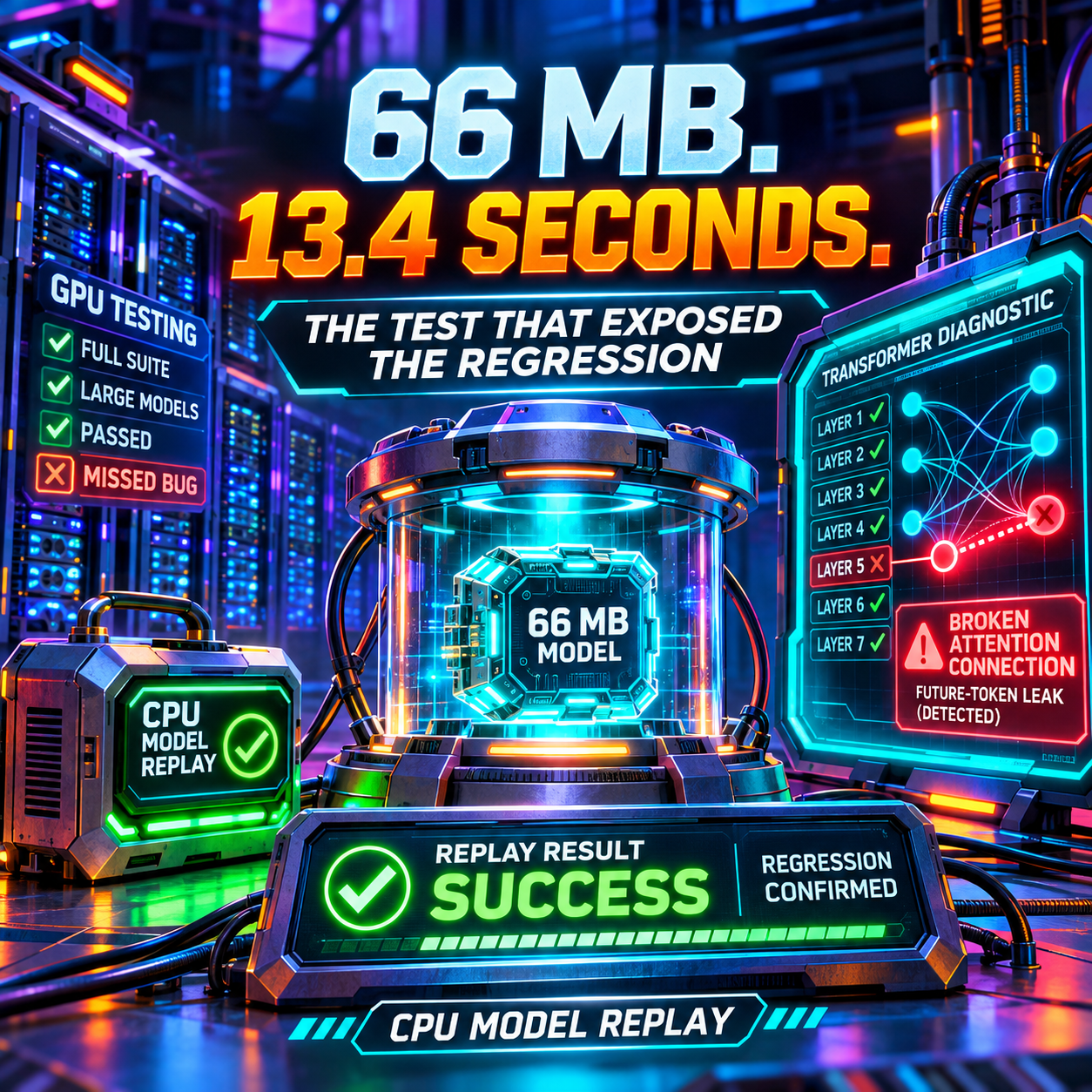
After the fix, the team replayed frozen contracts across five months of commits. The small UMT5 model running on CPU flagged the regression on every commit from its introduction on July 30 to its fix on September 28. Label log probabilities diverged from the reviewed baseline by 1.22 and training loss by about 0.20.
Two things make that replay worth copying. It was cheap. The fixture carried 66 MB of weights against 1,227 MB for the source checkpoint, and the selected T5 contract's runner step took 13.4 seconds on CPU, excluding setup. No cluster, no benchmark harness, no overnight queue.
And it was specific. One detail decided whether it worked at all. The contract exercised SDPA, the default attention path. A variant that only ran the eager attention path missed the bug entirely. A fixture only helps if it travels the same code your users travel.
MODEL INTEGRATION CONTRACTS
A Model Integration Contract is a contract test for weights, the same idea as a contract test for an API. You pin what you expect and you fail when the expectation breaks.
Hugging Face packages it in three parts. A fixture, which is a shrunken model built from the real checkpoint's configuration. A usage path, which is a runnable example of something people actually do with the model, such as generating text or running a training step. Baselines, which are the outputs recorded on a known good build and reviewed by a human. The contract holds when the usage path on the fixture still produces the baselines.
The shrinking recipe is the part people get wrong. Cutting dimensions and depth is the easy step. Keep fewer layers and you can delete every full attention layer by accident, leaving a model made only of sliding attention, which tests a topology nobody ships. So the recipe keeps every kind of layer, keeps vocabulary, special tokens and input dimensions, and copies tokenizer and processor files byte for byte. The weights are validated before they are accepted, then frozen and pinned. The original weight file format is preserved so the load path still runs the conversion code a user runs.
A contract covers an architecture and a usage path, not one checkpoint. Compatible checkpoints share a fixture, and each pinned revision keeps its own expected outputs. That is what makes the thing affordable at a library's scale, and it is also the limit you have to design around, because a contract says nothing about a model whose behavior was never covered by a usage path.
The scale is the point. Llama 4 Scout shrinks from 108.6 billion parameters to 44.7 million, its vision stack from 34 layers to 2 and its language stack from 48 to 4, with the layer kinds and MoE routing style intact. Every commit can then run a contract in seconds instead of waiting on a daily GPU job.
One honest line, because the difference matters for planning. As of November 1, 2026, the MIC job in Transformers CI reports failures without blocking pull requests. The mechanism exists. The enforcement is still under review.
THE THREE ASSERTIONS TO WRITE FIRST
- A causality probe. Feed the model a sequence where the answer is knowable only from tokens after the position being scored, then assert the prediction does not move. Perturb the future, hold the prefix fixed, compare the logits. If they shift, the model is reading ahead and nothing else you measure that day is worth much.
- A canary input. Fix the input, fix the seed, record the output token IDs on a known good build, and fail when they drift without a deliberate change. This catches the changes nobody meant to make: a kernel swap, a dtype default, a refactor inside the attention path.
- A shrunken model replay that runs on CPU on every commit. A test that costs a GPU run gets moved to nightly, and a nightly test does not block the merge that breaks you. Sixty six megabytes of weights and thirteen seconds of CPU is the entire budget, and it is small enough that you have no excuse.
WHAT AGENTS CAN AND CANNOT DO HERE
Hugging Face is building these contracts with agents, and the split is instructive. An agent can read a model implementation, propose a usage path, draft the manifest and generate candidate baselines. That fits, because the work is pattern extraction over code and the throughput matters when more than 750 model types need coverage.
The agent does not get to approve. In the tmic workflow the model drafts and a human reviews every changed expectation. That boundary is correct, and it is the same principle as a review harness that cannot sign off on its own work. Expectations are where your definition of correct lives, so an agent that can quietly rewrite its own baselines can make any regression pass.
The open question the team raises is sharper than it looks. A suite that only catches the bugs you already know is a museum. Their own numbers show the tension. On Whisper, random weight fixtures caught 18 of 24 injected faults and overfit fixtures caught all 24, yet both missed an assisted decoding bug that only the real checkpoint exposed. Sensitivity is a curve you manage, not a setting you pick once.
WHAT TO DO TODAY
- Check whether your model wrapper has a single assertion about model behavior. Most have none.
- Write one causality probe this week. A shrunken model, a fixed input, a yes or no answer.
- Add it to the commit hook, not the nightly run. If it does not block the merge, it is a suggestion.
- If you trained a UMT5 variant between July 30 and late September 2026, replay the affected checkpoints before you trust the eval.
THE UNCOMFORTABLE QUESTION
Your CI tells you the code runs. Nothing in it tells you the model is honest.
That gap widens every quarter. Coding agents now author and refactor large parts of the libraries your models load from, and they commit faster than any review queue clears. Each of those commits is a chance to flip a kernel default, change a mask, or swap an attention path, and an agent will not notice that the number still looks good, because the number is not its job. Model integration contracts are the invariant guardrails for that world: a small deterministic check that states what must stay true about the model no matter who wrote the diff. A human maintainer ships a silent regression a few times a year. An agent fleet ships them in parallel on a Friday afternoon, and merges them before review.
Ask that against your own stack. What test would have failed on July 30? If the answer is none, the leak never needed a top lab to happen. It only needed enough commits to bury it, and every library has those.
Get More Articles Like This
Getting your AI agent setup right is just the start. I'm documenting every mistake, fix, and lesson learned as I build PhantomByte.
Subscribe to receive updates when we publish new content. No spam, just real lessons from the trenches.
Build Real AI Infrastructure
PhantomByte teaches you to build real AI infrastructure yourself: local AI stacks, autonomous agents, multi-agent orchestration, web scraping, and custom tools. Step-by-step PDF tutorials you download, follow, and deploy. No subscriptions. No fluff. Just skills that ship.