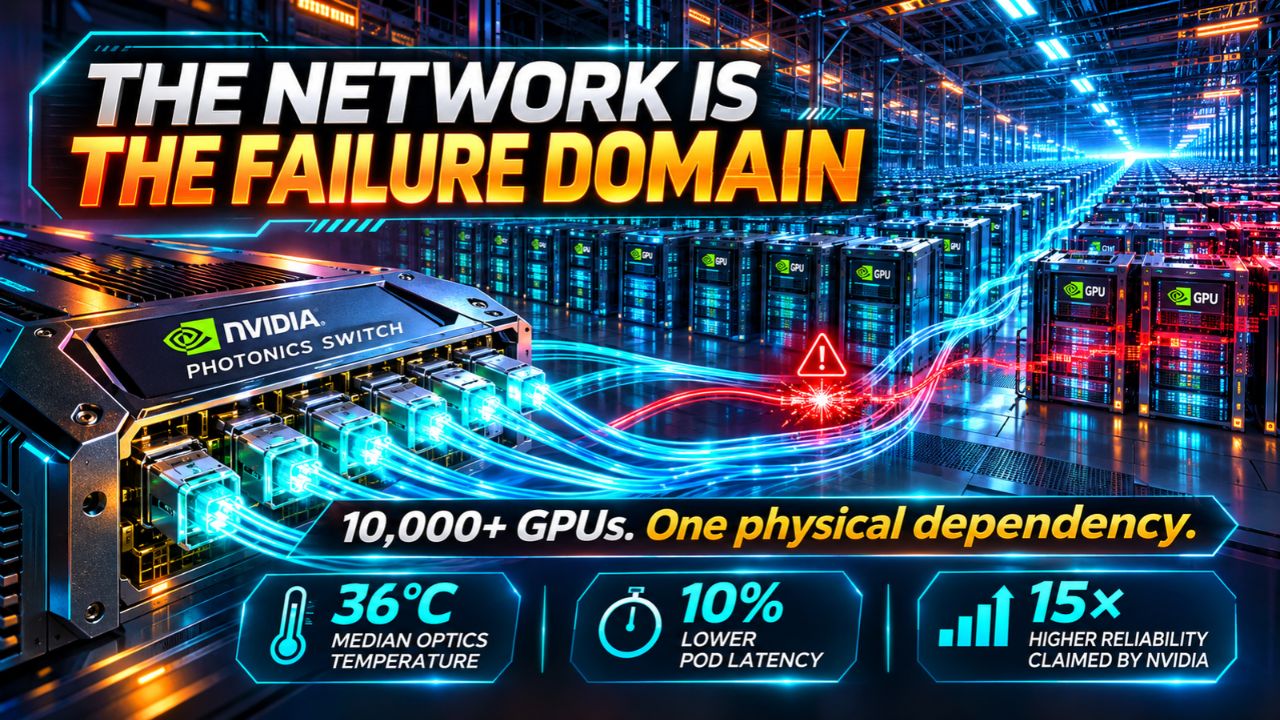
Lambda put co-packaged optics into production across more than 10,000 GPUs and published the numbers. Network latency fell about 4 percent at rack scale and up to about 10 percent at pod scale. Throughput stayed exactly where it was. The optics ran at a median 36C against 51C for pluggable modules.
Read that again, because the shape of it is the story. The network did not get faster. It got shorter, colder, and harder to kill.
This is a production deployment, not a demo. Lambda is connecting GB300 NVL72 racks with NVIDIA Photonics co-packaged optics switches. NVIDIA published the case on November 16. Lambda's own cloud chief, Dave Ward, called it an important step toward the next generation of AI.
"Your Cluster Is Interconnect-Bound, Not Compute-Bound" made the topology argument: the wire between the chips decides what your cluster can do. This is the layer below it. Same argument, one physical level down, where the failure is a laser and not a routing table.
THE FLOP FALLACY IS OVER
Three years of compute scarcity talk taught a generation of platform teams to budget in FLOPs. This week's receipts say the constraint moved.
Sam Altman, onstage at Semafor's Silicon Valley and the World summit on November 16, put numbers on memory. He said DRAM prices went up "5x, 7x, something like that" and that the world did not build the supply it said it would. He also conceded OpenAI has been constrained at different times by memory, rack assembly, datacenter capacity, and "some random component."
NVIDIA's own supply story is not about chip design either. The company published a profile of operations chief Deb Shoquist, whose manufacturing network runs through TSMC, Foxconn, Wistron, SPIL, King Yuan Electronics, Unimicron, Lumentum, Coherent, and Amkor. Her own framing is that the TSMC chip is the component they treat like air, and that the job is routing scarce wafers to the right factory each week. Packaging and partner capacity, not architecture, is where the plan gets hard.
Now put Lambda in that picture. The constraint is not arithmetic throughput any more. It is the memory you cannot buy, the rack you cannot assemble, the building you cannot power, and the link that takes a pod down. Those are all physical, and the last one is the cheapest to fix this quarter.
WHAT CO-PACKAGING ACTUALLY CHANGES
Co-packaged optics means the optical engine that converts electrical signals to light sits on the switch package next to the switch chip, instead of living in a pluggable transceiver at the end of a copper trace.
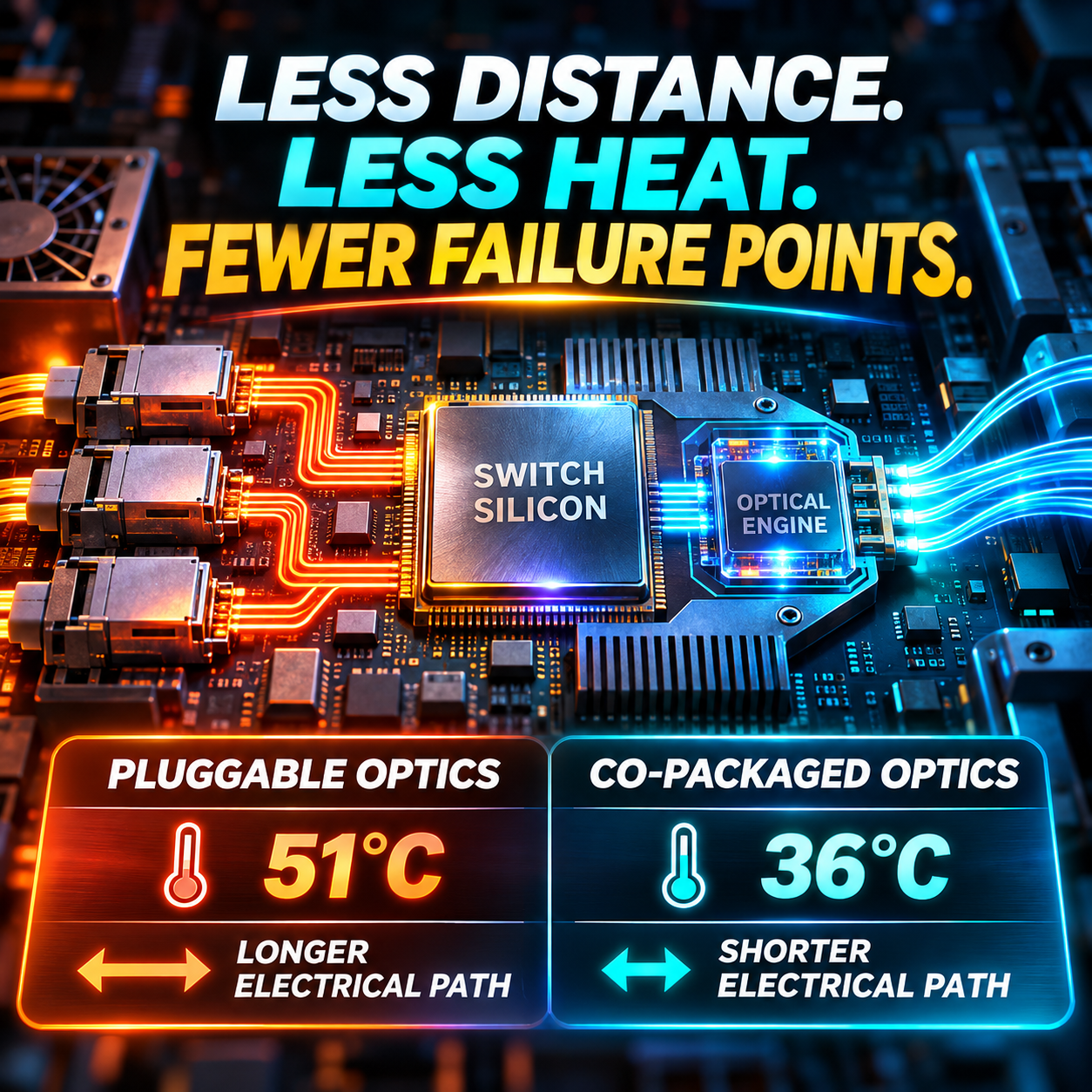
That single move does several things at once. The electrical path to the laser shortens from inches to millimeters, which cuts signal loss. The retimers that cleaned up that signal disappear, which cuts both power draw and part count. And the failure you used to fix by swapping a module now happens inside a package that is liquid cooled.
The numbers on the switch itself are worth putting on one line. 144 ports at 800Gb/s per port is 115.2Tb/s of aggregate capacity per switch, or 14.4TB/s. That arithmetic is mine. NVIDIA publishes the port count and the rate separately. Against pluggable optics, NVIDIA claims up to 5x better power efficiency, up to 15x higher reliability, and 4x fewer lasers. Each switch carries 18 removable external light sources, which works out to one source feeding eight ports.
Two caveats matter more than the headline multipliers, and both are yours to act on. First, 5x is a multiplier, not a wattage. No absolute power figure per switch was published, so you cannot drop it into a power budget without your vendor's number. Second, throughput matched pluggable optics at rack, scalable unit, and pod. You are not buying bandwidth here. You are buying failure rate, watts, and thermal headroom.
That distinction is the whole procurement lesson. A team that reads "10 percent lower latency" as a speed upgrade will misjudge the deal. A team that reads it as fewer interruptions, less heat, and fewer parts in the signal path will price it correctly.
THE FAILURE MATH NOBODY BUDGETS
NVIDIA's own sentence is the one to keep: in a large training job, one interrupted link can stall thousands of GPUs. Ten thousand GPUs at 72 per NVL72 rack is roughly 139 racks in one fabric. That is my division, not theirs. One bad light source can sit in front of all of it.
Now run the same math in inference, where the blast radius is different and arguably worse. Agentic work is not one forward pass. It is a chain of tool calls, reflection loops, and handoffs between agents, and every hop waits on the hop before it. Compounding is the whole point of the pattern. A tool call returns, the model reasons over the result, another call goes out, and each step re-sends a context that has grown. A fabric wobble therefore does not cost you one slow token. It costs you the round trip at every hop, on a context that keeps getting bigger, and a stalled agent loses the trajectory the model already spent real tokens building. A training job loses hours. An agent fleet loses state it cannot cheaply reconstruct, mid-trajectory, one handoff away from having been useful.
The same physics shows up one layer up, in the serving schedule rather than the switch. SpecRelay is an edge-cloud speculative decoding system, and its paper exists to price exactly this round trip. Drafting runs on a device, verification runs in the cloud, and the two overlap only if the schedule lets them, which a synchronous one does not: on any link slower than a local network, the next request can go out only after the previous reply lands. Its asynchronous schedule alone recovers up to 50 percent of decoding throughput over a reproduced synchronous baseline. With the router on top, at matched accuracy and 250 milliseconds of added round trip, it delivers 1.95 times and 1.55 times baseline throughput on SPROUT and OlympiadBench while sending only 47 percent and 39 percent of queries to the cloud.
Every one of those numbers is a statement about the wire, not the model. Which means fabric wobble is not a reliability footnote on your architecture diagram. It is a line item in your throughput.
THE THREE PROCUREMENT QUESTIONS
Take these to your colo or your cloud account team this week. They are answerable, and the evasive answer is itself the answer.
- First. What is the median optics temperature in this hall, and what is the replacement policy when one runs hot? Ask for the number, not the class of hardware. 36C against 51C is the kind of gap that decides whether a laser lasts its warranty.
- Second. When a laser fails, do you swap a light source or an entire module? Eighteen replaceable external sources per switch means a field technician with a spare part. A sealed pluggable means a module swap on a powered rack, and the downtime is the product.
- Third. How many lasers per switch, and what does the switch draw? 4x fewer lasers is a part count claim. Convert it into your failure rate and your watt budget before you sign.
If you are too small to buy any of that, look at what NVIDIA shipped to the desk instead. The DGX Spark HPC Developer Kit at SC26 is four nodes in a ring over ConnectX-7, no switch to buy or configure, 512GB of combined memory and 16TB of NVMe. On NVFP4 it runs models up to 700 billion parameters locally, DeepSeek V4.1 among them. The pitch is queue avoidance: debug on your desk, save the cluster for production.
The lesson transfers at any scale. When you cannot buy resilience, buy a topology small enough that you can reason about it.
WHAT THIS COSTS YOU IF YOU IGNORE IT
Skip the optics layer and you pay three times.
You pay in watts. Networking power is compute you did not get to buy, and every watt spent on a transceiver is a watt not spent on a tensor core.
You pay in stranded GPU hours. A stalled fabric on a 139-rack job is thousands of accelerators billing by the minute with nothing to do. That line item never appears in a per-GPU-hour quote, and it is real money.
You also pay in carbon, which is turning into a budget line with a regulator attached. A study in Nature Sustainability led by Gianluca Guidi at Harvard counted 403 US hyperscale data centers and estimated they consumed about 82 terawatt-hours between May 2024 and April 2025, roughly 1.8 percent of US electricity, more than about 148 individual nations. Emissions came to 25.7 million metric tons of CO2, comparable to Denmark, because about 54 percent of that power came from gas and coal. Generating in coal-heavy Wyoming produced roughly seven times the emissions per kilowatt-hour of hydropower-rich Oregon.
Efficiency at the optics layer is now a latency line, a budget line, and a carbon line at the same time. That is a rare alignment, and it is the reason this stops being a networking team's problem and becomes an architecture decision.
WHAT TO DO TODAY
- Ask your provider the three optics questions above: median optics temperature and replacement policy, field-replaceable light sources versus full module swaps, and laser count plus power draw per switch.
- Audit your own cluster and find the single link whose failure stalls the most GPUs. Then find out whether anyone owns it.
- Re-price your deployment assuming pod-scale latency drops about 10 percent and throughput stays flat. If your serving math does not move, you were modeling the wrong constraint.
- Read the SpecRelay numbers before you sign another edge contract. 1.95x and 1.55x at 250 milliseconds of added round trip is the size of the prize for fixing the schedule rather than the model.
THE UNCOMFORTABLE QUESTION
You budgeted for the GPUs. Did you budget for the light?
Get More Articles Like This
Getting your AI agent setup right is just the start. I'm documenting every mistake, fix, and lesson learned as I build PhantomByte.
Subscribe to receive updates when we publish new content. No spam, just real lessons from the trenches.
Build Real AI Infrastructure
PhantomByte teaches you to build real AI infrastructure yourself: local AI stacks, autonomous agents, multi-agent orchestration, web scraping, and custom tools. Step-by-step PDF tutorials you download, follow, and deploy. No subscriptions. No fluff. Just skills that ship.