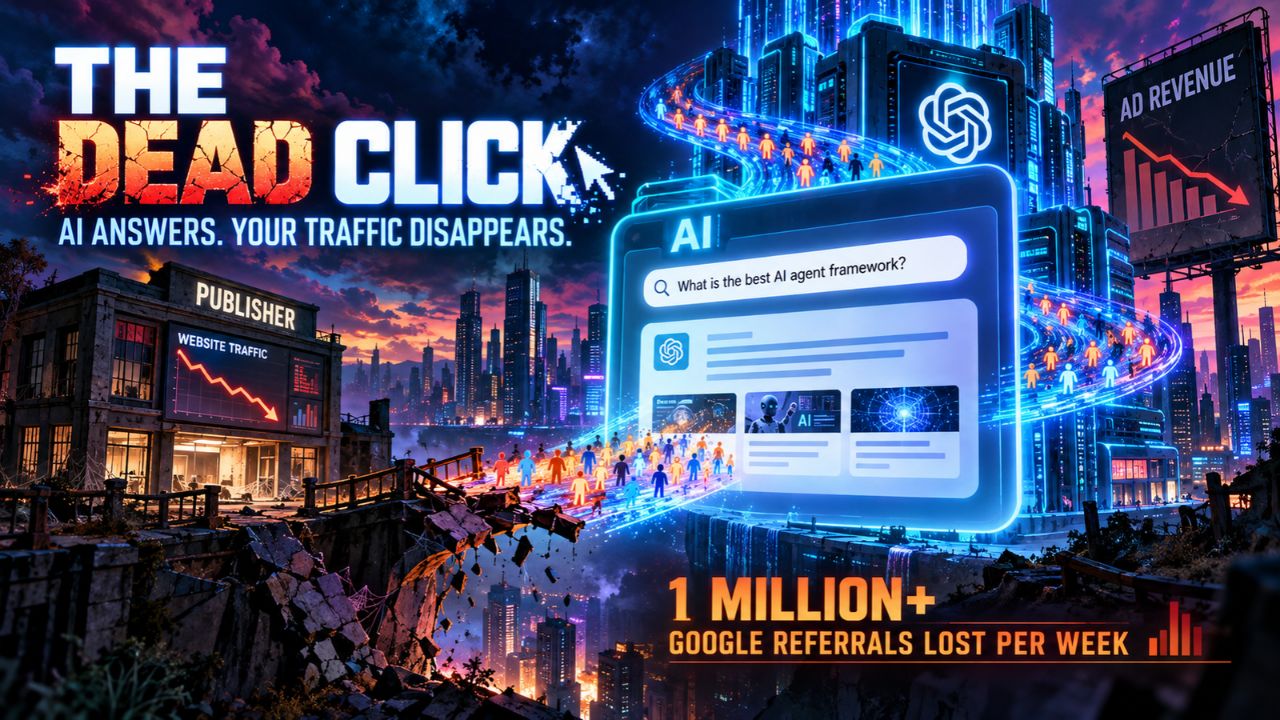
Reddit reported strong earnings on Thursday and lost more than a quarter of its market value anyway. The reason was one number. CEO Steve Huffman told investors the platform had lost more than one million Google search referrals per week in October (The Decoder).
He did not dress it up. "AI Mode does not drive traffic. Not for us, and not to anybody as far as I know. That's just a fundamental shift in how Google works," Huffman said.
We wrote about this mechanism in "Your Product Is a Tenant on Someone Else's Model. Here Is What That Costs You." That piece was about API dependency, about a company whose features sat on a frontier model it did not own and whose forecast collapsed when the economics underneath it changed. This is the same eviction at the search layer. It is coming for every publisher still pricing a business against a referral that no longer arrives.
THE REFERRAL ECONOMY JUST CLOSED
For twenty years the deal was simple. Rank on Google, collect the click, monetize the visit. The click was the product. Your analytics counted it, your ad server billed against it, your editor justified next month's budget with it.
AI Mode and AI Overviews break that deal at the request layer. The question gets answered on the results page, by a system that retrieved your page, read it, and summarized it in place. The citation replaces the click. No inbound HTTP request fires, so there is no referrer header to record and nothing for your analytics to count. You did the work and the answer shipped without you.
Both ends of that pipe are now losing money on the same mechanism. Reddit's US daily active users fell from 53.2 million in Q2 to 50.7 million in Q3, down 2 percent year over year, while global daily actives stayed flat at 130.3 million (TechCrunch). On the earnings call the company warned that if the trend holds, daily actives could fall by a low double digit percentage next quarter. Alphabet, on the same mechanism from the other side, lost just over $500 billion in market value in a single session after disclosing that its own AI summaries are hitting search ad revenue, with shares down over 12 percent to a six month low. Cloud was the offset, up 103 percent to almost $31 billion (BBC News).
Read those two facts together. The publisher lost the visit, and the landlord lost the ad impression that used to sit above the link. There is no third party in this transaction winning.
THE RENTED-AUDIENCE RULE
Here is the rule worth memorizing. If the only path to your reader runs through an index you do not control, your audience is rented. The landlord is not hostile. The landlord is arithmetic.
This month the landlord decided that answering the question in place is worth more than sending the click, because the answer keeps the user on the page that carries the ad. That decision was made inside someone else's P&L, using someone else's capex number, and you were not in the room. You will not be in the room next quarter either.
This is not a Google is evil piece. Repricing $500 billion of your own parent company's value is not the behavior of a company enjoying a clean win. It is a company choosing which revenue line survives, and it chose the one attached to the answer rather than the one attached to the visit.
So the referral is now a product decision. Treat it like a dependency you do not own, because that is what it is, and price it the way you would price any other single vendor risk on your critical path.
THE THREE RESPONSES, WITH PROOF POINTS
Operators are already running this playbook, and you can watch them do it in this week's numbers.

WALL THE CORPUS
Reddit is moving to a primarily logged-in experience and will test login walls in select markets outside the US in the fourth quarter. It converts an open web property into a gated one. The cost is real, because your own funnel narrows and the logged out front page is how most new readers ever find you. The benefit is that scraping gets harder and licensing leverage gets stronger. The company is also explicit that logged-in users carry more signal for ad targeting, which is the part most people skip. The gate is not only a defensive wall, it is a better instrument for knowing who your reader is.
There is a second casualty the earnings call did not name. A gated corpus does not only close a door on search traffic, it closes one on the agent stack. A browsing agent that resolves a task through open web retrieval fails the same way a crawler does, and a retrieval augmented generation pipeline pointed at public pages loses its source in the middle of a query. If your ingestion path assumes public HTTP access to a third party's corpus, you do not have a data pipeline, you have a relationship you have not priced. The engineering answer is the one you already give for any external dependency: mirror only what you are licensed to mirror, keep a snapshot with provenance, and treat a 403 or a login wall as an expected response with a defined fallback instead of an incident.
LICENSE THE CORPUS
This one has an honest ceiling. Reddit already has a lucrative deal with Google and cannot count on a second one, which is the whole problem with licensing as a strategy. You get one buyer, the buyer already has what it needs, and your negotiating position decays from the moment the contract is signed.
The Wikimedia Foundation just showed how loaded that fight is. It filed an amicus brief in the New York Times versus OpenAI and Microsoft cases taking neither side, and the split it draws is the useful part. For model training, Wikimedia argues fair use should apply when the model is something new and different from the original sources, with no licensing requirement. For retrieval, the systems that copy a work and hand it back through a chatbot, it argues fair use should not apply and companies should respect each publisher's license. Wikipedia's is CC BY-SA 4.0, which requires credit and share-alike. That is a precise line between learning from a corpus and reselling it by the paragraph, drawn by the operator of one of the largest training corpora on earth.
BUILD THE DIRECT CHANNEL
The logged-in shift is not only an antiscraper move. It is the only durable way to know who your reader is without asking a search engine for permission. An email address, an account, a community membership, these survive an index change. A referral does not.
Pick per business model. Each response is a bet on where value accrues: access, licensing, or relationship. Betting on all three badly is worse than betting on one deliberately.
THE NEW SIGNAL: ROBOTS.TXT GETS A STANDARD
There is one piece of good news this week, and it is small enough that you should read the mechanism before you get excited.
OpenAI said it will honor a common signal in robots.txt that lets a site state its preferences about generative AI training, and that one statement can be read by multiple participating providers at once. Today you identify each provider's crawler and maintain separate rules for every one of them. This collapses that into a single group.
The mechanics matter, because they tell you exactly how much you just gained. The draft published by the IETF AI Preferences working group, draft-kelley-aipref-training-preference-signal-00, authored by Kevin Kelley of Anthropic, introduces no new directive names and no new grammar. The preference rides in the User-Agent line as a policy token:
User-Agent: __usage_ai-training
Disallow: /
Allow: /press-kit/
That is an ordinary robots.txt group. Path language, longest match precedence, and group structure are unchanged, which means every existing parser on the internet keeps working and simply ignores a group keyed to a user agent it does not recognize. That is a genuinely good design choice, and it is also the limit. The signal is honored by the crawler that chooses to honor it. There is no enforcement in the protocol.
So publish the preference now, and do not confuse a preference with leverage. A crawler that ignores your robots.txt was always able to, and the thing that changes its behavior is not the file, it is the license and the gate. The leverage is the corpus.
For engineering teams this changes the ingestion contract, and most pipelines have not caught up. Reading the signal is the easy part: parse the robots.txt group keyed to the policy token, resolve the longest match for the path you intend to fetch, and carry that decision into the request. The hard part is that the decision has to be enforced where the fetch happens, not where the policy is documented. That means a policy resolver in front of every outbound request in the ingestion path, a recorded decision attached to every document you store, and a default that denies when the token group is missing or unparseable. A crawler that reads the file and ignores the result is worse than one that never read it, because now the audit log proves you knew.
WHAT TO DO TODAY
- Open your analytics and pull the Google referral trend for the last 90 days. If it is down and your direct traffic did not replace it, you are already living in Reddit's quarter, you just have not reported it yet.
- Publish the IETF AI preference signal in robots.txt this week. It costs nothing, it is one group, and it puts your position on the record in a format multiple providers now read.
- Start one owned channel this month. An email list, a logged-in community, a membership, anything where the relationship survives an index change. One channel, not a strategy deck.
- If you license data or could license data, watch the Wikimedia brief and the New York Times cases. The rules of citation and of use are being written right now, and the distinction Wikimedia drew between training and retrieval is the line the whole settlement will hang on.
THE UNCOMFORTABLE QUESTION
PhantomByte is writing this for the same reason you are reading it. We built on rented land too, and the citation in AI Mode that answers a question about AI traffic is not sending us your visit either.
If AI Mode answered this question instead of sending you here, would your business survive the session?
There is a larger version of that question, and it is the one engineers should be asking. When autonomous agents replace the search bar entirely, when a machine queries, retrieves, and acts without a human ever seeing a results page, what is the economic primitive that compensates the system generating the underlying knowledge? Advertising does not survive that transition, because an agent does not look at it. A citation does not survive it either, because the agent does not need one. Whatever replaces both has to be a payment at the point of retrieval, metered per document or per token and settled between machines. That primitive does not exist yet. The publishers who survive its arrival will be the ones holding a corpus someone must pay to reach, not an audience someone can summarize instead.
Get More Articles Like This
Getting your AI agent setup right is just the start. I'm documenting every mistake, fix, and lesson learned as I build PhantomByte.
Subscribe to receive updates when we publish new content. No spam, just real lessons from the trenches.
Build Real AI Infrastructure
PhantomByte teaches you to build real AI infrastructure yourself: local AI stacks, autonomous agents, multi-agent orchestration, web scraping, and custom tools. Step-by-step PDF tutorials you download, follow, and deploy. No subscriptions. No fluff. Just skills that ship.