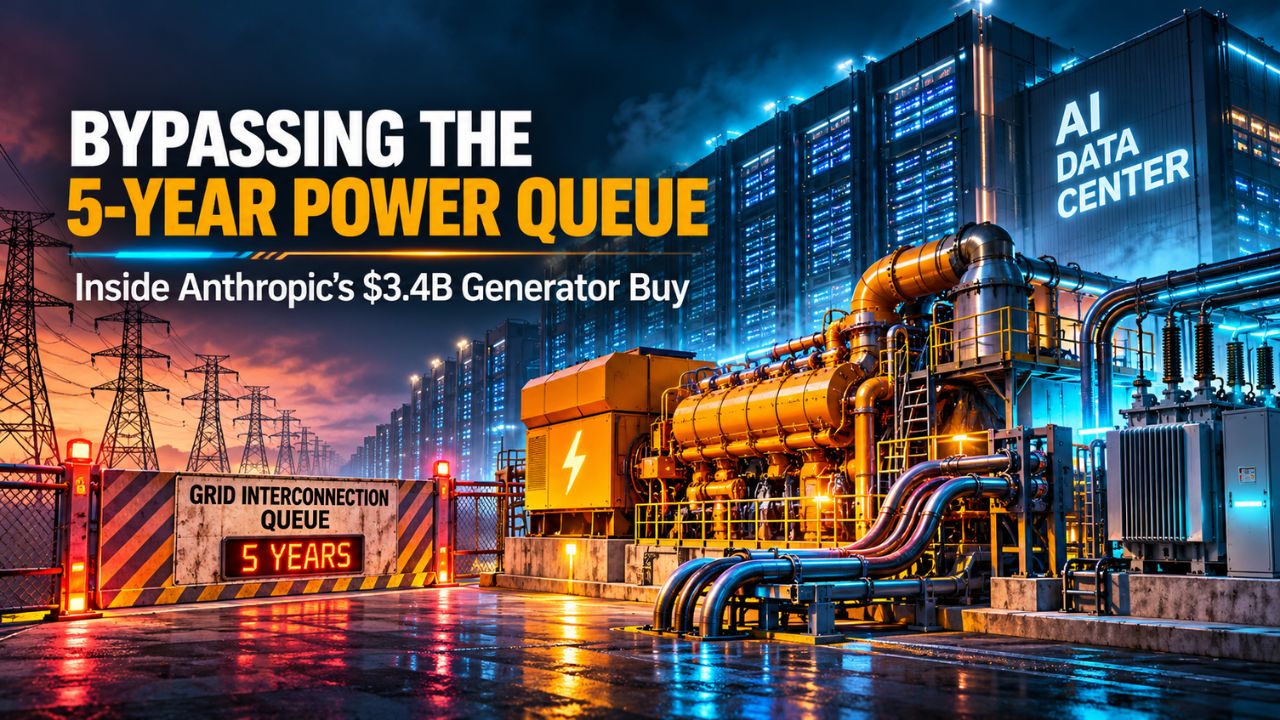
Anthropic just committed $3.4 billion for 1.7 gigawatts of gas generators. Not electricity. The machines that make electricity.
The company did not acquire the supplier, San Antonio based OnePWR Solutions, and no OnePWR staff transferred. What Anthropic bought in late September was the order itself: 1.7 gigawatts of heavy duty Caterpillar generators that OnePWR had placed roughly two years earlier and needed financing to close. The Financial Times called it the largest known single purchase of power generation equipment by an AI lab. It lands alongside a disclosure of close to $900 billion in computing commitments through 2045.
A model company now owns generation hardware. Not because it wants to become a utility, but because the grid could not promise it power on a schedule it can plan against.
This is not a sustainability story. It is a queueing story. If your 2028 capacity plan assumes a utility interconnection, this is the week that assumption expired.
WHY AGENTIC WORKLOADS MAKE THE QUEUE WORSE
A chatbot wastes your power budget differently than an agent does. A single turn prompt is bursty and stateless: the request arrives, a batch runs, the GPU idles, and a scheduler can move that work to another cluster when capacity tightens. Most architecture advice written in the last two years assumes exactly that shape of load.
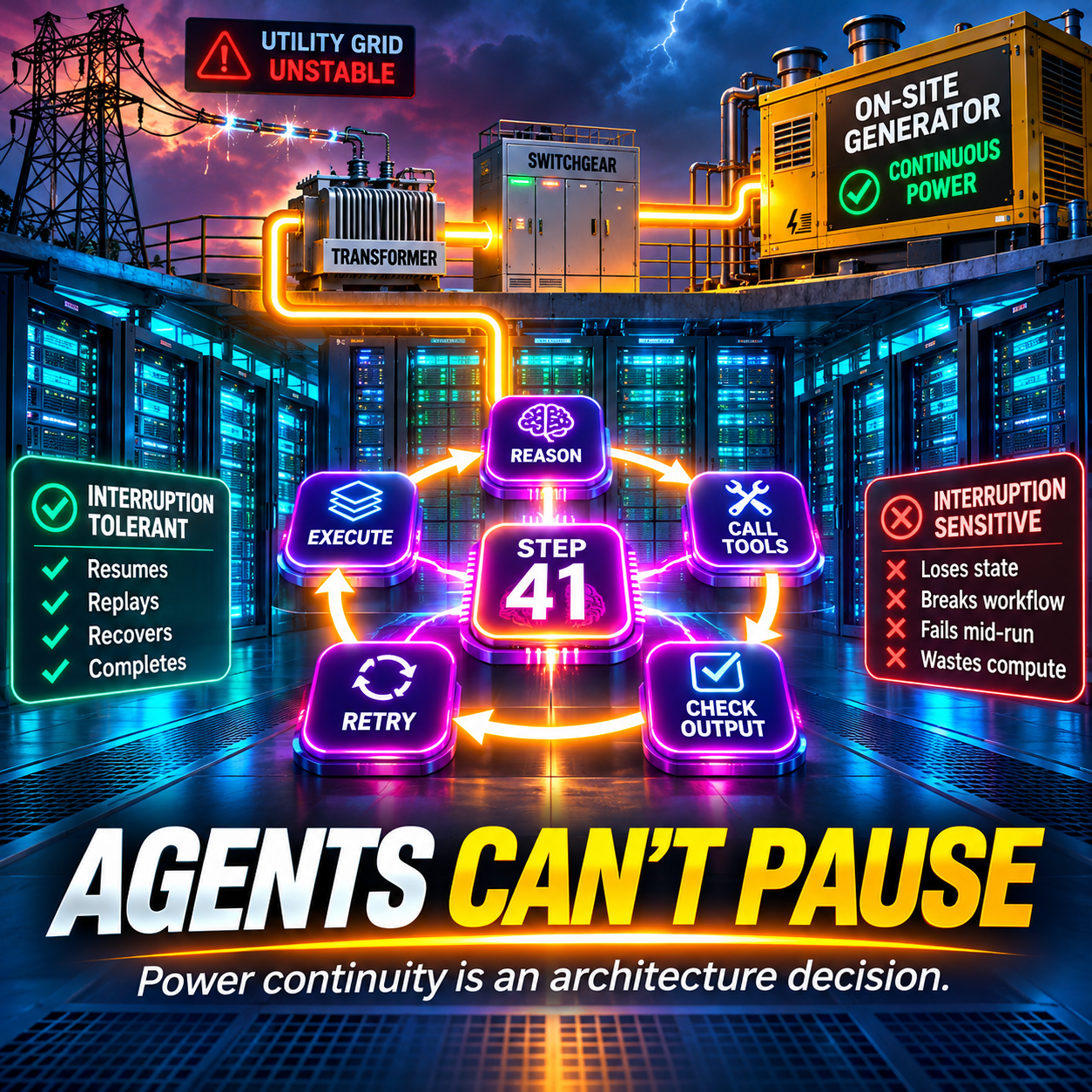
Agentic systems break the assumption. A reasoning loop that runs fifty steps, calls tools, checks its own output and retries on failure holds compute continuously rather than in bursts, and it holds state that cannot be quietly relocated mid run. Multi-agent swarms multiply it, because several contexts stay live at once and each one waits on the others.
Now put that workload on a colocation floor behind generators you bought because the grid would not commit a date. A rolling brownout, a curtailment event, or a transfer switch that sags during a cutover does not slow an agent down the way it slows a chat completion. It kills the run, burns the tokens already spent, and leaves you reconciling state you cannot reproduce. Stateless inference can be throttled. An autonomous loop on step forty one cannot.
That is why the power question is an architecture question, and why the rest of this piece prices stability rather than kilowatts.
THE QUEUE IS THE BOTTLENECK, NOT THE MEGAWATTS
To draw utility power at data center scale you need a signed interconnection agreement, and getting one means joining a queue behind every other project in the same region.
Lawrence Berkeley National Laboratory tracks those queues. As of the end of 2025, more than 2,060 gigawatts of generation and storage capacity sat in them actively seeking connection. For projects that reached commercial operation in 2025, the median time from interconnection request to operation was over five years, and that number is rising rather than falling.
Five years. A GPU generation turns over in about two, so your silicon will be two generations old before the substation energizes.
Then there is the consent signal. Redbud Consulting tracked 44 data center measures across 10 states in this week's election and counted 38 that passed, including dozens of moratoriums and bans. National Economic Council director Kevin Hassett said centers scheduled over the next two years are not affected, and analysts quoted on the results said most of those measures will not touch projects already under construction or approved through 2027.
Read that exemption honestly. It protects capacity that is already building. It says nothing about 2028, and it says nothing about the queue getting shorter. The constraint has moved twice: from chips to power, then from power to permission. Power is now a procurement problem with a lead time longer than a hardware generation.
THREE WAYS TO SKIP THE QUEUE, AND WHAT EACH COSTS
Here is the framework. Call it the Behind the Meter Decision Rule: pick by time to first megawatt and by how long you need the bridge, not by fuel type. Three tiers are live this week.
Tier one is owning the generators, which is the Anthropic move. The arithmetic is worth doing out loud because it reframes everything. $3.4 billion across 1.7 gigawatts works out to $2.00 per watt of generation hardware. That division is mine, and it gives your finance team a unit price per machine you can actually order. It also hard-codes gas into a company that has publicly warned about climate risk.
The generator is the easy half, though. A plant also needs step-up transformers, switchgear, and the substation that ties the whole thing to your bus, and those categories carry their own multi-year backlogs. That is the part of the Anthropic deal most operators skip past: it did not just buy engines, it took over an order that was already two years old and, per the reporting, carried the engineering and construction capacity needed to install the equipment. When you price your own bridge, price the transformers and switchgear as separate line items, because you will be sourcing them off market rather than waiting on a standard order book.
Tier two is renting the bridge. Developers are buying retired aircraft engines out of boneyards, including the Arizona desert storage sites where thousands of planes sit nose to tail, rebuilding them to burn natural gas, and running them on site while they wait. Converted engines can be running in months instead of the years a utility interconnection takes. Nobody involved calls them a permanent power plant, and they carry higher emissions and heavier maintenance than utility generation.
Tier three is fuel cells. Bloom Energy signed a 900 megawatt onsite solid oxide fuel cell agreement with NTT DATA across multiple data center projects, its largest international agreement to date, after earlier wins with Oracle and Google. Bloom shares rose about 4.2 percent on the news. Fuel cells are cleaner and quieter than a rebuilt turbine, and they cost more per watt.
The rule follows from the tiers. If you need megawatts in months, engines and fuel cells are the only products actually shipping. If you need them in 2028 and you can carry capital, you buy the machines now and you eat the fuel contract.
WHAT YOU GIVE UP WHEN YOU GO BEHIND THE METER
Four costs, and none of them appear in the procurement deck.
Emissions. Gas generators behind your fence do not make the carbon disappear, they make it yours to account for. Bloomberg reported this week that the largest US AI companies have not published detailed accounts of their energy or emissions performance, and that a prompt's footprint depends on where it is processed. When nobody publishes a ledger, nobody outside can audit the choice you just made.
Maintenance and life. A rebuilt aircraft engine is a bridge with an expiration date printed on it.
Politics. Owning generation ends the interconnection fight. It does not end the local fight. In Batam, Indonesia, residents protested data centers after taps ran dry during an El Nino driven drought, and authorities told developers in late September they must build desalination plants for cooling. The visible resource there was water, not electrons. Your neighbors will find the one that matters to them.
Credit. This is the part operators miss. CoreWeave's 2032 bond, carrying a 9.625 percent coupon, climbed above a 16 percent yield, and its five year credit default swaps spiked above 1,289 basis points before easing to about 1,155, according to Deutsche Bank data cited by CNBC. Nvidia's five year CDS sits near 139 basis points. The market charges roughly eight times more to insure the company renting the machines than the company selling them.
Generation you own is balance sheet, and balance sheet is what credit investors are repricing. That argument is the whole of "GPU Lease Terms Outlast the Silicon: The Compute Financing Decisions That Set Your 2027 AI Budget," and this week added a second leg to it. The silicon outlasts the lease, and now the power lead time outlasts both. This week's batch variance note, "Same Prompt, Different Answer: Solving LLM Batch Variance with BlockLock," is the sibling piece: both describe a stack that assumes its lower layers are stable.
THE EXOTIC OPTIONS ARE NOT OPTIONS YET
Orbital data centers are the cleanest test of how to read a vendor roadmap, because Google is running the experiment and Google's own energy chief priced it. Amanda Peterson Corio, Google's global head of data center energy, said at The Information's WTF Summit in Napa Valley that orbital data centers could cost up to 100 times as much as ground facilities, and her advice was to exhaust every terrestrial option first.
Meanwhile the prototype exists. Project Suncatcher, built with Planet, launched on SpaceX's Transporter-18 rideshare on October 1, and an onboard Gemma 4 model running on a TPU wrote a haiku in orbit. Real hardware, real inference, and the person who runs energy there saying the multiple is 100.
That gives you a dismissal rule worth keeping: when the energy head of the company testing a technology puts the cost at 100 times, it is not in your 2028 plan. A prototype is not a product, and a demonstration that something is possible is not a claim that it is affordable.
Underwater siting is at the same stage. Two facilities already operate off the coast of China, a Great Lakes nonprofit is preparing for the possibility, and the administration has shown interest. The regulatory path for a data center on a lakebed is assigned to nobody, which makes it a governance problem before an engineering one.
Waste heat recovery is real and small. Engineers in Denmark are capturing data center heat, against more than 12,500 data centers worldwide. Useful, worth doing, and not capacity you can schedule.
For the long version of this argument, the April note "The AI Infrastructure Gap: When the Hype Outruns the Power Grid" walks the supply chain that has to move before any of this changes.
WHAT TO DO TODAY
- Pull your utility interconnection position and read the actual queue date in the executed agreement, not the marketing date on the project page.
- Price a behind the meter bridge. Fuel cells for multi-year coverage, gas generators for bulk, and put the cost per watt next to your cost per GPU hour so the two numbers argue in the same units.
- Ask your cloud or colo provider, in writing, who owns the generation behind their facility and whether it is contracted or owned. The answer tells you whether your capacity survives their credit event.
- Recheck whether your GPU lease term outlives your power lead time. If the lease is five years and the queue is four, you have a window. If the queue is five and the lease is three, you are renting silicon you cannot power.
- Stop treating emissions as public relations. The first lab that publishes a full energy and emissions ledger sets the standard every competitor gets measured against, and the market is already pricing operators on the strength of their disclosures.
THE UNCOMFORTABLE QUESTION
Anthropic can buy 1.7 gigawatts of generators. It still cannot buy a faster grid, and it cannot buy a yes from a county board.
If the best funded lab in AI has concluded that the only reliable power is power you own, why is your 2028 capacity plan still waiting on a utility queue?
Get More Articles Like This
Getting your AI agent setup right is just the start. I'm documenting every mistake, fix, and lesson learned as I build PhantomByte.
Subscribe to receive updates when we publish new content. No spam, just real lessons from the trenches.
Build Real AI Infrastructure
PhantomByte teaches you to build real AI infrastructure yourself: local AI stacks, autonomous agents, multi-agent orchestration, web scraping, and custom tools. Step-by-step PDF tutorials you download, follow, and deploy. No subscriptions. No fluff. Just skills that ship.