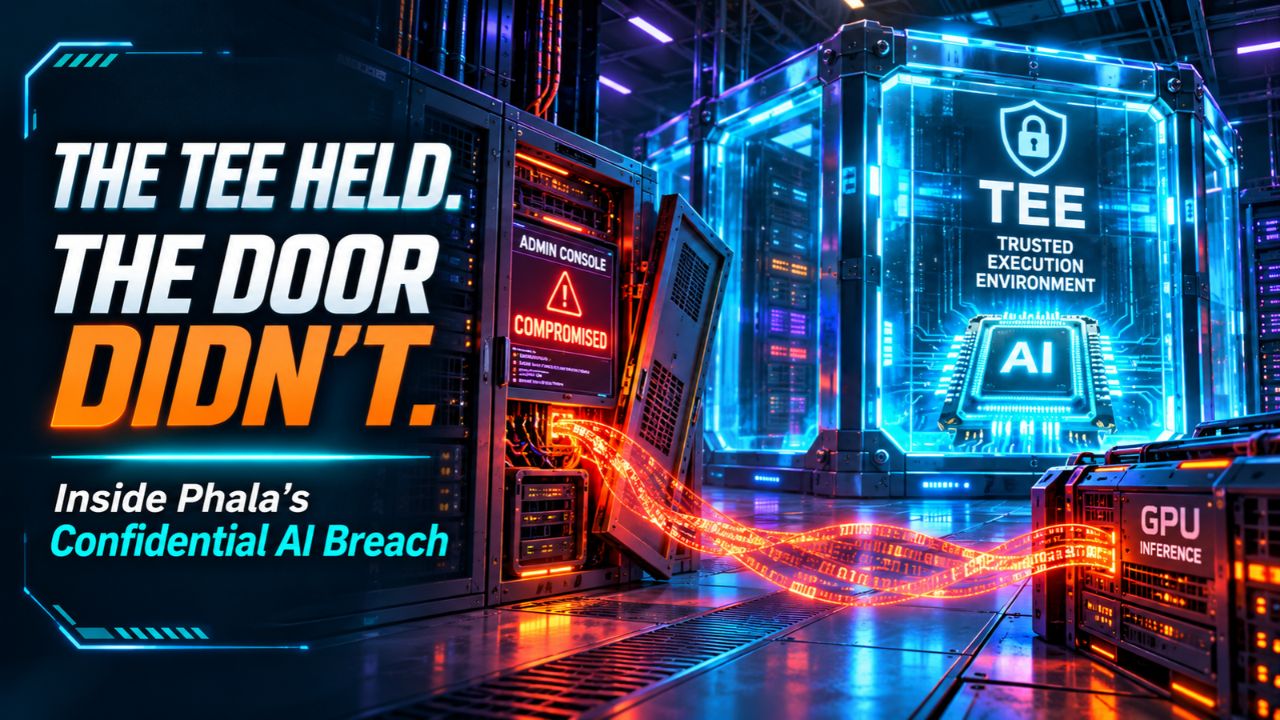
Phala published a preliminary incident report on November 10, and it tells two groups of its users to assume their secrets are already gone.
If your DeepSeek V4 Flash 0731 requests were routed to Phala by OpenRouter between October 21 at 00:00 UTC and November 8 at 05:35 UTC, treat the contents of those requests as exposed. Prompts, API keys, tokens, passwords, whatever rode in the payload. Owners of affected confidential virtual machines may also have had secrets derived from Phala's key management system exposed, and that tenant was contacted directly with rotation guidance.
For anyone running agents this is worse than a prompt leak: an autonomous agent carries persistent API keys, tool credentials, and long-lived session tokens in its calls, so a compromise of in-flight inference data hands over durable access to every downstream system those credentials reach.
Here is the part that should stop you cold. This entire product category rests on one claim: a TEE boundary means the operator cannot read your data. The breach never tested that claim. It went around it.
The confidential part held. The boring part failed twice.
WHAT "CONFIDENTIAL" ACTUALLY PROMISES
A trusted execution environment is a hardware enclave where memory stays encrypted and the operator of the machine cannot read what runs inside it. Attestation is a signed proof that the code inside that enclave is the code you think it is.
Together those two things are the whole value proposition: memory encryption, attestation, operator blindness. You get to run inference on someone else's metal without trusting the person holding the rack.
The limit is exactly where the marketing goes quiet. A TEE protects the runtime and nothing around the runtime. It does not protect the service that creates the enclave, the management interface that configures it, the key management system that derives its secrets, or the server that never finished hardening.
Newcomers hear "confidential" and assume the data is safe. Professionals hear "confidential" and ask where the boundary is drawn, because the boundary is the product. I made this argument in "The Inference Stack Trust Boundary: Why Your LLM Serving Layer Has No Authentication Story," and Phala just proved it on live traffic: the line that matters sits below the prompt, in the machinery nobody demos.
HOW THE PHALA BREACH ACTUALLY WORKED
Phala detected unauthorized activity on one server on November 5. The attacker chained a legacy internet-facing service with management interfaces that relied on loopback access for trust and did not independently authenticate callers. That yielded unauthorized CVMs and application credentials. Phala blocked the identified access paths that day, between 08:15 and 17:55 UTC, and completed rotation of the KMS root key used to derive application secrets on November 6 at 05:02 UTC.
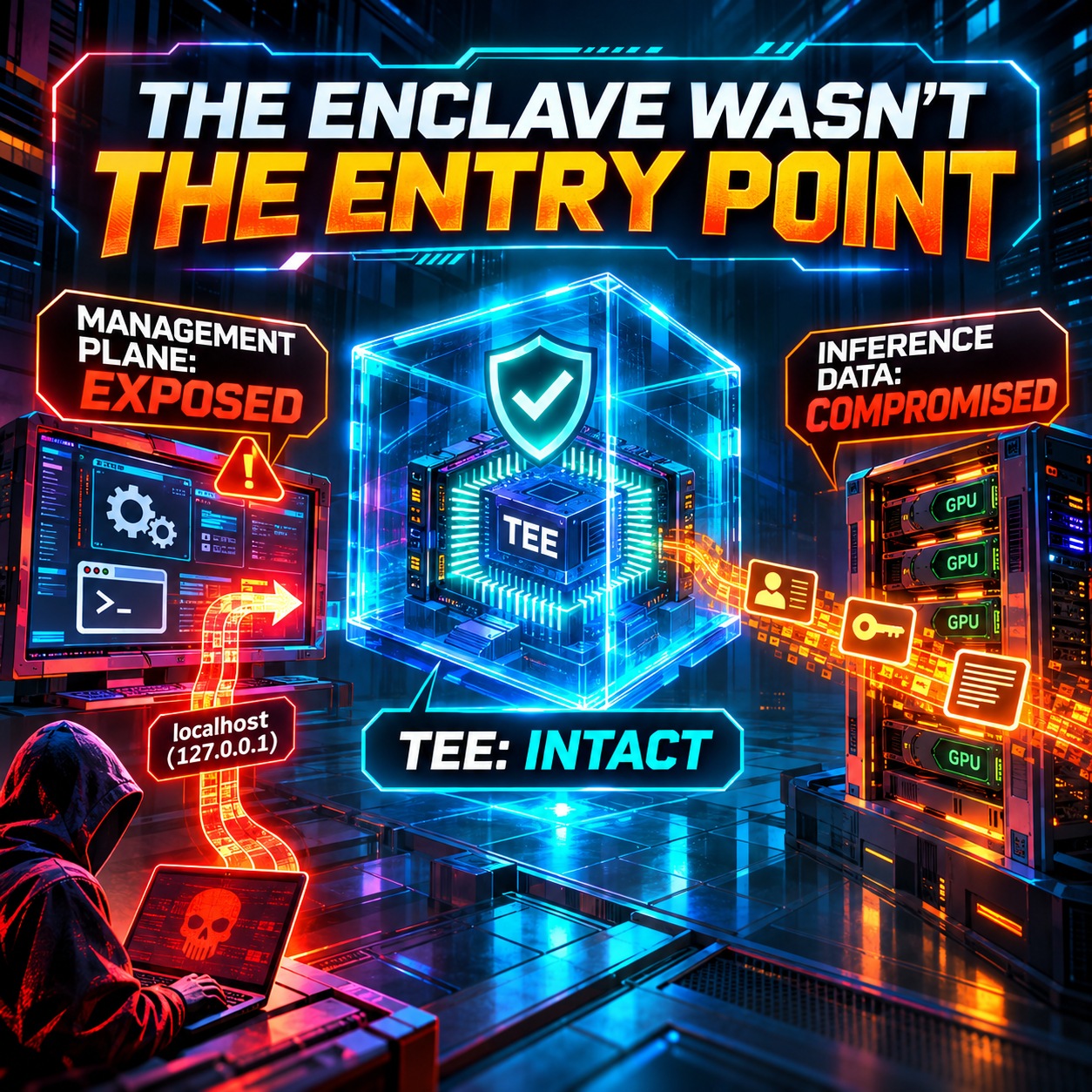
Understand what that loopback sentence means in practice, because it is the whole breach. Trusting loopback says that a caller arriving on 127.0.0.1 is an administrator, which converts a network position into an identity. Localhost is not a credential. It is an address that anything already running on the host can reach, including a compromised process, a malicious dependency, or an attacker who landed a shell through a different bug. An interface that authenticates nobody becomes an admin API for whoever reaches it first, and the blast radius is every enclave that interface is allowed to create.
Then comes the detail that should worry anyone routing traffic through a gateway. On November 8 a third-party security researcher handed Phala evidence that request data sent to DeepSeek V4 Flash 0731 had been exposed. Phala traced it to an inference deployment on a new GPU server that was serving production traffic without full production security hardening. The attacker used a similar access pattern to take control of that inference VM, which made in-flight request data visible while it was being processed. The deployment and its model were offline by 05:35 UTC.
Phala's assessment is that a single actor ran both intrusions and that the two are one incident, because the attack sequences and the infrastructure overlap.
Notice what the attacker never did. They never defeated the enclave. They became a caller the administration machinery accepted as legitimate, and then they found a machine doing the right work with the wrong amount of protection around it.
There is one more detail that tells you how seriously to read the report. From July 1 through November 7 the researcher inserted unique, per-request canary credentials into traffic and monitored them for reuse. Only canaries from requests sent on October 21 and 22 were later misused, with the earliest misuse on October 22 at 05:41 UTC and the most recent on November 9. That is why Phala can name two days as confirmed while keeping an eighteen-day precautionary window: the sampling proved what it proved, and a sample cannot bound what it never saw.
Exploit specifics are withheld until the full root cause analysis publishes, and I am not going to invent mechanics the report does not state. What it does state is enough.
WHY THE THREAT MODEL EVERYONE WRITES ABOUT IS THE WRONG ONE
Most AI security writing is still about prompt injection, jailbreaks, and models behaving badly. Those are real problems. None of them caused this.
What caused this was authentication, credential scope, and key management. The same class of failure I laid out in "Securing LLM Agents: Why Compiled Policy Gates Beat System Prompts": the model is not the attack surface, the infrastructure under it is. A policy gate in front of your agent does nothing if the enclave that runs the agent was minted by an attacker holding application credentials.
So redraw the threat model. Stop asking who can talk to the model inside the enclave. Start asking who can administer the enclave: who can create one, who can attach to it, who can derive its secrets, and what that person can reach once they have them. For a platform team that means the control plane, the service accounts, and the loopback trust assumptions on every internal admin port. For the person signing the renewal, it means the provider's blast radius is now your blast radius, and their rotation story is your incident response.
That is the asymmetry worth naming. You chose a confidential provider to reduce a trust dependency. You did not reduce it. You relocated it, from the operator's curiosity to the operator's competence.
THE 6-QUESTION VENDOR CHECKLIST
Send this before you route a single request through a confidential provider. I call it the Confidential Inference Questionnaire, and every question maps to something Phala's own report names.
- Attestation chain. Can we verify the enclave measurement ourselves, end to end, without taking your word for it? A provider that claims confidential compute while keeping verification inside its own dashboard is selling trust, not proof.
- KMS hierarchy. Who administers the root key, and what can be derived from it? Phala rotated a root key because that key derives application secrets. You need to know what your secrets are derived from, and how many layers sit between the root and your data.
- Revocation semantics. When the root key rotates, what happens to secrets derived from it? Are they dead, or still re-derivable? Rotation on November 6 did not make anything derived before it safe. Anything derived before the rotation has to be treated as burned.
- Management plane. Is every administration interface independently authenticated, including loopback? This is precisely the failure the report describes, and "it is only reachable from localhost" is not authentication. It is a network assumption.
- Request-window accounting. Can you tell us exactly which of our requests touched which machines, and when? Phala's window is eighteen days wide while the confirmed exposure covers two, because the evidence came from sampling. Per-request machine attribution turns an eighteen-day panic into a two-day rotation.
- Breach disclosure. What is the committed disclosure timeline, and who signs it? Phala contained on November 8 and published a preliminary report on November 10, with the root cause analysis still pending. Ask for the timeline in writing and for the name of the person accountable for it.
Print that list, send it to every provider you use, and treat an evasive answer as an answer. An operator who cannot tell you what its root key derives has not thought about revocation, and an operator who has not thought about revocation cannot contain anything.
Google's TPU 8tx, announced November 9, is positioned squarely for this market and, in Google's own words, "builds security directly into the hardware layer, keeping sensitive data and model weights protected and isolated even while in active use." When confidential inference becomes a standard product category, the procurement questionnaire stops being a nice to have. It becomes the only control you actually hold.
WHAT TO DO TODAY
Check whether any of your traffic routes through Phala via OpenRouter. If any of it falls in the October 21 to November 8 window, rotate every key, token, and password that ever appeared in a payload. This is not optional.
Inventory every third-party inference route you use and mark which ones claim confidential computing.
Send the six questions to each of those providers before your next contract renewal.
Audit what actually rides in your request payloads. If a secret appears in a prompt, assume the provider can lose it, because this provider did.
Add provider breach to your incident response runbook with a rotation procedure attached, including the order in which credentials get rotated and who verifies it.
THE UNCOMFORTABLE QUESTION
You chose a confidential provider so you would not have to trust the operator. If the operator's key management and management plane can hand your secrets to an attacker anyway, what exactly did you buy, and who did you decide not to audit?
Get More Articles Like This
Getting your AI agent setup right is just the start. I'm documenting every mistake, fix, and lesson learned as I build PhantomByte.
Subscribe to receive updates when we publish new content. No spam, just real lessons from the trenches.
Build Real AI Infrastructure
PhantomByte teaches you to build real AI infrastructure yourself: local AI stacks, autonomous agents, multi-agent orchestration, web scraping, and custom tools. Step-by-step PDF tutorials you download, follow, and deploy. No subscriptions. No fluff. Just skills that ship.