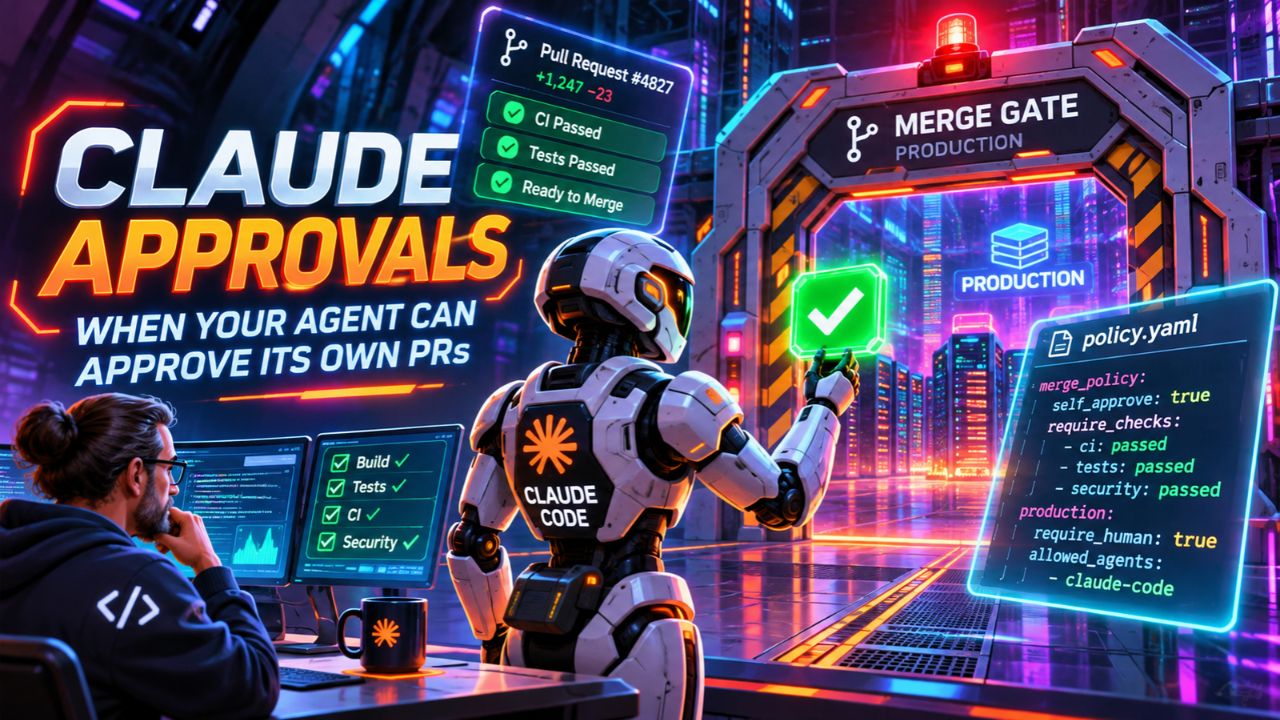
Anthropic launched Claude Ship on Monday, November 23. The product is a suite of agents for the pull request queue: Code Review, which has been generally available since October, plus two beta agents, PR Steward and Claude Approvals. Ship itself is in beta.
PR Steward is the one that jumps into a failing CI check, a merge conflict, or review feedback, fixes it, pushes, and comments on what it changed and how to roll it back. That is maintenance automation with a visible failure mode and a clean undo. Claude Approvals is the one that matters.
Claude Approvals is a check on GitHub pull requests, and it reads an approval policy your team commits to .claude/approvals.yml, in the repository root on the default branch. The signals include Code Review findings and, in Anthropic's own phrasing, "their own classifiers using natural language." The policies are written in natural language.
Read that twice. The control that decides who may approve a merge into production is a prose document that a model interprets.
The moment an agent can approve its own pull request, your policy file is the codebase's immune system, and almost nobody has written one. A month ago the merge permission lived in a person's head and a branch protection rule. Now it lives in a paragraph, and changes arrive as a pull request. Policy files are protected files in Anthropic's handling, so an edit can need a person with write access; the rest is branch protection and CODEOWNERS.
Anthropic's blog post is candid about the demand. "Most teams want a person to approve every change, and that's easy to keep up with when people write every line. But a lot of developers build with agents now." Then the line that explains it: "On the Claude Code team, Claude writes most of our code, and we wanted everything after the PR to move that fast too."
This is the same argument we made in "Securing LLM Agents: Why Compiled Policy Gates Beat System Prompts", moved up one level. A compiled gate decides what an agent may do. This decides what ships.
THE TRUST BOUNDARY JUST MOVED
Before: the agent writes, a human reviews, a human clicks merge. The trust boundary sits at the merge button, and the person reading the diff is the control.
After: the agent writes, the agent fixes CI, the agent approves. The trust boundary moves to two things, the policy text and the signals feeding it.
This is not a new surface. Code Review was announced in March and reached general availability in October, so Anthropic has been reading diffs for eight months. The permission is the part that changes your risk model, because review is advisory and approval is not.
Availability sets your timeline. Ship rolls out to Claude Team and Enterprise plans on GitHub repositories. Anthropic says teams keep control of review depth, escalation to a human, and monthly spending limits. Those are the knobs. The policy file is the control.
GitHub still decides what merges. The Claude Approvals check blocks a pull request only where you make it a required check in a branch rule, and a push to the default branch gets no check. Anthropic's setup guide says start in observe mode, where the check title is prefixed (observe mode) and the policy reports what it would decide. Observe mode is billed: every run draws on your usage credits, and bills even while credits are switched off.
WHAT A DEFENSIBLE APPROVAL POLICY ACTUALLY CONTAINS
Five things, in the order an approval decision needs them. Write them before you flip the toggle, not after the first bad merge.
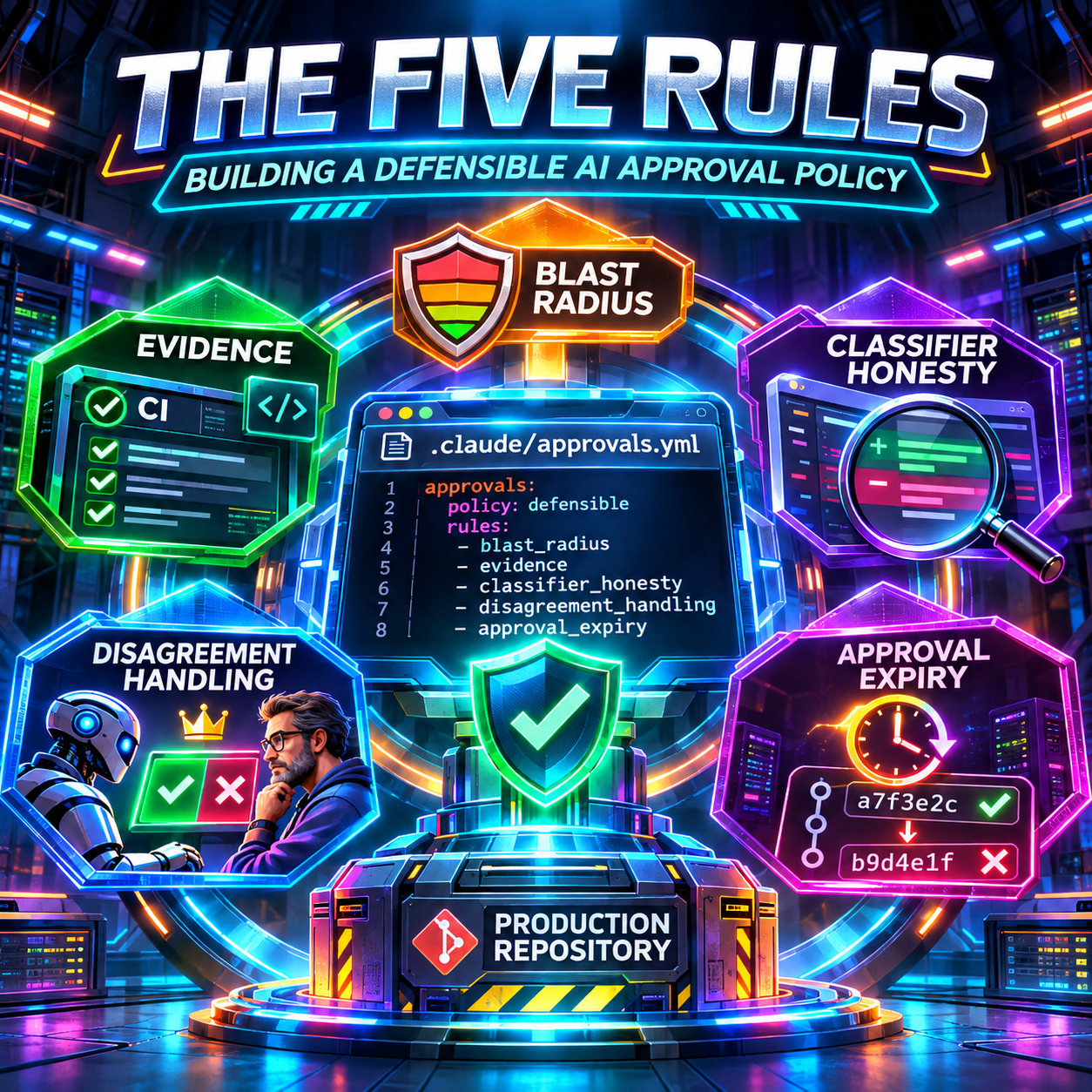
- Blast radius tiers. Map tiers to paths: docs and isolated tests at one person once Code Review passes, CODEOWNERS-owned code at one person who is not the author, migrations, auth, secrets and lockfiles at two, infra/ and .github/workflows/ at two plus the owning team. Patterns match from the directory holding .claude, so a recursive match reaches Terraform files without a script. Auto-approve nothing above the first tier.
- Evidence requirements. CI green, no unresolved review threads, no reviewer disagreement past a threshold you name. The evidence is the raw CI status and job logs, the diff scope GitHub reports, and the resolved threads, named by run id and commit SHA. No evidence, no approval, no exceptions, because the first exception teaches the system that the rule bends.
- Classifier honesty. If approval leans on a natural language classifier, the text it reads is an attack surface. The paper to read is "Intent-Conditioned Argument Mediation for Tool-Using LLM Agents" (arXiv 2611.30745), posted on November 23. It measures what happens when a call carries a value from a trusted source the user never asked for. Provenance checks alone let all 50 of those attacks execute. The intent contract blocked all 50, wrongly blocked none of 200 paired benign tasks, and wrongly blocked 4 of 50 hard ones. Across the wider benchmark, attack success fell from 50.5 percent to 12.0 percent, with a reported interval of 8.2 to 17.2 percent.
Put the narrow lesson in the policy. Your agent's account of its own diff is trusted content, and trusted content the user never authorized is precisely what sails through. A summary that omits the risky file is not a lie a classifier can see; it is an accurate statement about a subset. Evaluate claude/diff and the check outputs by id, never anything the agent wrote about itself.
- Disagreement handling. When the classifier and a human reviewer disagree, the human wins, and both reasons go to a log. A team that silently overrides the bot twice a week cannot tell a systemic false negative from a one-off. Make the override a structured record: actor, reason, target commit and tree SHA. A free text comment is unqueryable three months later.
- Approval expiry. Anthropic dismisses an earlier approval when the diff text changes, and reuse is the key that keeps seats after a push, so leave reuse out until you have watched it. Record base_sha, head_sha, tree_sha and the policy file hash; a new commit invalidates everything above it.
THE THREE FAILURE MODES
- Policy drift. The policy says routine changes, and nobody re-reads it after the tenth exception. Ninety days later the file holds eleven carved out paths and a comment that says temporary. Drift is not a product defect. It is what happens to any prose document that lives beside a deadline, which is why the re-read goes on a calendar.
- Classifier laundering. The agent summarizes its own diff, the classifier reads the summary, and the summary omits the risky file. Every component behaves as designed and the gate fails open. The policy item above is where the fix goes. If you cannot prove which input it read, assume it read the narration.
- The approval that lands while CI is still running. A greenlight issued before the last check finishes. If your policy does not name check completion as a precondition, in words, it is not a policy, it is a hope.
Then the bill nobody plans for: re-approval volume. These figures come from SchemaCaps, arXiv 2611.30750, a second paper on the same CEDRIC line, sharing Yulliwas Ameur and Samia Bouzefrane with 2611.30745, adding Soumya Banerjee there and Miqeas Pedro Mendes on the first. Across a pilot of 604 releases from 39 public MCP servers, their re-binding rule asks 645 re-approvals, against 1,197 for pinning the input schema and 2,004 once descriptions are counted. A policy that fires 1,197 prompts gets routed around by week three, and a gate your team routes around is worse than no gate, because it leaves a clean audit trail of approvals nobody meant.
That paper also found at least 76 of the compatible schema changes in the pilot add or widen an authority-bearing argument, and that none of eight surveyed MCP clients re-approves a tool whose schema widens. The tool's authority grew and nothing asked.
SIGNED, OFFLINE-VERIFIABLE RECORDS
An approval you cannot reconstruct is a green checkmark with a story stapled to it. The record is what you hand to an auditor, an incident review, or a regulator.
The pattern worth copying surfaced today as SignafAIde, an Apache-2.0 SDK and verifier from AIME-TECH-UK-LIMITED. Every tool call is signed with the agent's own key and chained to the previous record on the machine that made it. An independent witness allows or blocks the risky class, meaning payments, deletes, sends, command execution, and code pushes, under rules the operator publishes. A record carries a salted content hash, the tool name, the agent name, the timestamp, and its chain links, never inputs or outputs unless content storage is switched on. The salt is 16 random bytes that stay on your machine, so the hash cannot be used to guess the content even when only a few values are possible.
The honest split, which the README makes itself: recording is free and entirely local. With no API key, records are signed, chained, and verified inside a .signafaide directory and nothing leaves the machine. Blocking is not local, because a block needs the witness to allow the call, so a protected tool runs only with a key or a free sandbox. What the witness adds is the one thing a single party cannot give itself: a second signature, two public time bounds, and a check that no record was cut from the end of the chain. The verifier runs offline against keys pinned into each release and says plainly whether it cross-checked the published key list or did not.
For an approval trail, that shape is right. The decision record states who approved, under which policy hash, against which tree hash, with which CI artifacts, at what time. It verifies without trusting the vendor or the operator.
WHAT TO DO TODAY
- Write .claude/approvals.yml and land it in observe mode with full logging. Read what the policy would have approved for two weeks by hand before you enforce anything.
- Enable enforcement one tier at a time, lowest first, and require CI completion as a hard precondition in words.
- Make the classifier read the diff and the job logs, never the agent's summary of the diff.
- Turn on signed, hash-chained decision records and run the offline verification once yourself.
- Re-read the policy monthly and re-check the branch rules beside it. Policy drift is the default state, not an accident.
THE UNCOMFORTABLE QUESTION
If your agent approved a bad merge tonight, could you produce the decision record that shows why, or would you be reading a green checkmark and guessing?
That is the whole distance between a policy and a vibe.
Get More Articles Like This
Getting your AI agent setup right is just the start. I'm documenting every mistake, fix, and lesson learned as I build PhantomByte.
Subscribe to receive updates when we publish new content. No spam, just real lessons from the trenches.
Build Real AI Infrastructure
PhantomByte teaches you to build real AI infrastructure yourself: local AI stacks, autonomous agents, multi-agent orchestration, web scraping, and custom tools. Step-by-step PDF tutorials you download, follow, and deploy. No subscriptions. No fluff. Just skills that ship.