
A position paper on arXiv just argued something that should make every engineer building multi-agent systems stop and reread it. The claim: when your multi-agent system falls apart, the root cause is rarely the prompt or the model or the coordination logic. The root cause is a concurrency control problem. Your agents are reading stale state, overwriting each other’s updates, and producing inconsistent outcomes because nothing in your framework stops them from stepping on each other.
The paper maps multi-agent failure modes onto classical database anomalies. Stale reads. Lost updates. Inconsistent results. These are the same bugs that plagued databases in the 1970s before transaction isolation and conflict detection became standard. Your agent framework has the same problem, and it does not even know it.
PhantomByte has covered agent memory, agent persistence, and the verification gap. This Note is about the layer underneath all of that. The concurrency layer. The one nobody is building.
The Problem You Do Not Know You Have
Here is the scenario. You have three agents working on a shared task. Agent A reads a shared state file. Agent B reads the same file. Both agents modify it. Agent A writes first. Agent B writes second and clobbers Agent A’s update. Agent C reads the file after Agent B’s write and gets a state that includes B’s changes but not A’s. The system produces a result that looks correct but is based on inconsistent state.
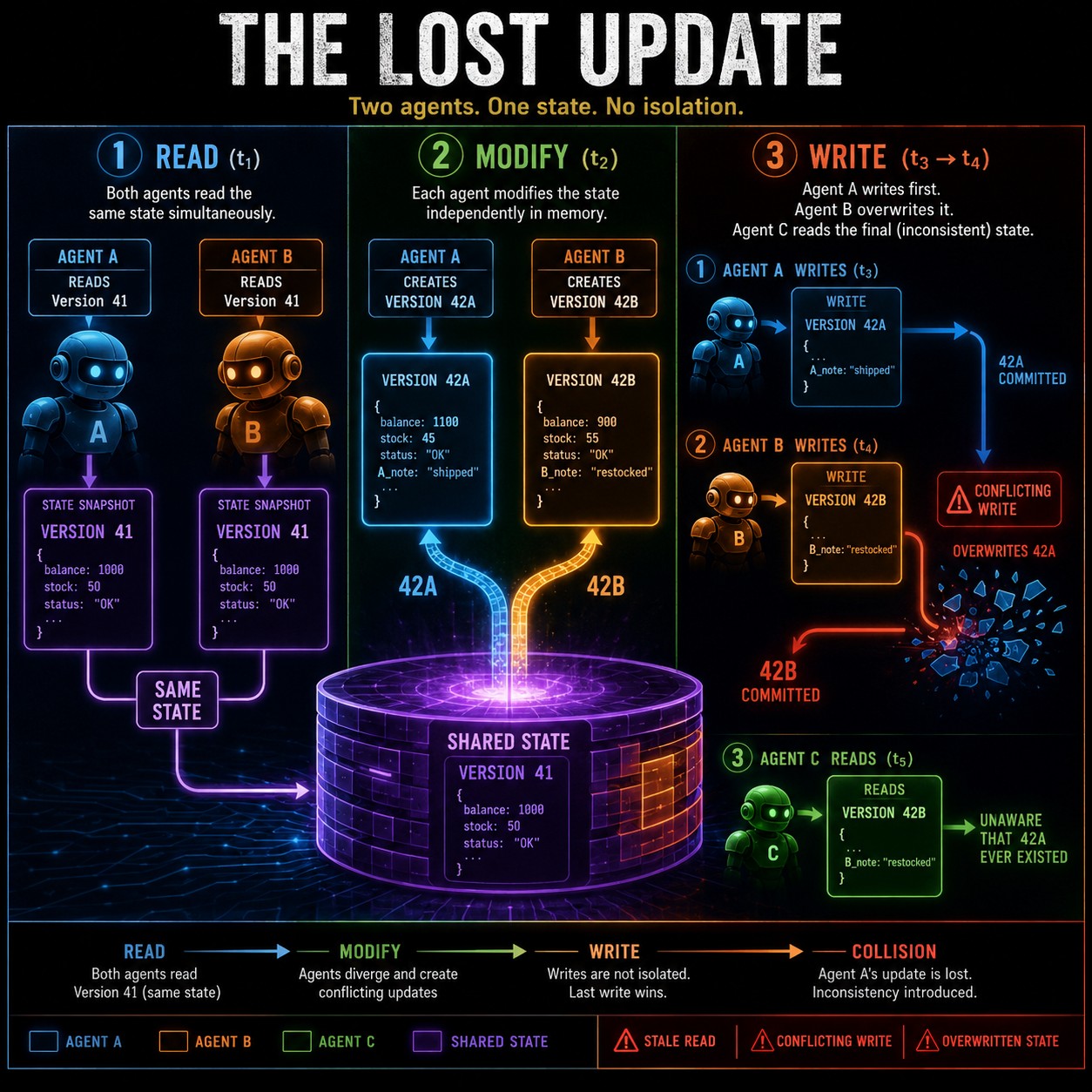
In a database, this is called a lost update. It is a solved problem. You use transaction isolation, row-level locks, or optimistic concurrency control. In an agent framework, it is an unsolved problem because most frameworks do not have a transaction layer at all. Agents read and write shared state with no isolation guarantees.
The paper’s key finding: adding more agents often reduces reliability. The reason is not that more agents produce more noise. The reason is that more agents produce more concurrent access to shared state, and uncontrolled concurrent access produces stale reads, lost updates, and inconsistent outcomes. More agents means more collisions.
The stakes are not academic. Binance launched Agent OS this week, a platform that lets AI agents trade crypto directly against its financial infrastructure. Withdrawals are blocked by default, and Binance itself acknowledges it cannot see the reasoning behind an agent’s decisions. Users decide whether agents must seek approval per order or trade autonomously. When you put agents in front of real money and real shared order books, a lost update is not a bug report. It is a financial loss. The concurrency problem stops being theoretical the moment the state your agents are clobbering is a ledger.
Why Prompt Engineering Cannot Fix This
You cannot prompt your way out of a concurrency problem. If Agent B reads stale state because Agent A’s write has not propagated yet, no amount of prompt engineering fixes that. The fix is a mechanism: conflict detection, isolation guarantees, or structured access to shared resources.
The paper argues these mechanisms should be first-class design concerns in multi-agent frameworks. Not afterthoughts. Not bolted on. First class. The same way every database since 1980 treats transaction isolation as a core feature, not a plugin.
PhantomByte covered the monolith problem (see Your Agent Is a Monolith. That’s the Problem.) and the memory bottleneck (see Your Agent’s Memory Is Too Slow to Think). The concurrency problem is the one that emerges when you solve the first two. You break the monolith into multiple agents. You give them shared memory. And then they race each other.
Think about what a prompt actually is. It is a string of text that changes how a model behaves. It has no locking semantics. It cannot detect that two agents read the same version of a file. It cannot reject a write that conflicts with a newer version. A prompt is the wrong tool for this job because it operates at the wrong layer. The problem lives in the state layer, and the state layer needs mechanisms, not prose.
The Calibrated Memory Connection
IBM Research’s ALTK-Evolve study, also in today’s data, found that agent memory works only when the dose matches the model’s capability. Strong models with headroom gained +9.5 percentage points from the full guideline set. Weaker models gained +16.1 points from a compact core plus per-task retrieval. Saturated models showed no measurable gain.
The takeaway: memory should be calibrated, not accumulated. That finding connects directly to concurrency. If your agents are injecting memory guidelines at inference time, and multiple agents are pulling from the same memory store, you have a concurrency problem on top of a calibration problem. The wrong agent pulls the wrong guideline at the wrong time, and the calibration advantage disappears.
The concurrency paper and the IBM memory paper are telling you the same thing from different angles. The state layer around the model is where the engineering happens now. The model itself is not the bottleneck. The plumbing is.
There is a second layer to this that the outline only hints at. Memory is not just a calibration problem, it is a shared resource. When several agents read and write the same memory store, you need the same isolation guarantees you would apply to any other shared state. A memory store with no versioning is a shared file with no locks. The IBM study tells you what to inject. The concurrency paper tells you what happens when two agents inject at the same time. You need both answers before you build.
The Negative Result That Confirms the Pattern
Also in today’s data: a pre-registered negative result on training Mixture-of-Experts routers to prefer cached experts, to reduce memory bandwidth at the edge. The approach did not work. The honest reporting of a negative result is valuable because it tells you what does not work before you spend six months trying it.
The pattern across all three papers: the hard problems are in state management, memory management, and resource coordination. Not in model capability. The model is good enough. The systems around the model are not.
This is the through-line of the entire engineering moment. Everyone is rediscovering that the interesting work is in the state layer, the memory layer, and the coordination layer around the model, not the model itself. The MoE negative result is the same story from the hardware side. The router cannot be trained to prefer cached experts because the locality problem is a systems problem, not a training problem. The concurrency paper is the same story from the software side. The multi-agent failure is a systems problem, not a prompt problem. When the same conclusion shows up in an arXiv position paper, an IBM memory study, and a hardware negative result, it stops being a coincidence and starts being a signal.
What to Do Today
- Map your shared state. List every piece of state your agents read and write. If multiple agents touch the same state, you have a concurrency surface. Identify it before it identifies you.
- Add conflict detection before you add more agents. If your framework does not detect when two agents read the same state and one overwrites the other, you are flying blind. Optimistic concurrency control is the cheapest first step: version your state and reject writes that conflict.
- Stop adding agents to fix reliability. The paper found that adding agents reduces reliability when concurrency is uncontrolled. If your system gets worse when you scale agents, concurrency is your problem, not your prompts.
- Calibrate memory per model. Follow the IBM finding: full guideline sets for strong models, compact core plus retrieval for weaker ones, nothing for saturated models. Injecting memory without calibrating the dose wastes tokens and can degrade performance.
- Read Ben’s Bites on simple agents. The case for simpler designs is not contrarian. It is the same case the concurrency paper makes implicitly: fewer agents means fewer concurrent access paths means fewer collisions. Start simple. Add agents only when you have the concurrency layer to support them.
There is a sixth step that belongs on this list even though it is uncomfortable. Audit your framework for a transaction layer before you trust it with anything that matters. If your framework has no isolation guarantees, no conflict detection, and no versioning, then every agent you add is a new way for your system to corrupt its own state. The framework is not a platform. It is a liability wearing a platform costume.
The Uncomfortable Question
You built a multi-agent system with no transaction layer, no isolation guarantees, and no conflict detection. When it produces inconsistent results, why is your first instinct to rewrite the prompt instead of asking whether your agents are stepping on each other’s state?
The answer is that prompts are the only lever you have been given. The concurrency layer is the one nobody is building, and the one you cannot prompt your way out of. The model is not the bottleneck. The plumbing is. And the plumbing is where the next generation of agent engineering will be won.
Get More Articles Like This
Getting your AI agent setup right is just the start. I'm documenting every mistake, fix, and lesson learned as I build PhantomByte.
Subscribe to receive updates when we publish new content. No spam, just real lessons from the trenches.
Build Real AI Infrastructure
PhantomByte teaches you to build real AI infrastructure yourself: local AI stacks, autonomous agents, multi-agent orchestration, web scraping, and custom tools. Step-by-step PDF tutorials you download, follow, and deploy. No subscriptions. No fluff. Just skills that ship.