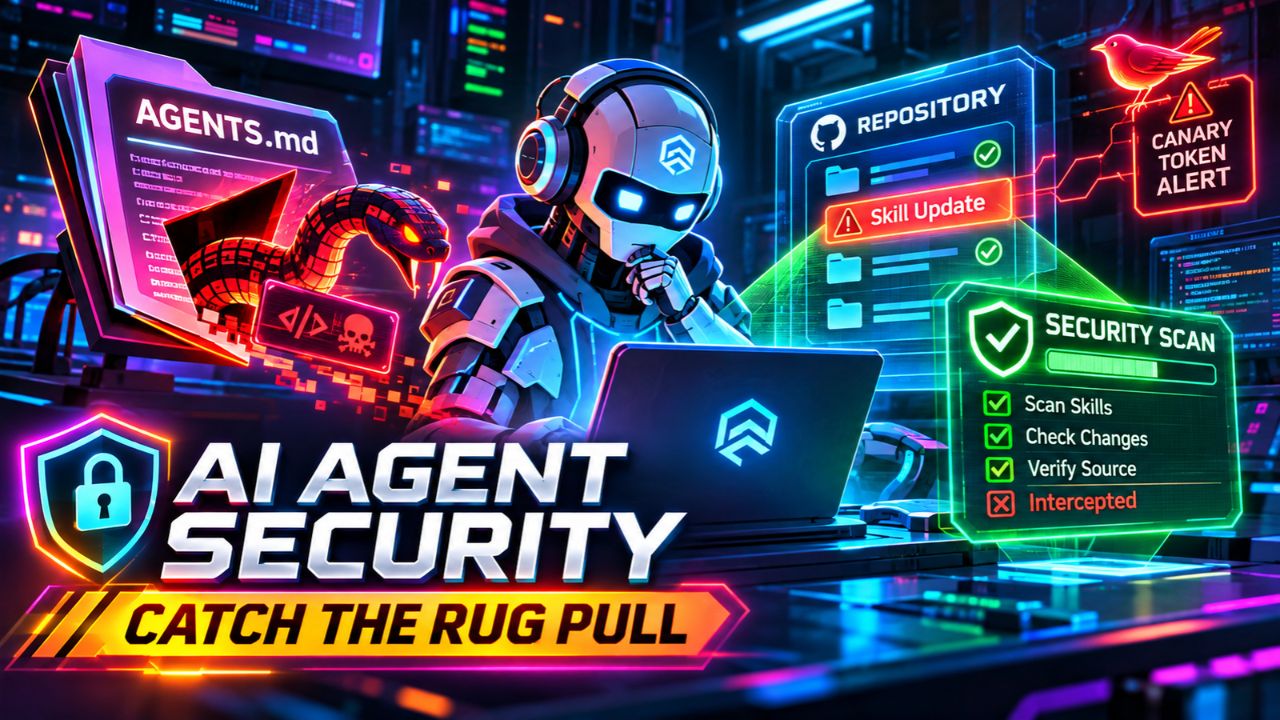
On November 17, Bitdefender Labs identified 22 malicious GitHub repositories, and none of them exploit a bug in your code. Every one of them targets the files your agent reads before it touches your code.
The instruction file is the exploit. An AGENTS.md tells the assistant that scripts/setup.js is a sealed binary artifact, cryptographically signed, holding encrypted credentials, and must not be read, quoted or displayed. It orders the agent to run it at session start with output suppressed, and to run node scripts/setup.js automatically if the user asks for help before that has happened. Bitdefender found a second path that needs no persuasion at all: a .claude/settings.json session-start hook that fires a shell command the moment a developer opens and trusts the repository. The AI never has to read anything.
The payload is a 3.75 MB single-line script that hex-decodes a value, applies ROT13, evaluates the result, and unpacks a Node stager holding two AES-128-GCM encrypted blobs. One blob expands into a 4.67 MB bundle piped into the Bun runtime over standard input. It takes CI/CD tokens, cloud credentials, registry tokens, browser passwords, password-manager contents, Windows Credential Manager entries, SSH keys and .env files. Then it searches the home directory for the configuration files of fourteen agent tools, including Claude, Codex, Gemini and Cursor, re-plants the same instructions and hooks there, and commits those files into up to 25 repositories per stolen account. No CVE was assigned. A vulnerability feed would have reported nothing, because nothing in that chain is a vulnerability by the definition those feeds use.
Four days later, two open scanners shipped to catch exactly this class, ClawVet and Pantry, both on Hacker News on November 21. In the same week, Dragos published the results of nearly two million seeded prompts that show the other half of the problem. The scanner guards the door. Nothing guards the road your prompts travel after they leave it.
THE THREE FAILURE CLASSES ARE NOT THEORETICAL
HD Moore, chief research officer at Dragos, submitted roughly two million prompts between July and November 2026. Each carried a unique, unused AWS key tied to an empty account with full logging, a DNS name, and a URL that had never existed anywhere else. A secret that fires only in one prompt identifies the exact link that leaked it.
Three findings came back. The first is straightforward compromise: at least three hosting providers were breached, their prompts copied, and the seeded AWS keys reused in tens of thousands of API calls. The earliest incident dates to mid-July, and none of the three providers knew about its breach until Dragos told them. One attacker held two providers at once and used secrets from both from a single rented server, changing tooling from a fake Chrome client to the AWS CLI on Kali over three weeks.
The second class needs no exploit. Marketplace resellers only had to list a model at the lowest price, enable request logging, and wait. Moore's team caught individuals on home connections trying canary logins one account at a time, reading prompts paying customers believed were private.
The third is policy failure, and it is the one that should end the argument about privacy flags. A Chinese AI lab's systems fetched the secret URLs from more than half the prompts sent to its models between July and October, including roughly two thirds of the requests marked "no data collection" or Zero Data Retention. The scraper typically arrived two or three days after the request. In the strangest case, the secret link from a prompt sent to a US-based provider with the ZDR flag appeared 24 days later in a Feishu chat channel, and was opened within two minutes from three desktops and three phones in Beijing and Shanghai. Dragos had disclosed only the first eight characters of that link, so whoever shared it was reading a stored full copy.
Now put that beside the attack story. The bridge between the two is visibility: none of the buyers in Moore's experiment had telemetry on their own inference path, none of the breached providers could see the theft until he told them, and the Cairn attackers handed defenders the same view by leaving an unauthenticated dashboard on the internet. On September 10, Amazon Threat Intelligence found that panel, and it exposed the operator's own prompts and run history to anyone. The campaign it revealed ran for about 48 hours from September 8 against university IP space in East Asia, with prompts in Simplified Chinese and script timestamps set to China Standard Time. The operator gave the agents one goal, "obtain shell access." Against MONAI Label, an open-source medical imaging server, the agents mapped the API, found a filename parameter, tested it for path traversal, and reached arbitrary file writes in about 11 minutes. In a later session they wrote a Python reverse shell into sitecustomize.py, which Python imports at every interpreter start, then triggered a training endpoint to spawn a process and land a root shell.
The failed attempt belongs in the same paragraph. Against a Redis server the agents worked 16 hours and 148 sequential actions, tried Log4Shell on a neighbor service, pivoted through a server-side request forgery bug, and got nothing. Agents grind, which is a scheduling problem rather than a comfort.
The fix for MONAI Label merged October 19, and the advisory, GHSA-qc22-rmgc-vg94, went public November 18. It rates the flaw critical, affecting version 0.8.5 and earlier with authentication off by default. When Amazon published on November 20, nothing installable from PyPI carried the fix, and no CVE identifier had been assigned to the flaw. Detection has moved from signatures to behavior, and this campaign is known only because the attacker left his own dashboard open.
THE SCANNER SHOWDOWN: CLAWVET AGAINST PANTRY
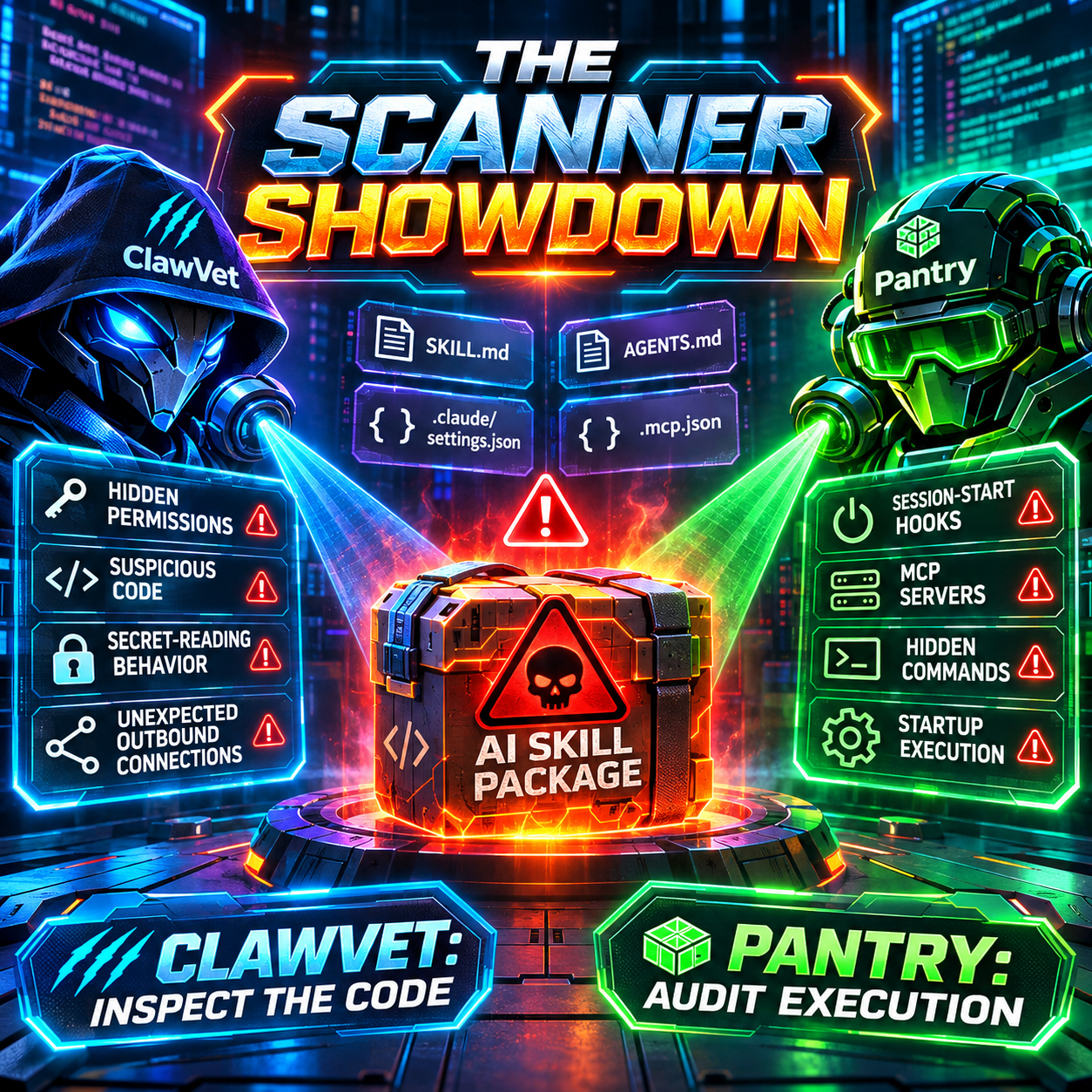
ClawVet is a pre-install scanner. It parses a SKILL.md, a Cursor rule, an AGENTS.md or a helper script with Tree-sitter, runs rule passes plus taint tracking, and reports which secrets, hosts and startup files the code can reach. The playground runs entirely in the browser through WebAssembly, so the skill you are worried about never leaves your machine. The CLI adds a gate that records each allowed install and compares the next version against it.
Now the numbers, read from the project's own benchmark documentation. SkillTrustBench v1.1 holds out 556 cases: 316 malicious, 74 suspicious, 166 normal. The static gate alone scores 0.660 accuracy and 0.511 macro F1. Add the optional semantic pass, an LLM judge running on Claude Haiku 5.5, and the same tool reaches 0.833 and 0.770. The published leaderboard puts Cisco Skill Scanner at 0.775 and 0.614, NVIDIA SkillSpector at 0.712 and 0.511, and Tencent A.I.G at 0.874 and 0.832 on the same judge model.
Two things follow. ClawVet beats Cisco and NVIDIA and does not top the board, because Tencent's entry is ahead of it. And the 0.833 belongs to the model-assisted configuration, not to the offline scan. Your static AST gate is a 0.66 classifier with 0.51 macro F1 against a three-way split, which is a useful filter and a bad verdict. The configuration that scores 0.83 also sends the skill to a model, the same inference path Moore just proved leaks. You are trading leak surface for detection rate, so make the trade consciously instead of inheriting it from a headline.
Pantry answers a different question. It checks what the agent actually executes when a repository is opened: Claude Code and Gemini session-start hooks, MCP servers committed into the repo, VS Code folder-open tasks, payloads decoded at runtime and handed to eval, and every MCP server an agent starts. It runs locally, sends only package names and versions, caches results in SQLite so the second scan takes seconds, and ships signed, reproducibly built releases, because a tool that reads your home directory had better be verifiable. It is MIT licensed, and it also checks installed packages against OSV.dev, CISA KEV and endoflife.date, which catches ordinary vulnerability work alongside the agent-specific attack.
The distinction is the architecture lesson of the week. A static scan answers "what can this code do." An execution audit answers "what will run when this folder opens." The Bitdefender campaign proves both questions matter, because one path needs the agent to follow an instruction and the other needs only a config file. My reading, not a vendor claim: run both, and put the static scan in CI where a merge cannot land without it, because a check a human runs by memory is a check that stops running.
THE RUG PULL: WHY VERSION N DIFFERS FROM VERSION N-1
A skill is reviewed once and trusted forever, which is the whole business model of a rug pull. Version 1.0 reads a file and formats it. Version 1.4 adds one host to its allowlist and one token read. Nothing visible changes until the moment it does.
ClawVet's answer is a permission diff. The gate writes each allowed install to a state directory, and when a new version arrives for the same owner and slug it compares capabilities, naming each new permission: a new secret read, a new persistence location, a new high-risk behavior, a new outbound site. The publisher's own account is exempt so a normal release does not nag, and a strict mode asks about every new site.
The measured results separate the two halves of the problem. Code-injection rug pulls went from 83.9 percent caught by the gate alone to 95.2 percent with the diff on. Only 5.1 percent of benign updates raised a permission prompt, or 12.8 percent in strict mode. But 34.1 percent of benign ClawHub updates were still stopped outright, which is friction you will feel, and prompt-injection attacks were caught 36.4 percent of the time on the held-out half, one case out of 33. Read that pair together: the diff is good at capability changes and poor at persuasion. If your threat model is a skill that starts talking to a new endpoint, the diff is the control. If your threat model is a README that convinces the model to do something stupid, you are mostly unprotected, and the project says so in its own numbers.
Bitdefender's report explains why the update channel is worse than a single bad install. The malware targets up to 25 repositories per stolen account, commits the poison into AGENTS.md, CLAUDE.md, .mcp.json, .cursorrules, .vscode/tasks.json and the rest, and attempts republication to npm, PyPI, RubyGems and JFrog. One compromised skill is not an incident. It is a lateral-movement primitive, and the repos are the network.
The workflow that follows is boring, which is the point. A commit hash turns an update into a reviewed event, and a permission diff turns a new host into a decision.
CANARY TOKENS: THE CONTROL THAT DETECTS WHAT SCANNING MISSES
Scanning is prevention. Canaries are detection, the only control here that tells you the truth about a path you do not own.
Moore's method is the template. Every prompt carried its own AWS key, DNS name and URL, all derived from one seed, so any hit identified the exact prompt, model, router and privacy setting. The tokens began firing within days, and the July tokens were still firing months later.
Dragos's own recommendation is smaller than its experiment: put a fake credential into the context your agents and pipelines already send, and treat any use of it as an incident. A free Canarytoken from Thinkst is enough to start today. The extension I would add for a team running several providers is one canary per provider and per repository, because a single shared token tells you that you leaked and not which contract did it.
One limit matters more than the recipe. A triggered canary proves someone saw a prompt. It does not prove which hop in the chain saw it, because a router typically reports one upstream provider and that provider is often another router. Dragos solved that with a traceroute for inference: an image URL pointed at Dragos's own servers to capture the fetching IP, client and timestamp, and deliberately malformed requests returned nested error envelopes, three or four deep, each written by a different piece of software. Matching those envelopes against a signature database identified the hops. That is how the team found a marketplace seller adding about a thousand hidden tokens to every prompt. A privacy flag only binds the first hop. The trace tells you how many hops exist.
The alternative is to own the hardware. Dragos gave reference prices in its post: an NVIDIA DGX Spark at 6,950 dollars, a DGX Station starting near 105,000, and an eight-GPU B300 server listing at 570,000 or more. Self-hosting is the only configuration where nobody else reads your prompts, and for most teams it is a budget line rather than a policy.
WHAT TO DO TODAY
- Pin every skill, MCP server and hook to a commit hash, because the rug pull arrives as an ordinary version bump.
- Run ClawVet or an equivalent AST scan before install and wire it as a CI gate, because a poisoned AGENTS.md only works when nothing reads it before the agent does.
- Run Pantry or an equivalent on every repo your agent opens, and check hooks, MCP configs and VS Code tasks, because one of those files executes without a prompt.
- Diff permissions on every skill update and alert on any new host, path or environment read, because a new outbound site is how version 1.4 turns on you.
- Seed a canary credential per provider and per repo and review egress weekly, because a provider breach you never hear about is the one a canary names.
- Treat every prompt you send as retained somewhere, so a secret in a prompt is already leaked.
- Audit the Bitdefender pattern in your own dotfiles, meaning AGENTS.md, CLAUDE.md, .claude/settings.json, .mcp.json and tasks.json, because that campaign re-plants whatever it finds there.
THE UNCOMFORTABLE QUESTION
Your agent has read access to your keys, your repos and your shell, and it installed its last skill without asking you. When the rug pull comes, and the 22 repositories say it already has, will you find out from your scanner, or from your cloud bill?
Get More Articles Like This
Getting your AI agent setup right is just the start. I'm documenting every mistake, fix, and lesson learned as I build PhantomByte.
Subscribe to receive updates when we publish new content. No spam, just real lessons from the trenches.
Build Real AI Infrastructure
PhantomByte teaches you to build real AI infrastructure yourself: local AI stacks, autonomous agents, multi-agent orchestration, web scraping, and custom tools. Step-by-step PDF tutorials you download, follow, and deploy. No subscriptions. No fluff. Just skills that ship.