
On May 19 and 20, 2026, three major AI platforms made persistent memory the headline story. Google kicked it off at I/O 2026 with Gemini Spark, a continuous agentic assistant living inside your Gmail, Calendar, and lock screen. Apple followed days later, announcing its dedicated Siri app will auto-delete chat history by default. OpenAI spent that same week scrambling to stop its persistent memory feature from completely breaking user trust.
The timing was uncoordinated, but the message is identical: AI platforms refuse to remain stateless. They want to remember everything to ensure you remember exactly how much you need them.
This is not an upgrade cycle. It is a power grab dressed in convenience. Persistent memory shifts the competitive battlefield from raw model performance directly to user retention. The platform that remembers your life best becomes the platform you simply cannot leave.
What Shipped and Why It Matters
Google Gemini Spark is the most aggressive move. Announced at I/O 2026 at Shoreline Amphitheatre, Spark is a multimodal agent that runs continuously. It reads your email, books your meetings, and surfaces suggestions directly on your lock screen. Google also unveiled Android Halo, an agentic AI monitoring system that watches your device behavior and adapts without being asked.
The lock screen angle is the tell. Google does not just want Spark to be helpful. Google wants Spark to be present before you even unlock your phone. That is not assistance. That is interception.
Sources: TechCrunch (May 20, 2026), Google Keyword Blog, Neowin
Apple took the opposite approach, at least in branding. Mark Gurman reported on May 17 that Apple will ship a standalone Siri app this fall with a natural interface similar to ChatGPT. The twist is that Siri will auto-delete chats from Apple servers after the conversation ends by default.
This is Apple projecting privacy while still collecting the data that actually matters. Apple Intelligence has already stored millions of user queries. The auto-delete promise covers chat transcripts, not inference patterns, behavioral profiles, or the model weights that actively learned from you.
Sources: Bloomberg (May 17, 2026), 9to5Mac, MSN
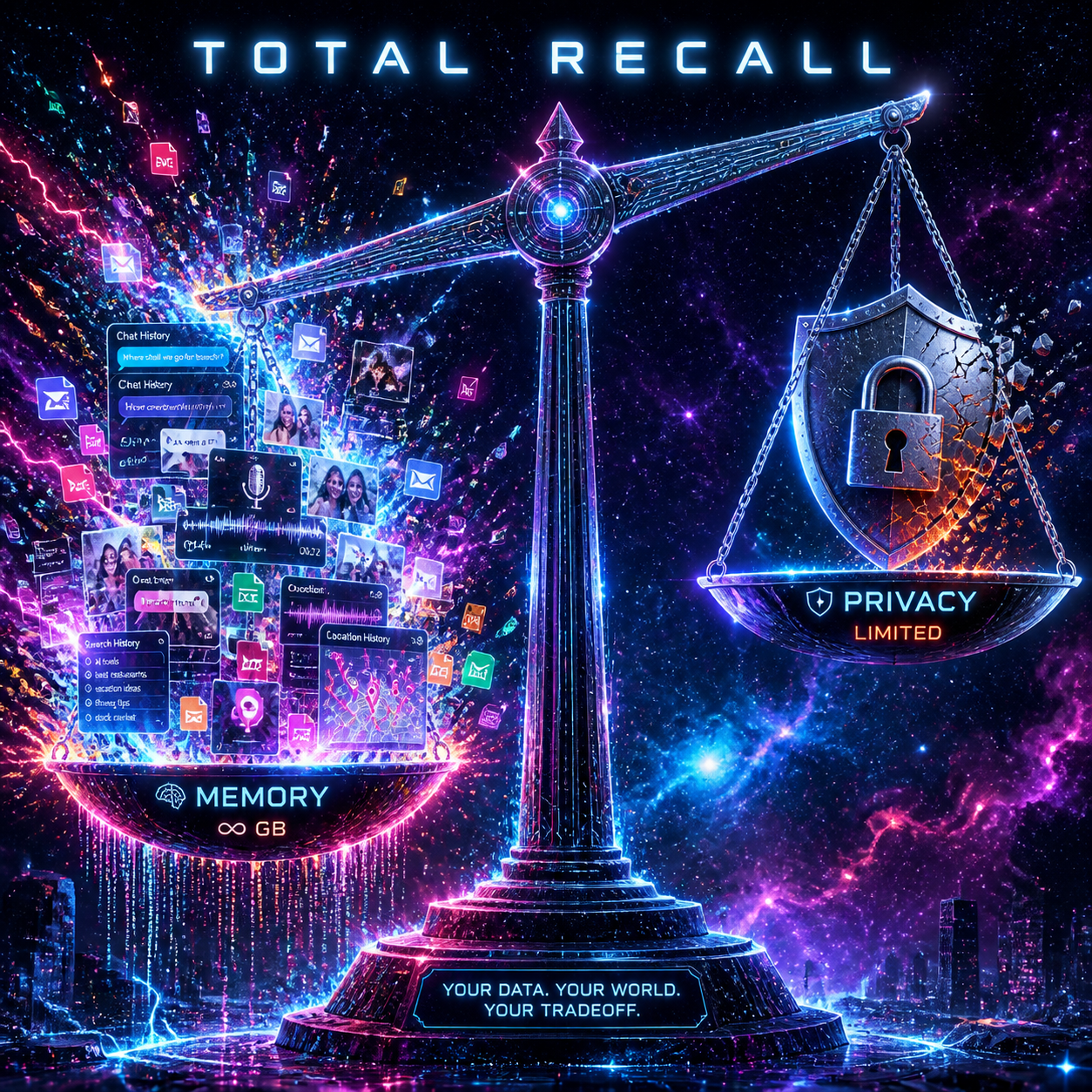
OpenAI spent the same week fighting fires. Persistent memory has been rolling out slowly since early 2026, but Reddit and user forums in mid-May were flooded with complaints. ChatGPT was forgetting user preferences or pulling old memories users thought were permanently deleted.
Anthropic, meanwhile, confirmed on May 22 that it is expanding Project Glasswing into two verticals: Glasswing Agents and Glasswing Workspace. Glasswing Agents use memory to learn your workflows. Glasswing Workspace does the same for enterprises, with Anthropic promising on-device processing for highly sensitive data. The caveat is that the enterprise tier is priced accordingly.
Sources: The Verge (May 22, 2026), r/ChatGPT, r/OpenAI
What actually shipped is a spectrum, not a trifecta. Google is going all-in on ambient surveillance. Apple is selling selective amnesia. Anthropic is pricing privacy as a premium feature. None of them are asking what users actually want.
Why Memory Is the New Moat
Platform lock-in used to mean file formats and app stores. Now it means your digital autobiography. The more an AI knows about you, the harder it becomes to switch to a competitor. A model that remembers your project deadlines, your writing style, your medical questions, and your relationship history has leverage that no file format ever possessed.
Three forces are driving this shift:
First, user retention in consumer AI is brutal. ChatGPT lost active users for three straight quarters in late 2025 and early 2026. When models are commoditized, the only real differentiator is context. The platform that holds your history holds your attention.
Second, memory is a technical moat that rivals cannot replicate quickly. Building stateful, privacy-compliant AI memory at scale requires infrastructure that only Google, Apple, and a few top labs possess. Anthropic's Glasswing expansion is a direct admission that it needs enterprise memory to survive and compete.
Third, the business model demands it. AI inference costs are still unsustainable. Tokenmaxxing, the practice of extracting maximum value per API call by frontloading context, is now standard across the industry. Microsoft, Meta, and Amazon have all been caught using similar tactics in recent months. Memory is how they justify higher prices without users noticing they are paying with data instead of dollars.
The Privacy Versus Personalization Trap
Most users do not understand what they are consenting to. Consent interfaces are explicitly designed to make opting in feel like common sense. "Would you like a more personalized experience?" is a yes-bias question that hides the reality. The alternative is not generic. The alternative is yours, but private.
Apple's auto-delete feature is the most honest approach so far, yet it remains fundamentally incomplete. Auto-deleting chat transcripts is a good step. However, Apple Intelligence still processes your data to build a localized profile. The model learns. The platform knows. The only thing that disappears is the evidence you could use to prove it.
Google's approach is far more brazen. Android Halo monitors device behavior. Spark reads your email. The lock screen suggestions require analyzing your usage patterns in real time. Google will claim this stays on-device or is fully anonymized. Both claims have been debunked repeatedly in other tech contexts.
Anthropic's two-tier system is honest in a completely different way. If you want real privacy, you pay enterprise rates. Everyone else gets surveillance at consumer prices.
The core tension is straightforward. Personalization requires data. Privacy requires deleting data. No platform has solved both. None of them are incentivized to even try.
The Legislative Reckoning
Regulation is starting to catch up, but not nearly fast enough.
Colorado's SB 24-205, the Consumer Protections for Artificial Intelligence Act, went into effect on February 1, 2026. The law requires developers and deployers of high-risk AI systems to use reasonable care to prevent algorithmic discrimination and to disclose exactly how they manage risks. It also mandates impact assessments and public statements about high-risk systems. This means persistent memory systems that profile users based on stored data could face severe scrutiny under Colorado's framework. The problem is that enforcement is still forming and penalties remain modest.
Source: Colorado General Assembly, SB 24-205
California's SB 53, the Transparency in Frontier Artificial Intelligence Act, goes much further. It targets large developers with specific requirements around catastrophic risk assessment, unauthorized access reporting, and harm from models operating without meaningful human oversight. The bill defines catastrophic risk as contributing to the death or serious injury of more than 50 people, or over one billion dollars in damage. While focused on frontier models, the disclosure requirements could force companies to reveal exactly how memory systems are stored, who can access them, and what happens when weights are exfiltrated.
That last point is critical. If a malicious actor steals the model weights containing your personal memory profile, California law may finally require these companies to inform you.
Source: California Legislative Information, SB-53
Both laws share a fatal weakness. They assume companies will self-report. They assume users will read disclosures. They assume regulators have the technical expertise to audit complex memory architectures. None of those assumptions are true today.
The FTC is investigating how AI platforms handle stored user data, but an investigation is not enforcement. Senator Amy Klobuchar has been highly vocal about AI accountability, particularly around consumer harm from automated systems. But federal legislation remains entirely stalled. The platforms know this. That is precisely why they are racing to lock users in right now.
Sources: FTC statements, IronPulse daily reports (May 22-24, 2026)
What Users Should Be Watching
Here is what actually matters if you use AI tools in 2026.
First, export your data periodically. If you cannot leave with your history, you are not a user. You are a hostage.
Second, read the actual privacy settings, not the marketing copy. Auto-delete does not mean the system is not learning from you. On-device processing does not mean it never phones home. The language is deliberately designed to mislead.
Third, watch for the enterprise pricing bait. When platforms say your data is private, the unspoken clause is always "if you pay enough." That is not privacy. That is a toll booth.
Fourth, pay close attention to lock-in architecture. If an AI platform makes it difficult to delete your history, or if export formats are fragmented and incomplete, that is not a bug. That is a business model.
The real threat is not a dystopian future. The real threat is the quiet normalization of platforms that know you better than you know yourself. They operate under terms you never read, are regulated by laws that have not caught up, and are monetized by companies heavily incentivized to remember everything and tell you absolutely nothing.
Get More Articles Like This
AI memory and privacy are evolving fast, and most of what matters is happening outside the headlines. I'm documenting every shift as it happens.
Subscribe to receive updates when we publish new content. No spam, just real analysis from the trenches.