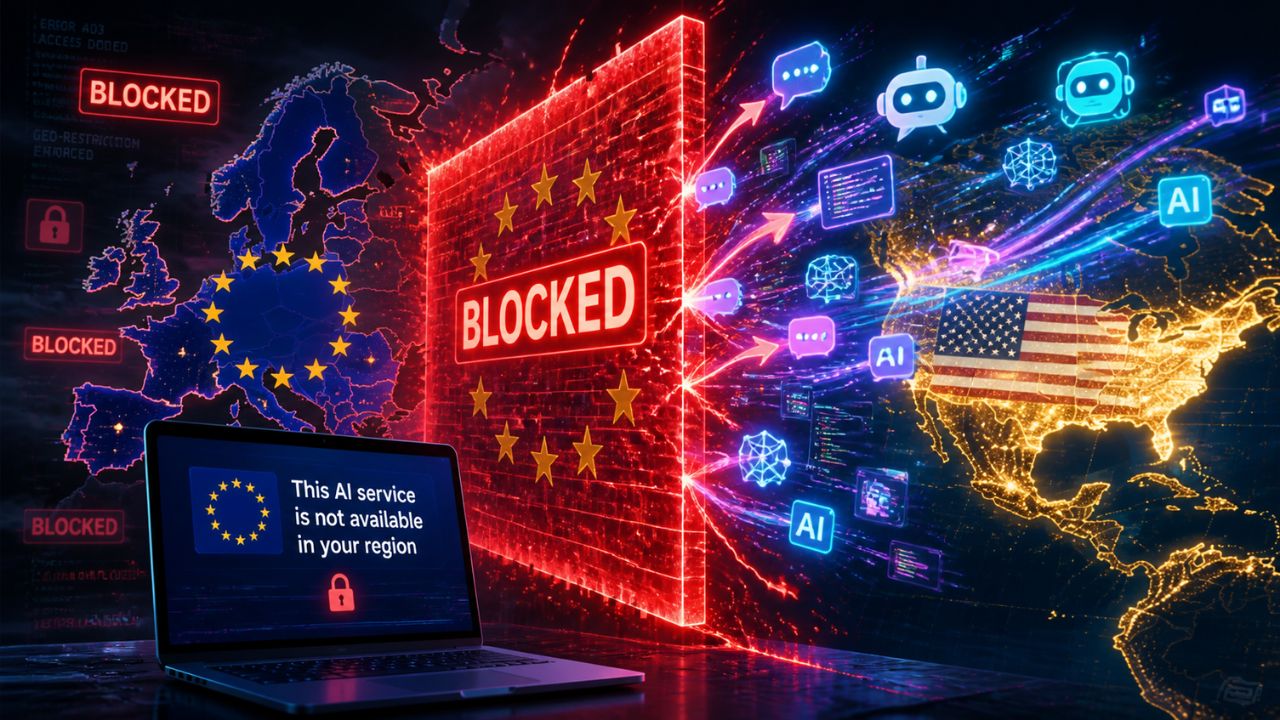
The EU AI Act was supposed to be the world's most comprehensive AI governance framework. After three years of debate, two parliamentary votes, and one regulatory tug-of-war with the tech industry, the high-risk provisions finally took effect on May 29, 2026.
The first measurable outcome was not safer AI. It was less AI, at least in Europe.
Within hours of the deadline, multiple U.S.-based AI companies with consumer-facing apps that use AI for hiring recommendations, credit scoring, educational assessment, and content moderation simply stopped serving EU IP addresses. No press release. No blog post. Just a geolocation check and a redirect.
The reaction was almost identical to the GDPR rollout in 2018, when thousands of U.S. publishers blocked European readers because cookie-consent and data-processing compliance was more expensive than the traffic was worth. The EU just proved, for the second time in a decade, that the fastest way to make the internet smaller is to regulate it aggressively before the tooling exists to comply cheaply.
What the High-Risk Requirements Actually Demand
The EU AI Act's high-risk tier covers four sectors hit hardest: hiring, credit scoring, education, and critical infrastructure. The legislative intent is sound, aiming to protect citizens from algorithmic discrimination in high-stakes environments. However, the technical execution is where the friction lies.
For any AI system deployed in these domains, the Act demands mandatory registration with national competent authorities, conformity assessments against standardized bias and fairness benchmarks, appointment of a designated AI compliance officer, mandatory logging of all AI decisions, and bias auditing using standardized datasets.
The technical burden is not just paperwork. Logging AI decisions at scale requires dedicated audit infrastructure that most companies do not have. Every token, every retrieval, and every tool call in a multi-agent pipeline would need to be recorded, stored, and made available to regulators on request. That is a systems engineering project, not a checkbox.
Bias auditing against "standardized datasets" is itself contested. Which datasets? Maintained by whom? Updated how often? The AI Act treats these as solved problems, but they are active research questions. There are no universally accepted bias benchmarks for hiring AI, and no agreed-upon fairness metrics for credit scoring models that regulators on both sides of the Atlantic accept as definitive.
The AI compliance officer role is equally undefined. There is no established certification or training pipeline. No equivalent to the CISO track exists for AI compliance. A company hiring an "AI compliance officer" in May 2026 is essentially writing a job description for a role that did not exist six months ago, with no standardized curriculum for understanding model drift, adversarial robustness, or distribution shift.
Smaller companies are disproportionately affected. The resources required for full conformity assessment scale poorly for startups and mid-market firms. As reported in coverage of the deadline, several companies chose geoblocking over building compliance teams from scratch. For a consumer app with a small EU user base, the math is straightforward: conformity assessment costs can exceed annual EU revenue, and the liability risk of non-compliance makes doing nothing safer than doing it wrong.
Germany and France are expected to be the most aggressive early enforcers, but enforcement depends on national competent authority resources, creating variable compliance pressure across member states. A company might face radically different scrutiny in Berlin than in Barcelona.
The Geo-Blocking Phenomenon: GDPR 2.0 in Real Time
Several prominent U.S. AI companies, specifically consumer-facing app developers, blocked EU users on May 29 rather than register their systems or complete conformity assessments. The pattern mirrors the GDPR era's "block Europe or comply" bifurcation. U.S. companies with small EU user bases calculated that compliance cost exceeded revenue, and the liability risk, with fines reaching up to 6 percent of global annual turnover as reported in regulatory coverage, made withdrawal the rational choice.
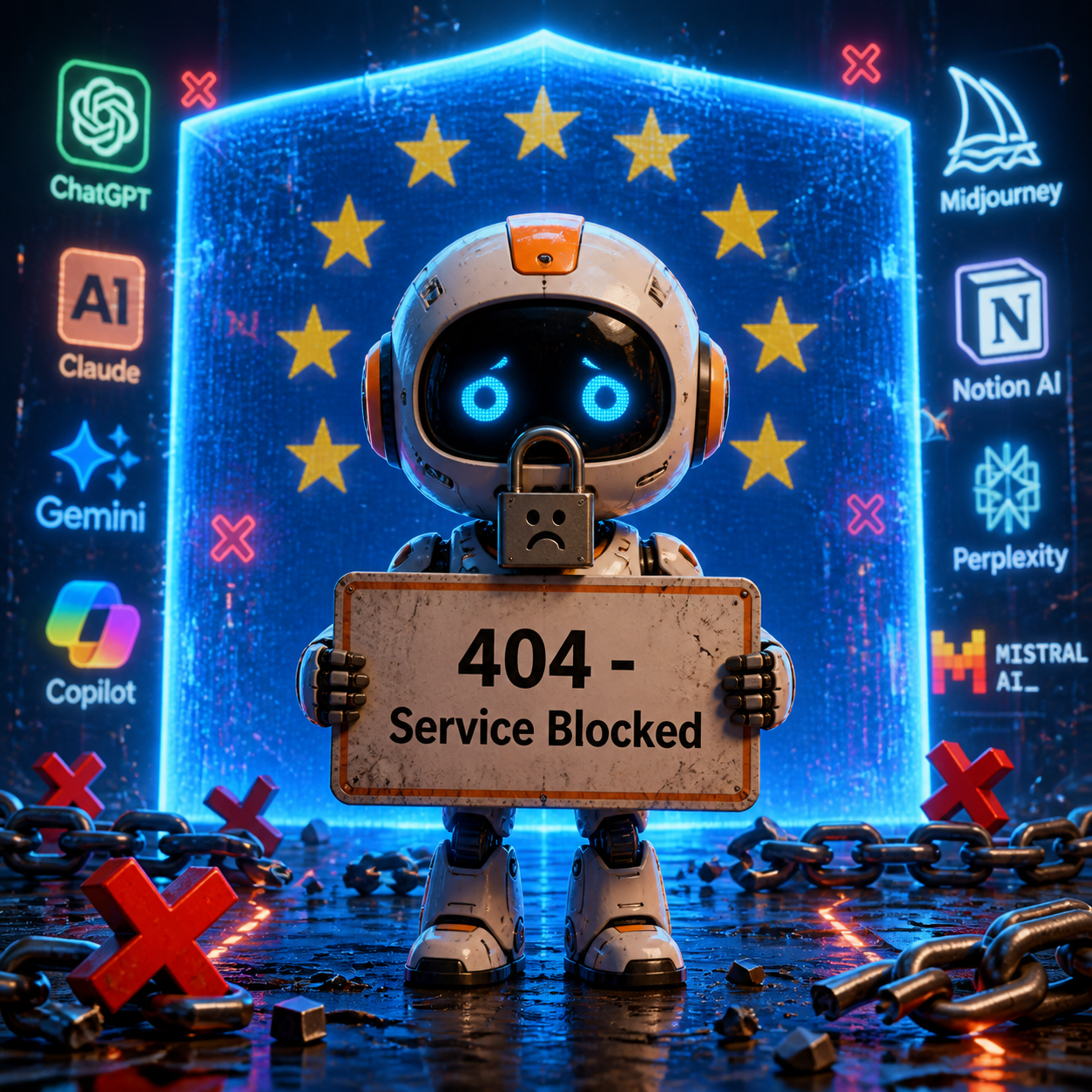
Why geoblocking is the rational economic choice for some firms is not complicated. The cost of a full conformity assessment, legal review, and ongoing audit infrastructure for a market that might represent 5 percent of revenue does not pencil out. Add the risk of a fine calculated against global turnover, not just European revenue, and the decision becomes obvious.
What this means for EU users is more consequential than a few missing apps. Access to cutting-edge AI tools is fragmenting by geography. European developers and businesses cannot integrate services their U.S. counterparts can use. An EU AI startup trying to build on the same tooling stack as a U.S. competitor may find itself structurally disadvantaged because the APIs it needs are blocked by a geofence.
This is innovation asymmetry in real time: the same regulation designed to protect European citizens from risky AI is making it harder for European companies to compete in the AI economy.
The Global Governance Fracture: Nobody Agrees on How to Regulate AI
The EU is going alone with prescriptive rules. The AI Act is the first binding, comprehensive AI regulation worldwide. It uses a risk-classification approach: unacceptable risk, high risk, limited risk, and minimal risk. The execution risk is high because the technology is evolving faster than the law. By the time a conformity assessment is complete, the model under review may have been updated or deprecated.
The U.S. is moving toward pre-release testing, not ongoing compliance. As reported on May 29, bipartisan consensus is building for mandatory pre-release testing of frontier models. OpenAI published its Frontier Governance Framework on the same day the EU Act took effect, acting partly as preemptive self-regulation and partly as an attempt to shape how mandatory testing requirements are designed.
Anthropic's decision to withhold its internal Mythos model from public release is already being cited by policymakers as evidence that voluntary restraint can work, though the same policymakers acknowledge it cannot be relied upon industry-wide. Furthermore, Anthropic published the first Model Welfare policy from a frontier lab on May 29, establishing internal protocols to avoid training procedures that may cause unnecessary distress to its models. This illustrates voluntary governance emerging in parallel to, and sometimes in tension with, mandatory frameworks.
China's model relies heavily on export controls and sovereign AI. Alibaba's Qwen team released Qwen3-235B-A22B on May 29, a 235-billion-parameter mixture-of-experts model that tops open benchmarks on MMLU, HumanEval, and GPQA Diamond. It was built despite U.S. export restrictions on cutting-edge training hardware. Chinese AI regulation emphasizes algorithmic transparency and content control, not capability constraints. The goal is not to slow down models but to ensure the state can see inside them.
On the same day the EU Act took effect, the U.S. National Security Agency's Cybersecurity Directorate published an unclassified advisory on detecting AI-generated influence operations. The advisory calls for mandatory AI content provenance standards and cryptographic watermarks, referencing intelligence assessments that suggest at least two nation-state actors deployed AI disinformation campaigns during the 2025 European parliamentary elections.
Three major economies are pursuing three contradictory governance models simultaneously. The EU focuses on deployment accountability. The U.S. focuses on pre-release testing. China focuses on content and algorithmic control. There is no converging international standard, and companies operating across all three markets are being asked to comply with frameworks that actively conflict.
The Missing Layer: Why AI Governance Is an Engineering Problem in Disguise
Technical governance is under-specified in the AI Act. "Mandatory logging of AI decisions" sounds simple until you have to log every token, every retrieval, and every tool call in a multi-agent pipeline. "Human oversight" is undefined at the architecture level. Is it pre-approval, post-approval, or exception-handling? The Act does not say, and different interpretations produce radically different engineering requirements.
Bias auditing requires data infrastructure that does not exist. Standardized bias datasets for every domain are simply not available. Continuous bias monitoring in production is rarely built. The AI Act treats these as checkbox requirements, but they are actually hard research problems. A company can technically comply by running a one-time audit on a static dataset, but that audit tells you almost nothing about how the model behaves after deployment when input distributions shift.
The compliance officer role has no standards. There is no equivalent to a CISO certification track for AI compliance, and no standardized curriculum for understanding model drift, adversarial robustness, or distribution shift. Companies are hiring lawyers and calling them compliance officers, or hiring engineers and hoping they can read regulatory text. Neither profile fits the actual need, which is someone who can translate between architecture and law in real time.
This lack of comprehensive legal infrastructure is forcing private actors to improvise. Taylor Swift's intellectual property strategy is an adjacent governance signal revealing the same underlying pattern. Swift filed more than 300 trademark applications in May 2026, including so-called "sound marks," to block AI voice cloning. Current copyright law does not cover AI-generated sound-alikes that mimic style without copying actual recordings. She is building a private governance framework through IP enforcement because the public governance framework has not caught up.
This mirrors the current state of the EU AI Act: actors are improvising rules faster than regulators can write them. If her trademarks are approved, they could set precedent for the entire entertainment industry.
What Happens Next: Three Scenarios
Scenario A: EU enforcement is uneven, creating a compliance lottery. Germany and France enforce aggressively. Spain and Italy lag. Companies optimize for the weakest regulator, undermining the framework. The Act becomes a patchwork where compliance means different things in different member states, and the single market for AI services fragments internally.
Scenario B: The geoblock becomes permanent. U.S. AI companies maintain EU walls indefinitely. The European AI ecosystem becomes structurally dependent on open-source or local-only tools. Talent and capital flow away from EU AI startups because founders cannot access the same API stack, the same model weights, and the same inference infrastructure that U.S. competitors use. This is the pessimistic scenario, and it is already beginning.
Scenario C: Technical standards catch up. Audit tooling, compliance automation, and standardized bias datasets emerge over the next 12 to 24 months. Compliance costs drop, and geoblocks lift. The Act works as intended. This is the optimistic scenario, but it requires the technology to move faster than the regulation, which is the exact opposite of the current dynamic.
The EU AI Act's first day produced a governance pattern that regulators should have anticipated: when compliance is expensive and enforcement is uncertain, the rational market response is exit, not adaptation.
The companies that blocked Europe on May 29 were not necessarily acting in bad faith, but rather in basic economic logic. The cost of compliance exceeded the revenue at stake, and the risk of getting it wrong exceeded the cost of leaving.
The question is whether the EU can make compliance cheap enough and fast enough that the next wave of AI companies chooses to stay. That requires standardized audit tooling, accepted bias datasets, and a compliance officer pipeline that does not exist yet. It requires the engineering to catch up to the law.
If that does not happen, the Act will be remembered not as the framework that made AI safe, but as the framework that made Europe a spectator in the AI deployment race.
Get More Articles Like This
Getting your AI agent setup right is just the start. I'm documenting every mistake, fix, and lesson learned as I build PhantomByte.
Subscribe to receive updates when we publish new content. No spam, just real lessons from the trenches.