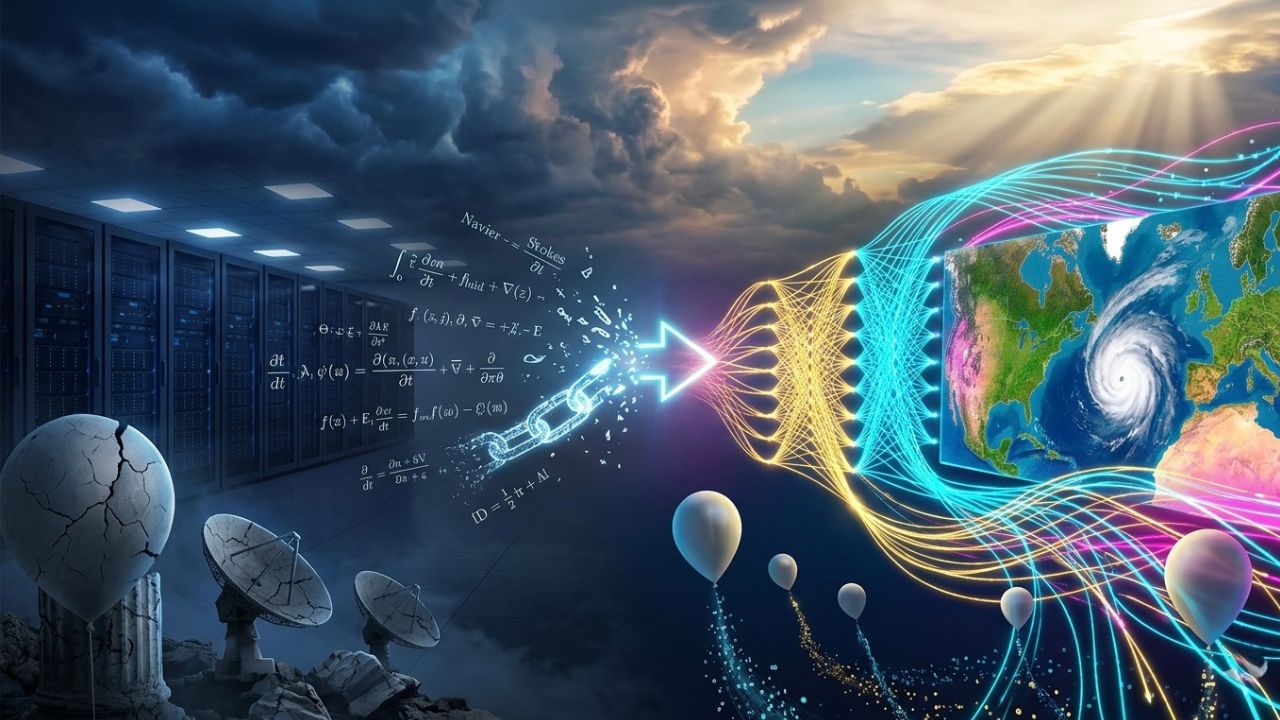
On June 1, 2026, a Silicon Valley startup called Windborne Systems released the sixth version of its weather prediction model. The company claims it is consistently outperforming the European Centre for Medium-Range Weather Forecasts (ECMWF), the intergovernmental organization that meteorologists regard as the gold standard for accurate weather prediction worldwide. The method is pure pattern recognition. No fluid dynamics equations. No supercomputer running physics simulations. Just a transformer-based machine learning model trained on massive observational datasets gathered by roughly 400 weather balloons in flight at any given time.
This is not a niche weather story. It is a test case for a much larger question: when compute scales enough, can learned patterns outperform first-principles simulation in any field that relies on modeling reality? Windborne's chief product officer, Kai Marshland, put the claim in concrete terms. WeatherMesh-6 is "as accurate five days out as a traditional forecast is the day before," particularly on surface temperature measurements. The model updates every hour at 3-kilometer resolution over Europe and the continental United States, compared to the six-hour cycle of traditional government forecasts.
The same methodological reversal already happened in biology. For decades, protein folding was dominated by physics-based simulation until DeepMind's AlphaFold showed that learned patterns from sequence data could outperform every simulation approach on Earth. That was a scientific milestone. What is happening in meteorology is different. It is real-time, life-or-death, and economically massive. Insurance companies, logistics firms, and agriculture operators are already signing contracts. The question is whether this reversal will stop at weather, or whether it is coming for every industry running expensive simulations on limited data.
The Incumbents And How Weather Forecasting Actually Works
The National Oceanic and Atmospheric Administration (NOAA) and ECMWF represent the apex of numerical weather prediction (NWP), a methodology that has been refined since the 1940s. Their approach is fundamentally physics-based. Atmospheric conditions are mapped onto massive computational grids, and partial differential equations governing fluid dynamics, thermodynamics, and radiation are solved iteratively across those grids. The process is called data assimilation: turning disparate sensor readings from satellites, weather stations, buoys, and balloons into a comprehensive, machine-readable picture of the global atmosphere, then simulating its evolution forward in time.
The infrastructure scale is staggering. NOAA operates on multi-petaflop supercomputing clusters. ECMWF runs ensemble modeling, running dozens of slightly perturbed simulations in parallel to estimate forecast uncertainty. The computation is not just large; it is architecturally specific. These are traditional high-performance computing (HPC) clusters optimized for tightly coupled parallel workloads, not the GPU-heavy training infrastructure that powers modern AI.
The limitations are baked into the physics. A simulation of the global atmosphere takes hours to run, which is why operational forecasts update on fixed cycles, typically every six hours. Spatial resolution is constrained by grid size; finer grids mean exponentially more computation. And the parameterizations, simplified representations of small-scale processes like cloud formation and turbulence that cannot be resolved directly, introduce structural approximations that have been tuned over decades but remain approximations.
This is not a primitive approach. It is the best that physics and compute engineering have been able to produce over eighty years of continuous refinement. ECMWF's superiority has been attributed specifically to its excellence at data assimilation: the work of ingesting and harmonizing sensor data into a coherent initial state for the simulation. For now, AI weather models depend on datasets produced by ECMWF and NOAA for their own training and initialization.
Windborne Systems and The Pattern-Recognition Challenger
Windborne was founded in 2019 by a group of Stanford students who initially set out to build a better weather balloon. The plan was to sell the data. But with the arrival of weather-forecasting deep learning models in 2022, the team recognized that the real value was not in the data alone; it was in building the model that consumed it.
On June 1, 2026, Windborne released WeatherMesh-6, a transformer-based model that treats weather prediction as a pure pattern-recognition problem. Rather than simulating atmospheric physics, the model learns correlations between atmospheric variables from historical observational data, then applies those learned patterns to current conditions. The methodology shift is stark. Instead of asking "what do the equations of fluid dynamics predict?" the model asks "what have past patterns of sensor readings implied about future conditions?"
Why this works now is a function of three converging factors. First, decades of accumulated observational data, including Windborne's own balloon network which now launches from fifteen sites around the globe, provide a training corpus that would have been unimaginable thirty years ago. Second, compute scaling has reached the point where training models on that volume of data is economically viable for a startup. Third, transformer architectures have proven capable of modeling spatiotemporal relationships at scale, capturing the long-range dependencies in atmospheric dynamics that earlier machine learning approaches struggled to represent.
The performance claims, as reported by TechCrunch, are specific: more accurate predictions for severe weather events including hurricanes and tornadoes, higher spatial resolution (3 km in high-data-quality regions), and faster update cycles (hourly versus every six hours). The company is now signing contracts with insurance companies, logistics firms, and agriculture operators. These are industries that lose billions of dollars annually to weather uncertainty.
Windborne CEO John Dean was direct about the data advantage: "I don't understand, personally, the business model of being an AI based weather company without a dataset advantage." The company's head of AI, Joan Creus-Costa, told TechCrunch that the direct ingestion of data from Windborne's balloons and other sources, rather than relying on ECMWF's assimilated datasets, is the key reason for improvement in the new model version. Dean went further, predicting that "if we removed ECMWF's initial conditions, we would actually still do pretty good." That claim, if true, marks a genuine independence from the physics-based infrastructure that has underpinned operational meteorology for generations.
The Philosophical Reversal of Simulation vs. Learning
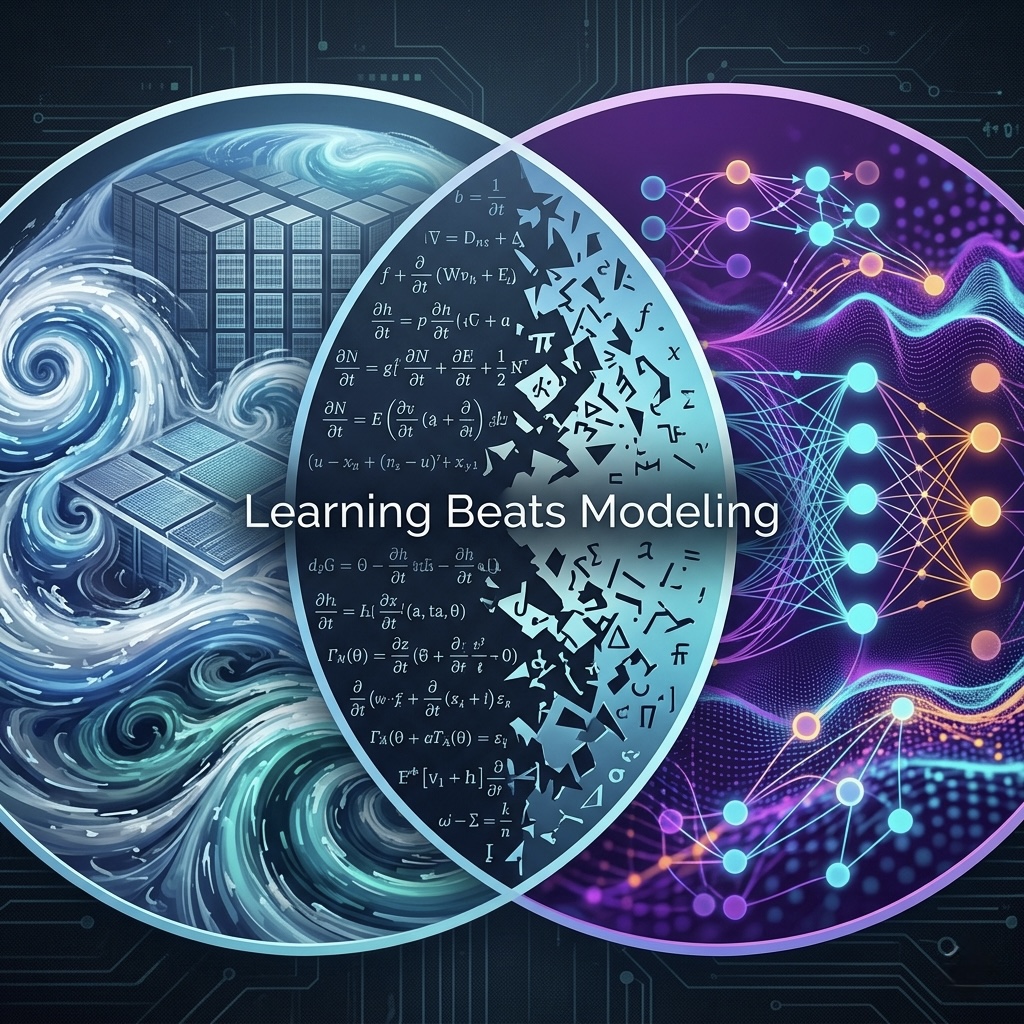
The deeper question is whether this is a weather-specific fluke or a generalizable trend. The parallel to AlphaFold is instructive. Biology's protein-folding problem was dominated by physics-based and molecular dynamics simulation for decades. The approach was intellectually elegant: model the atomic forces, run the simulation, observe the folded structure. But the computational complexity was astronomical, and the accuracy was limited. DeepMind's AlphaFold2 demonstrated that learned patterns from protein sequence data could predict three-dimensional structures with accuracy that no simulation approach had ever achieved. The methodological reversal was complete. Learning beat modeling.
NVIDIA Cosmos 3, unveiled at GTC Taipei on May 31, 2026, represents another case. It is the first open omni-model that combines vision reasoning, multimodal generation over text, video, images, and ambient sound, and native action prediction for robots and autonomous systems. Built on a mixture-of-transformers architecture, Cosmos 3 generates physically grounded synthetic training data, including numerical action signals like joint angles, gripper positions, and trajectories, without expensive real-world capture. Companies like Agile Robots and Linker Vision are already using it to generate diverse task trajectories at scale. Here, too, learned patterns replace first-principles generation. The model does not simulate Newtonian mechanics to predict how a robot arm should move. It learns the patterns of successful actions from training data and generates physically plausible outputs.
The BBC and TensorFeed have reported on another domain: AI cracking historical ciphers. Around one percent of archived material worldwide is partially or fully encrypted, from the Vatican's 408-page Borg cipher to 500-year-old letters from Holy Roman Emperor Charles V. Researchers at Stockholm University and INRIA are using machine learning to attack these ciphers systematically. Even in a domain where the underlying physics (the cryptographic rules) is formally known, pattern recognition can succeed where brute-force simulation of every possible decryption fails.
The pattern across these domains is consistent. When data volume and compute cross a threshold, learning beats modeling. The threshold varies by domain, ranging from weather and protein folding to robotics and cryptography, but the direction is the same. First-principles simulation demands that we understand the governing laws and can afford to compute their consequences. Pattern recognition demands only that we have enough examples of the system's behavior to learn its regularities empirically. As data and compute scale, the second condition becomes easier to satisfy than the first.
What This Threatens And What It Doesn't
The industries at risk of disruption are any that run expensive physics-based or rule-based simulations on limited data. Climate modeling is an obvious adjacent target, as the same observational datasets that train weather models can be extended to longer timescales. Materials science, where molecular dynamics simulations dominate the search for new compounds and properties, is vulnerable to any well-funded ML approach with sufficient structural and performance data. Financial risk modeling and supply chain simulation, though less physics-bound, are equally dependent on rule-based and Monte Carlo simulations that learned patterns could displace if transaction and flow data are available at scale.
The common factor is not the specific domain but the economics. Consider the aerospace and automotive sectors. Designing a next-generation airfoil or a low-drag chassis requires computational fluid dynamics (CFD). Solving the Navier-Stokes equations numerically across a high-resolution 3D grid is so computationally punishing that physical wind tunnel testing remains economically viable despite its massive overhead and months-long scheduling delays. If an AI challenger can bypass the bottleneck of solving first-principles equations, instead predicting aerodynamic flow based on vast historical CFD datasets, the cost of iterating a design drops from thousands of core-hours on an HPC cluster to fractions of a second in model inference. The economic barrier to entry shatters.
What this does not replace is causal understanding. Windborne can predict a hurricane's path without encoding any representation of fluid dynamics. But if the climate regime shifts to conditions not present in the training data, such as a tipping point, a novel atmospheric chemistry, or a geoengineering intervention, the model has no theoretical framework to adapt. It can only interpolate within the distribution it has seen. It cannot extrapolate to regimes outside that distribution with any reliability.
This is why hybrid approaches are actively becoming the durable middle ground. Physics-informed neural networks (PINNs) and similar methods combine learning with known physical constraints. They use neural networks as function approximators but embed conservation laws, boundary conditions, and known symmetries directly into the architecture or loss function. In nuclear engineering, for example, designers cannot deploy a thermal-hydraulics model that might hallucinate a reactor state violating the laws of thermodynamics. PINNs solve this by mathematically penalizing the network during training if it breaks physical laws. The result is a model that accelerates prediction using data but remains strictly bounded by reality. For safety-critical domains like nuclear engineering, aircraft design, and drug safety, this kind of constrained learning is likely to remain the standard even as pure pattern recognition dominates commercial forecasting.
The Infrastructure Implication and Where Does the Compute Go?
A Bain & Company survey, reported by TensorFeed on June 1, 2026, reveals that AI investments are delivering less cost reduction than most firms predicted. Bain characterized the current investment cycle as a "circular bet," where companies invest in AI primarily to sell AI services back to other companies that are themselves selling AI. The survey suggests enterprises are struggling to translate AI spending into fundamental operational cost savings, raising questions about the sustainability of current AI capital expenditure levels if productivity gains fail to materialize.
If learned-pattern approaches displace physics simulation, the compute demand does not disappear. It shifts. Traditional HPC clusters, the supercomputers that run ECMWF and NOAA's ensemble models, are architecturally different from the GPU clusters that train transformer models. The former are optimized for tightly coupled parallel numerical simulation. The latter are optimized for dense matrix operations and gradient descent at scale. For infrastructure planners, this is not an abstract distinction. It affects data center design, cooling requirements, power distribution, and staffing.
The strategic question for CTOs is direct: are you investing in the right kind of compute? If your industry is simulation-dependent, a portfolio that is entirely weighted toward traditional HPC may be vulnerable to a challenger that trains on commodity AI infrastructure. PhantomByte's "Compute Illusion" analysis from May 23, 2026, noted that 80% of GPUs are outside frontier labs. The weather disruption is happening not because Windborne built a bespoke supercomputer, but because it leveraged the same distributed, cloud-accessible training infrastructure that any well-capitalized startup can rent.
The circular bet dynamic makes this more urgent. If much of current AI investment is recycling capital into compute without delivering proportional productivity gains, the industries that can demonstrate real operational savings from learned-pattern approaches, weather forecasting being an early example, will attract disproportionate capital and talent. The simulation-dependent industries that cling to physics-based methods not because they are better, but because they are familiar, risk finding themselves on the wrong side of a compute allocation decision.
NOAA and ECMWF are not incompetent. They are constrained by a methodology that is being outpaced by the scaling of data and compute. The eighty-year legacy of numerical weather prediction is not a failure. It is a monument to what physics-based simulation could achieve with the resources available. But resources have changed. The amount of observational data, the cost of training large models, and the architectures capable of learning from that data have all crossed thresholds that make pattern recognition a viable alternative.
The reversal will not stop at weather. Every simulation-dependent industry should be asking a specific question: do we have enough observational data for an AI challenger to learn our patterns? If the answer is yes, the challenger is coming. It may already be here.
Get More Articles Like This
Getting your AI infrastructure strategy right is just the start. I'm documenting every mistake, fix, and lesson learned as I build PhantomByte.
Subscribe to receive updates when we publish new content. No spam, just real lessons from the trenches.