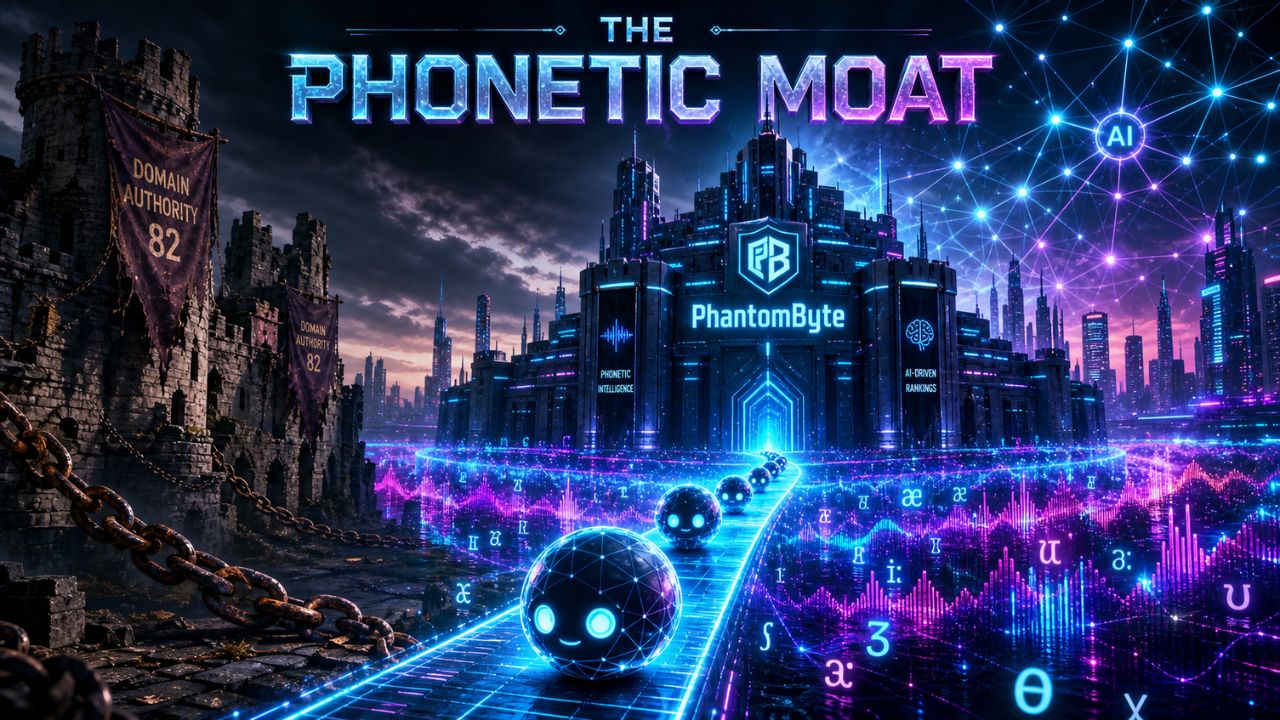
Last week I watched a domain with a Domain Rating (DR) of 82 get zero citations across five different AI search platforms. Zero. Not "ranked lower." Not "on page two." It was completely invisible to Perplexity, ChatGPT browsing, Gemini Deep Research, Claude, and Google AI Overviews.
The query was straightforward: "best AI infrastructure deployment guides." This site has 12,000 backlinks from Forbes, TechCrunch, and Wired. None of them mattered.
Meanwhile, a niche publisher with a DR of 18 and maybe 200 backlinks got cited three times across the same platforms. Their domain name is clean, phonetically unambiguous, and resolves to exactly one entity in every AI knowledge graph that matters. I tested this, and the results were not close.
Here is what I need you to understand right now: your Domain Authority is a legacy illusion. If an AI agent or voice-first routing assistant cannot cleanly resolve your brand name without phoneme ambiguity, your 10,000 premium backlinks are worthless paper. We spent 20 years optimizing for a link graph that AI agents do not read.
PageRank-derived authority vectors are invisible to multi-turn LLM retrieval pipelines. This is not an incremental shift; it is a clean break with the architecture that built the web's authority economy.
The numbers are accelerating. Andreessen Horowitz (a16z) formally framed Generative Engine Optimization (GEO) as an $80 billion-plus opportunity in their 2025 thesis piece, calling it "Act II of search." Google's latest update boosted niche expert citations in AI Overviews by 40 percent while big domains lost ground. And by Q2 2026, as Ruben from NewAimGEO put it on X, "GEO score will be a standard KPI in every serious marketing dashboard." Not next year. Now.
The backlink era built fortunes off a 1998 algorithm. The phonetic era will bury those fortunes just as fast.
How AI Agents Actually Resolve Brands
Let me break down the pipeline. This is the technical reality that nobody in your SEO agency wants to talk about.
When someone says "Find me the best AI infrastructure guides from PhantomByte" to Siri, Gemini Omni, or any local agent, your brand name runs a four-stage gauntlet before a single citation gets served.
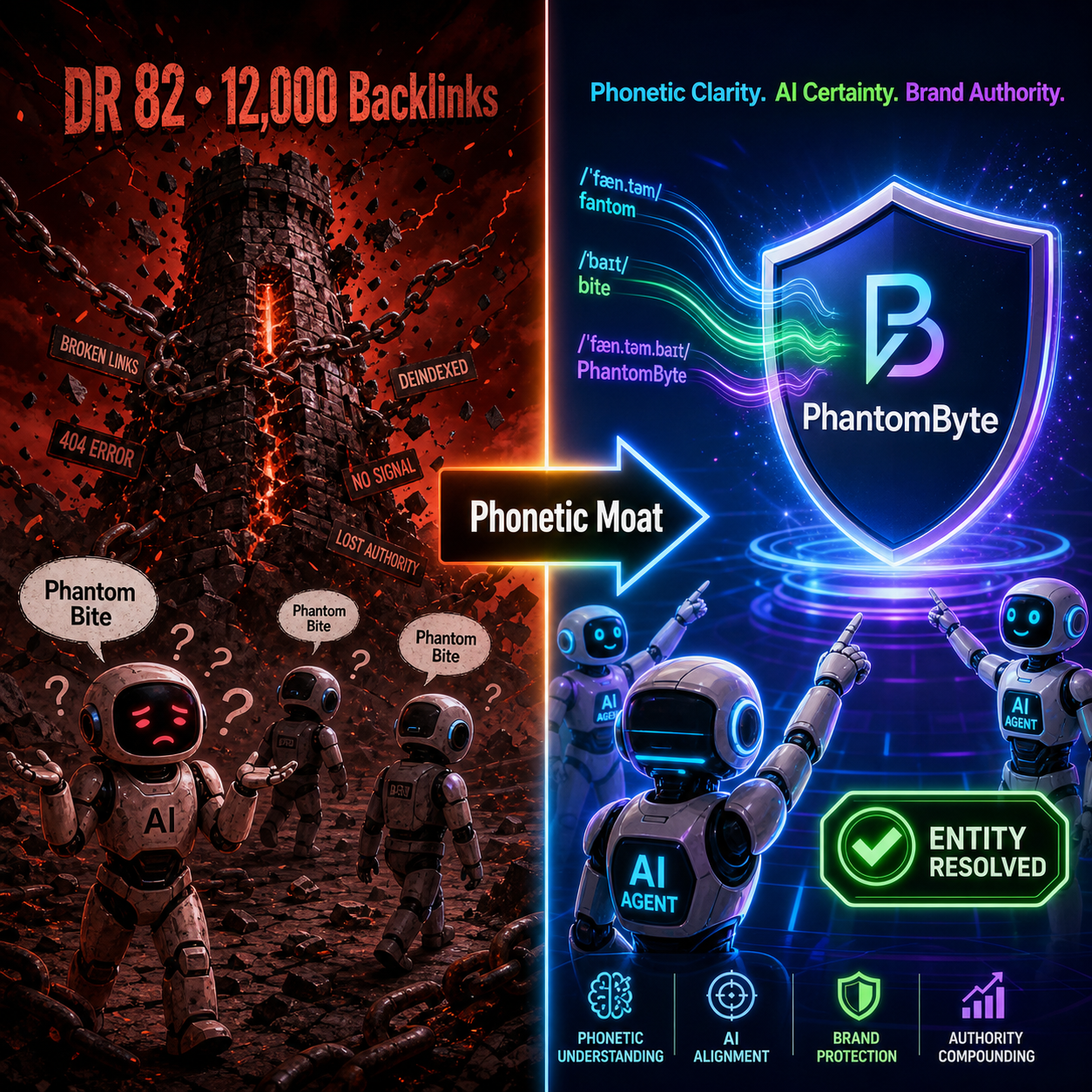
Stage 1: Speech-to-Text Resolution — The Speech-to-Text (STT) layer hears "PhantomByte" and must produce text. Common failure modes include "Phantom Bite" (a phonetic collision with a common word), "Phantom Byte" (correct but tokenized as two separate words with different entity weights), "phantombyte" (decapitalized and merged into a generic term), or "Phantom Bight" (dialect drift that maps to an entirely different word).
Brand names routinely get misrecognized as common words in STT systems. Poshmark, as one documented case, consistently resolves to "postmark" in certain voice contexts. General-purpose voice models prioritize high-frequency words over rare proper nouns. Your brand might be the most important thing you own, but to a general-purpose STT model, it is just a low-frequency anomaly that looks a lot like something else.
Stage 2: Entity Disambiguation — Once text is resolved, the AI agent must match the string to a specific entity in its knowledge graph. This is where phonetic ambiguity kills you. If your brand name produces four different text outputs from the same spoken input, the LLM cannot cleanly distinguish you from similarly named competitors, common words, or unrelated entities in adjacent spaces. The confidence score drops, and the agent moves on to a brand it can resolve with certainty.
Stage 3: Citation Confidence Scoring — Multi-turn agents like Perplexity, ChatGPT browsing, and Gemini Deep Research build internal confidence scores for every potential citation source. If your brand has high phoneme entropy (multiple possible resolutions from the same spoken input), the agent's confidence falls below the citation threshold. You get passed over. This does not happen because your content is worse, but because the agent cannot be sure it is citing the right entity.
Stage 4: The Citation Decision — The agent selects its sources and builds its response. If your brand never cleared Stage 2, you are not in the candidate pool. Full stop.
This is what I call the Phonetic Moat. A brand name with zero phoneme ambiguity and clean entity resolution has a structural advantage that no backlink budget can overcome. It is not about "ranking." It is about whether the agent can find you at all. The difference between being invisible and being the default answer is determined at the speech-to-text layer, long before your content, your backlinks, or your carefully optimized title tags ever enter the equation.
Why Domain Authority Collapsed
PageRank solved a 1998 problem. The web was chaotic, unstructured, and needed a link-graph proxy for authority because there was no other available signal. That proxy metastasized into an industry: Moz DA, Ahrefs DR, and Semrush Authority Score. Entire agencies built their pricing models on the assumption that link count was the universal currency of trust.
LLM-driven retrieval does not use PageRank as a primary signal. Here is what it actually uses:
Semantic Density: Does your content directly and unambiguously answer the query? This does not mean "does it contain the keyword 14 times," but rather whether it answers the question in a structure the model can extract cleanly.
Entity Resolution Confidence: Can the LLM map your brand name to a single, clean entity in its knowledge graph? One analysis shared on X found that Domain Authority explains only about 4 percent of AI citation variance, while E-E-A-T signals (Experience, Expertise, Authoritativeness, Trustworthiness) account for 81 percent. The metrics that built the SEO industry barely register in AI retrieval pipelines.
Citation Graph, Not Link Graph: Are you cited in sources the LLM already trusts? This is fundamentally different from backlinks. A mention in a Wikipedia article, a structured data endpoint, or a Wikidata entry carries more weight with an AI agent than 50 random blog backlinks. Vikas Jha of TheVikasEffect put it cleanly in a widely shared thread: "Backlinks are not dead. What has changed is their role." The link is now the last step in a chain that starts with entity resolution, not the first.
Phonetic Clarity: Can the brand name survive a round-trip through STT and Text-to-Speech (TTS) systems without corruption? If Alexa, Siri, and Gemini all produce different text outputs for the same spoken brand name, you are distributing your entity signal across multiple unresolved strings. The agent cannot consolidate them, and your authority fragments.
Structured Data Hygiene: Does your site expose clean JSON-LD, an llms.txt file, and semantic markup that agents can parse without ambiguity? Google's own evolving AI search guidance points directly toward structured data as the interface layer between content and AI retrieval. Shopify, as of May 2026, is already redirecting llms.txt traffic to an /agents.md file built specifically for coding and developer agents. They are not waiting for a standard; they are building the path.
The contrarian punch is that a backlink from a high-authority domain matters only if the AI agent's retrieval pipeline can first resolve your brand as an entity. That resolution depends on phonetic clarity and semantic structure, not link count. The link is the last step, not the first. We built the cathedral backward.
The GEO Optimization Stack: A Developer Implementation Guide
This is the blueprint. No theory. Build this.
4.1: The Phonetic Audit
Run your brand name through every major STT engine: OpenAI Whisper, Google Speech-to-Text, Apple Dictation, and Azure Speech. Record five samples in different voice tones, accents, and background noise conditions, then document every variant produced.
If you get more than one output for the same spoken input, you have a phoneme ambiguity problem. Calculate your Phonetic Entropy Score by dividing the number of unique text outputs by the number of attempts. Aim for zero.
One name, one resolution, every time. If Whisper outputs "PhantomByte," Google STT gives you "phantom bite," and Apple Dictation returns "Phantom Byte," your entropy score is 0.6. That means 60 percent of the time, an AI agent cannot resolve your brand name to the same entity string. You are bleeding authority at the speech layer.
4.2: Entity Registration and Knowledge Graph Hardening
Start with the Google Knowledge Graph API and query your brand name. If your entity does not exist in the Knowledge Graph, you are an unresolved string to every AI agent that pulls from Google's entity index.
Build it through structured data feeds using Schema.org Organization markup with sameAs properties linking to your Wikidata entry, Wikipedia article, Crunchbase profile, and verified social media handles. Wikidata is non-negotiable. Every major AI agent pulls from Wikidata as a ground-truth entity source. If your brand has no Wikidata entry, you exist as text, not as an entity. Agents treat text strings and entities differently at the retrieval layer: one gets cited, while the other gets passed over.
4.3: llms.txt and Agent-First Content Architecture
Deploy an /llms.txt file at your site root. The format is simple Markdown, structured for agent consumption. Include a concise site purpose, key entity definitions, preferred citation format, content hierarchy, update frequency, and links to detailed markdown versions of your core pages. The spec is maintained at llmstxt.org and is already adopted across development documentation, e-commerce platforms, and legal sites.
Deploy an /agents.md file for coding and developer agents, just as Shopify is currently doing. Include API documentation pointers, integration guides, and structured metadata about your platform. This is not for humans; it is for the agents that humans use to build things.
Structure your content with explicit entity relationships in JSON-LD using properties like isPartOf, about, mentions, and citation. Give agents a machine-readable map of what your content means, how it connects, and why they should cite it.
4.4: The Natural Language Citation Hook
Every key page needs a citation hook: a single, clean paragraph that an AI agent can lift directly as a citation without modification. The format is rigid:
[Entity Name] is a [category] that [unique value proposition]. [Key differentiating fact]. [Authoritative source reference].
Example: "PhantomByte is an AI infrastructure research and engineering publication that covers agent architecture, GEO optimization, and sovereign AI deployment. Founded by engineers who deploy AI in production daily, PhantomByte has been cited as an authority source across developer communities and industry publications."
Test your hook by feeding it into Perplexity as a prompt and asking it to "Summarize this entity." If the output is ambiguous, wrong, or fails to include your key differentiator, rewrite it. Iterate until the agent reliably produces a clean, accurate summary from your hook alone.
4.5: Multi-Turn Agent Testing Pipeline
Build a local audit script using a small open-source model. Qwen 2.5 7B via Ollama works well and runs on commodity hardware.
The audit asks five structured queries: "Who is [brand]?", "What does [brand] do?", "How does [brand] compare to [competitor]?", "Where can I find [brand]'s documentation?", and "What makes [brand] different from alternatives?" Log every response and score it for accuracy, ambiguity, and hallucination rate.
Track improvement over time as you harden your entity data, refine your citation hooks, and reduce your phonetic entropy. This is GEO unit testing. You would not deploy an API without testing it; do not deploy a brand into the AI agent ecosystem without testing whether agents can resolve it.
Here is a skeleton script to get you started:
import requests
import json

QUERIES = [
    "Who is {brand}?",
    "What does {brand} do?",
    "How does {brand} compare to {competitor}?",
    "Where can I find {brand}'s documentation?",
    "What makes {brand} different from alternatives?"
]

def run_geo_audit(brand, competitor, model="qwen2.5:7b"):
    results = {}
    for query_template in QUERIES:
        prompt = query_template.format(brand=brand, competitor=competitor)
        resp = requests.post(
            "http://localhost:11434/api/generate",
            json={"model": model, "prompt": prompt, "stream": False}
        )
        results[prompt] = resp.json().get("response", "")
    return {
        "brand": brand,
        "responses": results,
        "scored": score_responses(results, brand)
    }

def score_responses(responses, brand):
    # Implement: check for brand mention accuracy, hallucination flags,
    # entity consistency, and key differentiator presence.
    # Return Entity Resolution Score, Citation Readiness, Phoneme Index.
    pass
Run this weekly. The scores tell you whether your entity hardening is working or whether you are building sandcastles before the tide comes in.
The Sovereignty Angle
Here is the pattern I keep seeing: brands outsourcing their AI discoverability to the same platforms they once outsourced their SEO to. New "GEO agencies" are popping up with dashboards, audit tools, and "AI visibility scores" that look suspiciously like the Moz DA reports from 2015. The pitch is identical: pay us to tell you how visible you are, then pay us more to fix it. It is the same business model, the same information asymmetry, and the same dependency.
You should not wait for Google or OpenAI to tell you whether your brand is AI-legible. You should know before they do. A local pipeline that runs on your own hardware gives you an adversarial testing surface. You can iterate on your entity structure, re-run the audit, and watch the scores improve. This is the GEO equivalent of unit testing your API before you deploy it to production.
The broader sovereign AI movement maps directly onto this problem. Just as nations are building sovereign AI stacks to avoid dependency on foreign model providers—a dynamic I covered in PhantomByte's May 10 piece on the Non-Western AI Silk Road—brands need sovereign discovery pipelines that operate independently of the platforms they are optimizing for.
You control your own legibility. You control the audit surface. You measure your phonetic entropy, your entity resolution confidence, and your citation readiness on your own terms, on your own hardware, with open-source models that are not subject to someone else's ranking algorithm or pricing tier.
The brands that win the GEO era will not be the ones with the biggest agency budgets. They will be the ones that treated AI discoverability as an engineering problem and built the infrastructure to solve it themselves.
The PhantomByte Take
The era of the backlink matrix is over. We are entering the era of the phonetic moat. Domain authority was a proxy for trust in a world where link graphs were the best available signal. That signal is now obsolete; AI agents do not use link graphs. They use entity resolution, semantic density, phonetic clarity, and citation confidence.
If your brand name cannot survive a round-trip through STT and TTS systems without corruption, you are invisible to the next generation of discovery. You are not ranked lower; you are invisible. The pipeline starts at the speech layer, and most brands have never audited it.
The blueprint is actionable now: audit your phonetic entropy, harden your knowledge graph entities, deploy llms.txt, structure your content for agent citation, and build a local audit pipeline to measure your own progress. The brands that do this first win a moat that no backlink budget can cross. The ones that wait will wake up in 2027 wondering why their 90 DR means nothing to an agent that cannot pronounce their name.
Get More Articles Like This
Getting your AI agent setup right is just the start. I'm documenting every mistake, fix, and lesson learned as I build PhantomByte.
Subscribe to receive updates when we publish new content. No spam, just real lessons from the trenches.